Nanjing Medlander Medical Technology (688273)

Search documents
【光大研究每日速递】20260106
光大证券研究· 2026-01-05 23:05
Group 1: REITs Market Overview - The secondary market prices of publicly listed REITs in China continued to decline, with the CSI REITs closing at 778.6 and the CSI REITs total return index at 1009.84, reflecting monthly returns of -3.77% and -2.93% respectively [5] - Compared to other major asset classes, the return rates ranked from high to low are: A-shares > convertible bonds > gold > pure bonds > US stocks > REITs > crude oil [5] Group 2: Real Estate Sector Insights - The article from "Qiushi" emphasizes stabilizing expectations for the real estate market in 2026, with anticipation for stronger policy support. High-energy cities are expected to benefit from urban renewal, leading to structural optimization and gradual stabilization of prices [5] - In December 2025, the top 10 real estate companies reported total sales of 189.5 billion yuan, with year-on-year declines of 12.0% and a month-on-month increase of 49.3% [6] Group 3: Steel and Metal Industry Updates - The price of tungsten concentrate has seen its first decline since October 2025, with the central economic work conference reiterating the need to address "involution" competition and promote energy-saving transformations in key industries [7] - The National Development and Reform Commission emphasized management and optimization of copper smelting capacity, with cable manufacturing companies reporting the lowest operating rates in nearly six years [8] Group 4: Construction and Building Materials - Beijing's recent policy adjustments aim to optimize real estate regulations, including easing home purchase conditions for non-local families and enhancing support for multi-child households [8]



【麦澜德(688273.SH)】专注女性健康和美,“医疗+消费”双轮驱动——投资价值分析报告(黄素青)
光大证券研究· 2026-01-05 23:05
Core Viewpoint - The company has established itself as a leader in the female pelvic floor dysfunction (PFD) market in China, focusing on a comprehensive range of products and services that cater to women's health throughout their life cycle, with a strong emphasis on innovation and technology [4][5]. Group 1: Company Overview - Founded in 2013, the company specializes in the research, development, and sales of pelvic floor and obstetric rehabilitation devices, expanding into areas such as reproductive anti-aging, sports rehabilitation, and light medical aesthetics [4]. - The company has developed a product matrix that includes various energy source technologies such as ultrasound, laser, electrophysiology, electrical stimulation, magnetic stimulation, and high-frequency methods, leading the industry [4]. - As of mid-2025, the company has established a presence in over 8,700 hospitals and 6,000 outpatient professional institutions, with core executives holding more than 60% of shares [4]. Group 2: Market Potential - The prevalence of PFD among women in China is high, with over 280 million potential patients, yet the treatment and consultation rates remain low, indicating significant market demand [5]. - The company has created a comprehensive service model that includes screening, assessment, treatment, and home rehabilitation, positioning itself as a leader in the field [5]. - Revenue from pelvic rehabilitation products is expected to exceed 160 million yuan in 2023-2024, driven by aging demographics and increasing health awareness [5]. Group 3: Business Growth Strategy - The company is leveraging a dual-driven strategy of "medical + consumer" to enhance growth in reproductive health and anti-aging sectors, responding to the increasing demand from older and multi-child mothers [6]. - Through strategic acquisitions, the company has developed two major business systems focused on reproductive and skin health, providing comprehensive health management solutions [6]. - The revenue CAGR for reproductive rehabilitation and anti-aging products is projected to be as high as 90.1% from 2021 to 2024, supported by product upgrades and channel expansion [6]. Group 4: Future Prospects - The brain-computer interface (BCI) market presents significant growth opportunities, driven by an aging population and increasing clinical needs for neurological and degenerative diseases [8]. - The company is actively involved in high-barrier BCI technology and has initiated several national and provincial research projects, aiming to establish a comprehensive neuro-rehabilitation system [8]. - The development of a multimodal closed-loop neural regulation system is underway, with commercial products expected to be launched and generate revenue starting in 2026 [8].

麦澜德(688273):投资价值分析报告:专注女性健康和美,医疗+消费双轮驱动
EBSCN· 2026-01-05 07:39
Investment Rating - The report gives a "Buy" rating for the company, with a target price of 56.65 CNY, corresponding to a PE ratio of 44 times for 2026 [4][6][15]. Core Insights - The company, 麦澜德, is a leader in the pelvic floor dysfunction (PFD) market in China, focusing on women's health and beauty through a dual-driven model of "medical + consumer" [1][3]. - The company has established a comprehensive product matrix covering the entire lifecycle of women's health, including pelvic floor rehabilitation, reproductive health, anti-aging, and sports rehabilitation [1][3][4]. - The company has a strong technological foundation with various energy source technologies and has developed an AI-assisted pelvic rehabilitation diagnosis and treatment system that is internationally leading [2][4]. Summary by Sections Company Overview - 麦澜德 was founded in 2013 and has become a leading brand in the domestic PFD market, focusing on the research, production, and sales of pelvic and obstetric rehabilitation devices [1][22]. - The company has expanded its product offerings through self-research and acquisitions, covering over 8,700 hospitals and 6,000 outpatient professional institutions by mid-2025 [1][22]. Market Potential - The prevalence of PFD among women in China is high, with over 280 million potential patients, indicating a vast market demand [2][4]. - The company has established a full-cycle service model from screening to home rehabilitation, enhancing clinical efficiency and precision [2][4]. Business Growth - The company has seen a compound annual growth rate (CAGR) of 19.8% in revenue and 10.4% in net profit from 2018 to 2024 [1][4]. - The reproductive health and anti-aging product lines are expected to grow at a CAGR of 90.1% from 2021 to 2024, driven by increasing health awareness and aging population [3][4]. Technological Advancements - The brain-computer interface (BCI) market is projected to grow significantly, with the company actively developing high-barrier BCI technologies and participating in national-level research projects [4][4]. - The company plans to launch BCI-related products starting in 2026, which are expected to contribute to revenue [4][4]. Financial Projections - The company forecasts net profits of 1.09 billion CNY, 1.30 billion CNY, and 1.57 billion CNY for 2025, 2026, and 2027, respectively, with growth rates of 8%, 19%, and 22% [4][5]. - The projected revenue for 2025 is 4.69 billion CNY, with a growth rate of 10.5% [5][12].
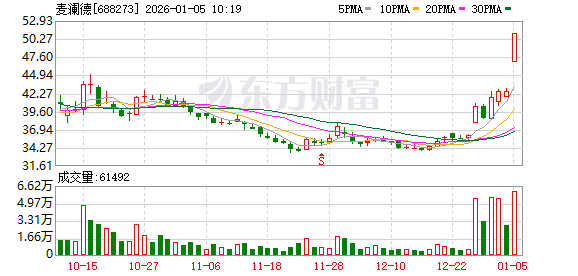
【盘中播报】麦澜德盘中涨停
Zheng Quan Shi Bao Wang· 2026-01-05 02:19
资金面上,麦澜德上一交易日主力资金净流入959.18万元,近5日净流入4416.20万元。 融资融券数据显示,该股最新(12月31日)两融余额为1.15亿元,其中,融资余额为1.15亿元,较上一 个交易日增加147.02万元,增幅为1.30%;融券余额为37.13万元,较上一个交易日增加1.65万元,增幅 为4.65%。近10日两融余额合计增加699.46万元,增幅为6.46%,其间融资余额增长6.22%,融券余额增 长235.77%。 从机构评级来看,近一个月该股获1家机构买入评级。12月8日华源证券发布的研报给予公司买入评级。 1月5日盘中科创板股麦澜德涨停,截至09:46,股价报51.02元,成交2.48亿元,换手率13.57%,振幅 9.74%。 科创板个股中,截至发稿上涨的有493只,下跌的有101只,涨停的有翔宇医疗、麦澜德等,跌幅居前的 有铂力特、富吉瑞、有研粉材等,分别下跌9.88%、9.43%、6.31%。 (文章来源:证券时报网) ...
今天A股,惊喜连连!
Sou Hu Cai Jing· 2025-12-30 05:12
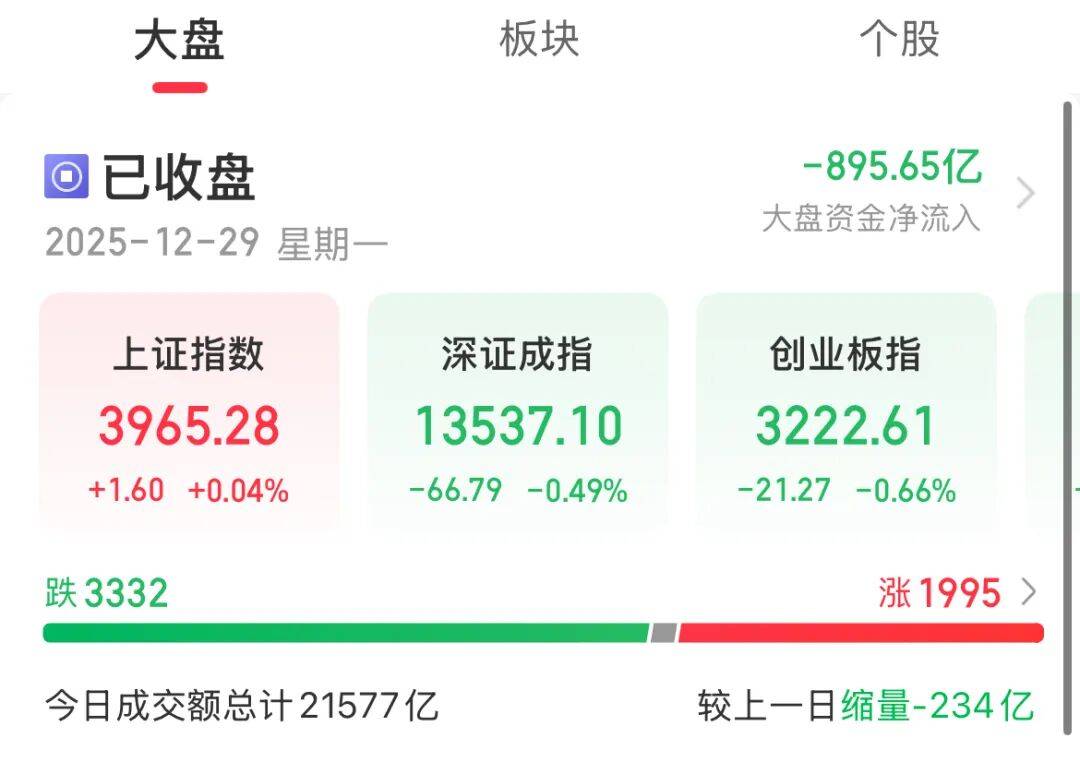
Market Overview - The A-share market experienced mixed performance with the Shanghai Composite Index recording a "9 consecutive days of gains" as of December 29, 2023, marking a slight increase of 0.04% [1] - The Shenzhen Component Index and the ChiNext Index fell by 0.49% and 0.66% respectively, while the North Star 50 Index decreased by 0.45% [1] - Total trading volume in the Shanghai and Shenzhen markets was 21,577 billion yuan, a decrease of 234 billion yuan from the previous day [1] Multi-Financial Sector - The multi-financial sector showed active performance, with stocks like Lakala leading the gains, and companies such as Cuiwei Co., Luxin Venture Capital, and Yuexiu Capital reaching around 10% limit up [3] - On December 26, the Shanghai Stock Exchange announced new guidelines to support high-quality commercial rocket enterprises under the Sci-Tech Innovation Board, which is expected to accelerate the development of the commercial aerospace industry [3] - The rapid growth of the commercial aerospace sector is projected to create significant market opportunities for carbon fiber composite materials, which can account for 70%-90% of the structural weight in spacecraft [3] Carbon Fiber Industry - Shanxi Securities noted that leading companies in the carbon fiber industry are announcing price increases, indicating a recovery in industry conditions [4] - The market for carbon fiber is showing clear differentiation, with general products facing strong competition, while high-end applications in aerospace, hydrogen storage, and wind power require consistent performance and reliable supply [4] - According to Baichuan Yingfu, China's actual consumption of carbon fiber is expected to reach 96,446 tons in 2025, a year-on-year increase of 71.89%, primarily driven by the wind power and aerospace sectors [4] Brain-Computer Interface Sector - The brain-computer interface sector saw significant gains, with Haige Communication reaching around 10% limit up, followed by companies like Meihao Medical and Mcland [5] - On December 26, the National Medical Products Administration released a list of high-end medical devices for priority approval, which includes implantable brain-computer interface devices [5] - The global brain-computer interface market is currently valued at several billion dollars and is expected to exceed 10 billion dollars by 2030, with the medical application market projected to reach 40 billion dollars by 2030 and 145 billion dollars by 2040 according to McKinsey [5][6]




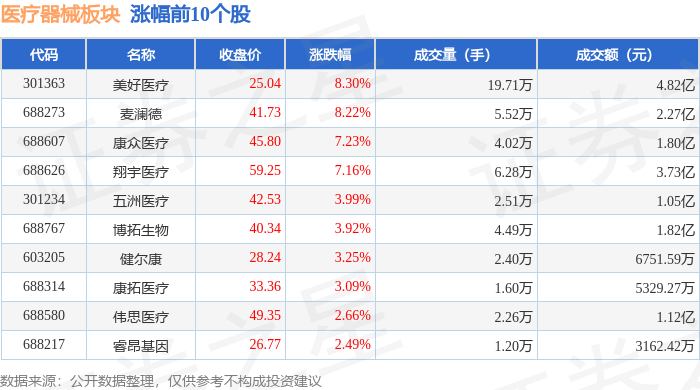
医疗器械板块12月29日跌0.74%,华康洁净领跌,主力资金净流出5.65亿元
Zheng Xing Xing Ye Ri Bao· 2025-12-29 09:06
Market Overview - The medical device sector experienced a decline of 0.74% on December 29, with Huakang Clean leading the drop [1] - The Shanghai Composite Index closed at 3965.28, up 0.04%, while the Shenzhen Component Index closed at 13537.1, down 0.49% [1] Top Performers - Meihao Medical (301363) saw a closing price of 25.04, with an increase of 8.30% and a trading volume of 197,100 shares, totaling a transaction value of 482 million yuan [1] - Mailande (688273) closed at 41.73, up 8.22%, with a trading volume of 55,200 shares and a transaction value of 227 million yuan [1] - Kangzhong Medical (688607) closed at 45.80, up 7.23%, with a trading volume of 40,200 shares and a transaction value of 180 million yuan [1] Underperformers - Huakang Clean (301235) closed at 39.21, down 8.54%, with a trading volume of 123,300 shares and a transaction value of 488 million yuan [2] - C Jianxin (688805) closed at 47.16, down 7.26%, with a trading volume of 89,000 shares and a transaction value of 426 million yuan [2] - Furuim Medical (300049) closed at 71.93, down 4.20%, with a trading volume of 66,800 shares and a transaction value of 485 million yuan [2] Capital Flow - The medical device sector saw a net outflow of 565 million yuan from institutional investors, while retail investors experienced a net inflow of 328 million yuan [2] - The overall capital flow indicates a mixed sentiment, with institutional investors pulling back while retail investors are more active [2] Individual Stock Capital Flow - Meihao Medical (301363) had a net outflow of 54.30 million yuan from institutional investors, with retail investors also showing a net outflow of 0.76 million yuan [3] - Jigaofazhan (600807) experienced a net inflow of 44.75 million yuan from institutional investors, while retail investors had a net outflow of 61.29 million yuan [3] - Kangzhong Medical (688626) saw a net inflow of 44.26 million yuan from institutional investors, with retail investors showing a slight net outflow [3]


A股收评:沪指微涨0.04%录得九连阳、创业板指跌0.49%,机器人及商业航天概念股走高,锂矿、医药商业板块表现疲软
Jin Rong Jie· 2025-12-29 07:11
Market Overview - The A-share market experienced fluctuations, with the Shanghai Composite Index closing up 0.04% at 3965.28 points, marking a nine-day rise, while the Shenzhen Component Index fell 0.49% to 13537.1 points, and the ChiNext Index dropped 0.66% to 3222.61 points. The total trading volume in both markets reached 2.14 trillion yuan, with over 3300 stocks declining [1] Hot Sectors - The commercial aerospace sector continued to show strength, with over ten stocks hitting the daily limit, including Shenjian Co. with eight consecutive limit-ups. The recent announcement from the Shanghai Stock Exchange regarding new listing rules for commercial rockets is expected to drive demand in related industries such as satellite manufacturing and ground equipment [2] - The brain-computer interface sector saw significant gains, with stocks like Haige Communication and Xilinmen hitting the daily limit. This surge followed the opening of the Fifth Frontier Brain Science and Industry Conference, which launched the "Guangdong-Hong Kong-Macao Greater Bay Area Brain Science and Central Nervous System Disease AI Innovation Alliance" [3] - The carbon fiber sector experienced a rally, with stocks like Heshun Technology and Jilin Chemical Fiber hitting the daily limit. This was influenced by Toray's announcement of a price increase for its carbon fiber products, expected to improve market conditions [4] - The robotics sector remained active, with stocks such as Awat New Materials and Buke Co. hitting the daily limit and reaching historical highs. The establishment of a humanoid robot standardization committee is anticipated to drive growth in specialized robotics [5] Institutional Insights - CITIC Securities noted that a year-end market rally has begun, driven by optimistic expectations among institutional investors, improved overseas liquidity, and a series of policy announcements. Key sectors to watch include non-ferrous metals and AI computing power, with commercial aerospace remaining the primary focus [6] - Guosheng Securities suggested that the market is likely to confirm its direction before the holiday, despite ongoing adjustments. They highlighted the potential for a mid-term reversal in various sectors [8] - Huatai Securities indicated that while the overseas environment has improved, the A-share market may still experience volatility in the short term due to a lack of cohesive funding and ongoing policy uncertainties. They recommend focusing on sectors with improving fundamentals, such as batteries and certain chemicals [9]



A股脑机接口板块集体走强,三博脑科、创新医疗涨超6%
Ge Long Hui· 2025-12-29 02:17
Group 1 - The A-share market's brain-computer interface sector experienced a collective surge, with Xiangyu Medical rising over 9%, Sanbo Brain Science, Meihao Medical, Mylande, and Innovation Medical increasing over 6%, and Xilinmen, Pulite, and Botuo Bio rising over 5% [1] - The Fifth Frontier of Brain Science and Industry Conference and the 2025 Shenzhen Brain-Computer Interface Expo commenced on December 28, marking a significant event in the sector [1] - The "Guangdong-Hong Kong-Macao Greater Bay Area Brain Science and Central Nervous System Disease AI Innovation Alliance" was officially launched, indicating a collaborative effort to advance brain science and technology [1]

脑机接口行业深度报告:解码大脑交互密码,开启人机协同纪元
EBSCN· 2025-12-26 11:02
Investment Rating - The report maintains an "Overweight" rating for the biomedical sector [4] Core Insights - The brain-computer interface (BCI) industry is at a critical stage of policy support, rapid technological iteration, and accelerated commercialization, with a global market approaching $10 billion [3][9] - The industry is driven by both policy and technology, with significant investments from major countries, including approximately $4.5 billion from the U.S. BRAIN Initiative and hundreds of billions in China [1][51] - The medical application of BCI technology is the most mature segment, focusing on neurorehabilitation, functional replacement, and disease treatment, with a dual growth curve emerging from medical and consumer applications [2][45] Summary by Sections Industry Overview - BCI is defined as a technology that creates a communication channel between the brain and external devices, enabling direct information exchange [16] - BCI can be categorized into invasive, semi-invasive, and non-invasive types, each with distinct applications in medical rehabilitation, consumer interaction, and military use [17][19] - The global BCI market is projected to grow from $1.2 billion in 2019 to approximately $7.63 billion by 2029, with a compound annual growth rate (CAGR) exceeding 13% [24] Policy Guidance - Major countries have launched BCI-related initiatives, with the U.S. and EU leading in funding and research efforts [52][53] - China's "Brain Plan" aims to enhance brain science and BCI technology, with significant funding expected in the coming years [54][57] Clinical Applications - The medical sector is the primary focus for BCI applications, with significant demand driven by conditions such as stroke and disabilities [45][48] - Clinical trials for BCI products are accelerating globally, with notable advancements in both invasive and non-invasive technologies [3][19] Industry Progress - The report highlights the competitive landscape, noting that while foreign companies like Neuralink and Synchron have a head start, domestic firms are making significant strides in key areas such as flexible electrodes and real-time language decoding [2][4][30] - The BCI industry is characterized by a complex supply chain, with upstream components like electrodes and chips, midstream product supply, and downstream applications across various sectors [30][33] Investment Recommendations - Investors are advised to focus on companies with strong technological barriers and clinical application capabilities, particularly in the medical sector, which is the most developed area for BCI commercialization [3][9] - Specific companies to watch include medical scene integrators and leaders in invasive/semi-invasive technologies, such as Xiangyu Medical, Weisi Medical, and Brain Tiger Technology [3][9]



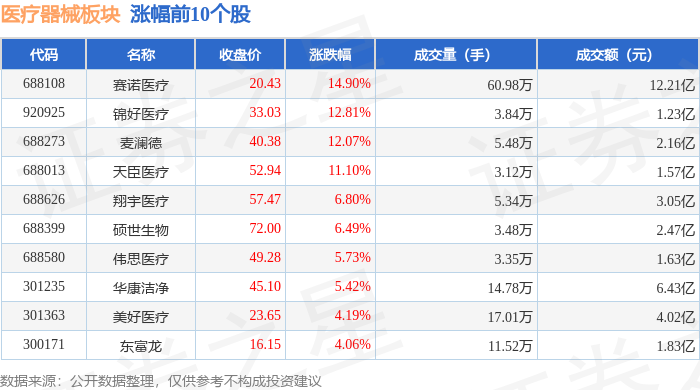
医疗器械板块12月25日涨1.35%,赛诺医疗领涨,主力资金净流入1.37亿元
Zheng Xing Xing Ye Ri Bao· 2025-12-25 09:07
Market Overview - The medical device sector increased by 1.35% on December 25, with Sainuo Medical leading the gains [1] - The Shanghai Composite Index closed at 3959.62, up 0.47%, while the Shenzhen Component Index closed at 13531.41, up 0.33% [1] Top Performers - Sainuo Medical (688108) closed at 20.43, up 14.90%, with a trading volume of 609,800 shares and a transaction value of 1.22 billion [1] - Jinhao Medical (920925) closed at 33.03, up 12.81%, with a trading volume of 38,400 shares [1] - Mailland (688273) closed at 40.38, up 12.07%, with a trading volume of 54,800 shares [1] - Tianchen Medical (688013) closed at 52.94, up 11.10%, with a trading volume of 31,200 shares [1] - Xiangyu Medical (688626) closed at 57.47, up 6.80%, with a trading volume of 53,400 shares [1] Underperformers - C Jianxin (688805) closed at 53.31, down 8.28%, with a trading volume of 142,100 shares and a transaction value of 754 million [2] - Tianyi Medical (301097) closed at 51.89, down 5.43%, with a trading volume of 18,800 shares [2] - Hualan Co. (301093) closed at 49.54, down 2.75%, with a trading volume of 39,000 shares [2] Capital Flow - The medical device sector saw a net inflow of 137 million from institutional investors, while retail investors experienced a net inflow of 65.58 million [2] - The sector's main funds saw a net outflow of 203 million from speculative funds [2] Individual Stock Capital Flow - Sainuo Medical had a net inflow of 117 million from main funds, but a net outflow of 98.09 million from retail investors [3] - Zhend Medical (603301) had a net inflow of 85.32 million from main funds, with a net outflow of 76.17 million from retail investors [3] - Huakang Clean (301235) had a net inflow of 65.37 million from main funds, with a net outflow of 64.32 million from retail investors [3]