
Daqo Energy(688303)

Search documents
“反内卷”推动价格回稳,光伏企业自救提速
Di Yi Cai Jing· 2025-12-28 03:50
Core Insights - The photovoltaic (PV) manufacturing industry is experiencing a cyclical low, with "anti-involution" becoming a core consensus and transformation path for the entire industry. Prices in the main PV supply chain are gradually stabilizing and even improving in the second half of 2025, driven by self-regulation and production cuts by companies [1][2]. Price Stabilization and Market Dynamics - Since July, multiple policy measures have been implemented to guide the PV industry towards a high-quality development phase focused on technological innovation. Core material prices, such as silicon, have shown signs of recovery, with the price of polysilicon contracts doubling since the end of June. The price of monocrystalline silicon wafers has increased by approximately 40% compared to early Q3 [2][3]. - The average price of N-type polysilicon has risen by about 54% compared to the end of Q2, indicating a significant upward trend in prices due to supply contraction, demand recovery, and rising costs [2][3]. Industry Self-Rescue and Transformation - The industry is undergoing a bifurcation, where technologically advanced companies are recovering profitability, while less efficient firms are exiting the market. Companies are focusing on cost control and improving production efficiency as part of their self-rescue strategies [4][5]. - Leading firms like LONGi Green Energy and Tongwei Co. are enhancing their operational capabilities through technological innovation and product upgrades, shifting the focus from price competition to value competition [4][5]. Financial Performance and Recovery Indicators - The financial performance of PV manufacturers is showing signs of improvement, with 14 out of 21 listed companies in the main PV supply chain reporting positive net profit growth in Q3. For instance, Daqo New Energy reported a 24.75% year-on-year increase in revenue for Q3, with a net profit turnaround [5][6]. - The stabilization of prices in the supply chain has been a key factor in reducing losses for manufacturers, particularly in the upstream silicon and wafer segments, where price increases have significantly improved gross margins [6]. Future Outlook and Challenges - The current recovery in the PV industry is still fragile, with terminal demand not fully restored and overcapacity issues remaining unresolved. The market is expected to face challenges as the "anti-involution" governance enters a critical phase, with 2026 being a pivotal year for the industry [1][6].



新能源发电行业2026年投资策略:反内卷大势不改,新技术推动升级
Bank of China Securities· 2025-12-26 06:19
Overview - The report maintains a "stronger than market" rating for the renewable energy sector, highlighting that the demand for offshore wind power in China and Europe is increasing, leading to a rise in foundation demand and profit recovery for wind turbines. The "anti-involution" policy is expected to continue driving the photovoltaic sector, particularly with the expansion of perovskite technology. Overall, while short-term installation demand for renewable energy globally may be weak, there are structural opportunities in the market [1]. Key Points Supporting the Rating - The "anti-involution" trend is stabilizing wind turbine prices, enhancing profitability for manufacturers. China's offshore wind projects are becoming economically viable, contributing significantly to installed capacity. The demand for offshore wind in Europe and emerging markets is also on the rise [3]. - In the photovoltaic sector, the "anti-involution" policy remains the main theme, with a focus on the potential for capacity exits in battery and module production, as well as the industrialization potential of perovskite technology. Investment should prioritize growth-oriented new technology directions and the main industry chain benefiting from the "anti-involution" trend [3]. Investment Recommendations - For wind power, the report suggests prioritizing investments in the turbine segment, which is expected to recover profitability, and in the foundation segment that is progressing quickly in Europe. The offshore wind market is projected to grow significantly, with a focus on deep-sea projects [3]. - In the photovoltaic sector, the report emphasizes the importance of monitoring the "anti-involution" policy's impact on the industry, particularly regarding the exit of inefficient capacity and the enhancement of efficiency in battery and module production [3]. Long-term Outlook for Renewable Energy Demand - The report indicates that China's renewable energy demand is expected to remain robust in the long term, with an average annual installation capacity of over 400GW projected from 2025 to 2035. This is driven by the country's energy security needs and the ongoing transition to a low-carbon economy [13][16]. - The "136 Document" is noted for guiding the development of renewable energy projects towards market-oriented pricing, which is expected to stabilize project returns and promote high-quality development in the sector [31]. Photovoltaic Sector Insights - The report anticipates a moderate decline in photovoltaic installations in 2026 due to a phase of pre-installation in 2025, with projected installations of 290GW in 2025 and 180GW in 2026, reflecting a year-on-year decrease of 38% [33]. - The report highlights that the European photovoltaic market is facing growth challenges, with a forecasted installation of 64.2GW in 2025, indicating a slight decline. The U.S. market is also expected to experience pressure on growth due to policy adjustments [34][37]. Perovskite Technology Potential - Perovskite technology is identified as a key area for enhancing competitiveness in the photovoltaic manufacturing sector, with expectations for significant breakthroughs in industrialization by leading manufacturers in 2026 [33][44].





硅片股普涨,头部企业联合大幅上调报价
Ge Long Hui· 2025-12-26 03:01
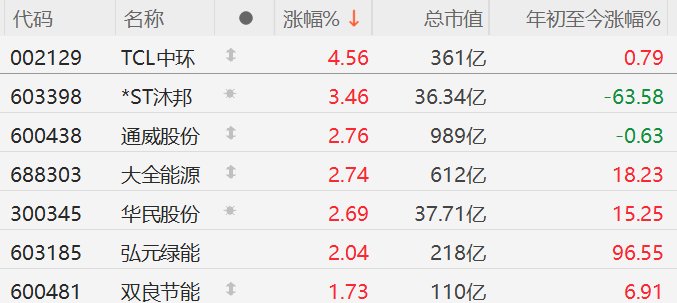
Group 1 - The A-share market saw a significant increase in silicon wafer stocks, with TCL Zhonghuan rising over 4%, and Tongwei Co., Daqo New Energy, Huamin Co., and Hongyuan Green Energy all increasing by over 2% [1] - Four leading silicon wafer companies have jointly raised their prices, with 183N silicon wafer priced at 1.4 yuan per piece, 210RN at 1.5 yuan per piece, and 210N at 1.7 yuan per piece, resulting in an average price increase of 12% [1] - The average transaction price for N-type G10L monocrystalline silicon wafers increased by 2.56% week-on-week to 1.2 yuan per piece, while N-type G12R and N-type G12 monocrystalline silicon wafers saw increases of 9.17% and 1.33%, respectively [1] Group 2 - Downstream battery prices have significantly increased, with mainstream battery prices ranging from 0.31 to 0.33 yuan per watt, reflecting a week-on-week increase of 10.3%, while module prices remained stable [1] - Silicon wafer companies have shown a strong willingness to maintain prices, leading to a substantial increase in silicon wafer prices [1]


光伏大变局:价格筑底 龙头盈利 跨界进退|2025中国经济年报
Hua Xia Shi Bao· 2025-12-25 02:25
Core Insights - The year 2025 marks a pivotal point for China's photovoltaic (PV) industry, transitioning from chaotic competition to rational collaboration, as stated by Wang Bohua, honorary chairman of the China Photovoltaic Industry Association [2] - The fixed electricity price era has ended, leading to a new market-oriented phase for the PV sector, with significant changes in pricing and production dynamics [2] Group 1: Market Dynamics - The price of polysilicon has rebounded, with futures prices soaring from over 30,000 yuan/ton to above 60,000 yuan/ton, nearly doubling [3] - Major upstream companies like Daqo Energy and Tongwei have reported profitability in Q3, indicating a recovery in the industry [3] - The profitability of 31 key companies in the PV main industry chain has improved, with Q3 losses narrowing to 64.22 billion yuan, a reduction of approximately 46.7% from Q2 [4] Group 2: Sector Challenges - Despite improvements, the industry still faces supply-demand imbalances, particularly in the equipment sector, where many leading companies reported declines in revenue and net profit [5] - The inverter sector shows a mixed performance, with some companies experiencing profit growth while others face declining profits [5] - The auxiliary materials sector is under pressure, with leading companies in quartz crucibles and glass reporting significant losses [5] Group 3: Industry Restructuring - The PV industry is witnessing a dual trend of cross-industry expansion and exits, with companies like Longi Green Energy entering the energy storage market [6] - Several companies have exited the PV sector through asset sales and project terminations, indicating a consolidation trend [6] - The restructuring signals are strengthening, with companies like Jingang Photovoltaic undergoing reorganization to focus on specific technologies [7] Group 4: Future Outlook - The competition in PV technology is entering a new phase, with BC technology products rapidly gaining market share, potentially reaching 100GW in production by next year [8] - The price of silicon is expected to regain its central role in the industry, with a projected recovery in silicon prices linked to upstream polysilicon prices [9] - The demand for auxiliary materials is anticipated to weaken further, but supportive policies may help stabilize the market [10]
中金:2026光伏需求有望修复 储能迎海内外景气共振
智通财经网· 2025-12-24 07:41
Core Viewpoint - The photovoltaic industry chain is expected to gradually bottom out and improve by the second half of 2025, aided by anti-involution measures, although financial improvements may slow market clearing, making the continuation of anti-involution essential [1] Group 1: Industry Outlook - The photovoltaic demand is anticipated to recover in the latter half of the 14th Five-Year Plan due to enhanced energy storage capacity and the need for market-oriented adjustments in the domestic electricity market [1] - The global energy transition is driving strong demand for energy storage, with a projected growth rate of nearly 50% for new installations in 2026, fueled by domestic policies and decreasing costs [2] Group 2: Market Dynamics - A decline in domestic installations is expected to lead to profit differentiation among glass glue film companies, with those having overseas clients likely to increase export ratios and profit margins [3] - The high silver prices are promoting the industrialization of silver-copper paste, while auxiliary material companies are actively seeking second growth curves in sectors like semiconductors and storage [3] Group 3: Valuation and Recommendations - Current valuations for major companies in the main industry chain are at historical low levels of 1xP/B to 2.5xP/B, with potential for performance recovery and sector opportunities as demand improves in 2Q26 [4] - Recommended stocks include: 1) Quality large-scale storage and industrial storage companies such as Canadian Solar (688472.SH), Shangneng Electric (300827.SZ), and others [4] 2) High-power module manufacturers like JinkoSolar (688223.SH) and Aiko Solar (600732.SH) [4] 3) Silicon material companies such as GCL-Poly Energy (03800) and Tongwei Co., Ltd. (600438.SH) [4] 4) Optimized players like Xinyi Solar (00968) and Flat Glass Group (601865.SH) [4] 5) Companies with new product launches like Dike Co., Ltd. (300842.SZ) and Juhe Materials (688503.SH) [4]



研判2025!中国硅基新材料行业产业链、发展现状、细分市场、竞争格局及发展趋势分析:硅基新材料作为战略性新兴产业的核心支撑,未来发展前景广阔[图]
Chan Ye Xin Xi Wang· 2025-12-24 01:19
Core Viewpoint - The silicon-based new materials industry is a crucial component of strategic emerging industries such as electronic information, new energy, and environmental protection, with significant government support driving its development [1][8]. Industry Overview - Silicon-based new materials are essential for various strategic emerging industries, including semiconductors, new energy, and aerospace, and include types such as organic silicon, silicon carbide, and microcrystalline silicon [4][10]. - The industry has seen substantial advancements in technology and capacity expansion, breaking foreign monopolies and enhancing overall competitiveness [1][8]. Market Size and Growth - The market size of China's silicon-based new materials industry is projected to reach 58.901 billion yuan in 2024, reflecting a year-on-year increase of 10.9% [1][9]. - The production volume of silicon-based new materials is expected to grow from 1.5265 million tons in 2019 to 5.4563 million tons by 2024, with a compound annual growth rate of 29.0% [9][10]. Industry Chain - The industry chain consists of upstream raw materials (metal silicon, silicon wafers), midstream manufacturers (producers of various silicon-based materials), and downstream applications (semiconductors, photovoltaic cells, and new energy vehicles) [5][6]. Competitive Landscape - The competitive landscape is characterized by a mix of leading enterprises and emerging market participants, with major players like Hoshine Silicon Industry, Jianghan New Materials, and Dongyue Silicon Materials dominating the market [11][12]. Future Trends - Market demand for silicon-based new materials is expected to expand further, driven by growth in sectors such as photovoltaics, semiconductors, and new energy vehicles [15]. - Technological innovation and industry upgrades will provide new momentum for the sector, with increasing requirements for material purity and performance in semiconductor applications [16]. - Continuous government support and policies aimed at promoting new material research and industrialization will create a favorable environment for the industry's growth [17].


低轨卫星+太空算力双轮驱动,太空光伏远期市场可观,科创新能源ETF(588830)备受关注
Xin Lang Cai Jing· 2025-12-23 01:48
Group 1 - Strategic cooperation agreement signed between Junda Co. and Shangyi Optoelectronics to explore the application of perovskite battery technology in space energy [1] - The low Earth orbit satellite and space computing power are expected to drive a significant market for space photovoltaics, with an estimated launch of around 15,000 satellites by 2030, potentially generating a total power output of 150 MW [1] - The market space for space photovoltaics is projected to be substantial, with Musk proposing the deployment of 100 GW of AI computing power in space annually [1] Group 2 - Gallium arsenide is currently the mainstream technology for space photovoltaics, offering advantages in efficiency and radiation resistance, but is expensive for large-scale applications [1] - Crystalline silicon technology is cost-effective for large-scale deployment, with enhancements in radiation resistance and power density expected from HJT technology [1] - Perovskite technology may be a long-term option, with potential conversion efficiencies exceeding 30% and superior power density compared to crystalline silicon and gallium arsenide [1] Group 3 - The Sci-Tech Innovation Board New Energy ETF closely tracks the Shanghai Stock Exchange Sci-Tech Innovation Board New Energy Index, which includes 50 major companies in the photovoltaic, wind power, and new energy vehicle sectors [2] - As of November 28, 2025, the top ten weighted stocks in the index include companies like Canadian Solar, Trina Solar, and JinkoSolar, collectively accounting for 47.84% of the index [2]


光伏产业从"内卷"走向"破卷",但明年才是行业治理的攻坚期
Di Yi Cai Jing· 2025-12-22 10:51
Core Viewpoint - The photovoltaic industry is expected to enter a continuous capacity clearing cycle by 2026, following a period of severe supply-demand mismatch and price wars, with a focus on addressing the industry's pain points and promoting "anti-involution" measures in 2025 [1][9]. Group 1: Industry Challenges - The first half of 2025 was characterized as "difficult," with all segments of the photovoltaic industry experiencing unprecedented losses, totaling a net loss of 12.58 billion yuan among 31 A-share listed companies in the photovoltaic main industry chain, a year-on-year increase of 274.3% [3][4]. - Over 40 companies have announced delistings, bankruptcies, or mergers since 2024 due to severe supply-demand imbalances and rapid price declines below industry cost lines [3][4]. Group 2: Financial Performance - Major companies reported significant losses in the first half of 2025, with Longi Green Energy losing 2.569 billion yuan, Tongwei Co. losing 4.955 billion yuan, JA Solar losing 2.58 billion yuan, Trina Solar losing 2.918 billion yuan, and TCL Zhonghuan losing 4.242 billion yuan, totaling 17.264 billion yuan in losses among these five leading firms [4][5]. - Despite a temporary boost in market demand from a "rush installation" trend in the distributed photovoltaic market, this demand growth was not sustained [4]. Group 3: Anti-Involution Measures - In the second half of 2025, measures to promote "anti-involution" began to intensify, with government and industry collaboration aimed at addressing low-price disorder and enhancing product quality [6][9]. - The implementation of the Anti-Unfair Competition Law in June 2025 positively impacted pricing, leading to a recovery in prices from July to October 2025, with prices across the photovoltaic industry chain rising compared to the beginning of the year [7][10]. Group 4: Future Outlook - The establishment of a multi-crystalline silicon capacity integration acquisition platform is seen as a significant step towards optimizing capacity and breaking the cycle of excessive competition [1][8]. - The Ministry of Industry and Information Technology plans to strengthen capacity regulation and promote the orderly exit of backward production capacity, indicating that 2026 will be a critical year for industry governance [9][10]. - The industry is expected to undergo a continuous capacity clearing cycle, with a focus on improving product quality standards and enhancing market entry barriers to ensure sustainable profitability across the entire supply chain [9][10].

26年光伏年度策略:供给侧拐点已至,供需逐步修复
2025-12-22 01:45
Summary of Key Points from the Conference Call Industry Overview - The conference call focuses on the photovoltaic (PV) industry, specifically the outlook for 2026 and beyond, highlighting supply-demand dynamics and technological advancements in the sector [1][2][3][4]. Core Insights and Arguments - **Domestic Market Projections**: The expected installed capacity in the domestic PV market for 2026 is between 200-215 GW, representing a 26% year-on-year decline. However, there is a collective hope to maintain levels above 200 GW [1][3][17]. - **Global Market Trends**: Global PV installations are projected to see a slight decrease of about 2% in 2026, with emerging markets like the Middle East and India expected to grow at rates exceeding 30% [1][4]. - **Supply Chain Dynamics**: The supply side of the PV industry has seen a halt in capacity expansion, with operating rates generally below 50%. The silicon material segment is attempting to raise prices through joint storage initiatives, targeting a price range of 70,000 to 80,000 CNY per ton [1][5][20]. - **Downstream Pricing Strategies**: Downstream segments are passing on increased silicon costs to consumers, with component prices rising. Companies are signing self-discipline agreements to control output and enhance competitiveness through differentiated products [1][6][21]. - **Energy Storage Growth**: The energy storage sector is expected to significantly contribute to component companies, with anticipated shipment targets for energy storage doubling in the coming year [1][7][25]. Additional Important Insights - **Technological Advancements**: New technologies such as Topcon upgrades, BC components, and perovskite technology are expected to play crucial roles in the future of the PV industry. Perovskite technology has already seen pilot production lines and is projected to expand significantly [1][9][10][27]. - **Market Conditions**: The overall market is currently experiencing a significant oversupply, leading to price wars and losses among major companies. Many firms are adjusting strategies to stabilize prices and restore profitability [18][19]. - **Investment Recommendations**: Investment focus should be on silicon material and component segments, as well as companies involved in new technologies and energy storage, which are expected to benefit from market recovery and growth [28]. Conclusion - The PV industry is navigating through a challenging landscape characterized by declining demand in certain markets, oversupply issues, and the need for technological innovation. However, there are optimistic growth prospects in emerging markets and segments like energy storage, which could provide significant opportunities for investors and companies alike [1][4][28].
年终盘点 | 光伏产业从“内卷”走向“破卷” 但明年才是行业治理的攻坚期
Di Yi Cai Jing· 2025-12-20 12:01
Core Viewpoint - The photovoltaic industry is undergoing significant changes to address severe supply-demand imbalances and "involution" issues, with a focus on capacity consolidation and high-quality development by 2025 [1][8]. Group 1: Industry Challenges - The photovoltaic industry faced unprecedented losses in the first half of 2025, with 31 A-share listed companies reporting a total net loss of 12.58 billion yuan, a year-on-year increase of 274.3% [2]. - Major companies such as Longi Green Energy, Tongwei Co., and TCL Zhonghuan reported substantial losses, with a combined loss of 17.26 billion yuan in the first half of 2025 [2][3]. - The industry has seen over 40 companies announce delistings, bankruptcies, or mergers since 2024 due to chaotic capacity expansion and severe supply-demand imbalances [2]. Group 2: Policy and Regulatory Developments - The establishment of the polysilicon capacity consolidation acquisition platform, "Guanghe Qiancheng," aims to address the industry's "involution" through market-oriented and legal mechanisms [1]. - The Chinese government has initiated various measures to combat low-price competition, including the passing of the Anti-Unfair Competition Law, which has positively impacted prices from July to October 2025 [5][8]. - The Ministry of Industry and Information Technology (MIIT) has emphasized the need for industry self-regulation and has organized discussions to address low-price competition [4]. Group 3: Market Recovery and Future Outlook - By the second half of 2025, prices across the photovoltaic supply chain began to recover due to industry self-regulation and reduced production, leading to improved profitability for some upstream companies [4][6]. - The photovoltaic industry is expected to enter a sustained capacity clearing cycle in 2026, with a focus on improving product quality and market entry standards [9]. - Industry leaders stress the importance of achieving profitability across all segments of the supply chain, not just in the upstream polysilicon sector, to ensure a healthy and sustainable market [9].