
REMEGEN(688331)

Search documents
跨国巨头艾伯维锚定本土创新,全球资源如何加速落地中国?
2 1 Shi Ji Jing Ji Bao Dao· 2026-01-15 09:36
Core Insights - The Chinese biopharmaceutical industry is witnessing a significant transformation, moving from a focus on generic drugs to innovative drug development, as evidenced by recent high-value licensing deals involving local biotech firms and multinational corporations [1][4][18] - Multinational pharmaceutical companies are increasingly engaging with local biotech innovations at earlier stages, utilizing open innovation models and partnerships with local incubators to integrate into China's biotech ecosystem [1][2][10] Industry Transformation - The shift in China's biopharmaceutical landscape began around 2015 with government reforms aimed at enhancing drug innovation, leading to a substantial increase in the approval of innovative drugs [4][5] - Data from the National Healthcare Security Administration indicates that the number of approved innovative drugs is expected to rise significantly, with 48 new drugs projected for approval in 2024, more than five times the number in 2018 [4] - China's clinical trial costs are approximately one-third of those in the U.S., and the speed of patient recruitment is notably faster, contributing to the surge in licensing agreements for innovative drugs [5][10] Collaboration Models - The collaboration between AbbVie and local incubators like ATLATL aims to address common challenges faced by local biotech firms, such as regulatory alignment and commercialization readiness [3][6] - The "China Innovation Award" launched by AbbVie emphasizes a "running alongside" approach, providing not just funding but also comprehensive support throughout the R&D process [8][10] - This new collaboration model promotes mutual empowerment, allowing multinational companies to become co-builders of the innovation ecosystem rather than just technology outputters [10][17] Project Selection Criteria - Multinational companies like AbbVie prioritize projects with significant sales potential, focusing on unmet clinical needs and innovative therapeutic candidates [11][12] - The selection process emphasizes the importance of safety and efficacy, with a keen eye on the global intellectual property strategy of projects to enhance their attractiveness for international markets [13][15] Early Engagement and Global Integration - AbbVie’s approach includes early involvement in projects to ensure alignment in clinical design, regulatory compliance, and commercialization strategies, which can significantly reduce integration costs later on [15][16] - The collaboration is designed to enhance the global competitiveness of local biotech firms by integrating international standards and practices into their development processes [9][10] Future Outlook - The success of this collaborative model hinges on the commitment of multinational companies to long-term investment strategies and the willingness of local biotech firms to leverage global resources while maintaining their innovative edge [17] - The ultimate goal is to create a more resilient and vibrant Chinese biopharmaceutical innovation ecosystem that aligns closely with international standards and practices [17][18]

荣昌生物(688331) - 荣昌生物关于调整回购股份价格上限的公告
2026-01-15 09:32
荣昌生物制药(烟台)股份有限公司 关于调整回购股份价格上限的公告 证券代码:688331 证券简称:荣昌生物 公告编号:2026-003 本公司董事会及全体董事保证本公告内容不存在任何虚假记载、误导性陈述 或者重大遗漏,并对其内容的真实性、准确性和完整性承担法律责任。 重要内容提示: ● 为保障回购股份方案顺利实施,荣昌生物制药(烟台)股份有限公司(以 下简称"公司")于 2026 年 1 月 15 日召开第二届董事会第三十五次会议,审议 通过了《关于调整回购股份价格上限的议案》,拟将回购价格上限由人民币 95 元/股(含)调整为人民币 116 元/股(含)。 本次回购股份方案调整符合《公司法》、《上市公司股份回购规则》、《上海证 券交易所上市公司自律监管指引第 7 号——回购股份》及《公司章程》等相关规 定,公司综合考虑证券市场变化以及股份回购进展等因素,拟将股份回购价格上 限调整为 116 元/股(含)。调整后的回购股份价格上限不高于董事会审议通过《关 于调整回购股份价格上限的议案》决议前 30 个交易日公司股票交易均价的 150%。 一、回购股份的基本情况 公司于 2025 年 12 月 15 日召开第 ...
荣昌生物:拟将回购股份价格上限由95元/股调整为116元/股
Xin Lang Cai Jing· 2026-01-15 08:53
Core Viewpoint - Rongchang Biotech announced a plan to repurchase shares between 20 million to 40 million yuan at a price not exceeding 95 yuan per share, intended for employee stock ownership plans or equity incentives, with the implementation still pending as of the announcement date [1] Group 1 - The company plans to hold a board meeting on January 15, 2026, to review a proposal to raise the repurchase price ceiling from 95 yuan per share to 116 yuan per share, while keeping other terms unchanged [1] - The adjustment to the repurchase price is due to the recent stock price consistently exceeding the previous upper limit [1] - There is a risk that the repurchase plan may not be implemented if the stock price exceeds the new upper limit during the repurchase period [1]
荣昌生物:调整回购股份价格上限至116元/股
Mei Ri Jing Ji Xin Wen· 2026-01-15 08:49
每经AI快讯,1月15日,荣昌生物公告称,公司拟将回购价格上限由95元/股调整为116元/股,以保障回 购股份方案顺利实施。除此调整外,回购方案其他内容不变。本次调整无需提交股东会审议。公司于 2025年12月15日已审议通过以集中竞价交易方式回购部分A股股票,拟回购资金总额不低于2000万元且 不超过4000万元,回购股份用于员工持股计划或股权激励。截至公告披露日,公司尚未开始实施回购。 ...
荣昌生物(688331):RC148数据优异,BD交易超预期,看好公司长期发展前景
NORTHEAST SECURITIES· 2026-01-15 06:15
Investment Rating - The report maintains a "Buy" rating for the company, indicating an expectation of stock price appreciation exceeding 15% over the next six months [5]. Core Insights - The company has signed an exclusive licensing agreement with AbbVie for the PD-1/VEGF dual antibody drug RC148, receiving an upfront payment of $650 million, with potential milestone payments up to $4.95 billion, and double-digit royalties on net sales outside Greater China [1][2]. - RC148 shows promising efficacy and safety data, with a reported overall response rate (ORR) of 61.9% in a Phase 1 trial and 66.7% in a Phase 2 trial for non-small cell lung cancer (NSCLC) [1]. - The company has successfully executed multiple business development (BD) transactions, enhancing its cash flow and validating its research capabilities [2]. Financial Summary - The company’s projected revenues for 2025-2027 are $250.8 million, $319.6 million, and $428.5 million, respectively, reflecting growth rates of 46.1%, 27.4%, and 34.1% [4]. - The net profit attributable to the parent company is expected to improve from a loss of $885 million in 2025 to a profit of $373 million in 2027 [4]. - Earnings per share (EPS) are projected to transition from -1.57 yuan in 2025 to 0.66 yuan in 2027, indicating a significant turnaround [4].
跨国药企“必备”肿瘤药,中国药企还有机会卖
经济观察报· 2026-01-15 05:55
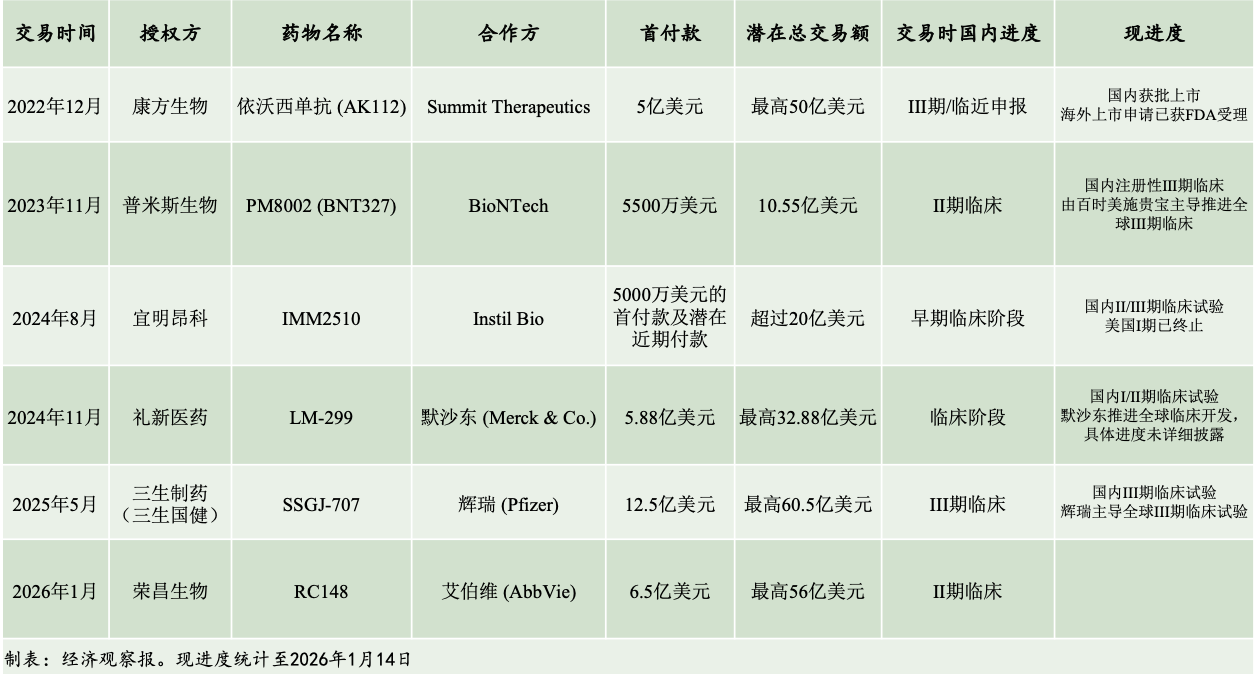
Core Viewpoint - The article discusses the potential for PD-1/VEGF drugs to generate external licensing deals, highlighting recent significant transactions in this sector and the competitive landscape among pharmaceutical companies [1][3]. Group 1: Recent Transactions - Rongchang Biopharma announced an exclusive licensing agreement with AbbVie for its dual-specific antibody drug RC148, targeting PD-1/VEGF, currently in Phase II clinical trials. The deal includes an upfront payment of $650 million and potential milestone payments up to $4.95 billion, with a total deal value of $5.5 billion [2][6]. - Other notable transactions include: - Canfite BioPharma licensed its PD-1/VEGF dual antibody to Summit Therapeutics for an upfront payment of $500 million, with a total deal value exceeding $5 billion [5][6]. - Three other companies have also secured deals for PD-1/VEGF drugs, with upfront payments ranging from $50 million to $1.25 billion and total deal values reaching up to $6.05 billion [5][6]. Group 2: Market Dynamics - The PD-(L)1/VEGF target is considered one of the most promising in oncology, combining immunotherapy and targeted therapy, with expectations of significant therapeutic benefits [5][9]. - Despite the presence of multiple drugs targeting the same pathway, there is still potential for new licensing agreements based on efficacy, different indications, and combination therapies [11][12]. - The competitive landscape is characterized by a trend where companies are looking to acquire PD-1/VEGF assets to strengthen their oncology portfolios, especially those that missed earlier opportunities in the PD-1 market [8][12]. Group 3: Future Outlook - There is an expectation for continued licensing transactions in the PD-1/VEGF space, as companies seek to leverage unique data and therapeutic advantages of their products [10][11]. - Companies like Zai Lab, Junshi Biosciences, and others are in various stages of developing PD-(L)1/VEGF pipelines, indicating ongoing interest and investment in this therapeutic area [11][12].


跨国药企“必备”肿瘤药,中国药企还有机会卖
Jing Ji Guan Cha Wang· 2026-01-15 03:32
Core Viewpoint - The recent licensing agreement between Rongchang Biologics and AbbVie for the dual-specific antibody drug RC148 highlights the competitive landscape of PD-1/VEGF targeted therapies, with significant financial implications for both companies involved [1][6]. Group 1: Licensing Agreement Details - Rongchang Biologics has entered into an exclusive licensing agreement with AbbVie for RC148, a dual-specific antibody currently in Phase II clinical trials, granting AbbVie rights outside Greater China [1][6]. - The deal includes an upfront payment of $650 million and potential milestone payments up to $4.95 billion, along with tiered royalties on net sales, bringing the total potential value of the agreement to $5.5 billion [1][6]. - This transaction's total amount is considered high, especially for a product not ranked among the top three in its category, raising questions about market share potential [6]. Group 2: Market Context and Comparisons - The PD-(L)1/VEGF target has gained significant attention in recent years, combining immunotherapy and targeted therapy, with expectations of enhanced efficacy [3]. - Several Chinese biotech companies have previously licensed their PD-(L)1/VEGF drugs to international firms, with notable deals including a $500 million upfront payment from Summit Therapeutics to Kanyin Biologics, and a $1.25 billion upfront payment from Pfizer to Sanofi [4][5]. - Despite the presence of multiple PD-1/VEGF drugs in the market, there remains potential for further licensing agreements, as efficacy and specific indications will play a crucial role in market segmentation [10]. Group 3: Future Trends and Industry Insights - The combination of PD-(L)1/VEGF drugs with ADCs (antibody-drug conjugates) is anticipated to be a major development trend among pharmaceutical companies [9]. - Companies that have not yet licensed their PD-1/VEGF drugs are actively seeking opportunities, with the success of future deals dependent on finding suitable partners and demonstrating strong clinical data [10]. - Major multinational pharmaceutical companies, including Eli Lilly, Novartis, and Sanofi, have yet to announce new licensing agreements, indicating a cautious approach while awaiting more mature data [12].
AI重塑新药研发!英伟达礼来砸百亿建联合实验室,医疗板块迎技术革命?
Jin Rong Jie· 2026-01-15 01:47
Core Insights - The 44th J.P. Morgan Healthcare Conference has highlighted significant industry developments, including a $1 billion investment by NVIDIA and Eli Lilly to establish a joint research lab in the San Francisco Bay Area to accelerate AI applications in the pharmaceutical sector [1] - The conference serves as a critical platform for domestic pharmaceutical companies to showcase core molecular product capabilities and advance overseas business development collaborations, indicating a return to global value validation for products [2] - The participation of over 8,000 global attendees and more than 500 listed companies underscores the strengthening global competitiveness of Chinese companies in the pharmaceutical sector [2] Group 1: Innovative Drugs - BeiGene focuses on oncology drug development and global commercialization, presenting progress on core products like CDK4 at the conference [2] - Rongchang Biologics has entered an exclusive licensing agreement with AbbVie for the novel PD-1/VEGF bispecific antibody drug RC148, granting AbbVie rights outside Greater China for development, production, and commercialization [2] - Hengrui Medicine, involved in the R&D, production, and sales of innovative and generic drugs, reported that over 50% of its revenue now comes from innovative drugs, with multiple self-developed products receiving approvals [2] Group 2: CRO/CMO - WuXi AppTec provides integrated CXO services covering the entire drug development and manufacturing process, projecting a 32.56% year-on-year growth in net profit for 2025 [3] - WuXi Biologics, specializing in biopharmaceutical CRDMO services, announced 209 new projects, bringing the total to 945, with potential milestone payments exceeding $4 billion from new research contracts [3] - Tigermed offers clinical trial CRO services and participated in the Asia-Pacific session of the conference, providing outsourcing services related to clinical trials for global pharmaceutical companies [3] Group 3: AI in Healthcare - NVIDIA and Eli Lilly's collaboration aims to build AI models to enhance new drug development, with a planned investment of $1 billion over the next five years [4] - RunDa Medical focuses on comprehensive medical testing services and is developing an automated testing interpretation system based on large models [4] - Anbiping has launched a digital pathology AI system and is exploring the registration and commercialization of AI medical devices in cervical cytology [4]


华西证券:维持荣昌生物“增持”评级 RC148双抗56亿美元出海
Zhi Tong Cai Jing· 2026-01-15 01:27
Recent Events - Company announced on January 12 that it has signed an exclusive licensing agreement with AbbVie for its self-developed PD-1/VEGF bispecific antibody drug RC148, granting AbbVie exclusive rights for development, production, and commercialization outside Greater China. The company will receive an upfront payment of $650 million and is eligible for up to $4.95 billion in milestone payments, as well as double-digit royalties on net sales outside Greater China [1] Product Development and International Collaboration - The recent licensing agreement further validates the company's speed in international expansion, following the external authorization of its core products RC18 and RC28 by 2025. As of January 2026, there are 17 PD-(L)1/VEGF bispecific antibody drugs in clinical trials globally, with several signed BD agreements, showcasing the company's strong R&D capabilities [2] - AbbVie, as an international MNC, has a diverse product pipeline including the first FRα-targeting ADC drug Elahere and others, which will strategically complement RC148 and expand its global reach [2] Clinical Data and Efficacy - At the 2025 ESMO-IO conference, the company disclosed promising data for RC148, showing an objective response rate (ORR) of 61.9% and a disease control rate (DCR) of 100% for monotherapy. For combination therapy, the ORR reached 66.7% and the DCR was 95.2%, indicating initial clinical advantages and manageable safety profiles [3] - Early clinical studies have shown that RC148, when used in combination with antibody-drug conjugates (ADCs), exhibits promising anti-tumor activity, with the company actively advancing related clinical trials [3]
华西证券:维持荣昌生物(09995)“增持”评级 RC148双抗56亿美元出海
智通财经网· 2026-01-15 01:25
Core Viewpoint - Huaxi Securities maintains an "overweight" rating for Rongchang Biopharmaceutical (09995), highlighting the company's strong independent R&D capabilities, stable sales growth of core products, experienced management team, steady progress in clinical indications, and reasonable domestic and international layout, with optimism regarding the company's commercialization capabilities post-product launch [1] Recent Events - On January 12, the company announced an exclusive licensing agreement with AbbVie for its independently developed PD-1/VEGF bispecific antibody drug RC148, granting AbbVie exclusive rights for development, production, and commercialization outside Greater China. The company will receive an upfront payment of $650 million and is eligible for up to $4.95 billion in milestone payments, along with double-digit royalties on net sales outside Greater China [1] International Expansion - Following the authorization of core products RC18 and RC28 in 2025, this recent agreement further validates the company's speed in international expansion. As of January 2026, 17 PD-(L)1/VEGF bispecific antibody drugs are in clinical trials globally, with several BD agreements signed, showcasing the company's R&D capabilities. AbbVie, as a partner, has a diverse product line that complements RC148, enhancing its global positioning [2] Clinical Data - At the 2025 ESMO-IO conference, the company disclosed promising data for RC148, showing an objective response rate (ORR) of 61.9% and a disease control rate (DCR) of 100% in monotherapy. In combination therapy, the ORR reached 66.7% and the DCR was 95.2%. The safety profile is manageable, indicating initial clinical advantages. The company is actively advancing related clinical studies, anticipating further clinical potential [3]