
Dioo Microcircuits (688381)

Search documents
帝奥微(688381.SH):预计2025年亏损5500万元至8200万元
Ge Long Hui A P P· 2026-01-30 12:53
Core Viewpoint - The company, DiAo Micro (688381.SH), anticipates a revenue increase for 2025, but expects significant net losses compared to the previous year [1] Financial Performance - The company expects to achieve an annual revenue of approximately 562 million yuan in 2025, representing an increase of 35.75 million yuan, or 6.79%, compared to the previous year [1] - The projected net loss attributable to the parent company for 2025 is estimated to be between 55 million yuan and 82 million yuan, a decrease of 7.93 million to 34.93 million yuan, reflecting a year-on-year decline of 16.85% to 74.22% [1] - The expected net loss excluding non-recurring gains and losses is projected to be between 112 million yuan and 139 million yuan, which is a reduction of 18.32 million to 45.32 million yuan, indicating an increase in losses of 19.56% to 48.38% year-on-year [1] R&D and Market Strategy - The company has been increasing its R&D investment to enhance its product matrix and improve product performance and quality [1] - Despite a competitive market environment, the company's product gross margin remains around 43% [1] - The company has intensified its promotion of new products and expanded downstream sales channels to increase its share among major clients, leading to a combined increase of approximately 13.5% in R&D and sales expenses compared to the previous year, which has contributed to the decline in profits [1]

帝奥微(688381) - 2025 Q4 - 年度业绩预告
2026-01-30 10:25
Financial Projections - The company expects to achieve an annual revenue of approximately 562 million yuan in 2025, representing a year-on-year increase of 35.75 million yuan, or 6.79%[4]. - The projected net loss attributable to shareholders for 2025 is estimated to be between 55 million and 82 million yuan, a decrease of 7.93 million to 34.93 million yuan compared to the previous year, reflecting a decline of 16.85% to 74.22%[4]. - The expected net loss attributable to shareholders after deducting non-recurring gains and losses is estimated to be between 112 million and 139 million yuan, a decrease of 18.32 million to 45.32 million yuan compared to the previous year, indicating an increase in loss of 19.56% to 48.38%[4]. - The previous year's net loss attributable to shareholders was 47.07 million yuan, with a net loss of 93.68 million yuan after deducting non-recurring gains and losses[6]. R&D and Expenses - The company has increased its R&D investment and expanded its product matrix, achieving a gross margin of approximately 43% despite intensified market competition[9]. - The total R&D and sales expenses have increased by approximately 13.5% compared to the previous year, contributing to the decline in profits[9]. - The company incurred share-based payment expenses of approximately 30 million yuan in 2025, which, when excluded, results in a projected net loss of between 25 million and 52 million yuan, roughly in line with the previous year[9]. Performance Forecast and Risks - The company emphasizes that the performance forecast is based on preliminary estimates and has not been audited by certified public accountants[10]. - Investors are advised to pay attention to investment risks as the forecast data is subject to change pending the official audited annual report[11].
帝奥微:2025年全年预计净亏损5500.00万元—8200.00万元
2 1 Shi Ji Jing Ji Bao Dao· 2026-01-30 10:03
Core Viewpoint - The company, DiAo Micro, is forecasting a significant net loss for the year 2025, with expected losses ranging from 55 million to 82 million yuan, indicating a year-on-year decrease in net profit by 16.85% to 74.22% [1] Financial Performance - The projected net profit attributable to shareholders, excluding non-recurring gains and losses, is expected to be a loss between 112 million and 139 million yuan, with a year-on-year increase in losses of 19.56% to 48.38% [1] - The company anticipates that the net profit attributable to shareholders will be approximately -25 million to -52 million yuan when excluding share-based payment expenses, which is roughly in line with the previous year [1] Reasons for Performance Changes - The primary reasons for the performance changes include increased R&D investment to enhance product quality and performance, which has led to a gross margin of around 43% despite intensified market competition [1] - The company has also increased its promotional efforts for new products and expanded downstream sales channels, resulting in a combined increase of approximately 13.5% in R&D and sales expenses compared to the previous year [1] - Additionally, the company incurred share-based payment expenses of about 30 million yuan during the fiscal year 2025 [1]
帝奥微1月26日获融资买入1480.65万元,融资余额2.18亿元
Xin Lang Cai Jing· 2026-01-27 01:36
Group 1 - The core viewpoint of the news is that DiAo Microelectronics has shown fluctuations in its stock performance and financing activities, indicating a mixed outlook for the company [1][2]. Group 2 - On January 26, DiAo Microelectronics experienced a stock decline of 2.32%, with a trading volume of 105 million yuan. The financing buy-in amount was 14.81 million yuan, while the financing repayment was 16.91 million yuan, resulting in a net financing buy of -2.11 million yuan [1]. - As of January 26, the total financing and securities lending balance for DiAo Microelectronics was 218 million yuan, with the financing balance accounting for 4.51% of the circulating market value, which is above the 50th percentile level over the past year [1]. - The company has a securities lending balance of 29.44 million yuan, with a remaining quantity of 11,700 shares, which is above the 90th percentile level over the past year [1]. Group 3 - As of September 30, the number of shareholders for DiAo Microelectronics was 16,000, an increase of 3.00% from the previous period, with an average of 11,955 circulating shares per person, up by 1.32% [2]. - For the period from January to September 2025, DiAo Microelectronics reported operating revenue of 457 million yuan, representing a year-on-year growth of 11.41%. However, the net profit attributable to the parent company was -24.28 million yuan, a decrease of 232.46% year-on-year [2]. Group 4 - Since its A-share listing, DiAo Microelectronics has distributed a total of 153 million yuan in dividends [3].
半导体并购估值博弈加剧?差异化定价成各方共识
Zheng Quan Shi Bao Wang· 2026-01-12 23:29
Core Viewpoint - The semiconductor merger and acquisition (M&A) landscape is experiencing increased valuation disputes, leading to a rise in failure rates of deals, despite a more accommodating regulatory environment [1][2][4]. Group 1: M&A Activity and Trends - In 2025, the number of M&A cases in the semiconductor sector increased by nearly 25% year-on-year, reaching 161 cases, with 12 failures, marking a five-year high [2][3]. - The total M&A amount in China's semiconductor industry reached approximately 279.67 billion, with 496 cases and 32 failures, a more than twofold increase compared to previous years [3]. - The overall M&A market in A-shares saw about 4,773 cases in 2025, a 5% increase year-on-year, with a slight decline in overall failure rates [2][3]. Group 2: Valuation Discrepancies - There is a significant divergence in valuations between buyers and sellers, particularly as sellers' expectations remain high due to previous market conditions, while buyers are cautious due to industry adjustments [4][5]. - The average price-to-earnings ratio for the semiconductor industry peaked at 291 times in 2021 but fell to 53 times by 2024, reflecting a substantial valuation correction [5]. - The termination of several high-profile M&A deals, such as the merger between Haiguang Information and Zhongke Shuguang, was attributed to disagreements over core terms, particularly valuation [4][5]. Group 3: Differentiated Pricing Strategies - Industry experts suggest implementing differentiated pricing strategies to address valuation discrepancies, allowing for tailored exit options for different investor types [10][11]. - Recent M&A cases have shown a trend towards differentiated arrangements in terms of valuation, payment methods, and performance commitments, which can help align interests among diverse stakeholders [10][11]. - Regulatory support for differentiated M&A practices has increased, encouraging the use of various assessment methods and flexible payment structures [11][12]. Group 4: Challenges in M&A Execution - The semiconductor industry is characterized by high cyclicality, complicating M&A negotiations as both parties seek to capitalize on market recovery while managing inherent risks [6][12]. - The presence of a "trilemma" in M&A—high seller expectations, buyer performance commitments, and high success rate targets—poses significant challenges, especially during industry downturns [12][14]. - The need for performance guarantees in M&A deals has led to complications, particularly for unprofitable semiconductor firms, as they may resist signing performance commitments [12][14].



帝奥微涨2.02%,成交额1817.14万元,主力资金净流出25.70万元
Xin Lang Zheng Quan· 2026-01-05 02:01
Core Viewpoint - The stock price of DiAo Microelectronics has shown a slight increase of 2.02% this year, but has experienced declines over various trading periods, indicating potential volatility in the stock performance [2]. Group 1: Stock Performance - As of January 5, DiAo Microelectronics' stock price is 23.27 CNY per share, with a market capitalization of 5.759 billion CNY [1]. - The stock has decreased by 1.73% over the last 5 trading days, 3.32% over the last 20 days, and 13.62% over the last 60 days [2]. - The trading volume on January 5 was 18.1714 million CNY, with a turnover rate of 0.41% [1]. Group 2: Financial Performance - For the period from January to September 2025, DiAo Microelectronics achieved a revenue of 457 million CNY, representing a year-on-year growth of 11.41% [2]. - The net profit attributable to the parent company was -24.2819 million CNY, reflecting a significant year-on-year decrease of 232.46% [2]. Group 3: Company Overview - DiAo Microelectronics, established on February 5, 2010, is located in Shanghai and specializes in the research, design, and sales of high-performance analog chips [2]. - The company's main business revenue is composed of power management (51.58%) and signal chain (48.42%) [2]. - The company is classified under the semiconductor design sector and is associated with concepts such as AI smartphones, wireless earphones, small-cap stocks, automotive chips, and Xiaomi concepts [2]. Group 4: Shareholder Information - As of September 30, the number of shareholders for DiAo Microelectronics was 16,000, an increase of 3.00% from the previous period [2]. - The average circulating shares per person increased by 1.32% to 11,955 shares [2]. Group 5: Dividend Information - DiAo Microelectronics has distributed a total of 153 million CNY in dividends since its A-share listing [3].
帝奥微12月31日获融资买入888.00万元,融资余额2.27亿元
Xin Lang Cai Jing· 2026-01-05 01:37
Group 1 - The core viewpoint of the news is that DiAo Microelectronics has shown mixed financial performance, with a slight increase in revenue but a significant decline in net profit [2] - As of December 31, DiAo Microelectronics' financing balance reached 227 million yuan, accounting for 5.21% of its market capitalization, indicating a high level of financing activity [1] - The company reported a revenue of 457 million yuan for the first nine months of 2025, representing a year-on-year growth of 11.41%, while the net profit attributable to shareholders was a loss of 24.28 million yuan, a decrease of 232.46% compared to the previous year [2] Group 2 - DiAo Microelectronics has distributed a total of 153 million yuan in dividends since its A-share listing [3] - The company specializes in the research, design, and sales of high-performance analog chips, with its main business revenue composition being 51.58% from power management and 48.42% from signal chains [1] - As of September 30, the number of shareholders increased to 16,000, with an average of 11,955 circulating shares per person, reflecting a slight increase in shareholder engagement [2]
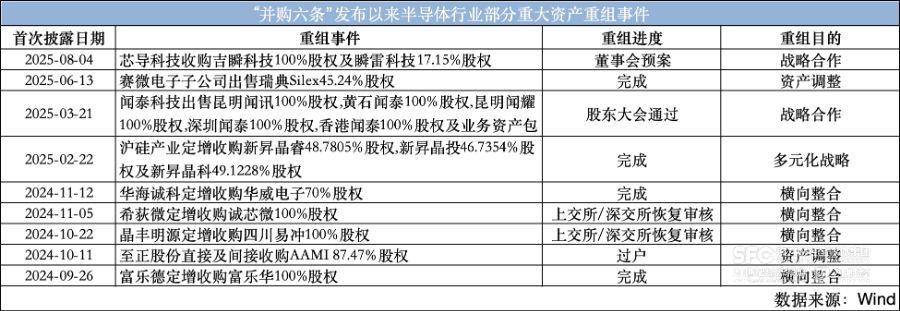
半月11起 半导体并购新叙事如何走
2 1 Shi Ji Jing Ji Bao Dao· 2025-12-19 02:20
Group 1 - The semiconductor industry has become a hotbed for mergers and acquisitions, with 206 related events reported since the announcement of the "merger six rules" last September, averaging one event every two days, including 16 major asset restructurings [1][2] - However, since December, there has been a noticeable slowdown in A-share semiconductor mergers, with several companies, including Haiguang Information and SIRUI, announcing the termination of significant asset restructuring plans [1][5] - Cross-industry mergers are increasingly common, with companies from different sectors, such as outdoor brands and retail, entering the semiconductor space to diversify and seek new growth opportunities [1][8] Group 2 - The semiconductor sector is viewed as the foundation of digitalization and intelligence, making it a focal point for global competition and resource allocation [2][10] - Mergers and acquisitions are seen as essential for companies to overcome technological barriers and expand market share, necessitating clear industry judgment and effective post-merger integration capabilities [2][9] - Recent statistics indicate that 11 semiconductor-related merger announcements were made in early December alone, covering various fields such as semiconductor equipment and chip design [4] Group 3 - Notable recent mergers include the acquisition of a 49% stake in Zhuhai Noah Changtian Storage Technology by Puran Co., which aims to enhance its non-volatile storage product layout [4] - Conversely, several companies, including Haiguang Information and Chipone, have terminated their merger plans due to disagreements on core transaction terms and market conditions [5][7] - Industry experts suggest that the current trend of merger terminations is normal, as various factors influence negotiations, and future opportunities for mergers may still arise [7][12] Group 4 - The end-of-year surge in semiconductor mergers is attributed to a combination of capital market dynamics, policy support, and industry growth, with over 20 companies currently pursuing IPOs in the semiconductor sector [10][11] - The semiconductor industry is characterized by high research and development risks and significant capital requirements, making cross-industry mergers particularly challenging for traditional companies [12]

半导体并购为何频频“刹停”?
Jin Rong Shi Bao· 2025-12-18 01:04
Group 1 - Several recent mergers and acquisitions in the A-share semiconductor sector have been halted, raising market concerns [1] - DiAo Micro announced the termination of its acquisition of Rongpai Semiconductor due to failure to reach consensus on key terms [1] - SiRuPu decided to terminate its acquisition of Ningbo Aola Semiconductor as the conditions for major asset restructuring were not fully mature [1] Group 2 - The majority of terminated transactions involve small and medium-sized private listed companies, primarily focusing on significant cash or share transactions [2] - The core issues leading to transaction terminations are the inability to agree on key terms and changes in market conditions that render transaction conditions immature [2] - The success rate of mergers and acquisitions in the Sci-Tech Innovation Board is over 70%, indicating that a certain percentage of terminated transactions may be a normal aspect of market-driven mergers [2] Group 3 - The high activity level in the semiconductor industry and the complexity of shareholder structures contribute to increased negotiation difficulties in mergers and acquisitions [3] - Market demand fluctuations and changes in the market environment have made companies more cautious in pursuing acquisitions to avoid operational risks [3] Group 4 - To protect investor interests, regulations have been established to enhance information disclosure and communication regarding terminated restructurings [4] - Companies that terminate restructurings have been proactive in disclosing reasons and potential impacts, often holding investor meetings to address market concerns [4] - Following the termination of restructurings, related companies' stock prices have seen an approximate decline of 4%, reflecting a stable market response without significant irrational fluctuations [4] Group 5 - The China Securities Regulatory Commission has proposed regulations to standardize merger and acquisition behaviors and clarify the responsibilities of financial advisors [5] - In 2024, regulatory authorities addressed 35 cases of insider trading related to mergers and acquisitions, demonstrating a strict regulatory approach [5] - The regulatory environment emphasizes a "zero tolerance" policy towards fraudulent activities in mergers and acquisitions, aiming to protect the rights of small investors [5]
三七互娱(002555.SZ):拟投资帝奥微湖杉基金将投资于AI产业链相关企业
Ge Long Hui· 2025-12-17 12:15
Core Viewpoint - The company Sanqi Interactive Entertainment (002555.SZ) announced an investment plan through its wholly-owned subsidiary Anhui Taiyun Investment Management Co., Ltd. into the Di'ao Weihu Shan (Jiaxing) Equity Investment Partnership (Limited Partnership), which will focus on the AI industry chain [1] Group 1 - Anhui Taiyun plans to invest up to 50 million RMB in the Di'ao Weihu Shan Fund, which has a target subscription scale of 300 million RMB, not exceeding 400 million RMB [1] - The remaining capital will be contributed by other partners, with the final amount depending on actual fundraising conditions [1] - The fund is managed by Shanghai Hushan Investment Management Co., Ltd., appointed by the general partner Suzhou Hushan Investment Center [1]
