
TRINA(688599)

Search documents
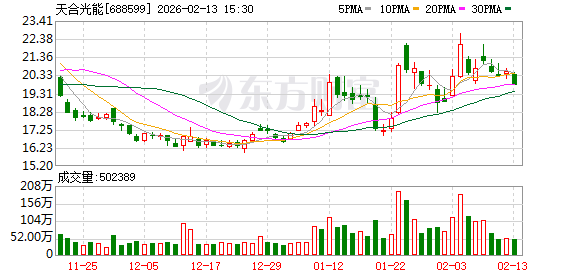
688599 遭监管警示 又是因为SpaceX
Zhong Guo Ji Jin Bao· 2026-02-13 12:09
Core Viewpoint - Trina Solar has received a regulatory warning from the Shanghai Stock Exchange due to misleading information regarding its collaboration with SpaceX, which has raised concerns among investors [2][8]. Company Summary - Trina Solar was involved in a previous partnership with Tesla Motors and its predecessor SolarCity, supplying a total of 775 MW of components from 2010 to 2018, but has not engaged in any business with SpaceX [4]. - The company clarified that it has no current orders related to "space photovoltaics" and that its main photovoltaic products are primarily used in ground-based applications [8]. - As of February 13, Trina Solar's stock closed at 19.76 CNY per share, with a total market capitalization of 46.3 billion CNY [8]. Industry Summary - The concept of "space photovoltaics" gained popularity following support from Elon Musk, leading to significant market interest and stock price increases in related companies [9]. - However, recent enthusiasm for "space photovoltaics" has waned, resulting in noticeable corrections in some photovoltaic concept stocks [9]. - The China Photovoltaic Industry Association has indicated that gallium arsenide (GaAs) batteries remain the preferred choice for commercial aerospace applications due to their high efficiency and radiation resistance, despite their high costs [9].


688599,遭监管警示,又是因为SpaceX
Zhong Guo Ji Jin Bao· 2026-02-13 11:52
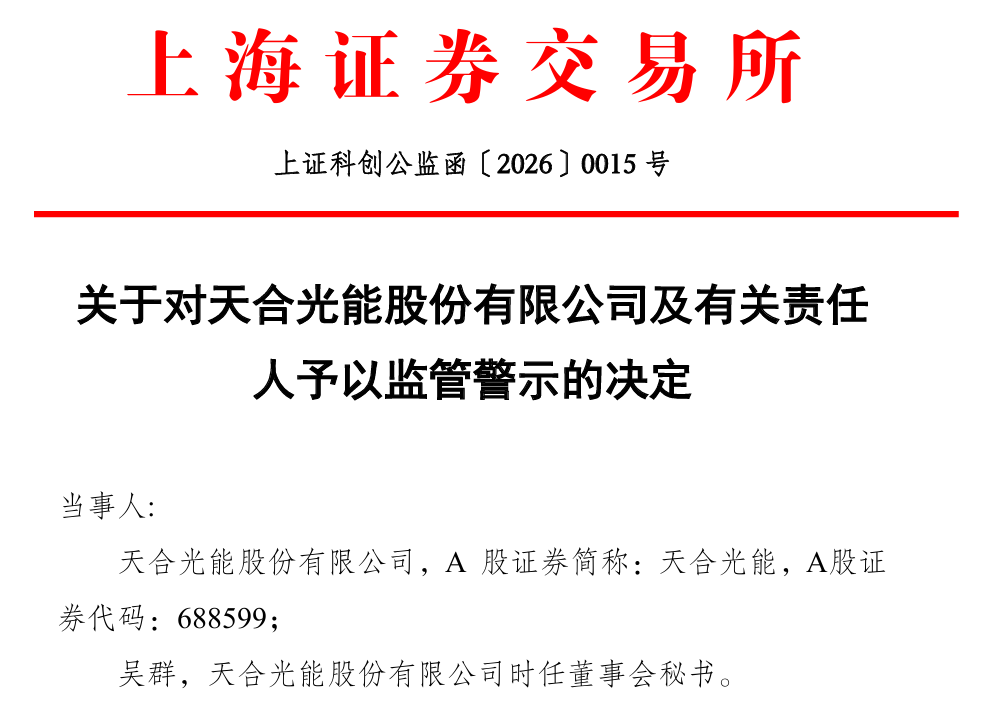
Core Viewpoint - Trina Solar has received a regulatory warning from the Shanghai Stock Exchange due to misleading information regarding its collaboration with SpaceX, which has raised concerns among investors [1]. Group 1: Regulatory Actions - On February 13, the Shanghai Stock Exchange issued a regulatory warning to Trina Solar and its Secretary of the Board for providing incomplete and inaccurate information regarding its business dealings [1]. - The company was specifically warned for its misleading response about a supposed collaboration with SpaceX, which was found to be untrue [8]. Group 2: Company Operations - Trina Solar confirmed that it had previously supplied 775 MW of components to Tesla Motors and its predecessor SolarCity between 2010 and 2018, but has not engaged in any business with SpaceX [4]. - The company stated that its photovoltaic products are primarily used in ground-mounted solar applications, and there have been no significant changes in its main product application scenarios [8]. - As of the announcement date, Trina Solar has not generated any revenue from "space photovoltaics," and its operational performance has not been affected [8]. Group 3: Market Context - The concept of "space photovoltaics" has gained popularity in the market since January, particularly following support from Elon Musk, leading to a surge in related stocks [9]. - However, the enthusiasm for "space photovoltaics" has started to wane, with some solar concept stocks experiencing noticeable corrections [9]. - The regulatory scrutiny is increasing for companies that have been speculating on market trends without substantial backing, as seen with Double Good Energy, which also received a warning for misleading statements regarding its relationship with SpaceX [9].

天合光能及董秘被上交所予以监管警示
Zhong Guo Ji Jin Bao· 2026-02-13 11:51
Core Viewpoint - Trina Solar has received a regulatory warning from the Shanghai Stock Exchange due to misleading information regarding its collaboration with SpaceX, which was inaccurately communicated to investors [2][9]. Group 1: Regulatory Actions - On February 13, the Shanghai Stock Exchange issued a regulatory warning to Trina Solar and its Secretary of the Board for providing misleading information about its relationship with SpaceX [2]. - The company was found to have inaccurately stated its collaboration with SpaceX, leading to a warning for the Secretary of the Board, Wu Qun, and a requirement to submit a rectification report within one month [9]. Group 2: Company Operations and Financials - Trina Solar clarified that it had previously supplied 775 MW of components to Tesla Motors and its predecessor SolarCity between 2010 and 2018, but has not engaged in any business with SpaceX [5]. - As of February 13, Trina Solar's stock closed at 19.76 CNY per share, with a total market capitalization of 46.3 billion CNY [9]. - The company primarily focuses on photovoltaic products for ground applications, with no significant changes in its main product application scenarios [9]. Group 3: Market Context - The concept of "space photovoltaics" gained popularity following support from Elon Musk, leading to a surge in related stocks, although enthusiasm has since waned, resulting in noticeable corrections in some solar concept stocks [12]. - The China Photovoltaic Industry Association indicated that gallium arsenide (GaAs) batteries remain the mainstream choice for commercial aerospace and space stations due to their high efficiency and reliability, despite their high costs [12].

上交所对天合光能股份有限公司及有关责任人予以监管警示
Jin Rong Jie· 2026-02-13 10:00
Core Viewpoint - Trina Solar Limited has not engaged in any collaboration with SpaceX, contrary to statements made on the Shanghai Stock Exchange Interactive Platform, leading to regulatory warnings for the company's former board secretary [1] Group 1 - The Shanghai Stock Exchange announced that Trina Solar Limited has no actual cooperation with SpaceX [1] - The company's responses on the interactive platform were found to be significantly misleading regarding the facts [1] - Regulatory warnings were issued to Wu Qun, the former board secretary of Trina Solar Limited, due to the violations and circumstances surrounding the misleading information [1]
安泰科:本周市场观望为主 硅片价格持稳运行
智通财经网· 2026-02-13 01:55
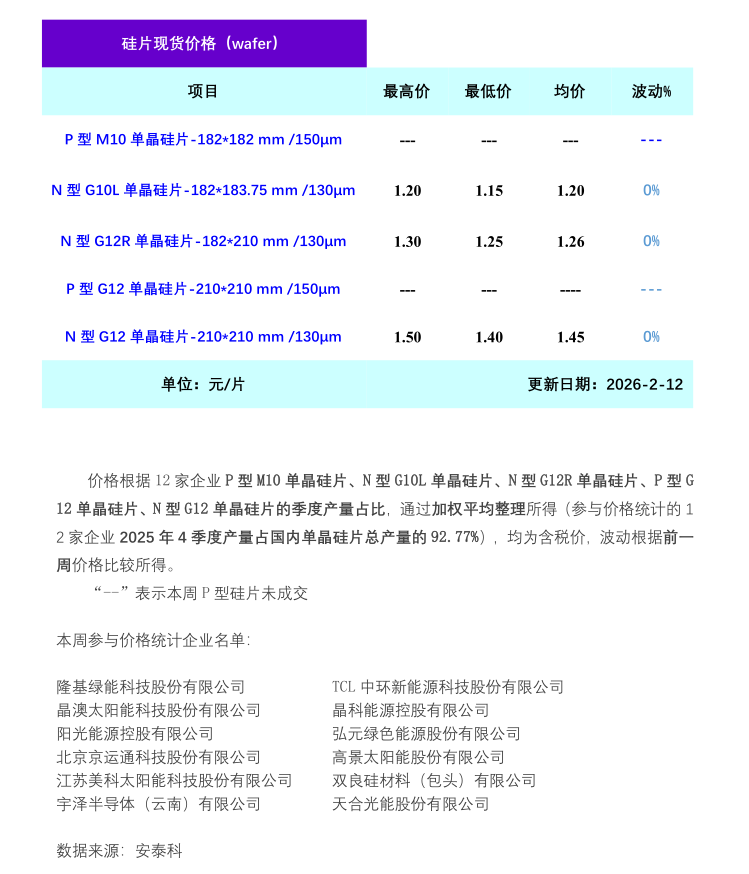
Core Viewpoint - The silicon wafer prices remain stable this week, with no significant changes observed in the market due to weak demand and pre-holiday purchasing behavior [1][2]. Price Summary - N-type G10L silicon wafer (182*183.75mm/130μm) average transaction price is 1.20 CNY per piece, N-type G12R silicon wafer (182*210mm/130μm) is 1.26 CNY per piece, and N-type G12 silicon wafer (210*210mm/130μm) is 1.45 CNY per piece, all unchanged from last week [1][3]. - The mainstream price for battery cells is between 0.41-0.45 CNY/W, and for modules, it is between 0.71-0.75 CNY/W, also remaining stable compared to the previous week [1]. Market Activity - The silicon wafer market has seen general transaction activity, with companies halting purchasing orders ahead of the holiday, leading to minimal transactions [1]. - The overall operating rate in the industry has slightly decreased, with leading companies operating at 46% and 45%, while integrated companies are at 50%-60%, and other companies range from 50%-70% [1]. Future Outlook - In the short term, the silicon wafer market is expected to remain in a stalemate between upstream price support and downstream price pressure, with prices likely to stabilize [2]. - After the Spring Festival holiday, as terminal installation projects resume, there is potential for a slight market recovery driven by improved downstream demand for silicon wafers [2].



光伏行业"反内卷"成效进一步显现
Zheng Quan Ri Bao· 2026-02-12 09:29
Core Viewpoint - The photovoltaic industry is experiencing a significant cost gradient differentiation due to fluctuations in silver prices and technological upgrades, leading to a visible "anti-involution" effect within the industry [1]. Cost Pressure - The global silver investment demand is expected to remain strong through 2026, supported by geopolitical tensions and U.S. policy uncertainties, with silver prices having risen by 11% this year after surpassing $100 per ounce for the first time in January [2]. - Despite high prices leading to a projected 17% reduction in global jewelry and silverware demand, industrial demand remains resilient [2]. - A supply shortage of approximately 67 million ounces is anticipated in the global silver market by 2026, marking the sixth consecutive year of deficit, which is expected to keep silver prices strong [2]. - The photovoltaic sector, as a major consumer of silver, will continue to face cost pressures due to high silver prices, accelerating the development of silver paste substitution technologies among leading companies [2][3]. Technological Breakthroughs - Leading companies are rapidly advancing silver paste substitution technologies, with some planning large-scale production of alternative materials in the near future [4]. - Longi Green Energy has announced plans to start large-scale production of non-silver solutions, which could further reduce component costs [4]. - Other major players like JinkoSolar and Aiko are also actively pursuing silver paste alternatives, with significant collaborations aimed at industrializing low-silver technologies by 2026 [4][5]. Industry Restructuring - The shift towards high-efficiency and reliable components is expected to create a competitive landscape where companies with technological advantages can command price premiums, while less efficient capacities face dual pressures from price and demand declines [5][6]. - The Chinese photovoltaic industry is projected to see a significant change in 2026, with new installations expected to range between 180GW and 240GW, following a record high of 315GW in 2025 [5][6]. - The core theme of the industry's "anti-involution" in 2026 will be driven by upgraded end-user demand, pushing manufacturers towards high-quality development through technological iterations and improved market mechanisms [6].

国内光伏组件报价大涨
2 1 Shi Ji Jing Ji Bao Dao· 2026-02-12 07:05
Group 1 - The core point of the article is the significant increase in solar module prices in China, with recent bidding results showing prices exceeding 1 yuan/W for the first time in years [1] - The bidding for Huadian Group's 8GW solar module procurement included two segments: 6GW of N-type high-efficiency modules at an average price of 0.8831 yuan/W and 2GW of N-type conventional modules at an average price of 0.8438 yuan/W [1] - Longi Green Energy reported that high-power (670W) module prices have surpassed 1 yuan/W, indicating a broader trend of rising component prices in the market [1][2] Group 2 - Aiko Solar indicated that their domestic module prices are nearing 0.9 yuan/W, while overseas prices exceed 1 yuan/W, reflecting the overall price increase in the industry [2] - Several companies noted that the recent rise in silver prices is a major factor driving the increase in module prices [3] - According to the China Photovoltaic Industry Association, the average all-in cost of mainstream photovoltaic products varies with silver prices, with costs at 0.783 yuan/W, 0.824 yuan/W, and 0.866 yuan/W at silver prices of 15,000 yuan/kg, 20,000 yuan/kg, and 25,000 yuan/kg respectively [3]
央企光伏组件集采再现1元/W报价 多家公司回应涨价
2 1 Shi Ji Jing Ji Bao Dao· 2026-02-12 06:36
Group 1 - The core point of the news is the significant increase in the prices of photovoltaic (PV) components in China, with recent bidding results showing prices exceeding 1 yuan/W for the first time in years [1][2] - China Huadian Group's recent tender for 8GW of PV components included two segments: 6GW of N-type high-efficiency components (645W) and 2GW of N-type conventional components (620W) [1] - The bidding results revealed that 25 companies participated in the first segment with prices ranging from 0.78 to 1.018 yuan/W, averaging 0.8831 yuan/W, while 31 companies participated in the second segment with prices from 0.76 to 0.923 yuan/W, averaging 0.8438 yuan/W [1] Group 2 - Longi Green Energy reported a noticeable increase in component prices, with high-power (670W) components now exceeding 1 yuan/W [1] - Trina Solar has raised its distributed PV component prices three times this year, with current prices for mid-size and large-size components ranging from 0.88 to 0.92+ yuan/W, and anti-glare components priced at 0.95 to 0.99+ yuan/W [1] - Aiko Solar indicated that domestic component prices are nearing 0.9 yuan/W, while overseas prices exceed 1 yuan/W [2] Group 3 - The increase in component prices is attributed to the rising silver prices, which have been identified as a key factor driving the current price surge [2] - The China Photovoltaic Industry Association's report on the cost analysis of mainstream PV products indicates that the average all-in cost for the TOPCon210R product varies significantly with silver prices, ranging from 0.783 yuan/W to 0.866 yuan/W depending on the silver price per kilogram [2]
或终止项目或剥离资产 部分A股"追光者"止损
Shang Hai Zheng Quan Bao· 2026-02-12 05:51
Core Viewpoint - The photovoltaic industry is transitioning from oversupply to a phase of accelerated capacity clearance, with expectations of a more intense market correction in 2026 compared to 2025 due to weakening demand forecasts [1][4]. Group 1: Company Actions - Several photovoltaic companies, including Mingguan New Materials and Trina Solar, have announced project terminations or fund reallocations to more promising areas due to declining profitability in the photovoltaic packaging materials sector [2]. - Mingguan New Materials terminated its investment in a solar backplane production project, initially planned with a total investment of 5 billion yuan, citing industry competition and rising operational costs as reasons for the decision [2]. - Trina Solar plans to reduce funding for its original project and redirect the remaining funds to a new distributed smart photovoltaic power station project, which is expected to contribute a net profit of 94.91 million yuan annually [2]. Group 2: Production Halts - Some companies, such as Oujing Technology and Tianyi New Materials, have suspended production due to decreased demand from downstream customers, with production utilization rates as low as 14.66% for certain subsidiaries [3]. - *ST Green Kang, a company that crossed into the photovoltaic sector from veterinary medicine, has completely exited the photovoltaic industry by selling all related assets and liabilities to alleviate financial pressure [3]. Group 3: Supply and Demand Dynamics - The photovoltaic industry is facing significant overcapacity, with analysts indicating that the supply-demand imbalance is worsening, leading to accelerated industry consolidation [4][5]. - The China Photovoltaic Industry Association projects that the new photovoltaic installation capacity in China for 2026 will be between 180 GW and 240 GW, a decrease of 24% to 43% compared to 2025's 315.07 GW [4]. - Globally, the new photovoltaic installation capacity is expected to decline slightly in 2026, with estimates ranging from 500 GW to 667 GW, down from 580 GW in 2025 [5]. Group 4: Future Outlook and Strategies - Despite the high levels of existing capacity, the industry may find a path to recovery through necessary market corrections, which could lead to a return to profitability and normal investment cycles [6]. - Companies are encouraged to explore diversification strategies, such as integrating photovoltaic technology with energy storage and hydrogen energy, to mitigate risks associated with reliance on a single business line [8]. - Trina Solar has set ambitious performance targets, aiming for a net profit of no less than 200 million yuan in 2026, reflecting confidence in recovering profitability and growth in related sectors [8].

或终止项目或剥离资产 部分A股“追光者”止损
Shang Hai Zheng Quan Bao· 2026-02-11 17:57
Core Viewpoint - The photovoltaic industry is transitioning from oversupply to a phase of accelerated capacity clearance, with expectations of a more intense market correction in 2026 compared to 2025 due to weakening demand forecasts [1][4]. Group 1: Company Actions - Several photovoltaic companies, including Mingguan New Materials and Trina Solar, have announced project terminations or fund reallocations to more promising areas due to declining profitability in the industry [2]. - Mingguan New Materials terminated its investment in a solar backplane production project, initially planned with a total investment of 5 billion yuan, citing industry competition and rising operational costs as reasons [2]. - Trina Solar plans to reduce funding for its original project and redirect remaining funds to a new distributed smart photovoltaic power station project, which is expected to contribute a net profit of 94.91 million yuan annually [2]. Group 2: Production Adjustments - Some companies, such as Oujing Technology and Tianyi New Materials, have suspended production due to decreased demand from downstream customers, with utilization rates as low as 14.66% for certain subsidiaries [3]. - Cross-industry companies like *ST Lvkang have completely exited the photovoltaic sector to alleviate financial pressures by selling all assets related to photovoltaic film business [3]. Group 3: Supply and Demand Dynamics - The photovoltaic industry is facing significant excess capacity, with analysts noting that the slowdown in short-term demand exacerbates supply chain pressures [4]. - The China Photovoltaic Industry Association projects a decrease in new photovoltaic installations in 2026, estimating a range of 180 GW to 240 GW, down from 315.07 GW in 2025, indicating a decline of 24% to 43% [4]. Group 4: Future Market Outlook - Global photovoltaic installation growth is also expected to slow, with projections for 2026 ranging from 500 GW to 667 GW, compared to 580 GW in 2025 [5]. - Analysts predict that the era of high growth in the photovoltaic sector may be over, with annual growth rates potentially stabilizing at around 3% after 2027 [5]. Group 5: Industry Resilience and New Opportunities - The competitive environment has fostered resilience and adaptability among Chinese companies, prompting them to seek new growth avenues beyond traditional photovoltaic operations [7]. - Companies are focusing on cost control and efficiency improvements to maintain competitiveness, while also exploring diversification into areas like energy storage and new photovoltaic applications [8][9]. - Trina Solar has set ambitious profit targets for 2026, reflecting confidence in recovering profitability and expanding into energy solutions [8].