J.S. Machine(000821)

Search documents
2026年度光伏设备行业策略报告:光伏设备商基本面筑底,看好太空算力应用场景打开&海外地面需求增长
Soochow Securities· 2026-02-24 06:05
Investment Rating - The report maintains a positive outlook on the photovoltaic equipment industry, indicating a recovery and growth trajectory for 2026, driven by space computing applications and increasing overseas ground demand. Core Insights - The photovoltaic equipment sector is characterized by both growth and cyclical attributes, with supply, demand, and technological factors resonating together [2]. - The industry is expected to enter a recovery phase in 2026, following a significant adjustment in 2025, where leading equipment manufacturers have strengthened cash flow management and reduced operational risks [5]. - The emergence of space computing applications is anticipated to expand the long-term growth potential of the photovoltaic sector, transitioning from ground energy to orbital energy systems [5]. - Overseas demand, particularly from the U.S. and the Middle East, is projected to be a significant source of incremental growth in 2026, with U.S. solar installations remaining robust and local manufacturing policies enhancing supply chain security [5]. - A new round of technological iterations is seen as a key variable for capacity reset amid supply-demand imbalances, with advancements in HJT technology expected to drive structural expansion [5]. Summary by Sections Section 1: 2025 Industry Fundamentals and 2026 Outlook - The fundamentals of leading photovoltaic equipment manufacturers are expected to bottom out in 2025, with a positive outlook for 2026 driven by recovery in equipment orders [5]. - The report highlights the importance of cash flow management and risk control among leading manufacturers, with adjustments in payment models to mitigate risks during industry downturns [9][10]. Section 2: Space Computing Applications - The report discusses the significant reduction in launch costs due to advancements in reusable rocket technology, which is expected to facilitate the deployment of space data centers powered by photovoltaic energy [38]. - The U.S. and China are leading in the planning and deployment of space computing capabilities, with ambitious goals for satellite constellations and data centers [41][42]. Section 3: Overseas Ground Demand - The U.S. market is highlighted as a key area for growth, with local manufacturing policies and high installation rates driving demand for photovoltaic equipment [5]. - The report notes that Middle Eastern countries are also increasing their solar installation plans, providing further opportunities for growth [5]. Section 4: Domestic Policy Changes and Technological Iteration - The report emphasizes the need to monitor domestic policy changes and the ongoing technological advancements within the industry, which are crucial for maintaining competitiveness [5]. Section 5: Investment Recommendations - The report recommends focusing on leading companies in the HJT technology space, such as Maiwei Co., Jinsheng Electric, and Aotwei, as well as those specializing in automation and thin silicon wafer cutting equipment [5].





2026年度光伏设备行业策略报告:光伏设备商基本面筑底,看好太空算力应用场景打开、海外地面需求增长-20260224
Soochow Securities· 2026-02-24 03:05
Group 1 - The core view of the report indicates that the photovoltaic equipment sector is expected to recover in 2026, driven by the application of space computing power and growth in overseas ground demand [5][8] - The report highlights that the supply and demand dynamics, along with technological factors, give photovoltaic equipment both growth and cyclical attributes [2] - The report emphasizes that the leading equipment manufacturers have strengthened cash flow management through adjusted payment models, which enhances their risk control capabilities [9][10] Group 2 - The application of space computing power is accelerating, transitioning photovoltaic energy from terrestrial to orbital energy systems, thus opening up long-term growth potential [5][38] - The report notes that overseas ground demand, particularly in the U.S. and the Middle East, is expected to be a significant source of incremental growth in 2026 [5][41] - The report discusses the importance of domestic policy changes and the continuous iteration of new technologies in the photovoltaic equipment industry [5][34] Group 3 - The report suggests that the photovoltaic equipment sector is entering a new structural expansion window driven by technological upgrades, as the industry faces a supply-demand imbalance [5][56] - Investment recommendations include focusing on leading companies in HJT technology, low-oxygen monocrystalline furnaces, and automation equipment [5][34]
未知机构:招商电新开工大吉关注叠瓦组件设备叠瓦粘胶太空光伏-20260224
未知机构· 2026-02-24 02:45
【招商电新】开工大吉 关注叠瓦组件设备、叠瓦粘胶 太空光伏电池片极致减重与柔性的前提下,超薄硅片很脆弱,如采用串焊极易造成硅片碎裂,且硅与焊带膨胀系 数差异大,在轨极端温变情况下,脱焊概率大。 使用叠瓦结构,硅片柔性连接,焊点数量少,机械应力有效分散,隐裂、破碎风险小。 除此之外,叠瓦结构能够实现电池片零间距,相同太阳翼面积下,有效发电面积提升。 【招商电新】开工大吉 关注叠瓦组件设备、叠瓦粘胶 太空光伏电池片极致减重与柔性的前提下,超薄硅片很脆弱,如采用串焊极易造成硅片碎裂,且硅与焊带膨胀系 数差异大,在轨极端温变情况下,脱焊概率大。 使用叠瓦结构,硅片柔性连接,焊点数量少,机械应力有效分散,隐裂、破碎风险小。 建议关注: ➡ST京机:全资子公司晟成光伏组件整线设备领先,在北美光伏组件设备市占率超50%,并已实质供货北美头部 企业 公司叠瓦设备很早就有储备,业界反馈,公司是北美知名公司地面叠瓦整线的独供! 后续北美地面/太空光伏如果普遍采用叠瓦结构,有望带来较大弹性(价值量为国内2倍,盈利能力5倍以上) ➡帝科股份:光伏银浆领先企业,研发见长;公司与控股子公司索特(原杜邦浆料)有高低温银浆全球核心专利 优势 ...




2025年光伏设备行业发展现状分析 行业规模突破1300亿元【组图】
Qian Zhan Wang· 2026-02-22 04:07
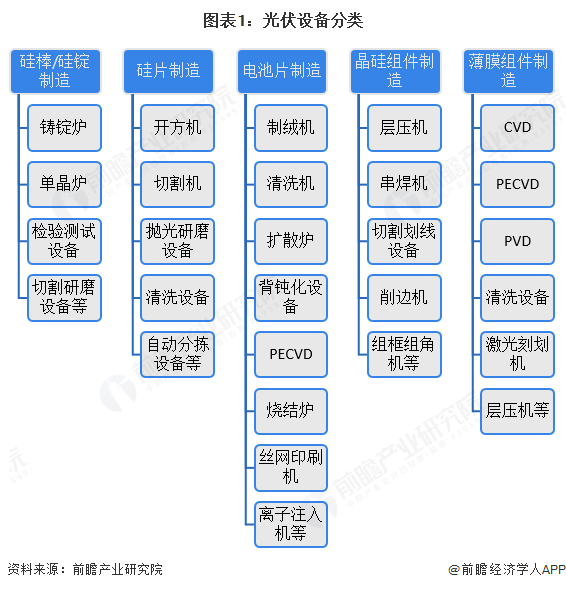
转自:前瞻产业研究院 以下数据及分析来自于前瞻产业研究院光伏设备行业研究小组发布的《中国光伏设备行业市场前瞻与投 资战略规划分析报告》。 行业主要上市公司:捷佳伟创(300724)、晶盛机电(300316)、迈为股份(300751)、京山轻机(000821)、连 城数控(920368)、北方华创(002371)、奥特维(688516) 金辰股份(603396)、帝尔激光(300776)、罗博特科 (300757)、高测股份(688556)、双良节能(600481) 先导智能(300450)、微导纳米(688147)、大族激光 (002008)、博硕光电(831019)、拉普拉斯(688726)、宇晶股份(002943)、京运通(601908)等 本文核心数据:光伏设备行业企业布局情况;中国光伏设备行业发展历程;中国光伏设备行业规模 光伏设备种类繁多 参考中国光伏行业协会的资料,光伏设备指光伏制造企业用于生产原料、电池及电池组件、零部件等产 品中使用的,并在反复使用中基本保持原有实物形态和功能的机器设备。 光伏设备的种类较多,主要包括硅棒/硅锭制造设备、硅片制造设备、电池片制造设备、晶体硅电池组 件制造设备、薄 ...



机械行业2026年度策略报告:与时代共舞,拥抱“科技+出海”-20260213


CMS· 2026-02-13 08:04
Core Viewpoints - The mechanical industry is expected to embrace "technology + going global" as its dual main lines in 2026, focusing on high elasticity growth opportunities and performance certainty from overseas expansion [13][9][7] 2025 Review Market Performance - In 2025, the mechanical sector achieved a 41% increase, significantly outperforming the CSI 300 index, which rose by 18%, ranking fifth among A-share sub-industries [6][16] - The sub-sectors that performed well included PCB equipment (+252%), 3C equipment (+129%), controllable nuclear fusion (+119%), data centers (+112%), and humanoid robots (+85%) [20][6] Demand Side - Domestic demand showed signs of bottoming out, with a marginal improvement towards the end of 2025, while external demand began to recover positively [31][35] - The manufacturing PMI in December 2025 rebounded to 50.1, indicating a return to expansion territory, driven by large enterprises and high-tech manufacturing [32][35] Cost Side - The cost structure showed a continuous improvement trend, with PPI declining by 2.6% year-on-year in 2025, reflecting insufficient industrial demand [31][33] 2026 Outlook Macro Perspective - The macro narrative for the next five years is centered around "AI commercialization + global re-industrialization," with expectations of a cyclical recovery driven by proactive fiscal policies [6][7] Mid-level Perspective - Technology - The technology sector is expected to see explosive growth, with key areas including data centers, PCB equipment, semiconductor equipment, humanoid robots, and commercial aerospace [7][9] Mid-level Perspective - Going Global - The overseas production capacity is anticipated to enter a release phase in 2026, with significant revenue and profit growth expected for companies in the machinery and equipment sectors [7][8] Investment Recommendations - Investment strategies should focus on high-certainty directions with strong industry trends and competitive advantages, prioritizing stock selection based on industry trends, competitive positioning, and valuation [7][8] - Long-term investments should consider companies with platform capabilities that offer sustainable value [7][8]
未知机构:天风电新重视TS的叠瓦技术下一个天地共振的方向0212-20260213
未知机构· 2026-02-13 02:00
Summary of Key Points from the Conference Call Industry and Company Involvement - The discussion primarily revolves around the solar energy industry, specifically focusing on the advancements in solar module manufacturing techniques, particularly the **Tiling and Stacking (叠瓦)** technology being adopted by companies like **Tesla** and **聚和材料** [1][3][5]. Core Insights and Arguments - **Tesla's Manufacturing Resumption**: Tesla is set to restart its component manufacturing at its Buffalo, New York facility, utilizing the Tiling technology for its solar modules [1]. - **Potential Issues with Space Applications**: During a recent materials exchange meeting, it was noted that components welded in space may lead to micro-cracks, suggesting a possible shift towards Tiling methods to mitigate these risks [2][4]. - **Innovations in Manufacturing Processes**: The Tiling process introduces several new manufacturing steps compared to traditional lines, including: 1. **Slicing and Splitting**: The battery cells are divided into six segments, increasing the slicing and splitting processes [5]. 2. **Welding Method Changes**: A new welding technique using conductive glue is implemented to connect the split battery cells, which adds to the coating and stacking processes [5]. 3. **Layout Adjustments**: The new processes necessitate changes in the layout and busbar welding techniques to accommodate the modified battery cell arrangement [5]. Investment Recommendations - **Inflation Logic in Component Equipment**: The Tiling technology is expected to create inflationary pressures in component equipment, leading to investment recommendations for: - **ST京机**: A supplier of module lamination equipment and automated production lines, which stands to benefit directly from the inflation in component lines [5]. - **奥特维**: This company faces higher requirements for the Tiling components compared to conventional ones, with an anticipated increase in value [5]. - **Material Suppliers**: The primary growth in materials is expected to come from conductive glue, with recommendations for: - **德邦科技**: Recognized as a leader in Tiling conductive glue, supplying major companies like SunPower, 通威, and 阿特斯 [6]. - **聚和材料**: Currently testing silver paste and conductive glue samples with North American clients [7]. Additional Important Content - The emphasis on Tiling technology indicates a significant shift in the solar module manufacturing landscape, with potential implications for both production efficiency and product reliability in various applications, including space [2][4].
未知机构:招商电新关注叠瓦在太空光伏应用1太空光伏电池片极致减重与柔-20260213
未知机构· 2026-02-13 01:55
Summary of Conference Call Notes Industry Overview - The focus is on the application of **tandem solar cells** in **space photovoltaic** systems, highlighting the challenges and advancements in technology related to lightweight and flexible solar panels [1][2]. Key Points and Arguments 1. **Challenges with Thin Silicon Cells**: - Space photovoltaic cells require extreme weight reduction and flexibility, making ultra-thin silicon cells very fragile. The use of string welding can lead to mechanical stress and high-temperature welding issues, increasing the risk of silicon cell breakage and detachment under extreme temperature variations in space [1][2]. 2. **Advantages of Tandem Structure**: - The tandem structure allows for flexible connections of silicon cells, reducing the number of solder joints. This effectively disperses mechanical stress, minimizing the risks of hidden cracks and breakage [1][2]. 3. **Increased Effective Power Generation**: - The tandem structure can achieve zero spacing between solar cells, which enhances the effective power generation area for the same solar wing size [3]. 4. **Historical Context**: - The application of tandem structures in space photovoltaics is well-established, with the "Shijian-1" satellite launched in 1971 being an early example of a solar panel using a "comb-type" structure designed in China [4]. 5. **Industry Feedback**: - Leading North American renewable energy companies are currently using tandem solutions for ground photovoltaic modules. The production line for tandem components is reported to be more than twice the cost of conventional string welding lines, indicating significant market interest [4]. Company Highlights 1. **ST Jingji**: - The wholly-owned subsidiary, Shengcheng Photovoltaics, possesses competitive manufacturing technology for tandem components. It is noted for being the sole supplier of ground tandem production lines to a well-known North American company and has also supplied coating equipment to overseas space perovskite enterprises. The company holds a significant market share in North America, estimated to exceed 50% [4]. 2. **Dike Co., Ltd.**: - A leading company in photovoltaic silver paste, known for its R&D capabilities. It has nearly 100% market share in North America and has been promoting tandem adhesive products since 2019, leveraging its core patent advantages in conductive paste solutions [5]. 3. **Debang Technology**: - A core supplier of tandem conductive adhesives, with products widely used in leading photovoltaic companies such as Tongwei, Canadian Solar, and major North American renewable energy firms, holding a strong competitive position in the market [5]. 4. **Juhe Materials**: - A leading company in photovoltaic silver paste, developing copper paste products suitable for photovoltaic cells, currently undergoing testing with major clients and expected to benefit from the adoption of high/pure copper paste materials [5]. 5. **Aotewei**: - A leading company in photovoltaic component equipment, with key products including string welding machines and silicon wafer sorting machines. The company has also made advancements in tandem equipment, achieving high precision and yield rates [6]. Additional Important Insights - The integration of semiconductor material assets by companies is seen as a solution to domestic supply chain issues, addressing critical bottlenecks in the industry [5][6].
光伏系列报告:叠瓦方案有望在太空光伏得到应用
CMS· 2026-02-12 14:31
Investment Rating - The report maintains a strong recommendation for companies such as 帝科股份 (Dike Co., Ltd.) and 聚和材料 (Juhua Materials) [3][4] - ST 京机 (ST Jingji) and 德邦科技 (Debang Technology) are not rated [3] Core Insights - The report highlights the potential application of the tile structure in space photovoltaic systems, which can reduce the risk of damage to solar cells and improve power output per unit area [1][7] - The use of tile structures is expected to create new demand scenarios for conductive adhesives and related equipment, benefiting companies involved in these technologies [1][7] Industry Overview - The industry consists of 308 listed companies with a total market capitalization of 792.4 billion and a circulating market value of 693.8 billion [4] - The industry has shown strong performance with absolute returns of 63.1% over 12 months [6] Key Companies - **ST 京机 (ST Jingji)**: A leader in automated manufacturing technology for photovoltaic modules, with a significant market share and established partnerships in tile technology [8] - **帝科股份 (Dike Co., Ltd.)**: A leading company in photovoltaic silver paste, with a strong market position and potential for growth in space photovoltaic applications [9] - **德邦科技 (Debang Technology)**: A core supplier of conductive adhesives for tile photovoltaic cells, with a strong competitive advantage [10] - **聚和材料 (Juhua Materials)**: A leading company in photovoltaic silver paste, developing copper paste products and addressing domestic supply chain issues [11] - **奥特维 (Aotewi)**: A prominent manufacturer of photovoltaic equipment, with deep reserves in tile technology and a comprehensive solution for vacuum process equipment [12]
东方证券:海内外同步催化驱动太空光伏景气度向上 优选高市占率设备厂及核心材料企业
智通财经网· 2026-02-09 03:32
Group 1 - The core viewpoint is that the space photovoltaic industry has significant potential, driven by both domestic and international developments, particularly with SpaceX's plans for a solar energy satellite network and China's increasing satellite launch capabilities [1][2] - The global market for space photovoltaics could reach 8GW annually, with a potential market size of 8 trillion yuan, even if the cost of components decreases significantly [2] - China's photovoltaic industry is strong, with leading manufacturers in equipment and materials, such as Maiwei and Aotwei, which are expected to gain incremental orders due to the expansion of overseas leaders [3] Group 2 - The report suggests focusing on key photovoltaic equipment manufacturers like Aotwei, Maiwei, and others that are likely to benefit from the expansion of overseas leaders [3] - It also highlights core material manufacturers like Dongfang Risen and others that have established deep relationships with overseas clients, which will drive profit growth [3]

钙钛矿:迎来GW级量产
GOLDEN SUN SECURITIES· 2026-02-06 13:26
Investment Rating - The report maintains a rating of "Increase" for the industry [4] Core Insights - Perovskite solar cells are entering the era of GW-level mass production, with leading companies like JinkoSolar and LONGi Green Energy accelerating capacity release [2][35] - The efficiency of perovskite cells is rapidly improving, with laboratory efficiencies reaching 27.3% for single-junction cells and 35.0% for perovskite-silicon tandem cells, significantly surpassing the maximum efficiency of silicon cells at 27.9% [15][19] - The cost competitiveness of perovskite cells is expected to improve, with unit production costs projected to drop to 1.0 RMB/W by 2026, potentially surpassing silicon cells [2][35] Summary by Sections Section 1: Perovskite as the Next Generation Photovoltaic Solution - Perovskite solar cells utilize a hybrid organic-inorganic metal halide semiconductor as the light-absorbing material, offering advantages such as high efficiency, low cost, and lightweight [8][11] Section 2: Efficiency and Stability Breakthroughs - The report highlights significant advancements in efficiency and stability, with perovskite cells achieving rapid efficiency improvements compared to silicon cells [15][18] - The industry is overcoming stability challenges through material modifications and process optimizations, with some products achieving IEC commercial standard certification [25][26] Section 3: GW-Level Production Era - The first GW-level production line for perovskite solar cells has been launched, marking the beginning of large-scale production [35] - By 2027, global production capacity is expected to exceed 5GW, with a complete supply chain being established [2][35] Section 4: Investment Recommendations - The report suggests focusing on leading companies in the perovskite supply chain, particularly those with clear capacity deployment and advancements in tandem technology, such as LONGi Green Energy and Trina Solar [3] - Equipment manufacturers with high domestic production rates and sufficient orders, like JinkoSolar and Mibet, are also recommended for investment [3]