
GoerTek(002241)

Search documents
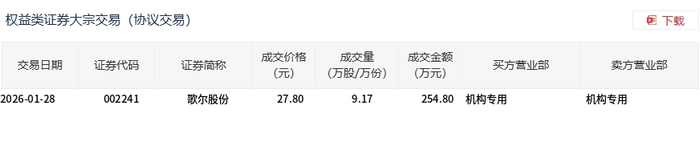
歌尔股份今日大宗交易溢价成交9.17万股,成交额254.8万元
Xin Lang Cai Jing· 2026-01-28 08:58
| 交易日期 | 证券代码 | 证券简称 | 成交价格 | 成交量 | 成交金额 | 买方营业部 | | 卖方营业部 | | --- | --- | --- | --- | --- | --- | --- | --- | --- | | | | | (元) | (万股/万份) | (万元) | | | | | 2026-01-28 | 002241 | 歌尔股份 | 27.80 | 9.17 | 254.80 机构专用 | | 机构专用 | | 1月28日,歌尔股份大宗交易成交9.17万股,成交额254.8万元,占当日总成交额的0.05%,成交价27.8 元,较市场收盘价26.97元溢价3.08%。 ...

消费电子板块1月28日跌0.84%,苏州天脉领跌,主力资金净流出37.29亿元


Zheng Xing Xing Ye Ri Bao· 2026-01-28 08:56
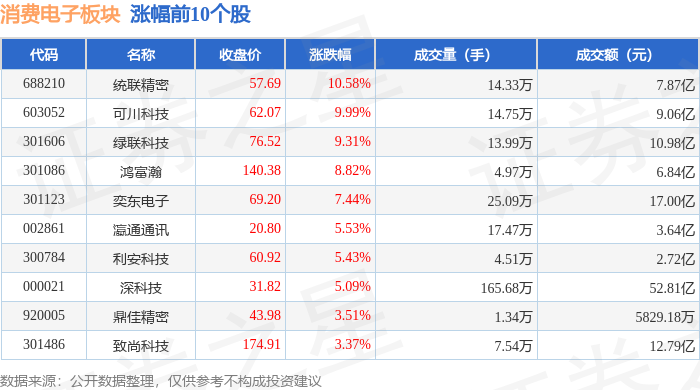
Group 1 - The consumer electronics sector experienced a decline of 0.84% on January 28, with Suzhou Tianmai leading the drop [1] - The Shanghai Composite Index closed at 4151.24, up 0.27%, while the Shenzhen Component Index closed at 14342.9, up 0.09% [1] - Notable gainers in the consumer electronics sector included Tonglian Precision, which rose by 10.58% to a closing price of 57.69, and Kechuan Technology, which increased by 9.99% to 62.07 [1] Group 2 - Suzhou Tianmai saw a significant decline of 7.92%, closing at 179.53, with a trading volume of 32,000 shares and a turnover of 590 million [2] - Other notable decliners included Beilong Precision, down 5.28% to 50.28, and ST Boda, down 4.99% to 4.19 [2] - The consumer electronics sector experienced a net outflow of 3.729 billion in main funds, while retail investors saw a net inflow of 3.309 billion [2][3] Group 3 - Major inflows were observed in stocks like Gongfu Lian, which had a net inflow of 309 million, and Yidong Electronics with a net inflow of 207 million [3] - Conversely, stocks like Xiechuang Data and Feirongda experienced significant net outflows of 109 million and 40.47 million, respectively [3] - The overall market sentiment indicated a mixed response, with retail investors showing a preference for certain stocks despite the overall sector decline [3]
遭Meta「砍单」?歌尔股份启动裁员:研发中心成「重灾区」,称要「削到筋骨」
Xin Lang Ke Ji· 2026-01-27 01:38
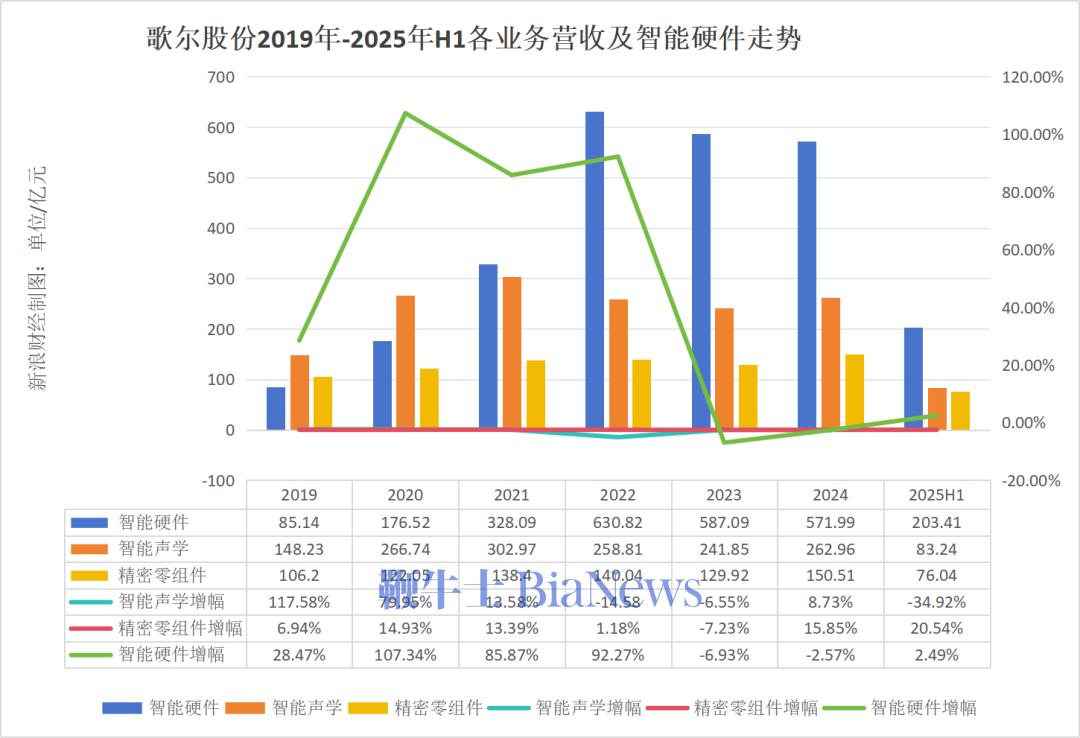
Core Viewpoint - Meta's adjustment in its metaverse business has significantly impacted its Chinese partner, GoerTek, leading to substantial financial losses and workforce reductions [1][2][4]. Group 1: Impact of Meta's Decision - Meta's decision to cut resources in its metaverse division may result in GoerTek facing losses exceeding 10 billion yuan [1][4]. - GoerTek's Alpha Labs, a core R&D center, has seen budget cuts across all departments, with layoffs expected to be between 30% and 50% in various centers [2][4]. - Employees have confirmed that the layoffs are directly related to Meta's order reductions, with some departments experiencing varying levels of impact [2][4]. Group 2: Financial Performance and Business Segments - GoerTek's main business segments include precision components, smart acoustic products, and smart hardware, with the latter accounting for 60% of overall revenue [5][7]. - The smart hardware segment, which includes VR, MR, and AR products, experienced a significant revenue growth of 107.34% in 2020, but has since seen a decline, with a drop of 6.93% in 2023 [7][8]. - The company's overseas revenue growth has also slowed down, reflecting the overall decline in the smart hardware business [8]. Group 3: R&D Investments and Market Position - Over the past five years, GoerTek has invested 24.5 billion yuan in R&D, focusing on various innovative platforms, which has led to a significant market share in MR headsets and AI smart glasses [8]. - Despite substantial investments, the changing attitudes of major tech companies like Apple and Meta towards MR and the metaverse may hinder the expected returns on these investments [8].

遭Meta“砍单”? 歌尔股份启动裁员:研发中心成“重灾区”,称要“削到筋骨” | BUG
Xin Lang Cai Jing· 2026-01-27 01:21
Core Viewpoint - Meta's adjustment of its metaverse business has significantly impacted its Chinese partner, GoerTek, leading to budget cuts and potential layoffs within the company [2][3][12]. Group 1: Impact of Meta's Actions - Meta is reportedly reducing its investment in the metaverse, resulting in the elimination of over 1,000 positions in its Reality Labs [3][12]. - GoerTek's Alpha Labs, a key R&D center, has seen all its budgets cut, with layoffs expected to range from 30% to 50% across various departments [4][5][14]. - The potential financial loss for GoerTek due to Meta's order cuts could exceed 10 billion yuan [5][14]. Group 2: GoerTek's Business Overview - GoerTek's main business segments include precision components, smart acoustic devices, and smart hardware, with the latter accounting for 60% of overall revenue [6][14]. - The smart hardware segment, which includes VR, MR, and AR products, has been the fastest-growing area, previously experiencing growth rates of over 85% from 2020 to 2022 [15][17]. - However, in 2023, the smart hardware business saw a decline of 6.93%, marking a significant downturn from previous years [8][17]. Group 3: Historical Context and Future Outlook - GoerTek has previously faced challenges due to order cuts, notably a "black swan" event in 2022 linked to a major client, resulting in losses of 2 to 2.4 billion yuan [9][17]. - The company has invested 24.5 billion yuan in R&D over the past five years, focusing on VR and AR technologies, which have yielded significant market shares [17][18]. - The shift in strategy from major tech players like Apple and Meta regarding MR and the metaverse may hinder the short-term returns on GoerTek's substantial investments in these technologies [18].
中国,造出全球80% AI眼镜
创业邦· 2026-01-26 04:09
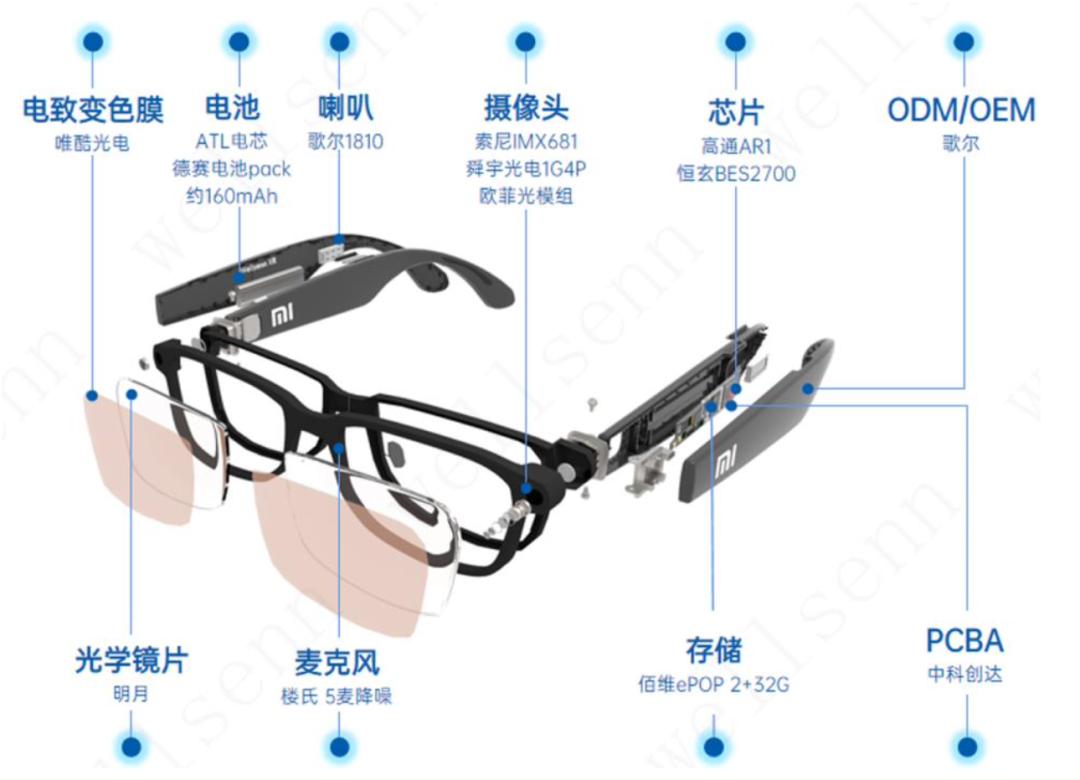
Core Insights - The article emphasizes that China has become a dominant player in the AI glasses industry, controlling over 80% of the global supply chain [5][6][26] - The rapid innovation and manufacturing capabilities in China have allowed for significant advancements in AI glasses technology, making them a key player in the global market [16][30] Industry Overview - AI glasses are viewed as the next generation of computing devices, with China leading in the supply chain and production [6][8] - Key components such as chips and optical modules are primarily produced in China, with optical modules accounting for over 40% of the cost and chips over 30% [10][13] Technological Advancements - Chinese companies have made significant breakthroughs in optical waveguide technology, which is crucial for AI glasses [11] - Companies like JBD and Zhizhi Technology have developed advanced Micro LED and optical components that are lightweight and energy-efficient [11][13] Market Dynamics - The integration of the supply chain in China has led to reduced costs for AI glasses, with prices dropping from over 10,000 yuan to around 1,999 yuan [26] - The market for AI glasses is expected to grow significantly, with predictions of a compound annual growth rate of 55.6% over the next five years [30] Competitive Landscape - Major Chinese brands are emerging in the AI glasses market, with companies like TCL, XREAL, and Rokid showcasing innovative products at international tech exhibitions [27][29] - The article highlights that Chinese manufacturers are not only producing but also innovating, moving from a role of OEM to becoming leaders in the industry [17][24]
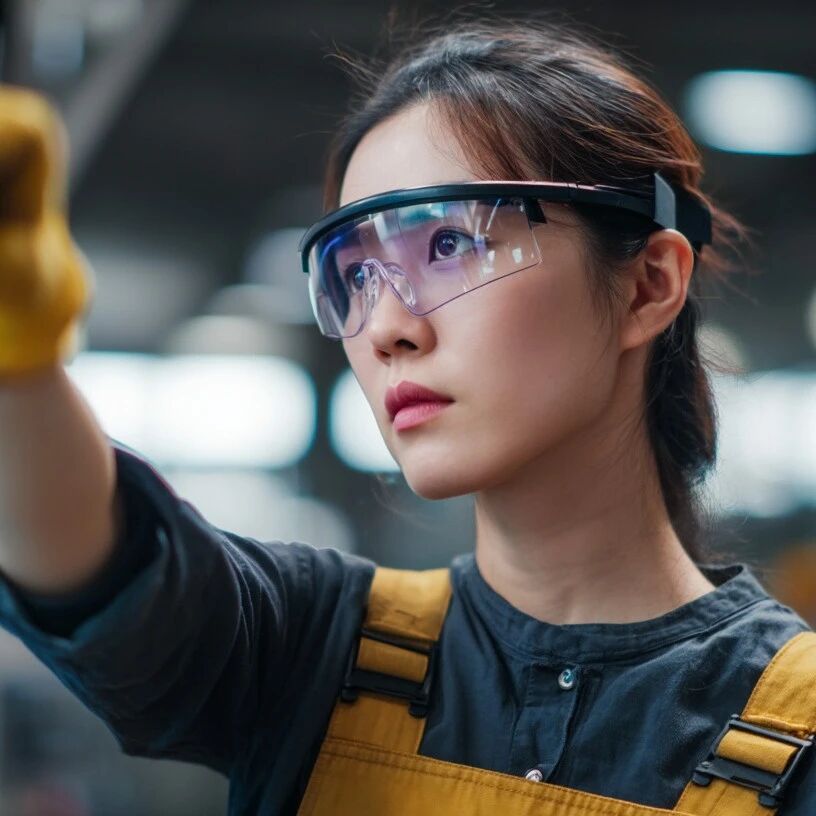
中国,造出全球80% AI眼镜
3 6 Ke· 2026-01-26 00:33
Core Insights - The article highlights China's dominance in the AI glasses supply chain, with over 80% of companies involved located in China, making it a key player in the global market [2][18] - The rapid innovation and manufacturing capabilities in China have allowed for significant cost reductions in AI glasses, with prices dropping from over 10,000 yuan to around 1,999 yuan [18] - Chinese companies have made substantial advancements in core technologies such as optical modules and chips, positioning themselves as leaders in the AI glasses industry [5][7] Industry Overview - In the Pearl River Delta, AI glasses can be prototyped in three days and launched in seven days, showcasing the efficiency of Chinese manufacturing [2] - Key components of AI glasses include chips and optical modules, which account for over 70% of the total cost, with optical modules alone comprising over 40% [5] - Companies like Zhuhai Hengxuan Technology and Fuzhou Rockchip Microelectronics are becoming core suppliers for major brands like Meta and Xiaomi, indicating a shift in the supply chain dynamics [7] Technological Advancements - Chinese firms have achieved breakthroughs in optical waveguide technology, overcoming challenges such as the "rainbow effect" in AI glasses [5] - JBD's Micro LED light engine is noted for its compact size and low power consumption, highlighting advancements in display technology [6] - The integration of precision manufacturing techniques from the smartphone industry into AI glasses production has improved quality and reduced weight [8] Market Dynamics - The global market for smart glasses is projected to see significant growth, with a forecasted shipment of 4.065 million units in the first half of 2025, a 64.2% increase year-on-year [23] - Chinese manufacturers are expected to dominate this market, with a compound annual growth rate of 55.6% over the next five years [23] - Major Chinese brands are increasingly recognized on the international stage, with companies like TCL and XREAL showcasing innovative products at global tech events [20][21] Strategic Developments - The article notes a shift from mere manufacturing to innovation, with Chinese companies now participating in product design and optimization [13][15] - The establishment of companies like JBD and Zhizhi Technology reflects a strategic focus on developing proprietary technologies to break free from foreign technology dependencies [15] - The collaboration between Chinese firms and global tech giants, such as Google's partnership with XREAL, underscores the importance of Chinese manufacturing capabilities in the tech ecosystem [8][12]
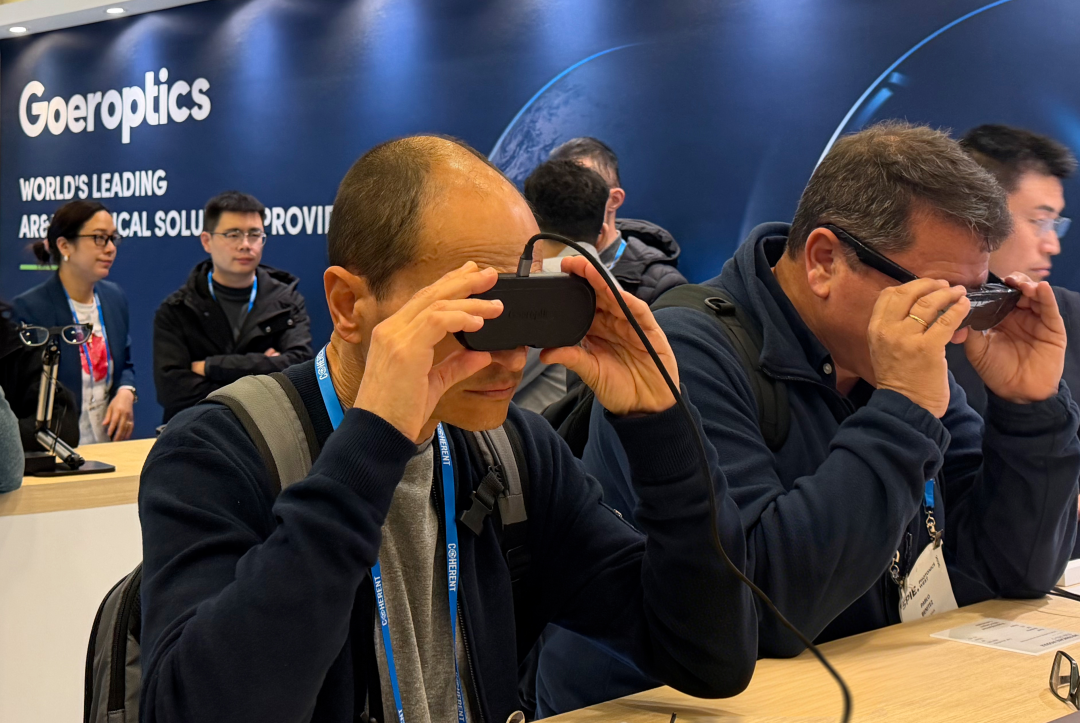
歌尔光学首发50°大视场角碳化硅光波导模组
Xin Lang Cai Jing· 2026-01-22 12:11
Core Insights - Goer Technologies showcased the F50Se AR full-color waveguide display module at the SPIE AR|VR|MR conference, achieving a 50° field of view (FOV) for ultra-thin AR glasses with superior display quality [1][2] Group 1: Product Innovations - The F50Se module utilizes high-refractive silicon carbide waveguide materials, breaking the physical limitation of traditional glass substrates which only support a 30° FOV, thus reaching an impressive 50° FOV [1][2] - Innovative grating design and dry etching processes effectively eliminate common issues in AR waveguide displays, such as ghosting and rainbow artifacts, significantly enhancing visual clarity [1][2] - The F50Se module, combined with a compact full-color LCoS optical engine, achieves over 1500 nits of brightness, providing a key optical solution for lightweight AR glasses that enhance viewing and entertainment experiences [1][2] Group 2: Additional Product Offerings - Goer Technologies also presented several core products, including the F30Se silicon etched waveguide module with a thickness of only 0.65 mm, the lightweight full-color resin waveguide module F15Pi, the F25Ge module designed for outdoor bright light and industrial applications, and the slim MR Pancake module [3][5] - The company plans to continue deepening the synergy between materials and processes to support the iterative upgrade of XR devices [3][5]

专业文章丨苹果供应链企业赴越南投资建厂指引与律师实务
Sou Hu Cai Jing· 2026-01-22 08:54
Core Viewpoint - The global tech giants, represented by Apple, are accelerating the implementation of the "China +1" strategy, which aims to create a dual-core system that is spatially dispersed and logically coordinated, rather than decoupling from Chinese manufacturing [2] Group 1: Vietnam's Industrial Landscape and Site Selection Guidance - By the end of 2025, Vietnam is expected to have taken on over 65% of global AirPods production, 20% of iPad, and Apple Watch capacity, and is gradually entering trial production for more complex products like MacBooks [2] - The merger of Bac Ninh and Bac Giang provinces has created a "super electronic industrial corridor," making it the undisputed center for electronic manufacturing in Vietnam, attracting major players like Foxconn and Luxshare [4] - The northern core region is facing land resource exhaustion and rising rental costs, while Nghe An province is emerging as a new hotspot for labor-intensive and heavy asset projects due to its abundant land and labor resources [4][8] Group 2: Supply Chain and Investment Trends - Chinese companies are shifting from simple processing to localized manufacturing and full industry chain establishment in Vietnam, requiring enhanced cross-border compliance management and local operational capabilities [3] - Site selection for Apple supply chain companies is now a precise calculation involving logistics efficiency, land costs, labor costs, and compliance costs [5] Group 3: Legal and Compliance Considerations - The new Land Law in Vietnam, effective from August 2024, fundamentally changes land use rights, impacting the security and financial attributes of investments by Chinese companies [11] - Companies must verify the payment method for land rent during negotiations and ensure that land use rights are not encumbered by other debts [12] Group 4: Environmental and Safety Regulations - New fire safety standards have significantly raised the requirements for industrial buildings, prohibiting mixed-use of production and residential functions [13] - Environmental assessments (EIA/DTM) are becoming more stringent, especially for high-pollution projects, necessitating thorough compliance checks during site selection [14] Group 5: Labor Compliance and Human Resource Management - Vietnamese labor law limits overtime, with specific caps on hours that can be worked, which poses compliance risks for companies facing fluctuating order demands [18][19] - Establishing regular labor-management dialogue mechanisms and ensuring compliance with union regulations are crucial for preventing strikes and labor disputes [20] Group 6: Tax Planning and Customs Compliance - Vietnam offers significant tax incentives for high-tech projects, including tax holidays and reduced rates, but these benefits require careful documentation and compliance [22] - Ensuring products qualify for "Vietnamese origin" is essential for avoiding U.S. trade tariffs, necessitating compliance with customs regulations [24] Group 7: Case Studies of Representative Companies - Luxshare's strategic placement of high-precision module bases in Bac Giang and labor-intensive projects in Nghe An effectively addresses labor shortages in the northern region [25] - GoerTek's restructuring to restart tax incentives demonstrates the importance of legal compliance in optimizing tax benefits [26] - Victory Technology's site selection in VSIP Bac Ninh highlights the critical role of environmental compliance in high-pollution projects [27] - Lens Technology's focus on energy security during negotiations reflects the challenges of power supply in northern Vietnam [28] Group 8: Legal Services Value - The firm provides comprehensive legal support for Chinese companies investing in Vietnam, covering all stages from due diligence to operational compliance [29] - The firm emphasizes the importance of local legal expertise to navigate the complexities of the Vietnamese market [30]




歌尔股份等在上海新设创投合伙企业
Zheng Quan Shi Bao Wang· 2026-01-22 07:03
Group 1 - A new venture capital partnership named Shanghai Tongge Phase II has been established with a capital contribution of 100 million yuan [1] - The business scope of the partnership includes venture capital, specifically limited to investments in unlisted companies [1] - The partnership is co-funded by GoerTek Inc. (stock code: 002241) among other contributors [1]
人形机器人利好,工信部加码支持!融资资金显著加仓18只概念股
Zheng Quan Shi Bao· 2026-01-21 11:00
Group 1 - The Chinese humanoid robot industry is accelerating its development, with the Ministry of Industry and Information Technology (MIIT) emphasizing ongoing support for technological innovation and ecosystem enhancement [2][3] - By 2025, the number of domestic humanoid robot manufacturers is expected to exceed 140, with over 330 humanoid robot products launched [2] - China is projected to lead the global market in humanoid robot shipments by 2025, with an estimated 5,168 units shipped, capturing 39% of the global market share [3] Group 2 - The number of patents related to humanoid robots in China has surpassed 2,000, with 1,620 applications filed since 2021, marking a 30.7% year-on-year increase in 2025 [3] - The humanoid robot sector is anticipated to unlock a trillion-yuan market across various applications, including industrial, medical, commercial, and domestic settings [4] - Companies like Ningde Times and Northern Rare Earth are significantly investing in humanoid robotics, with Ningde Times establishing a self-research team focused on robotic arms and AGVs [5] Group 3 - Shenghong Technology expects a net profit growth of 260.35% to 295% in 2025, having established partnerships with leading companies in the humanoid robot sector [6] - Jinli Permanent Magnet anticipates a net profit increase of 127% to 161% in 2025, with products for humanoid robots already in small-scale delivery [6]




