
RSPC(002493)

Search documents
基础化工行业专题:涤纶长丝减产推进,“金三银四”值得期待
Guotou Securities· 2026-01-14 03:05
Investment Rating - The industry investment rating is maintained at "Outperform the Market-A" [5] Core Viewpoints - The report highlights that major polyester filament manufacturers have initiated a new round of production cuts since late December, with plans to further expand reductions as the Spring Festival approaches, effectively responding to market changes and improving profitability [1][2] - The report anticipates a favorable "golden March and silver April" period, with a projected industry load of around 71%-72% during the Spring Festival, marking a three-year low, and a significant reduction in inventory levels [2] - The overall fundamentals of the filament industry are improving, with supply growth expected to be moderate and demand gradually recovering due to consumption stimulus policies and external factors [3] Summary by Sections 1. Polyester Filament: A Key Link in the Polyester Industry Chain - Polyester filament is a widely used synthetic fiber with characteristics such as durability, elasticity, and resistance to corrosion, widely applied in textiles and various industrial products [14] 2. Industry Self-Regulation and Supply-Demand Dynamics - The polyester filament industry has established a mature self-regulation mechanism, with two rounds of collaborative pricing strategies implemented to stabilize prices and manage production effectively [20][21] - The supply peak has passed, with future capacity additions concentrated in major companies, and the industry is expected to maintain a balanced supply-demand situation through 2026-2027 [27] 3. Sufficient Profit Elasticity and Expectations for "Golden March and Silver April" - The report indicates that polyester filament has strong profit elasticity, with significant profit increases observed during previous upturns, leading to improved profitability for key companies [30]


石油化工行业周报(2026/1/5—2026/1/11):欧佩克+继续暂停增产,短期原油供应端支撑明确-20260112
Shenwan Hongyuan Securities· 2026-01-12 15:24
Investment Rating - The report maintains a neutral outlook on the oil and chemical industry for 2026, with specific recommendations for various companies based on their performance and market conditions [10]. Core Insights - OPEC+ has decided to continue its production cuts, with a focus on cautious and flexible adjustments based on market conditions. The group has reaffirmed its commitment to compensate for overproduction since January 2024, which is expected to support oil prices in the short term [2][5]. - The downstream polyester sector is tightening in supply and demand, with expectations for improvement in market conditions. Key recommendations include high-quality companies in polyester filament and bottle-grade materials [10]. - The report highlights that oil prices are expected to stabilize, with a limited downside, and suggests focusing on companies with strong dividend yields and improving operational quality [10]. Summary by Sections OPEC+ Production Plans - OPEC+ has confirmed a pause in its planned production increase of 1.65 million barrels per day for February and March 2026 due to seasonal demand weakness. The group emphasizes the need for full compensation for overproduction since January 2024 [2][5]. - The actual production for Q1 2026 is expected to be lower than nominal quotas, with adjustments in compensation plans leading to a reduction of 0.1-0.2 million barrels per day compared to nominal quotas [5]. Price Trends - As of January 9, 2026, Brent crude oil futures closed at $63.34 per barrel, reflecting a week-on-week increase of 4.26%. WTI futures rose to $59.12 per barrel, up 3.14% [14]. - The report notes that the average price for Brent and WTI for the week was $61.55 and $57.66 per barrel, respectively, indicating slight fluctuations in the market [14]. Company Recommendations - The report recommends focusing on high-quality companies in the polyester sector, such as Tongkun Co. and Wankai New Materials, as well as major refining companies like Hengli Petrochemical and Rongsheng Petrochemical, which are expected to benefit from improved cost structures and competitive advantages [10]. - It also highlights the offshore oil service sector, suggesting continued optimism for companies like CNOOC Services and Haiyou Engineering due to high capital expenditures in offshore exploration [10]. Market Dynamics - The report indicates that the U.S. oil production for January 2, 2026, was 13.81 million barrels per day, showing a slight decrease from the previous week but a year-on-year increase of 330,000 barrels per day [23]. - The number of active oil rigs in the U.S. decreased to 544, down 2 from the previous week and down 40 year-on-year, indicating a potential slowdown in exploration activities [25]. Valuation Metrics - The report provides a valuation table for key companies in the oil and chemical sector, detailing market capitalization, earnings per share (EPS), and price-to-earnings (PE) ratios for companies like China National Petroleum and Hengli Petrochemical [11].

石油化工行业周报:欧佩克+继续暂停增产,短期原油供应端支撑明确-20260112
Shenwan Hongyuan Securities· 2026-01-12 12:42
Investment Rating - The report maintains a positive outlook on the oil and petrochemical industry, indicating a favorable investment rating due to clear short-term support from the oil supply side [2][3]. Core Insights - OPEC+ continues to pause production increases, with a focus on compensating for overproduction since January 2024, which strengthens short-term supply support [2][3]. - The upstream sector is experiencing rising oil prices, while day rates for self-elevating drilling rigs are declining, indicating a mixed outlook for drilling services [2][13]. - The refining sector shows a decrease in overseas refined oil crack spreads, while olefin spreads are increasing, suggesting a potential improvement in refining profitability [2][47]. - The polyester sector is witnessing a decline in PTA profitability but an increase in polyester filament profitability, indicating a need for close monitoring of demand changes [2][10]. Summary by Sections Upstream Sector - Brent crude oil futures closed at $63.34 per barrel, up 4.26% week-on-week, while WTI futures rose 3.14% to $59.12 per barrel [13]. - U.S. commercial crude oil inventories decreased by 3.83 million barrels to 419 million barrels, which is 3% lower than the five-year average [14]. - The number of active U.S. drilling rigs decreased to 544, down 2 rigs from the previous week and down 40 rigs year-on-year [27]. Refining Sector - The Singapore refining margin for major products was $11.04 per barrel, down $4.15 from the previous week [49]. - The U.S. gasoline RBOB-WTI spread increased to $15.4 per barrel, up $1.3 from the previous week, but still below the historical average of $24.5 per barrel [52]. - The olefin sector shows a positive trend with an increase in the ethylene-crude oil spread, indicating potential profitability improvements [57]. Polyester Sector - PTA prices have declined, with the average price in East China at 5069.25 CNY per ton, down 0.75% week-on-week [2]. - The polyester filament POY spread increased to 905 CNY per ton, up 17 CNY from the previous week, indicating a slight improvement in profitability [2][10]. - The overall performance of the polyester industry is average, with expectations for gradual improvement as new capacity comes online [2][10]. Investment Recommendations - The report recommends focusing on high-quality companies in the polyester sector, such as Tongkun Co. and Wankai New Materials, due to tightening supply and demand conditions [10]. - It suggests monitoring large refining companies like Hengli Petrochemical and Rongsheng Petrochemical, which may benefit from improved cost structures and competitive advantages [10]. - The upstream exploration and development sector remains robust, with recommendations for offshore oil service companies like CNOOC Services and Offshore Engineering [10].


2026年硫磺涨势延续 荣盛石化产能TOP3迎高景气红利
Quan Jing Wang· 2026-01-12 00:59
Core Viewpoint - The sulfur market is experiencing a strong upward trend in prices due to tightening supply and demand dynamics, with significant price increases reported from major exporting countries in the Middle East [1][2]. Supply and Demand Dynamics - The sulfur supply-demand balance in China for 2026 is expected to be tight, with a structural gap continuing to widen, leading to a "tight balance" as the main theme for the year [2]. - Only two new or expanded sulfur production facilities are planned for 2026, adding a total capacity of 500,000 tons per year, with uneven production schedules [2]. - Downstream demand is projected to grow significantly, with 15 new facilities planned, resulting in an additional sulfur consumption capacity of approximately 3.29 million tons per year [2][3]. Price Trends - The latest sulfur prices from Qatar and the UAE for January 2026 are reported at $517 and $520 per ton, respectively, reflecting increases of $22 and $25 per ton from the previous month [1]. - The domestic sulfur price is expected to rise, with predictions that it could exceed 5,000 yuan per ton and potentially reach 6,000 yuan per ton in optimistic scenarios [5]. Market Structure - The sulfur industry in China is highly concentrated, with major players like Sinopec, PetroChina, and Rongsheng Petrochemical dominating the market, collectively holding over 70% of the total production capacity [4]. - The total sulfur production capacity in China has reached approximately 16.79 million tons, but future capacity expansion is limited due to government policies on crude oil processing [4]. Profitability Outlook - The increase in sulfur prices is expected to significantly enhance profits for leading companies, with estimates suggesting that a price increase of 100 yuan per ton could yield billions in profit for top firms [5]. - Rongsheng Petrochemical, with its substantial production capacity and low-cost structure, is projected to achieve a gross profit of around 3.4 billion yuan from its sulfur business [5].



多项产品出口退税政策调整,不改中国产业竞争优势
Orient Securities· 2026-01-11 15:38
Investment Rating - The industry investment rating is maintained as "Positive" [5] Core Viewpoints - The adjustment of export tax rebate policies does not alter the competitive advantage of China's chemical industry. The cancellation of export tax rebates for various chemical products is expected to increase export costs, reflecting China's energy and waste treatment capabilities. Despite theoretical concerns about competitiveness, high energy-consuming products like PVC lack global expansion capacity, and the price increase due to VAT will not significantly change competitive dynamics [2][7] - Market rumors do not change the profit recovery opportunities in the industry. Reports of regulatory discussions regarding monopolistic risks have led to stock price corrections for leading chemical companies. However, the industry is still in a self-rescue phase, with production cuts not aimed at achieving monopolistic profits but rather at facilitating recovery from previous losses [2][7] Investment Recommendations and Targets - Recommended leading companies in the refining industry include Sinopec (600028, Buy), Rongsheng Petrochemical (002493, Buy), and Hengli Petrochemical (600346, Buy). The report also highlights recovery opportunities in various chemical sub-industries, such as MDI leader Wanhua Chemical (600309, Buy) and PVC-related companies like Zhongtai Chemical (002092, Not Rated), Xinjiang Tianye (600075, Not Rated), Chlor-alkali Chemical (600618, Not Rated), and Tianyuan Co., Ltd. (002386, Not Rated). In the phosphoric chemical sector, companies like Chuanheng Co., Ltd. (002895, Not Rated) and Yuntianhua (600096, Not Rated) are noted for their growth potential driven by rapid energy storage growth. In the oxalic acid sector, attention is drawn to Hualu Hengsheng (600426, Buy), Huayi Group (600623, Buy), and Wankai New Materials (301216, Buy) [3]


——基础化工行业周报:多晶硅、丁二烯价格上涨,关注反内卷和铬盐-20260111
Guohai Securities· 2026-01-11 13:03
Investment Rating - The report maintains a "Recommended" rating for the chemical industry [1] Core Insights - The chemical industry is expected to experience an upward cycle due to the implementation of "anti-involution" policies in China and the accelerated exit of some European facilities [29] - The report highlights the potential for domestic substitution of semiconductor materials from Japan due to rising geopolitical tensions, which could benefit various companies in the sector [5] - The chromium salt industry is undergoing a value reassessment driven by increased demand from AI data centers and commercial aircraft engines, with a projected supply-demand gap of 340,900 tons by 2028 [8] Summary by Sections Industry Performance - The chemical industry has shown strong relative performance with a 1-month increase of 10.7%, 3-month increase of 9.6%, and a 12-month increase of 45.1%, outperforming the CSI 300 index [3] Price Trends - Key products such as lithium carbonate and polysilicon have seen significant price increases, supported by policy guidance and industry self-discipline [12] - The price of chromium salts has remained stable, with metal chromium priced at 82,000 CNY/ton as of January 9, 2026 [15] Investment Opportunities - Focus on companies with low-cost expansion capabilities, such as Wanhu Chemical and Hualu Hengsheng, as well as those in sectors with improving market conditions like chromium salts and phosphates [6][9] - High dividend yield opportunities are identified in state-owned enterprises like China Petroleum and China National Chemical [10] Key Company Tracking - Companies such as Dongfang Shenghong and Huabei Yihua are highlighted for their earnings potential, with projected EPS growth for 2026 [30] - The report tracks specific price movements for various chemicals, including a notable increase in the price of ammonium phosphate and a stable price for urea [17][19]



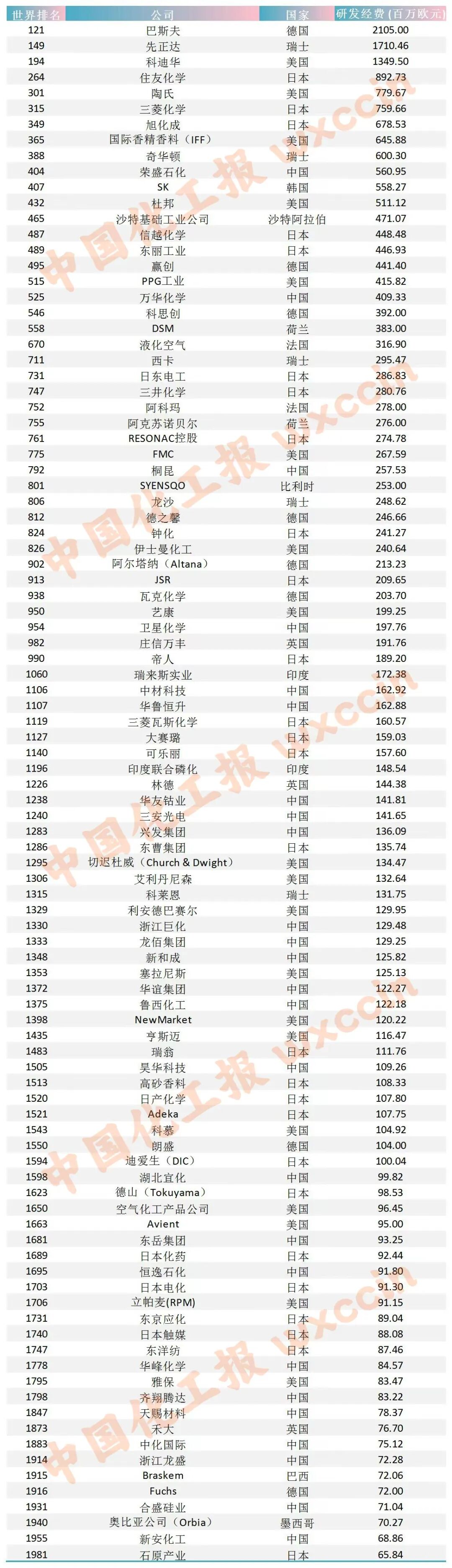
25家中国化企上榜全球研发投入2000强(附名单)
Zhong Guo Hua Gong Bao· 2026-01-11 04:33
Group 1 - The European Commission's report on the "2025 EU Industrial R&D Investment Scoreboard" reveals that 25 Chinese chemical companies are among the top 2000 global industrial R&D investors for 2025 [1] - Among the top 2000 companies, there are 98 chemical firms, with a total R&D investment of €26 billion in 2024, averaging €1.32 million per chemical company [2] - BASF leads the chemical industry with an R&D investment of €2.1 billion in 2024, ranking 121st overall; Syngenta ranks 149th with €1.71 billion, and Corteva ranks 194th with €1.34 billion [2] Group 2 - By country, Japan has the highest number of companies on the list with 27, followed by China with 25, the USA with 19, Germany with 8, and Switzerland with 5 [3] - The total R&D investment of the top 2000 companies in 2024 is €144.6 billion, accounting for over 90% of global corporate R&D investment [3] - The top ten companies globally include Amazon, Alphabet (Google's parent company), Meta (Facebook's parent company), Microsoft, Apple, Huawei, Samsung Electronics, Volkswagen, Johnson & Johnson, and Intel [4] Group 3 - The detailed list of the top chemical companies includes BASF (Germany), Syngenta (Switzerland), Corteva (USA), and others, with their respective R&D expenditures listed in millions of euros [5][6] - Notable Chinese companies in the list include Rongsheng Petrochemical (ranked 404th with €560.95 million), Wanhua Chemical (525th with €409.33 million), and others [5][6] - The report highlights the competitive landscape of the chemical industry, showcasing significant investments in R&D by various global players [2][3]


2025年1-11月中国合成纤维产量为7240.4万吨 累计增长4.9%
Chan Ye Xin Xi Wang· 2026-01-10 02:19
Core Viewpoint - The report highlights the growth trends in China's synthetic fiber industry, indicating a production increase and providing insights into market dynamics from 2026 to 2032 [1] Industry Overview - In November 2025, China's synthetic fiber production reached 6.88 million tons, reflecting a year-on-year growth of 5.7% [1] - From January to November 2025, the cumulative production of synthetic fibers in China was 72.404 million tons, with a cumulative growth rate of 4.9% [1] Companies Mentioned - The report lists several key companies in the synthetic fiber sector, including Hengyi Petrochemical, Rongsheng Petrochemical, Xin Fengming, Tongkun Co., Hengli Petrochemical, Jilin Chemical Fiber, Huafeng Chemical, Aoyang Health, Taihe New Materials, and Jiangnan High Fiber [1] Research and Consulting - The insights are derived from a report by Zhiyan Consulting, a leading industry consulting firm in China, which specializes in providing in-depth industry research reports, business plans, feasibility studies, and customized services [1]


POE胶膜概念下跌0.68%,6股主力资金净流出超3000万元
Zheng Quan Shi Bao Wang· 2026-01-09 09:28
Group 1 - The POE film concept index declined by 0.68%, ranking among the top declines in the concept sector, with notable declines from companies such as New Guangyi, *ST Green Kang, and Dingjide [1] - Among the concept stocks, 7 companies experienced price increases, with Changyang Technology, Ningbo Color Master, and Donghua Technology rising by 3.14%, 0.86%, and 0.60% respectively [1] - The top-performing concept sectors included Xiaohongshu concept with a rise of 6.21%, Kuaishou concept at 6.06%, and DRG/DIP at 5.67% [1] Group 2 - The POE film concept saw a net outflow of 472 million yuan from main funds, with 19 stocks experiencing net outflows, and 6 stocks seeing outflows exceeding 30 million yuan [1] - The stock with the highest net outflow was Baofeng Energy, with a net outflow of 186 million yuan, followed by Foster, New Guangyi, and Satellite Chemical with net outflows of 89.65 million yuan, 62.97 million yuan, and 61.71 million yuan respectively [1][2] - The stocks with the highest net inflows included Wanhua Chemical, Jizhi Technology, and Changyang Technology, with net inflows of 30.19 million yuan, 16.94 million yuan, and 14.13 million yuan respectively [1][3]


石化行业拐点显现,长丝链条景气上行——西部证券看好荣盛石化等大炼化企业业绩弹性
Quan Jing Wang· 2026-01-09 05:44
Group 1 - The global refining macro conditions are gradually improving, indicating a potential turning point for the petrochemical industry [1] - The profitability of PTA and long filament is expected to grow due to the anti-involution policy and the anticipated increase in demand in 2025 and 2026 [1][2] - The refining profit margins are projected to rebound in 2025, with significant profit increases for companies like Rongsheng Petrochemical, Dongfang Shenghong, and Sinopec in 2026 [1] Group 2 - The operating rates for PX, PTA, and long filament in 2025 are forecasted to be 84%, 76%, and 89% respectively, with year-on-year changes of +1.4%, -3.1%, and +2.7 percentage points [2] - The price spread for PX is expected to rise from $203/ton in Q1 2025 to $267/ton in Q4 2025, while PTA processing fees are projected to increase from 73 RMB/ton to 362 RMB/ton during the same period [2] - The industry concentration for PTA and long filament is high, with CR8 concentrations of 62.43% and 68.58% respectively, indicating a strong market position for leading companies [3]