
RSPC(002493)

Search documents
油气ETF华泰柏瑞(561570)开盘涨1.22%,重仓股中国海油涨1.98%,中国石油涨2.01%
Xin Lang Cai Jing· 2026-02-04 01:42
Group 1 - The oil and gas ETF Huatai-PB (561570) opened with a gain of 1.22%, priced at 1.331 yuan [1] - Major holdings in the ETF saw positive movements: CNOOC rose by 1.98%, PetroChina by 2.01%, Sinopec by 0.79%, and others like Jereh, COSCO Shipping, and Guanghui Energy also experienced gains [1] - The ETF's performance benchmark is the CSI Oil and Gas Industry Index, managed by Huatai-PB Fund Management Co., with a return of 31.70% since its inception on October 9, 2024, and a monthly return of 14.01% [1]





荣盛石化:截至2025年三季度末股东人数为73726户
Zheng Quan Ri Bao Zhi Sheng· 2026-02-03 11:44
(编辑 王雪儿) 证券日报网讯 2月3日,荣盛石化在互动平台回答投资者提问时表示,截至2025年三季度末,公司的股 东人数为73726户。截至2025年四季度末公司的股东人数,公司将于2025年年度报告中披露。 ...

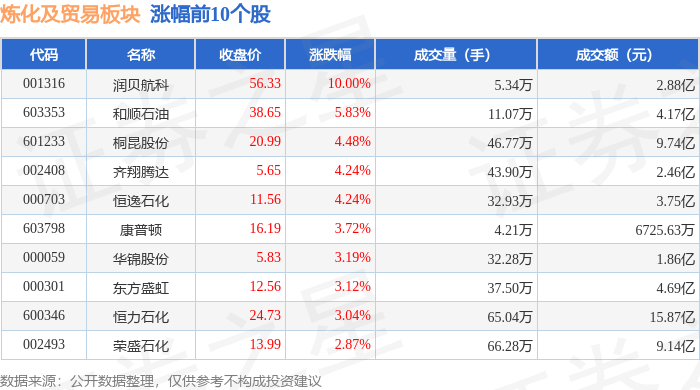
炼化及贸易板块2月3日跌0.77%,ST沈化领跌,主力资金净流出7901.46万元
Zheng Xing Xing Ye Ri Bao· 2026-02-03 09:10
Market Overview - The refining and trading sector experienced a decline of 0.77% on February 3, with ST Shenhua leading the drop [1] - The Shanghai Composite Index closed at 4067.74, up 1.29%, while the Shenzhen Component Index closed at 14127.1, up 2.19% [1] Stock Performance - Notable gainers in the refining and trading sector included: - Runbei Hangke (001316) with a closing price of 56.33, up 10.00% [1] - Heshun Petroleum (603353) at 38.65, up 5.83% [1] - Tongkun Co. (601233) at 20.99, up 4.48% [1] - Conversely, ST Shenhua (000698) saw a decline of 3.04%, closing at 3.83 [2] Trading Volume and Capital Flow - The total trading volume for the refining and trading sector showed a net outflow of 79.01 million yuan from main funds, with retail investors contributing a net inflow of 244 million yuan [2] - The capital flow for individual stocks indicated that: - Guanghui Energy (600256) had a net inflow of 48.13 million yuan from main funds [3] - China Petroleum (601857) recorded a net inflow of 45.05 million yuan from main funds [3] - Runbei Hangke (001316) had a net inflow of 46.34 million yuan from main funds [3]


如何看待化工龙头的空间-拥抱碳约束下的-类资源化-红利
2026-02-03 02:05
Summary of Key Points from Conference Call Records Industry Overview - The chemical industry is expected to experience a significant decline in new supply in 2026 and 2027, leading to an upward cycle due to price synergy effects and the exit of overseas capacity [1][2] - The tightening of national carbon emission targets will impact the approval of oil and infrastructure projects, pushing chemical companies towards green transformation [1][7] Core Insights and Arguments - Major chemical companies have made substantial fixed asset investments during the 14th Five-Year Plan, which are expected to translate into profits in the coming years, with some companies potentially having P/E ratios as low as 3-4 times [1][5] - The PX market is operating at high capacity utilization, with expected profits around 1,000 CNY/ton being sustainable due to the rapid digestion of new capacity [1][9] - The olefin market is projected to improve long-term, supported by national policies, with an expected upward cycle from 2027 to 2029 [1][11] Company-Specific Insights Wanhua Chemical - Fixed assets and construction projects have significantly increased, with potential profits at the bottom of the cycle estimated at 15-16 billion CNY, and central profit levels reaching around 30 billion CNY [3][20] - The company’s market cap corresponds to a P/E ratio of 8-9 times, indicating substantial profit potential as the cycle rebounds [20] Longbai Group - Fixed assets have grown significantly, with potential profits estimated at 12 billion CNY based on historical averages [21][22] - The company’s market cap corresponds to a P/E ratio of around 9 times, suggesting a favorable valuation [22] Rongsheng Petrochemical - Fixed asset investments have been significantly higher than those of Hengli Petrochemical, with potential peak profits estimated between 20 billion to 30 billion CNY [23][24] - Future profitability will depend on the market conditions for ethylene and its downstream products [24] Hengli Petrochemical - The company is seen as stable and a key indicator of product reversals, with significant overseas expansion potential [14][13] - Expected profits could reach 60-70 billion CNY if current favorable conditions persist [13] Shenghong Petrochemical - The company has not fully benefited from industry conditions but has significant upside potential, with expected profits from new energy sectors [12] Other Important Insights - The chemical industry is currently characterized by a shorter duration from the bottom of the down cycle to the upturn, aided by price synergy effects and high industry concentration [4] - The large refining industry is at the tail end of its capacity cycle, with cash flow expected to improve significantly [8] - The agricultural chemicals sector faces oversupply issues, with key signals from agricultural product prices [28] Market Trends and Future Outlook - The oil market is expected to improve in the second half of 2026, with prices potentially fluctuating between 70-80 USD per barrel [15][16] - OPEC is likely to maintain production levels, indicating a slow growth cycle for oil supply, which could stabilize prices [17] - The refrigerant market is expected to see price increases, although the rate of increase may slow down [33][34] This summary encapsulates the key points from the conference call records, highlighting the chemical industry's dynamics, company-specific insights, and broader market trends.



石化化工行业 2026 年 2 月投资策略:推荐油气、炼油炼化、钾肥、磷化工的投资方向
Guoxin Securities· 2026-02-02 14:04
Core Viewpoints - The petrochemical industry is currently facing significant "involution" competition, leading to a situation where increased production does not result in increased profits, with the industry's operating income profit margin declining from 8.03% in 2021 to 4.85% in 2024 [2][17] - The report recommends investment directions in oil and gas, refining and chemical, potash fertilizer, and phosphorus chemicals, anticipating a gradual recovery in profitability as supply-side reforms take effect [4][21] Supply Side - Fixed asset investment in the chemical raw materials and products manufacturing sector turned negative starting June 2025, indicating the end of the current expansion cycle, with the "anti-involution" policy introduced in July aimed at curbing low-price competition and promoting the orderly exit of outdated capacity [2][19] - The report expects stricter approval for new chemical product capacities and accelerated clearance of outdated capacities, effectively alleviating the oversupply issue in the petrochemical industry [19][20] Demand Side - Traditional demand is expected to recover moderately due to global central banks entering a rate-cutting cycle and fiscal stimulus, while emerging demands from sectors like renewable energy and AI will drive the need for key chemical materials [3][19] - The report highlights that China's chemical products account for over 40% of global sales, and with overseas capacity being cleared, Chinese chemical companies are expected to gain market share globally [20] Oil Price Outlook - Geopolitical risks have led to fluctuations in international oil prices, with Brent and WTI prices rising by 16.17% and 13.57% respectively by the end of January 2026 [4][21] - The report forecasts Brent oil prices to stabilize between $55-65 per barrel and WTI prices between $52-62 per barrel in 2026, influenced by OPEC+ production decisions and high operational costs in the U.S. shale oil sector [22][30] Key Industry Research - The refining and chemical sector is expected to see improvements in supply-demand dynamics, with the report suggesting a focus on companies like China Petroleum and Rongsheng Petrochemical for potential recovery in refining profits [7][22] - In the potash fertilizer sector, the report recommends Yara International, which has significant potash reserves and is expected to increase production capacity significantly by 2026 [8][22] - The phosphorus chemical sector is anticipated to benefit from increased demand driven by energy storage applications, with a recommendation for Chuanheng Co. due to its strong resource base [23][24] Investment Portfolio - The recommended investment portfolio includes China Petroleum, China National Offshore Oil Corporation, Rongsheng Petrochemical, Yara International, and Chuanheng Co., highlighting their competitive advantages and growth potential in the current market environment [24][25]



石化化工行业2026年2月投资策略:推荐油气、炼油炼化、钾肥、磷化工的投资方向
Guoxin Securities· 2026-02-02 13:43
石化化工行业 2026 年 2 月投资策略 优于大市 推荐油气、炼油炼化、钾肥、磷化工的投资方向 证券研究报告 | 2026年02月02日 石化化工行业 2026 年 2 月投资观点: 石化化工是周期性行业,现阶段石化化工行业"内卷式"竞争问题突出, 低质量、同质化的无序竞争导致企业普遍面临增产不增利困境,全行业 营业收入利润率从 2021 年的 8.03%持续降至 2024 年的 4.85%,2025 年 以来部分子行业率先复苏,前三季度行业归母净利润同比增长 10.56%, 行业盈利逐渐企稳复苏。 供给端:化学原料及化学制品制造业投资固定资产累计投资额于 2025 年 6 月开始转负,SW 基础化工行业及多个细分子行业的资本开支连续多 个季度转负,此轮行业扩产周期接近尾声;7 月"反内卷"政策正式出 台,旨在治理企业低价无序竞争、推动落后产能有序退出,农药、石化、 有机硅、PTA 聚酯等子行业相继响应"反内卷"出台或正在制定行业指 导文件。我们认为,后续将会看到更多化工产品新产能审批趋严、落后 产能(如规模小、能耗高、污染大)将加速出清,石化化工行业供给过 剩问题将得到有效缓解。 需求端:传统需求方面,伴 ...
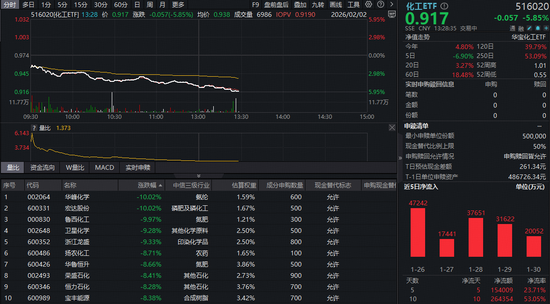
化工板块重挫,三股跌停!化工ETF(516020)跌近6%,后市如何看?
Xin Lang Cai Jing· 2026-02-02 05:42
Core Viewpoint - The chemical sector experienced a significant pullback on February 2, with the chemical ETF (516020) declining by 5.85% during trading, reflecting a broader downturn in the industry [1][7]. Market Performance - The chemical ETF (516020) opened lower and saw a decline of 5.85%, with a trading price of 0.917 as of the latest update [2][7]. - Key stocks in the sector, including Huafeng Chemical, Hongda Co., and Luxi Chemical, hit the daily limit down, while others like Satellite Chemical and Zhejiang Longsheng fell over 9% [1][7]. Supply Chain and External Factors - A cold wave in the U.S. Gulf Coast has led to the shutdown of several chemical plants, affecting over 30% of the chemical production capacity in Texas, which accounts for about one-third of the U.S. chemical output [3][10]. - The cold weather has increased natural gas prices, raising the costs of ethylene and polyethylene, while supply constraints are expected to strengthen the pricing outlook for chemical products [10]. Future Outlook - Analysts predict that the chemical industry will face low demand in 2025, but measures to counteract "involution" may help restore profitability by 2026, alongside growth in new materials driven by rapid downstream demand [10]. - The current low valuation of the industry presents potential opportunities for investors, particularly through the chemical ETF (516020), which tracks a specialized index covering various themes including AI and new energy [10]. Investment Strategy - Investors are encouraged to consider the chemical ETF (516020) for efficient exposure to the sector, as it tracks the CSI segmented chemical industry index and includes stocks related to trending themes [10].


2025年中国原油加工量产量为73758.8万吨 累计增长4.1%
Chan Ye Xin Xi Wang· 2026-02-02 03:49
Core Viewpoint - The report highlights the growth in China's crude oil processing capacity, indicating a positive trend in the industry with a projected increase in processing volume and production over the coming years [1]. Industry Overview - According to the National Bureau of Statistics, China's crude oil processing volume reached 62.46 million tons in December 2025, representing a year-on-year increase of 5% [1]. - The cumulative crude oil processing volume for the entire year of 2025 was 737.588 million tons, showing a cumulative growth of 4.1% [1]. Company Insights - Listed companies in the sector include Hengyi Petrochemical (000703), Rongsheng Petrochemical (002493), Sinopec (600028), PetroChina (601857), Shanghai Petrochemical (600688), Huajin Co. (000059), Taishan Petroleum (000554), Yueyang Xingchang (000819), ST Shihua (000637), and Shenyang Chemical (000698) [1]. Research Report - The report titled "2026-2032 China Oil Industry Development Strategy Analysis and Investment Prospects Research Report" by Zhiyan Consulting provides insights into the future strategies and investment opportunities within the oil industry [1].


大型民营石化企业“西进”布局煤化工
中国能源报· 2026-02-02 03:38
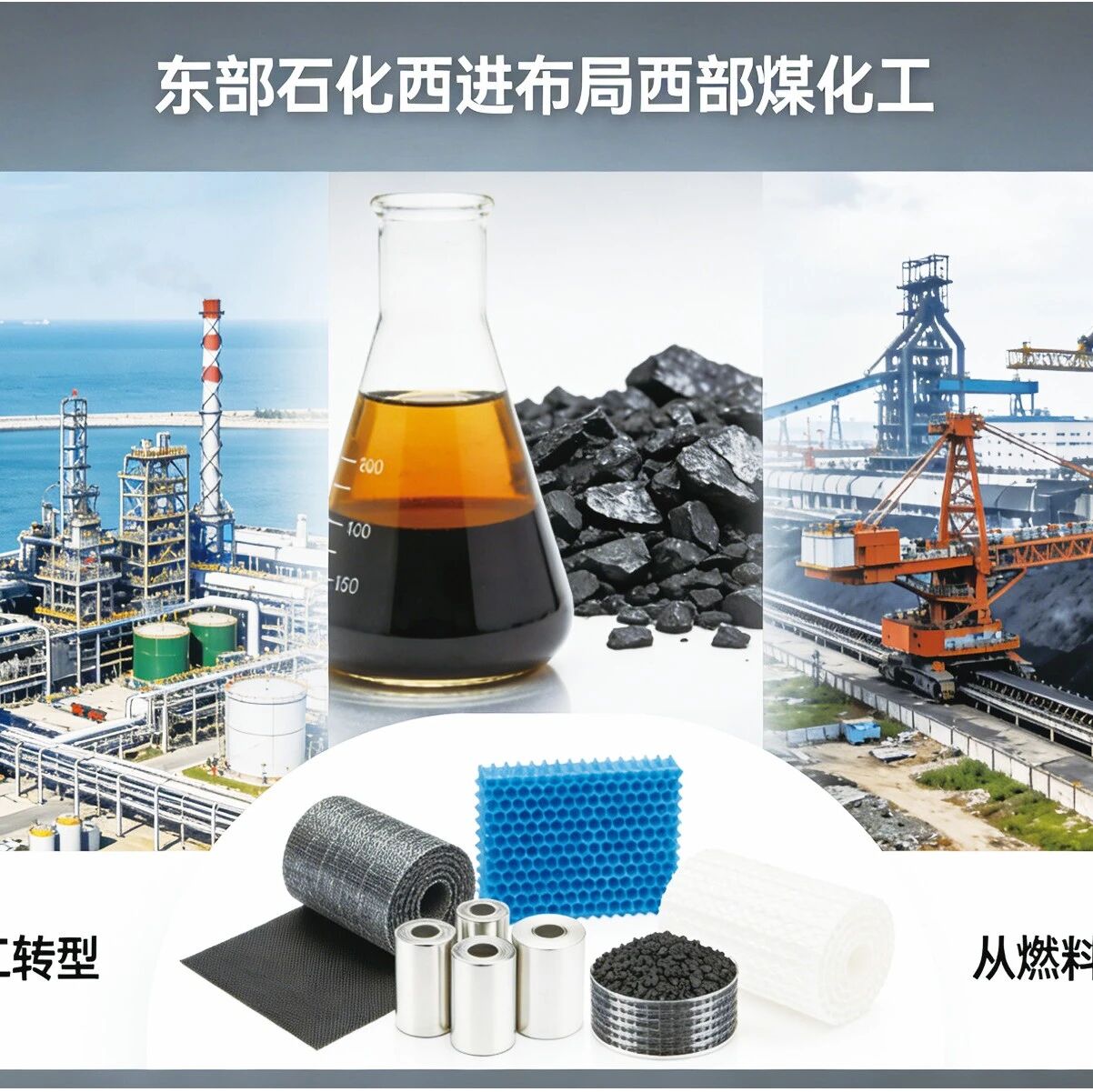
Core Viewpoint - The major chemical and petrochemical companies in China's eastern coastal regions are strategically shifting towards coal chemical projects in the western regions to reduce reliance on oil and enhance cost control, marking a transition from a "fuel era" to a "materials era" [3][10]. Group 1: Industry Trends - The investment in coal chemical projects is exemplified by Rongsheng Petrochemical's approximately 160 billion yuan investment in Inner Mongolia for a green coal chemical integration project, which aims to convert 35 million tons of raw coal annually into over 20 high-end chemical materials [3][4]. - The industry is facing declining revenue profit margins, dropping from 8.03% in 2021 to an estimated 4.85% in 2024, indicating a growing challenge of "increased production without increased profits" [6][4]. - The correlation between traditional petrochemical products and crude oil prices is weakening, with market supply and demand becoming the primary determinants of product pricing [6][4]. Group 2: Cost Advantages - The cost of producing olefins from coal is estimated to be 20% to 30% lower than traditional oil routes, making it an attractive option for profit-sensitive chemical companies [9][8]. - Rongsheng Petrochemical's project in Inner Mongolia is designed to leverage local low-cost coal resources, ensuring competitiveness even amid price fluctuations in chemical products [9][10]. Group 3: Strategic Intent - Companies are not only motivated by cost advantages but also by the desire to establish a self-controlled raw material supply chain, as seen in Hengyi Petrochemical's integrated coal-to-ethylene glycol project in Xinjiang [10][10]. - Technological advancements in modern coal chemical processes, such as gasification and methanol-to-olefins, are enabling efficient conversion of coal into high-quality chemical raw materials [10][10]. Group 4: Future Outlook - The Ministry of Industry and Information Technology's plan emphasizes the support for modern coal chemical projects in resource-rich areas, encouraging the development of new chemical materials to guide industry upgrades [12][12]. - The focus on high-end products like polyolefins, specialty rubbers, and carbon fibers in coal chemical projects indicates a significant increase in value compared to traditional bulk chemical products [12][12]. - The integration of energy resources in the west with industrial capital and technological advantages in the east is expected to redefine the future of the chemical industry, transitioning from oil dependency to coal utilization and from fuel production to material manufacturing [13][13].

石油化工行业周报(2026、1、26—2026、2、1):油价冲高反映地缘风险,中长期或回归基本面逻辑-20260201
Shenwan Hongyuan Securities· 2026-02-01 13:51
Investment Rating - The report maintains a positive outlook on the oil and petrochemical industry, indicating a "Buy" rating due to the current geopolitical risks and potential for price recovery in the medium to long term [1]. Core Insights - The report highlights that the recent surge in oil prices reflects geopolitical risk premiums, particularly due to ongoing tensions between the U.S. and Iran, which significantly impact global oil supply security [4][7]. - It is anticipated that oil prices will exhibit characteristics of being "geopolitically driven with fundamental support" around the Chinese New Year, with potential further increases if conflict expectations materialize [7]. - The medium to long-term outlook suggests a return to fundamental pricing logic as the oil supply-demand balance is expected to loosen, limiting upward price movement without sustained geopolitical conflict [7]. Summary by Sections Upstream Sector - As of January 30, Brent crude oil futures closed at $70.69 per barrel, a 7.30% increase from the previous week, while WTI futures rose by 6.78% to $65.21 per barrel [15]. - U.S. commercial crude oil inventories decreased to 424 million barrels, down 2.296 million barrels week-on-week, which is 3% lower than the five-year average [17]. - The report notes a trend of increasing oil service activity, with drilling day rates remaining stable despite low levels, indicating potential for future increases as global capital expenditures rise [15][35]. Refining Sector - The Singapore refining margin for major products fell to $9.40 per barrel, a decrease of $2.69 from the previous week [54]. - The report indicates that while refining profitability has improved, the current product price differentials remain low, with expectations for gradual improvement as economic recovery progresses [51]. Polyester Sector - The report observes an increase in PTA profitability, with prices rising to 5,271.4 CNY per ton, a 4.66% increase week-on-week [1]. - The overall performance of the polyester industry is deemed average, with a need to monitor demand changes closely [1]. Investment Recommendations - The report recommends focusing on high-quality companies in the polyester sector, such as Tongkun Co. and Wankai New Materials, as well as large refining companies like Hengli Petrochemical and Rongsheng Petrochemical due to expected improvements in cost structures and competitive advantages [1][10]. - It also suggests maintaining a neutral outlook on oil companies, with a focus on those offering high dividend yields, such as China National Petroleum and China National Offshore Oil [10].
