Adobe(ADBE)

Search documents
3 Best Earnings Acceleration Stocks to Watch for February 2026
ZACKS· 2026-02-09 21:00
Key Takeaways Adobe is among a small group of stocks showing accelerating quarter-over-quarter EPS growth this month.Goldman Sachs meets strict screening criteria, highlighting rising EPS growth rates across recent quarters.ETR made the final cut as earnings acceleration narrowed thousands of stocks down to just 11 candidates.In February, astute investors are likely to prioritize companies that deliver consistent earnings growth as a sign of profitability. Even more impactful, though, is earnings accelerati ...



3000亿美元因Agent一夜蒸发,纳德拉、MongoDB CEO等宣告:传统SaaS已走到拐点
3 6 Ke· 2026-02-09 05:19
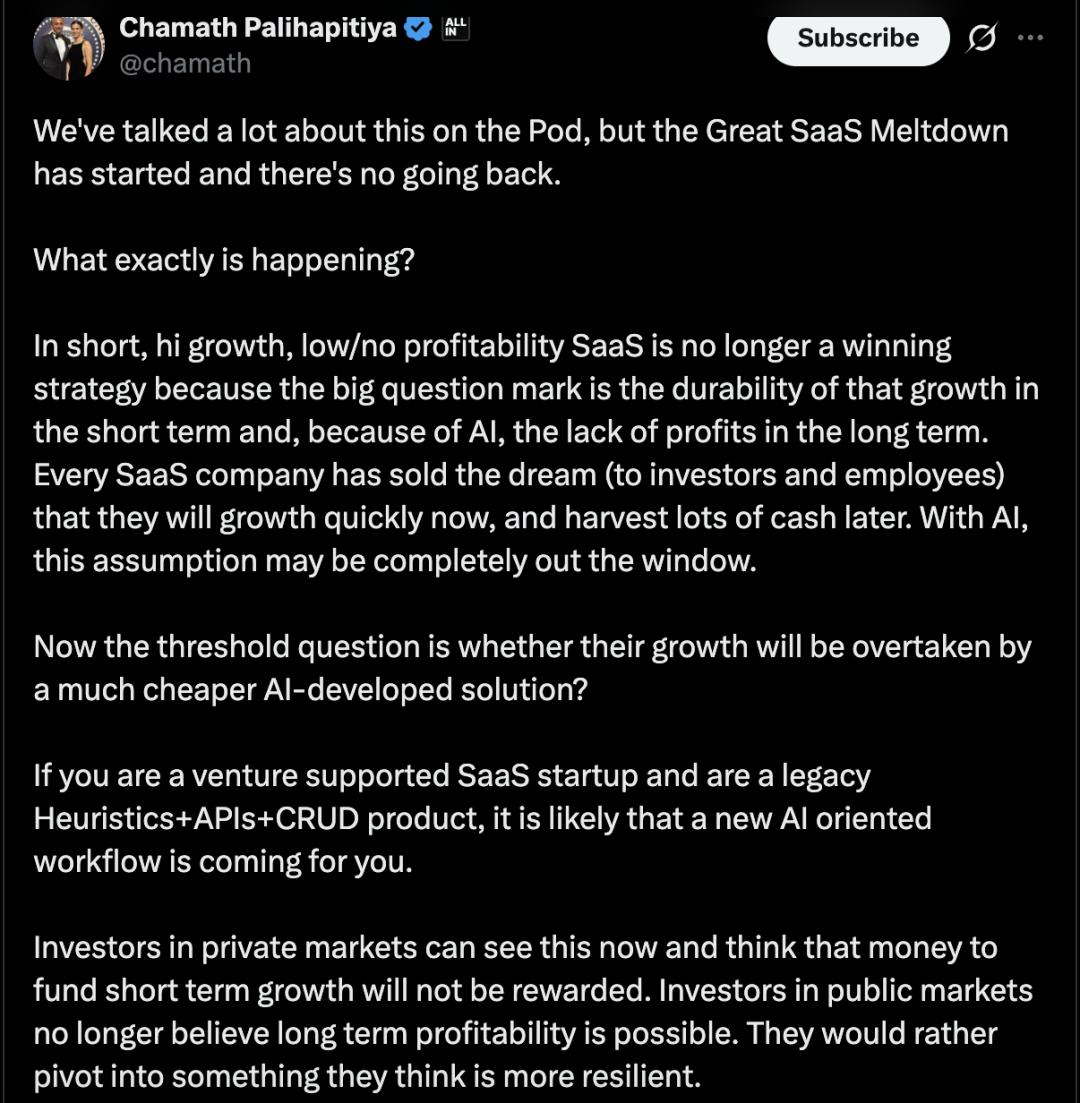
这周二,SaaS、数据和软件类投资公司的市值蒸发了约 3000 亿美元。这并非因为盈利不及预期或宏观经济冲击,而是因为一款人工智能产品发布。 这场危机已经持续数月。等到市场做出反应时,IGV 软件指数已较 9 月下旬的峰值下跌了约 30%。上周发生变化的不是方向,而是速度。 几家根基深厚的企业软件公司股价在一天之内大幅下跌。Salesforce、ServiceNow、Adobe 和 Workday 的股价均下跌约 7%。Intuit 的股价更是暴跌近 11%。与此同时,整个行业的估值倍数也急剧下降。软件公司的平均预期市盈率在短短几个月内从约 39 倍暴跌至约 21 倍。做空者已通过押注传统 SaaS 业务在 2026 年获利超过 200 亿美元,并且还在加倍下注。 除非核心假设被打破,否则市场不会抹去如此巨大的价值。 1 纳德拉判断 SaaS 已死 在过去二十年的大部分时间里,企业软件受益于异常稳定的经济形势。软件开发成本高昂,转换成本也很高,数据都存储在专有系统中。 一旦某个平台成为记录系统,它便会一直占据这一位置。这种信念支撑着从公开市场估值倍数到私募股权收购再到私募信贷承销等方方面面。经常性收入 被视为 ...



软件没有死,但“通用软件”已死
3 6 Ke· 2026-02-09 01:58
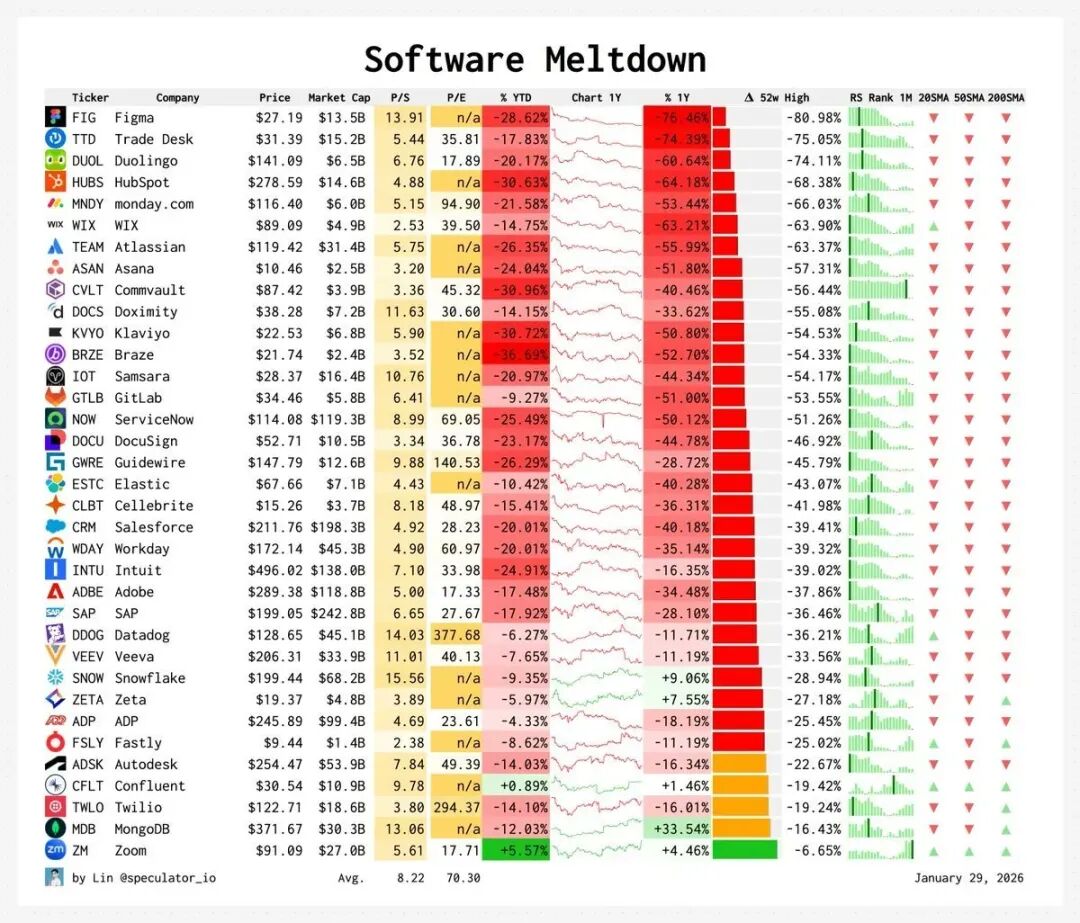
这不是板块轮动,这是在投降。 看来在投资领域,"硬件"已经成了新的"软件"。—— Paul Andreola 近期,软件股正在遭受重创! 这种下跌并非针对特定标的,也非战术性调整,几乎是无差别的打击。 观察当下的行业现状,与其说是板块轮动,不如说更像是一场大清算,甚至到了彻底投降的地步。无论是增长领头羊、赛道赢家、基础设施平台,还是通 用型 SaaS 或垂直型 SaaS,全都在同步跌落。 我今天在 X 上看到的一张图表,极其直观地展现了这种残酷现状。在数十家知名软件公司中,股价较近期高点的回撤幅度非常集中。这种跌幅通常只会 在企业面临生存危机时出现,而非仅仅源于周期性的不确定性 。 | | | | | | | | Software Meltdown | | | | | | | --- | --- | --- | --- | --- | --- | --- | --- | --- | --- | --- | --- | --- | | Ticker | Company | Price | | Market Cap | P/S | P/E | % YTD Chart 1Y | % 1Y | A 52w High ...
48小时万亿蒸发,高盛用Claude「杀死」人类会计,亲手埋葬软件帝国
3 6 Ke· 2026-02-09 01:08
华尔街的空气,仿佛在一夜之间被抽干了。 过去几天,全球软件行业都在经历一场无声的屠杀。 交易员们甚至来不及惊呼,屏幕上那片触目惊心的红色就已经蔓延成灾,如同失控的病毒。 | Ticker | | Company | Price | Market Cap | P/S | P/E | % YTD Chart 1Y | 1 % 1Y | A 52w High | RS Rank 1M 20SMA 50SMA 200SMA | | | | --- | --- | --- | --- | --- | --- | --- | --- | --- | --- | --- | --- | --- | | | | Figma | $27.19 | $13.58 | 13.91 | n/a | -28.62% | | -80.98% .. | | | | | | | | | | | | | તરી લગ | | A | V | | | | | Trade Desk | $31.39 | $15.2B | 5.44 | 35.81 | -17.83% | -7/3 -3/4 | -75.05% | V | V | V | | | ...



48小时万亿蒸发,高盛用Claude「杀死」人类会计
36氪· 2026-02-09 00:10
Claude刚刚血洗全球软件业, 高盛就放出炸弹。 来源| 新智元(ID:AI_era) 封面来源 | unsplash 华尔街的空气,仿佛在一夜之间被抽干了。 过去几天,全球软件行业都在经历一场无声的屠杀。 交易员们甚至来不及惊呼,屏幕上那片触目惊心的红色就已经蔓延成灾,如同失控的病毒。 | Ticker | Company | Price | Market Cap | P/S | P/E | % YTD Chart 1Y | 2 14 | A 52w High | RS Rank 1M 20SMA 50SMA 200SMA | | | | --- | --- | --- | --- | --- | --- | --- | --- | --- | --- | --- | --- | | F FIG | Figma | $27.19 | $13.58 | 13.91 | n/a | -28.62% | 15 GB | -80.98% | A | A | A | | (0) TTD | Trade Desk | $31.39 | $15.2B | 5.44 | 35.81 | -17.83% -- | 769 ...

Software stocks have been crushed. Here's how to play the sector as the dust settles.
MarketWatch· 2026-02-07 12:30
Core Viewpoint - Investors are encouraged to evaluate potential buying opportunities in undervalued software stocks following what analysts describe as "indiscriminate selling" [1] Group 1 - The recent market activity has led to a significant decline in software stock prices, prompting a reassessment of investment strategies [1] - Analysts suggest that the selling pressure may have been excessive, creating potential entry points for investors [1]

Wall Street Roundup: Risk Off
Seeking Alpha· 2026-02-06 18:25
Bet_Noire/iStock via Getty Images Listen below or on the go on Apple Podcasts and Spotify Risk off concerns, Bitcoin sell off (0:20) Software stocks drop (2:00) Big name AI earnings (4:00) Good news for Hershey (10:45) Next week's earnings and economic data (12:00) Transcript Rena Sherbill: Brian Stewart, Seeking Alpha's Director of News. Welcome back to another week of Wall Street Roundup. Brian Stewart: Great to be here. Rena Sherbill: It's great to have you talk to us. We've got Bitcoin, we've ...



两周搓出的Claude Cowork,让硅谷一夜蒸发2万亿,AI真要杀死软件?
虎嗅APP· 2026-02-06 14:10
Core Viewpoint - The article discusses a significant sell-off in the software sector, triggered by the introduction of AI capabilities by Anthropic, which threatens traditional software companies and their business models [4][6][19]. Group 1: Market Reaction - The global capital market has indiscriminately sold off software stocks, with major companies like Salesforce, Workday, and Intuit losing nearly $258 billion in market value in a single day [4]. - The North American software index experienced a 15% decline in January, marking the worst monthly performance since 2008 [4]. - The sell-off has spread to the Asia-Pacific market, leading to sharp declines in the stock prices of several industry leaders [4]. Group 2: AI's Impact on Software - Anthropic's AI application, Claude Cowork, has introduced capabilities that allow it to perform tasks traditionally done by humans, such as managing files and operating software [8][10]. - The release of specific plugins for various industries, including law and finance, indicates a shift where AI is not just a tool but a competitor to traditional software providers [11][13]. - Analysts predict that up to 50% of entry-level white-collar jobs may be impacted by AI within the next 1 to 5 years, posing a threat to companies that provide software tools for these roles [13]. Group 3: Software Industry Challenges - Software vendors are in a precarious position, needing to demonstrate revenue growth to alleviate concerns about AI's impact [15]. - Major companies are announcing layoffs, indicating a tightening of corporate budgets and a reluctance to invest in traditional software when AI can perform tasks at a lower cost [16]. - The trend of "downgrading" software is emerging, as companies reconsider the necessity of expensive SaaS solutions in light of AI capabilities [16]. Group 4: Future of Software Companies - The software industry is expected to split into two categories: "tool-based" software that will likely be eliminated and "system-based" software that must adapt to survive [24][25]. - Future software companies will need to shift from a per-user pricing model to a results-based pricing model, as AI agents reduce the need for human users [27]. - Gartner predicts that by the end of 2026, 40% of enterprise SaaS will incorporate outcome-based pricing elements, marking a significant shift in the industry [27].

Software Stocks Selloff: What's Behind the Rout?
Youtube· 2026-02-06 11:02
Group 1 - The recent selloff in the market is attributed to concerns over the impact of new technologies on traditional sectors such as legal, medical, and financial services, similar to the disruption caused by the Internet [1][2] - There has been a decline in stock values since their peak in summer 2025, indicating a prolonged downturn in certain sectors [1] - The software industry has seen many deals made at peak valuations during and after the COVID pandemic, followed by a sharp rise in interest rates, leading to concerns about overvaluation [5][6] Group 2 - Private equity firms are facing unexpected challenges, with a significant amount of financing for deals being sourced from private credit, raising concerns about the sustainability of these investments [4][6][7] - The market is experiencing a lack of clarity regarding which companies will emerge as winners or losers, leading to indiscriminate selling [9][10] - There is a growing anxiety among investors about the quality of stocks, as many companies are perceived to lack competitive advantages or "moats" [8][9] Group 3 - The current market environment is characterized by a momentum unwind, with significant declines across various asset classes, including Bitcoin and gold, indicating a broader risk-off sentiment [17][19] - The strength of the US dollar is impacting other assets negatively, suggesting a correlation between dollar strength and asset weakness [19][20] - There are concerns about systemic risks in the financial sector, particularly related to leveraged investments and margin calls, especially among retail investors in the US [16][11]
AI fears pummel software stocks: Is it 'illogical' panic or a SaaS apocalypse?
CNBC· 2026-02-06 04:21
The Anthropic AI logo is displayed on a mobile phone with a visual digital background.The software sector faced renewed market concerns this week after artificial intelligence company Anthropic released new AI tools, triggering a sell-off in software-as-a-service and data provider stocks. Anthropic's new AI tools, built for its Claude "Cowork" AI agent, are designed to handle complex professional workflows that many software and data providers sell as core products.The tools and other similar AI agents targ ...