
Adobe(ADBE)

Search documents
A scary SaaS selloff changes the calculus for startups and private markets: “code alone was never a real moat”
Fortune· 2026-02-13 11:40
Market Overview - The public market for 2026 appeared stable until recent advancements in enterprise AI raised concerns among investors regarding the software-as-a-service (SaaS) industry's assumptions [2][3] - A significant selloff occurred, with notable declines in major SaaS companies: Salesforce down over 3%, Adobe down 3%, Docusign down 5.5%, and Workday down more than 10% over five days [3] Industry Concerns - The term "SaaSpocalypse" has emerged, highlighting the uncertainty in the SaaS sector as the industry lacks a clear strategy for monetizing enterprise AI [3] - Experts suggest that the traditional reliance on software execution as a competitive advantage is diminishing, as the cost of software development approaches zero [4] Future Implications - The long-term impact of AI on SaaS revenue is uncertain, with potential losses amounting to hundreds of billions or even trillions of dollars [5] - The prevailing sentiment indicates that the current market reaction may be exaggerated, but the fundamental question remains whether AI will significantly disrupt SaaS [5] Venture Capital Activity - Anthropic raised $30 billion in Series G funding, indicating strong investor interest in AI companies [7] - Other notable funding rounds include Talkiatry with $210 million in Series D funding and Simile with $100 million, reflecting ongoing investment in AI and related technologies [8]



3 Historically Cheap Software Stocks Begging to Be Bought Amid the Recent Tech Rout
The Motley Fool· 2026-02-13 10:06
Core Viewpoint - The current bear market for software stocks presents a significant opportunity for long-term investors seeking value, despite major stock indexes reaching new highs [1][4]. Group 1: Market Overview - The Dow Jones Industrial Average recently surpassed 50,000, the S&P 500 has gained at least 16% in six of the last seven years, and the Nasdaq Composite has outperformed both [1]. - The iShares Expanded Tech-Software Sector ETF is nearly 28% below its all-time high, indicating a challenging environment for software investors [2]. Group 2: Salesforce - Salesforce is identified as a bargain amid the software sell-off, with a market cap of $174 billion and a current price of $185.36 [6][7]. - The company has embraced AI as a growth driver, with its Agentforce AI platform generating over $500 million in annual recurring revenue (ARR), up 330% year-over-year [8]. - Salesforce's remaining performance obligation (RPO) surged 11% to $29.4 billion, and it maintains a forward price-to-earnings (P/E) ratio of 14.8, a 52% discount to its five-year average [9][10]. Group 3: Adobe - Adobe is also considered a historically cheap stock, with a closing price of $266.90, the lowest since October 2019 [12]. - Despite concerns about generative AI impacting its software solutions, Adobe's Digital Media segment ended with $19.2 billion in ARR, up 11.5% year-over-year [15]. - The company's forward P/E of 10.1 is 61% below its average since 2020, indicating a favorable valuation [18]. Group 4: Okta - Okta, a cloud-based cybersecurity company, is viewed as a strong investment opportunity, with a current price of $84.99 and a market cap of $15 billion [20]. - The company reported a 17% year-over-year increase in RPO to nearly $4.3 billion and a 37% increase in net cash from operating activities [23]. - Okta's forward P/E of 24 reflects a significant drop from previous years, making it an attractive option for investors [24].


AI wreaking havoc across software stocks, job losses might follow: Tom Lee
Youtube· 2026-02-13 00:11
Core Viewpoint - The impact of AI on job markets and inflation is significant, leading to a potential disinflationary environment, which may influence the Federal Reserve's monetary policy decisions [2][6][7]. Group 1: Job Market and AI Impact - The Federal Reserve is aware that AI is causing disruptions in the software sector, which may lead to job losses in the near future [2][5]. - The stock market may not react strongly to labor reports due to concerns about future job losses attributed to AI [3][5]. - The software sector, valued at $450 billion, is facing challenges from AI, which could lead to deflationary pressures [6]. Group 2: Inflation and Federal Reserve Policy - Core CPI year-over-year is expected to drop to 2.52%, indicating a return to pre-COVID inflation levels [6]. - The Federal Reserve is anticipated to adopt a dovish stance, with potential rate cuts later in the year due to the disinflationary environment [7][6]. Group 3: Market Dynamics and Sector Rotation - The market is currently experiencing a rotation from technology stocks (MAG 7) to sectors like energy, industrials, and commodities, which are perceived as more resilient [8][11]. - A potential market drawdown of 10-20% could lead to a bullish outlook for non-U.S. markets, as they are less tech-dependent [11][12]. Group 4: Cryptocurrency Market Sentiment - The cryptocurrency market is facing challenges, with investor sentiment negatively impacted by recent price actions and market conditions [12][15]. - The shift in investor focus towards gold, driven by its strong performance, has contributed to a decline in interest in cryptocurrencies [15][16].

Beaten-Down Software Stocks Are Still Good Buys, Despite Investors' AI Fears
Youtube· 2026-02-12 16:31
Core Insights - Software stocks have significantly lagged behind artificial intelligence (AI) stocks for most of the past year, and this performance gap has continued even as the AI trade has cooled [1][2] - Concerns about AI potentially threatening the software industry have driven investor sentiment, leading to a disconnect between stock performance and underlying fundamentals [5][13] Group 1: Performance and Sentiment - Software stocks began to diverge from the broader market around July 2025, with fears surrounding AI contributing to a steep decline in their performance [3][9] - Initial fears included the belief that AI would eliminate the need for traditional software, which has since evolved into concerns about reduced demand for software licenses [3][4] - Despite the negative sentiment, the fundamentals of software companies remain strong, with many reporting better-than-expected earnings and guidance [7][8][10] Group 2: Revenue and Growth - In Q3 2025, 20 software companies reported earnings that beat expectations, indicating robust revenue and profitability across the sector [7][8] - AI-related revenue for software companies remains minimal, accounting for approximately 1.5% of total revenue, with projections suggesting it could rise to 2% in the near term [16][18] - Companies like Salesforce are experiencing rapid growth in AI-related revenue, but overall revenue from AI remains small compared to traditional software offerings [18][19] Group 3: Market Valuation and Investment Opportunities - Current valuations of software stocks are considered undervalued, with an estimated 25% upside potential across the sector [24][25] - Top investment picks include Microsoft and ServiceNow, both of which are well-positioned in the AI space and have strong free cash flow margins [25][29] - Microsoft leads in public cloud computing and AI, while ServiceNow is recognized for its growth potential and profitability compared to larger peers [29][31]



Adobe: The Best Time To Buy Is Often When It Is The Most Difficult (NASDAQ:ADBE)
Seeking Alpha· 2026-02-12 15:21
Core Insights - The individual has extensive experience in investment research, having worked in various roles across different investment firms in Toronto for nearly a decade [1] - The journey began in sell-side research at a Canadian bank, followed by positions in a hedge fund, a family office, and wealth management [1] - Achieving CFA and CAIA designations by the age of 25 was a significant milestone in the individual's career [1] Lifestyle Changes - The individual has transitioned to living in a yurt in the boreal forest, approximately 100 kilometers from the nearest paved road or grocery store [1] - This lifestyle change includes living close to nature, with access to a lake for fishing and a creek for water [1] - The individual expresses a sense of freedom and gratitude for life after this significant lifestyle shift [1]

Adobe: The Best Time To Buy Is Often When It Is The Most Difficult
Seeking Alpha· 2026-02-12 15:21
Core Insights - The individual has extensive experience in investment research, having worked in various roles across different investment firms in Toronto for nearly a decade [1] - The journey began in sell-side research at a Canadian bank, followed by positions in a hedge fund, a family office, and wealth management [1] - Achieving CFA and CAIA designations by the age of 25 was a significant milestone in the individual's career [1] Personal Transformation - The individual emphasizes the importance of self-conquest and personal growth before achieving professional success [1] - A significant lifestyle change occurred, with the individual living in a yurt in the boreal forest, indicating a shift towards a simpler, more self-sufficient life [1] - The current living situation is characterized by proximity to nature, with access to natural resources for water and heat, reflecting a deep appreciation for life [1]

Iberdrola counters grid operator's claim that its solar plant contributed to blackout
Reuters· 2026-02-12 15:20
Core Viewpoint - Iberdrola's CEO refutes claims that mismanagement at its Nunez de Balboa solar plant contributed to a significant blackout in Spain on April 28, 2025, marking the first public acknowledgment of the plant's ownership by Iberdrola [1] Group 1: Company Response - The CEO of Iberdrola, Mario Ruiz-Tagle, stated that there was no poor management or operation at the Nunez de Balboa solar plant on the day of the blackout [1] - A spokesperson for Redeia, the owner of the grid operator REE, declined to comment on the situation [1] Group 2: Background Information - Beatriz Corredor, chair of Redeia, previously indicated that mismanagement at a large solar plant in Badajoz made the power system more vulnerable during the blackout, although she did not specify the plant's name or owner at that time [1]

从高盛到黑石,华尔街巨头都来站台:软件不会垮
美股IPO· 2026-02-12 00:54
Core Viewpoint - Concerns about AI leading to the demise of the software industry are significantly exaggerated, according to executives from Goldman Sachs, Blackstone, Apollo, and KKR. They acknowledge that while AI will bring about a "dramatic technological cycle" and disruption, established software companies are likely to be protected and may even benefit from these changes [1][3][10]. Group 1: Market Reaction and Software Industry Outlook - The recent sell-off in the software sector was triggered by fears that AI could replace traditional software functions, leading to significant declines in stock prices for major companies like Salesforce and Adobe, resulting in the evaporation of hundreds of billions in market value [3][6][8]. - Executives from major financial institutions argue that the market's reaction is an "indiscriminate" sell-off, and the belief that all software companies will become obsolete is overly broad and unfounded [3][9][10]. - Apollo's John Zito stated that while the software industry will not disappear, its business logic will change, emphasizing that the usage of software is expected to increase significantly [4][5]. Group 2: Investment Risks and Diversification - KKR's CFO Robert Lewin indicated that approximately 15% of their private equity investments are exposed to software companies, which represents about 7% of their total assets, suggesting a manageable risk exposure [11]. - Goldman Sachs' CEO David Solomon downplayed the risk exposure in software investments, stating it is "insignificant" relative to the overall scale of their platform [13]. - The executives emphasized the importance of diversification in their investment portfolios to mitigate the impact of potential disruptions in the software sector [11][12].



从高盛到黑石,华尔街巨头都来站台:软件不会垮
Hua Er Jie Jian Wen· 2026-02-12 00:02
Core Viewpoint - The recent sell-off in the software sector due to AI threat narratives is exaggerated, according to executives from major financial institutions on Wall Street [1]. Group 1: Market Reaction and Sentiment - The stock prices of major software companies like Salesforce and Adobe plummeted, resulting in the evaporation of hundreds of billions in market value, driven by fears that AI will replace traditional software functions [1]. - Executives from firms such as Goldman Sachs, Blackstone, Apollo Global Management, and KKR have stated that the current market reaction is an "indiscriminate" sell-off, arguing that the belief that all software companies will become obsolete is overly broad and unfounded [1][8]. Group 2: Industry Transformation - Apollo's co-president John Zito emphasized that while the software industry will not disappear, its business logic will change, and the market will experience a "very severe technology cycle" with clear winners and losers [2]. - Zito warned investors against judging software companies solely based on current revenue figures, using the analogy of BlackBerry's decline after the iPhone's release [2]. Group 3: AI's Impact on Subscription Models - The immediate cause of market panic was Anthropic's announcement of a new legal tool for its Cowork assistant, which raised concerns about the fate of various software providers [2][7]. - Software companies are seen as particularly vulnerable due to their reliance on subscription and licensing fees for revenue [7]. Group 4: Differentiation in Market Response - Blackstone's CFO Michael Chae noted that the market's response lacks rationality, predicting that larger, well-established companies will be better protected and may even benefit from AI advancements [8]. - Goldman Sachs CEO David Solomon echoed this sentiment, suggesting that the narrative surrounding the software sector has been overly generalized [8]. Group 5: Risk Exposure of Financial Institutions - KKR's CFO Robert Lewin indicated that approximately 15% of KKR's private equity investments are exposed to software companies, representing about 7% of their total assets, but emphasized the diversity of their investments as a protective measure [9]. - Goldman Sachs' David Solomon downplayed the risk exposure in software investments, stating it is "insignificant" relative to the overall scale of their platform [9].
Buy These 2 Beaten-Down Growth Stocks
Yahoo Finance· 2026-02-11 21:06
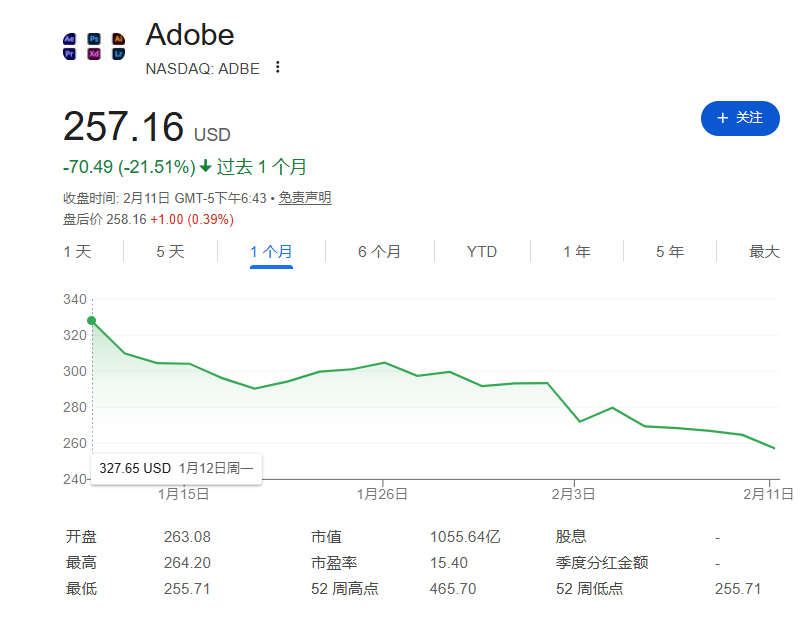
Group 1: Market Overview - The recent sell-off in software-as-a-service (SaaS) stocks has been severe, despite market indexes like the S&P 500 and Nasdaq Composite trading near all-time highs [1] - Investors are questioning whether the premium valuations of SaaS stocks are justified in the context of AI's disruptive impact [1][2] Group 2: Valuation and Investment Opportunities - Many SaaS stocks had frothy valuations leading into 2026, making a pullback in stock prices reasonable [2] - There are potentially oversold SaaS stocks that present buying opportunities, particularly Adobe and Intuit, which have seen their stocks decline by 26% and 39% year to date, respectively [3] Group 3: Adobe's Performance and Growth Prospects - Adobe's stock is considered undervalued with a price-to-earnings ratio of 16 and a forward price-to-earnings ratio of 11 [6] - The company reported a 10% year-over-year revenue growth in its fourth quarter, driven by the increasing importance of AI and the adoption of AI-driven tools [7] - Adobe aims for a 10.2% year-over-year increase in annual recurring revenue for fiscal 2026, with an earnings-per-share growth guidance of 7.8% [7]
