Adobe(ADBE)

Search documents
2025年中国营销智能体研究报告
艾瑞咨询· 2026-02-06 00:07
Core Insights - The article emphasizes the rapid evolution of marketing intelligence agents, which are transforming from auxiliary tools to autonomous decision-making systems in marketing, driven by advancements in AI technology [1][4][11]. Market Trends and Global Dynamics - Three major changes are identified: accelerated changes in platform advertising environments, rising privacy requirements, and increased digital marketing investments by companies [2]. Emergence of Global Marketing Intelligence Agents - The application of computer technology in marketing is undergoing a profound transformation, evolving from data analysis and decision support to full-chain marketing automation systems [4][11]. Challenges for Chinese Enterprises in Overseas Marketing - Chinese companies face significant challenges in overseas marketing, including cultural differences, complex channels, privacy and compliance issues, and cross-border payment difficulties [6]. Opportunities for Chinese Enterprises in Overseas Marketing - Marketing intelligence agents provide crucial support in content creation, compliance review, and localization for Chinese enterprises venturing abroad, leveraging the rapid iteration of open-source large language models [8]. Definition of Marketing Intelligence Agents - Marketing intelligence agents are defined as products based on generative AI or machine learning algorithms that can autonomously or semi-autonomously execute marketing-related tasks, assisting or replacing human marketing efforts [9]. Transition from Marketing Tools to Autonomous Agents - The development of marketing technology is transitioning from "tools" to "agents," with these agents now capable of real-time optimization across multiple channels [11][13]. Key Capabilities of Marketing Intelligence Agents - The four core capability areas of marketing intelligence agents include market insights, content generation, campaign optimization, and evaluation report generation, enabling full-chain automated marketing and continuous optimization [15]. Future Technology Trends - The collaboration of multiple agents forms a closed-loop system, combining creative, deployment, and analytical agents to achieve a cycle of creative generation, advertising deployment, data feedback, and strategy adjustment [17]. Challenges in AI + SaaS Models - The monetization of AI within SaaS models faces challenges, with companies adopting a consistent commercial approach but maintaining conservative expectations regarding AI's impact on financial reports [19]. Global and Chinese AI Marketing Market Environment - The AI + marketing market is rapidly evolving, driven by technological innovation, regulatory policies, and changes in business models, with both international and Chinese markets transitioning from "tool-based" to "intelligent" approaches [22]. Commercial Model Analysis of Marketing Intelligence Agents - The commercial model of marketing intelligence agents is evolving from a "single software subscription" to a "multi-dimensional revenue system," encompassing SaaS subscriptions, advertising revenue sharing, and value-added services [31]. Market Size and Forecast for China's Intelligent Marketing Agents - The market for intelligent marketing agents in China is expected to exceed 100 billion yuan by 2030, driven by the integration of AI technologies and the digital transformation of the advertising industry [34]. Digital Marketing Penetration in China - China's digital economy is growing rapidly, with a growth rate of 7.39%, and the digital marketing sector is entering a phase of accelerated penetration due to advancements in AI technologies [36]. Policy Framework for AI + Marketing in China - China has established a multi-layered policy framework to support and regulate the integration of AI and marketing, covering strategic guidance, technological research, industry applications, and compliance [38][41]. Global Opportunities for Chinese Enterprises - Chinese marketing intelligence products have a global opportunity to challenge existing giants by offering next-generation, AI-native automated infrastructure, leveraging unique business and talent structures [45][48].



Software stocks fall for an eighth straight day, with a sweeping roster of decliners
MarketWatch· 2026-02-06 00:03
Core Viewpoint - The software sector is experiencing significant declines, with concerns about AI tools negatively impacting traditional financial software offerings [1] Group 1: Market Performance - Software stocks have fallen for eight consecutive days, marking the worst eight-day performance in nearly six years [1] - Out of 114 stocks in the iShares Expanded Tech-Software ETF, 102 have declined, indicating widespread losses across the sector [1] - The ETF has recorded a total loss of approximately 19% during this recent eight-day period, including a roughly 5% drop on the latest trading day [1]

“软件股末日”论调席卷华尔街之际 “AI重塑软件盈利”的增长叙事悄然扩散
智通财经网· 2026-02-05 10:48
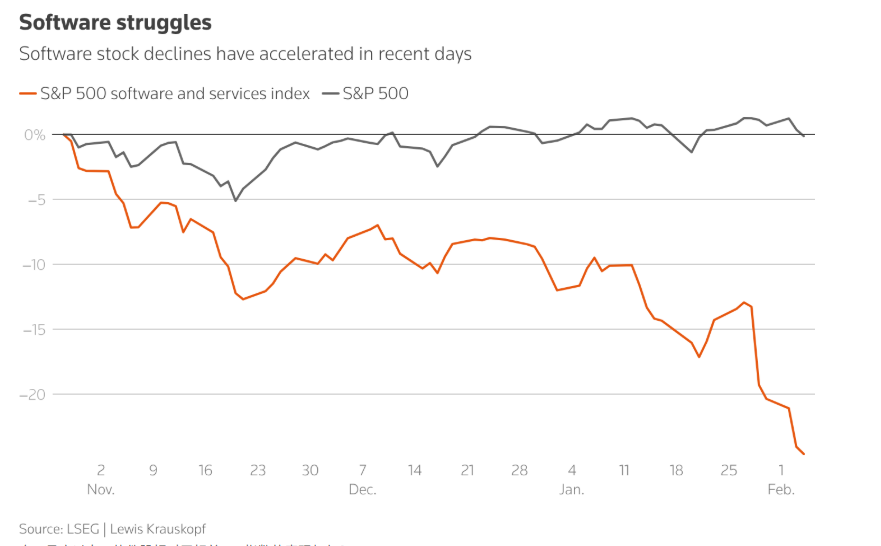
Group 1: Market Overview - The narrative of "Software-mageddon" is gaining traction among global investors, with debates on whether to initiate bullish calls on recently battered software stocks [1] - Large institutional investors are beginning to enter the market to buy the dip in software stocks that have experienced significant declines, with some supporting optimistic views on AI-focused software giants [1][3] - The S&P 500 Software and Services Index has dropped approximately 25% since its recent peak at the end of October, while the overall S&P 500 index has remained relatively stable [3][4] Group 2: Impact of AI Tools - The launch of Anthropic's AI programming tool, Claude Cowork, has intensified fears of AI agents disrupting the SaaS software industry, leading to a collective sell-off in software stocks [2] - The S&P 500 Software and Services Index experienced its worst performance since May 2002, with a significant market cap loss exceeding $800 billion [4] Group 3: Investor Reactions and Divergence - Institutional investors are showing mixed reactions, with some cautiously buying while others remain hesitant, indicating a divide in sentiment regarding the software sector [8] - Some portfolio managers are starting to see long-term value in certain software stocks, while others are waiting for stronger catalysts, such as robust AI-related revenue reports, before making aggressive purchases [8][9] Group 4: Future Outlook and AI Integration - The market is reassessing the value chain in the software industry, with AI potentially redistributing profits rather than completely replacing existing software infrastructure [11][12] - The current sell-off is seen as a response to the question of how much profit pools will be redistributed among SaaS vendors due to AI advancements, with a focus on real deployment and revenue growth from AI-related products [12][13]



Adobe 连夜认怂!前几天官宣关停 Animate 遭大量吐槽
程序员的那些事· 2026-02-05 10:29
Core Viewpoint - Adobe announced the discontinuation of its 25-year-old Animate animation tool, which was met with significant backlash from users, leading to a rapid reversal of the decision and highlighting the company's aggressive pivot towards AI products while neglecting user needs [1]. Group 1: Announcement and User Reaction - On February 2, Adobe declared it would shut down Animate, ceasing sales on March 1, with support for regular users until 2027 and enterprise users until 2029, without a direct replacement [1] - The decision sparked outrage among users who feared losing years of work and experience, criticizing Adobe for prioritizing AI over user needs and calling for the software to be open-sourced [1]. Group 2: Reversal of Decision - Following the user protests, Adobe quickly retracted its shutdown plan on February 4, confirming that Animate would continue to serve both new and existing users, providing technical support and security updates, but would not develop new features [1]. - This incident underscores the importance of user feedback in corporate decision-making, as Adobe's initial plan was ultimately abandoned due to the strong collective response from its user base [1].

万亿市值一夜蒸发,Claude Cowork血洗全球软件业,老黄急了
3 6 Ke· 2026-02-05 07:40
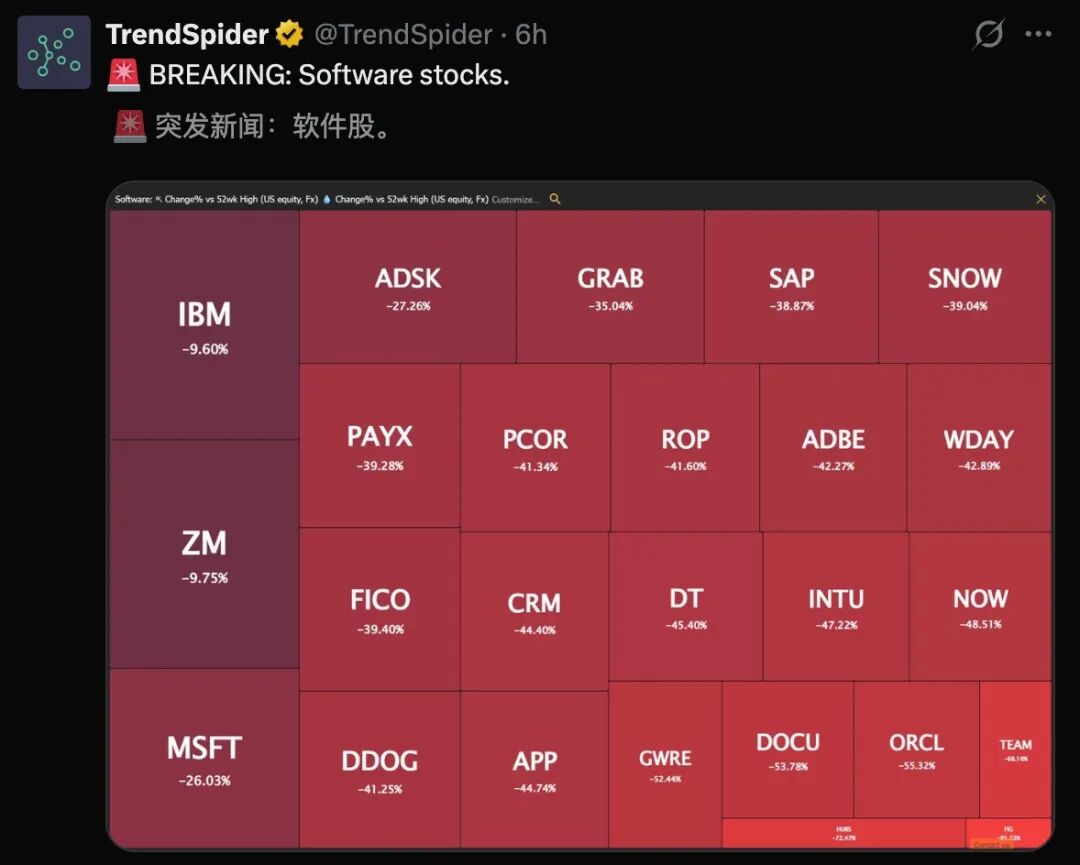
又崩了!硅谷软件巨头短短一夜,蒸发3000亿美金,过去一周全球近万亿美金没了。令人想不到的是,罪魁祸首竟是Anthropic推出的一款插件。 瞳孔地震!一夜之间,全球软件股集体跳水,蒸发3000亿美金。 如今,整个硅谷都在说:软件(SaaS)已死! | 90 0 0 00 | TrendSpider & @TrendSpider · 6h * BREAKING: Software stocks. | | | | | | | | | | --- | --- | --- | --- | --- | --- | --- | --- | --- | --- | | | * 突发新闻:软件股。 | | | | | | | | | | | Softwarn: & Change% vs 52wk High (US equity, Fx) & Change% vs 52wk High (US equity, Fx) Customze ... | | Q | | | | | | × | | | IBM -9.60% | ADSK -27.26% | | GRAB -35.04% | | SAP -38.87% | | SNOW ...

Earnings Outlook Improves: A Closer Look
ZACKS· 2026-02-05 01:20
Core Viewpoint - The Tech sector has emerged as a significant driver of aggregate earnings growth since Q2 2023, reversing a previous trend of decline that lasted for about six quarters starting in Q1 2022 [2][3] Group 1: Tech Sector Performance - The Tech sector has shown impressive earnings growth and a favorable estimates revision trend, contributing positively to stock market momentum [2][3] - Despite the overall positive outlook, certain segments, particularly software stocks, have faced challenges in the market [3][4] - Gartner's recent quarterly results highlight the struggles within the sector, as it reported better-than-expected EPS and revenue but provided disappointing guidance, leading to a 71% decline in its stock over the past year [4][5] Group 2: Earnings Trends and Estimates - The Q4 earnings season indicates a steadily improving earnings outlook, with total earnings for 236 S&P 500 members up 12.6% year-over-year, driven by an 8.2% increase in revenues [7] - For the Tech sector specifically, earnings are up 16.6% year-over-year, with 92.7% of companies beating EPS estimates and 90.2% beating revenue estimates, marking a notable improvement compared to previous periods [7][9] - The Tech sector is projected to contribute 36.7% of the S&P 500 index's total earnings over the next four quarters and currently represents 42.4% of the index's total market capitalization [16]



Why Software Is Facing A Market Sell-Off
Youtube· 2026-02-04 20:40
Software stocks have become ground zero for investors' anxiety over the possible disruption coming from AI. The software sector as a whole has lost about 30% of its value in just the last three months, with those losses accelerating this week even despite some relatively strong earnings from leaders such as Salesforce. com, such as Microsoft.Now the main concern here is that either free or cheap coding tools being rolled out by the likes of Anthropic, through its Claude service, may displace a lot of paid-f ...

Do Stock Sell-Offs Pay Off? These Experts Warn Not to ‘Bottom Feed' on New Lows
Investopedia· 2026-02-04 19:26
Core Insights - The article discusses the risks associated with buying stocks at new lows, particularly in the technology sector, and emphasizes that beaten-down shares may not be as attractive as they appear [1] Group 1: Market Trends - Recent sell-offs in technology stocks, including companies like Adobe, Salesforce, Intuit, and Workday, have led to many trading around 52-week lows [1] - Analysts warn against the common strategy of "buying the dip," suggesting that stocks making new lows often continue to decline [1] Group 2: Academic Insights - Research from Erasmus University and Northern Trust indicates that stocks with positive price momentum tend to yield better returns, while those with weak momentum continue to underperform [1] - The study analyzed long-short stock portfolios from 1990 to 2024, showing that winners keep winning and losers keep losing [1] Group 3: Market Recovery Patterns - Deutsche Bank's macro strategist notes that the year has seen sharp sell-offs that often recover quickly, with no lasting damage inflicted on the market [1] - Historical patterns suggest that significant market downturns are typically associated with negative macroeconomic reassessments, which have not been observed recently [1]

From AI Darlings To Bargains: 5 Tech Stocks Near Covid-Era Valuations
Benzinga· 2026-02-04 18:44
Wall Street spent 2024 worshiping artificial intelligence. In 2026, reality has set in. The S&P 500 is still steady, but software stocks have broken away to the downside in a move that feels less like routine rotation and more like genuine panic — the kind of selloff that usually creates bargains, not last rites.Software P/E CompressionAccording to Liz Thomas, Head of Investment Strategy at SoFi Technologies Inc (NASDAQ:SOFI) , software's forward 12-month P/E has collapsed from 33.1x to 23.2x — a 30% contra ...

Tech Sell-Off Weighs on Broader Market, Dow Defies Trend Amid Key Earnings and Economic Data
Stock Market News· 2026-02-04 17:07
Market Overview - The U.S. stock market is experiencing mixed trading patterns with a notable rotation out of technology giants and into broader market sectors [1] - The S&P 500 has slipped around 0.2% to 0.3%, marking a modest decline for the fourth time in the last five days [2] - The Nasdaq Composite has traded approximately 1% lower, with the Nasdaq 100 specifically seeing a 1.4% loss [2] - The Dow Jones Industrial Average has risen by as much as 389 points, or 0.8%, indicating a shift away from tech stocks towards firms expected to benefit from improving growth prospects [2] Economic Indicators - The yield on 10-year Treasuries has remained steady at 4.28% [3] - Upcoming economic data includes the ADP Employment Change and ISM Services PMI for January, which are crucial for assessing the labor market and services sector [5] - The week will culminate with the U.S. Employment Report on February 6th, which includes non-farm payrolls and average hourly earnings [6] Company-Specific Highlights - Advanced Micro Devices (AMD) shares dropped by as much as 15.7% despite stronger-than-expected profits, indicating high expectations for AI-related companies [9] - Uber Technologies (UBER) fell 3% to 5% after its quarterly results and profit forecast fell short of expectations [10] - Super Micro Computer (SMCI) rallied by 12% to 14% after delivering stronger-than-expected profits [10] - Eli Lilly (LLY) surged by 9.2% after exceeding profit expectations and providing strong guidance, driven by its obesity drugs [11] - Silicon Laboratories (SLAB) shares soared by 51% following the announcement of its acquisition by Texas Instruments for approximately $7.5 billion [13] - Nvidia (NVDA) shares declined 2.8% due to a broad tech sell-off and uncertainty surrounding its OpenAI investment [14]