American Express(AXP)

Search documents
Trump's Proposed 10% Credit Card Rate Cap Would Hurt - What Dividend Investors Should Do
Seeking Alpha· 2026-01-20 12:45
Group 1 - The President has proposed a 10% cap on credit card fees to assist Americans in managing their credit card costs [1] - This initiative aims to benefit lower and middle-class workers by promoting financial independence through better management of credit card expenses [1] Group 2 - The article emphasizes the importance of quality dividend-paying stocks for long-term investment strategies [1] - It highlights the role of dividend investing in supplementing retirement income over a 5-7 year horizon [1]



Is 2026 the Year to Buy American Express Stock?
Yahoo Finance· 2026-01-20 11:15
Core Insights - Warren Buffett's tenure as CEO of Berkshire Hathaway has concluded, but his investment in American Express remains significant for investors [1] - American Express shares have delivered a total return of 207% over the past five years, suggesting potential for retail investors to consider this financial stock [2] Company Overview - American Express is recognized for its strong economic moat, characterized by a premium brand in the card payments market, offering valuable perks and high annual fees that attract affluent customers [3] - The company connects 160 million merchant locations with 151 million active cards, creating a network effect that enhances the value of its ecosystem as it grows [4] - The competitive landscape appears favorable for American Express, with minimal threats from fintech innovations or traditional banking competitors [5] Financial Performance - American Express has demonstrated robust revenue and net income growth, with compound annual growth rates of 8.4% and 8.6% respectively from Q3 2015 to Q3 2025 [6] - The ongoing rise in spending activity and the shift towards noncash transactions are expected to support continued financial gains [6] Valuation Concerns - Despite the strong business fundamentals, the current valuation of American Express raises concerns, with a price-to-earnings ratio of 23.9, which is above its trailing five-year average [8] - The market sentiment remains optimistic about American Express, reflected in its premium valuation [8]
德银详解七大消费金融美股2026年业绩蓝图:指引比财报更重要 SoFi(SOFI.US)预期最被低估
智通财经网· 2026-01-20 09:00
Core Viewpoint - Deutsche Bank has released a report on the outlook for the U.S. consumer finance sector in 2026, focusing on the earnings guidance of seven companies, which is expected to have a greater impact on stock prices than the actual Q4 performance [1] Group 1: Company-Specific Guidance - American Express (AXP): Deutsche Bank expects a short-term revenue growth slowdown to 8.5% for FY2026, below the market expectation of 9.0%, with diluted EPS projected at $17.75, slightly above the consensus of $17.56 [2] - Synchrony Financial (SYF): Projected loan receivables growth of 4.75% for 2026, exceeding the market expectation of 3.14%, but net revenue forecasted at $15.7 billion, below the market's $16.5 billion [2] - Ally Financial (ALLY): Expected average earning assets growth of 1.7% in 2026, with net interest margin rising to 3.72%, slightly above the market expectation of 3.70% [3] - OneMain Holdings (OMF): Projected management receivables growth of 6.55% for 2026, below the market expectation of 8.00%, with revenue growth of 6.15%, also slightly below the consensus [3] - SoFi Technologies (SOFI): Management reiterated EPS guidance of $0.55-$0.80 for 2026, with a midpoint forecast of $0.67, significantly above the market consensus of $0.58 [4] - Navient Corp (NAVI): Expected NIM for private education loans to rise to 2.81% in 2026, with core EPS projected at $1.15, benefiting from market opportunities due to the cancellation of the GRAD PLUS program [5] Group 2: Market Trends and Influences - The guidance from these companies is expected to influence stock prices more than their Q4 actual performance, highlighting the importance of forward-looking statements in the consumer finance sector [1] - The report indicates that the consumer finance sector is experiencing varying growth rates, with some companies facing challenges due to market saturation and regulatory changes [2][3][4]





Berkshire Hathaway Has 56% of Its Portfolio in These 4 Stocks. Are They Buys to Begin 2026?
The Motley Fool· 2026-01-19 14:15
Core Viewpoint - Adding blue chip stocks, particularly those held by Berkshire Hathaway, can be a sound investment strategy due to their historical performance and stability. Group 1: Berkshire Hathaway's Portfolio - Berkshire Hathaway's portfolio is heavily concentrated, with its top four holdings comprising nearly 56% of its total stock portfolio [2] - The top four holdings are Apple (19.7%), American Express (17.3%), Bank of America (9.5%), and Coca-Cola (9.1%) [3] Group 2: Apple - Apple is the largest holding in Berkshire Hathaway's portfolio and has built a strong ecosystem around its products, enhancing customer retention [4][5] - The company generates significant free cash flow and has a growing service business that provides higher margins compared to hardware sales [6] - As of the latest data, Apple's market cap is $3.8 trillion, with a gross margin of 46.91% and a dividend yield of 0.40% [7] Group 3: American Express - American Express is positioned as a luxury brand, attracting affluent customers and generating steady income through premium card fees [8] - The company owns its payment network, allowing it to earn from transactions, annual memberships, and interest, differentiating it from competitors like Visa and Mastercard [9] - American Express has a market cap of $251 billion, a gross margin of 61.04%, and a dividend yield of 0.90% [11] Group 4: Bank of America - Bank of America operates across various banking sectors, making it a stable investment tied to the U.S. economy's long-term growth [12] - The bank's "too big to fail" status provides a safety net, enhancing consumer trust and regulatory stability [13] - As of the end of 2025, Bank of America had over $285 billion in cash and cash equivalents and over $3.4 trillion in assets, with a dividend yield of 2.04% [15] Group 5: Coca-Cola - Coca-Cola is a long-standing holding of Berkshire Hathaway, known for its stability and consistent dividend payments, having increased its annual payout for 63 consecutive years [16] - The company's products maintain strong sales regardless of economic conditions, providing it with pricing power [17] - Coca-Cola is considered a defensive stock, making it a reliable choice for long-term investors [16][18]


With Financial Stocks Suddenly Tanking, Is Now the Time to Buy?
Yahoo Finance· 2026-01-17 12:05
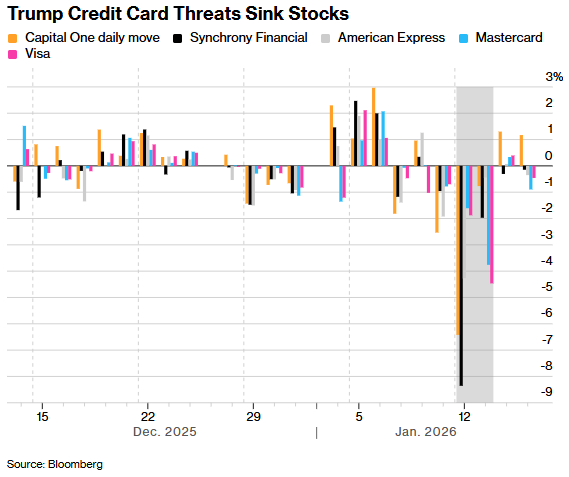
Core Viewpoint - The financial sector, particularly credit card issuers, is currently experiencing stock price declines despite potential long-term profitability due to proposed regulatory changes on interest rates [2][8]. Group 1: Impact of Proposed Interest Rate Cap - President Trump proposed a one-year, 10% cap on credit card interest rates, effective January 20, which has led to significant declines in stock prices of major credit card issuers [2][3]. - Major credit card issuers such as Bank of America, JPMorgan Chase, American Express, Capital One Financial, and Citigroup saw stock declines ranging from 4.5% to 9.9% following the announcement [9]. - Payment networks Visa and Mastercard also experienced stock drops of 8% and 6.9%, respectively, indicating a broader impact on the financial sector [4]. Group 2: Historical Context and Legislative Challenges - Previous attempts to cap credit card interest rates have failed, with a similar proposal by Senator Bernie Sanders stalling in Congress last year [5][6]. - The financial industry is expected to strongly oppose the current proposal, suggesting that it is unlikely to be enacted [6][7]. - Analysts predict that the banking industry will effectively counter this proposal before it gains traction [7].



US weighs executive action to cap credit card rates, Bloomberg News reports
Reuters· 2026-01-16 23:59
Core Viewpoint - The White House is considering an executive action to implement President Donald Trump's proposal for capping credit card interest rates, as reported by Bloomberg News, citing sources familiar with the matter [1] Group 1 - The potential executive action reflects the administration's focus on consumer financial protection [1] - The move could significantly impact credit card companies and their interest rate structures [1] - This initiative aligns with broader efforts to address consumer debt and financial burdens [1]

Kevin Hassett floats 'Trump card' proposal after pushback on credit card interest rate cap
Fox Business· 2026-01-16 23:47
Core Viewpoint - The Trump administration is proposing a 10% cap on credit card interest rates, which has faced opposition from the financial services industry due to concerns over access to credit for millions of consumers [1][2]. Group 1: Proposal Details - President Trump announced a proposed 10% cap on credit card interest rates, set to take effect on January 20, coinciding with the anniversary of his second inauguration [1]. - The proposal may require Congressional action and has been met with significant pushback from the financial services sector [2]. Group 2: Industry Response - National Economic Council Director Kevin Hassett indicated that discussions with major banks have included a "Trump card" aimed at expanding credit access for consumers [3][6]. - Hassett mentioned that large banks are supportive of the idea, suggesting they could voluntarily offer credit to consumers who are financially stable but currently lack access [6]. Group 3: Impact Analysis - The Electronic Payments Coalition (EPC) analyzed the potential impact of the proposed interest rate cap, estimating that 82% to 88% of credit card holders could lose their cards or face significant reductions in credit limits, particularly affecting low- to moderate-income consumers [9]. - EPC's analysis projected that nearly all credit card accounts linked to credit scores below 740 would be closed or severely restricted, impacting approximately 175 million to 190 million credit card holders [10]. - JPMorgan Chase's CFO warned that the proposed cap could lead to reduced access to credit, negatively affecting both consumers and the broader economy [13][14].

Banks CEOs Carefully Push Back on Trump's Credit-Card Rate Cap
WSJ· 2026-01-16 19:19
Core Viewpoint - Bank executives are cautiously opposing President Trump's proposal to temporarily cap credit-card interest rates at 10%, while trying to avoid conflict with the White House [1] Group 1 - The banking industry is navigating a delicate balance between opposing the interest rate cap and maintaining a positive relationship with the current administration [1] - Executives are concerned that capping interest rates could impact their profitability and lending practices [1]

“It’ll Be Weird,” If They Go After American Express (AXP) CEO, Says Jim Cramer
Yahoo Finance· 2026-01-16 18:21
Core Viewpoint - American Express Company (NYSE:AXP) has experienced a 14.7% increase in share price over the past year, but a decline of 3.8% year-to-date, influenced by President Trump's proposal for a 10% interest rate cap on credit card companies [2]. Group 1: Company Performance - American Express is one of the largest card payment and travel services companies in the U.S. [2]. - The company's shares have shown a significant annual increase but have faced a decline in the current year [2]. Group 2: Market Influences - The decline in share price is attributed to President Trump's suggestion of a 10% interest rate cap for credit card companies, aimed at reducing costs for consumers [2]. - Wolfe Research had previously set a Peer Perform rating for American Express, indicating potential for the company to exceed revenue and earnings per share targets [2]. Group 3: Analyst Commentary - Jim Cramer has frequently discussed American Express, linking its performance to consumer health and highlighting its successful card initiatives that appeal to younger users [2]. - Cramer expressed skepticism about the implications of the President's proposal on American Express, suggesting that targeting the company's CEO would be unusual [2].
特朗普利率突袭冲击金融股,华尔街高管财报季遭质询
智通财经网· 2026-01-16 12:48
Core Viewpoint - President Trump's unexpected request for credit card companies to set a cap on interest rates at 10% could significantly impact the profitability of the financial sector, leading to a decline in financial stocks and raising concerns among bank executives during earnings calls [1][4]. Financial Sector Impact - The proposed interest rate cap is half of the current average rate on outstanding balances, potentially erasing billions in profits for credit card issuers [1]. - Major banks such as Capital One (COF.US), JPMorgan Chase (JPM.US), and American Express (AXP.US) experienced significant stock declines following the announcement [1]. - Analysts from KBW indicated that if the policy is implemented, it would severely weaken the profitability of credit card issuers and could trigger economic repercussions [4]. Legislative Developments - Trump has called for Congressional support for the Credit Card Competition Act, which targets the nearly $200 billion in swipe fees charged by banks and payment companies, negatively affecting stocks of Visa (V.US) and Mastercard (MA.US) [4]. - Some analysts doubt the feasibility of the interest rate cap, suggesting that the probability of it being enacted is less than 20% due to the lack of legislative support [4]. Broader Economic Effects - Bank executives have warned that the interest rate cap could lead to a significant economic slowdown and push consumers towards unregulated lending sources [5]. - The proposed changes are expected to have ripple effects beyond the financial sector, impacting industries such as airlines and retail, which rely on partnerships with credit card companies for substantial revenue [7]. - Airlines like Delta (DAL.US) and United Airlines (UAL.US) saw stock declines, as did retailers like Macy's (M.US) and Kohl's (KSS.US), due to concerns over the potential impact of the proposed legislation [7].