Bank of America(BAC)

Search documents
Why Is Bank of America (BAC) Down 0.1% Since Last Earnings Report?
ZACKS· 2026-02-13 17:30
A month has gone by since the last earnings report for Bank of America (BAC) . Shares have lost about 0.1% in that time frame, outperforming the S&P 500.But investors have to be wondering, will the recent negative trend continue leading up to its next earnings release, or is Bank of America due for a breakout? Before we dive into how investors and analysts have reacted as of late, let's take a quick look at its most recent earnings report in order to get a better handle on the important drivers.Bank of Amer ...


美国银行股价回调,监管政策与业绩表现受关注
Jing Ji Guan Cha Wang· 2026-02-13 16:19
美国银行2025年第四季度及全年财报显示稳健表现:第四季度营收285.3亿美元,同比增长7.1%,每股 收益0.98美元超预期;全年营收1131亿美元,归母净利润305亿美元,同比增长13.1%。管理层在财报电 话会议中重申2026年净利息收入增长5%-7%的指引,并强调信贷扩张(2025年美国四大行贷款总额增速 超7%)和净息差韧性(美国银行2025年净息差2.08%)为盈利提供支撑,但需关注信用卡贷款等资产质量风 险。 近7天(2026年2月7日至13日),美国银行股价呈现回调态势。区间累计下跌7.84%,振幅达9.53%,最高 价为56.83美元(2月10日),最低下探51.44美元(2月13日)。成交活跃,区间成交额约104亿美元。最新交 易日(2月13日)收盘价52.10美元,单日跌幅0.80%,换手率0.09%,盘中振幅1.54%。同期银行板块整体 下跌0.55%,道指和纳指分别下跌1.41%和2.12%。 以上内容基于公开资料整理,不构成投资建议。 财报分析 经济观察网近期美国银行(BAC)的热点集中在监管政策动态和宏观经济评论。美联储针对银行压力测试 的改革提案公众意见征询期将持续至2026年 ...
Why Analysts Are Closely Watching Bank of America Corporation (BAC)
Yahoo Finance· 2026-02-13 15:09
Core Viewpoint - Bank of America Corporation (NYSE:BAC) is highlighted as a profitable mega cap stock, with recent price target adjustments reflecting market conditions and expectations for the banking sector [1][2]. Group 1: Price Target Adjustments - JPMorgan raised its price target for Bank of America to $61.50 from $61 while maintaining an Overweight rating, citing expectations of two rate cuts and stable fundamentals in the banking sector [1]. - Truist Securities lowered its price target for Bank of America to $60 from $62 but maintained a Buy rating, indicating adjustments in provision assumptions and share repurchase momentum [2]. Group 2: Earnings Projections - Truist Securities maintains its EPS guidance for Bank of America at $4.30 for 2026 and $4.95 for 2027, with a forecast of 160 basis points of positive operating leverage for the year, which is lower than the bank's own estimate of 200 basis points [3]. Group 3: Company Overview - Bank of America Corporation is a North Carolina-based financial services provider, founded in 1784, operating through four segments: Consumer Banking, Global Wealth & Investment Management, Global Banking, and Global Markets [4].
Musk’s bankers are discussing a plan to wrangle xAI debt after SpaceX merger
Yahoo Finance· 2026-02-13 14:44
Core Viewpoint - Elon Musk's bankers are exploring a financing plan following the merger of SpaceX and xAI to alleviate the significant interest costs incurred by Musk in recent years [1][2]. Group 1: Debt and Financing - Musk has accumulated nearly $18 billion in debt from the Twitter buyout and the establishment of xAI, with a financing deal expected to help reduce this debt burden ahead of a potential IPO later this year [2]. - Morgan Stanley, which facilitated Musk's Twitter acquisition and xAI's debt raising, is anticipated to play a key role in the financing plan, alongside other banks like Goldman Sachs, Bank of America, and JPMorgan [3]. - Musk's acquisition of Twitter was supported by a $12.5 billion financing package, which has resulted in substantial monthly interest payments [4]. Group 2: Debt Management and Market Response - Initially, banks holding Twitter's debt faced challenges due to concerns over Musk's content moderation approach, which affected ad revenue, leading to a delay in offloading the debt [5]. - In April, banks successfully sold the last portion of Twitter's buyout debt, amounting to $1.23 billion, at a fixed rate of 9.5% and a discounted price of 98 cents on the dollar [5]. - Following the merger with xAI, the social network was valued at $45 billion, including debt, and xAI subsequently took on an additional $5 billion in debt, with creditors expressing concerns about profitability and cash flow [6].


“抛售美国2.0”?美银:全球再平衡升温,非美资产走俏
Zhi Tong Cai Jing· 2026-02-13 11:08
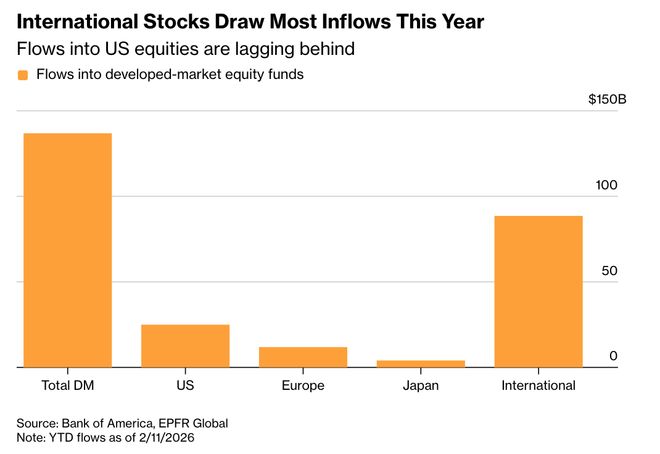
Group 1 - The core viewpoint of the article is that U.S. trade policies are creating a "new world order," leading investors to shift from U.S. assets to non-U.S. assets, particularly benefiting emerging market commodity-producing countries due to rising AI demand [1][4] - According to Bank of America strategist Michael Hartnett, the trend of moving away from U.S. stocks is supported by significant capital flows, with $104 billion flowing into international developed market equity funds compared to only $25 billion into U.S. equity funds this year [1] - Since the announcement of significant tariffs by former President Trump, U.S. assets have been volatile, and despite the withdrawal of some tariffs, the S&P 500 has underperformed compared to international indices, with the MSCI global index (excluding the U.S.) outperforming by 39% [4] Group 2 - The trend of capital shifting towards international markets has accelerated, with European, Japanese, Korean, and emerging market indices collectively outperforming U.S. stocks since the beginning of 2026, driven by a weaker dollar enhancing overseas returns [4] - Fund managers indicate that the perception of U.S. stocks as the only viable investment option is changing, with a growing interest in diversifying into international equities [5][6] - Despite some investors labeling the current trend as a "sell-off of America 2.0," many still believe that U.S. stocks will continue to lead the global market, albeit with a reduced advantage compared to previous years [5][6]
X @Bloomberg
Bloomberg· 2026-02-13 09:28
US trade policies are creating a “new world order” says Bank of America’s Michael Hartnett https://t.co/bekZmCJuB1 ...
Will Crypto ETFs Have Lasting Appeal? (BTC-USD)
Seeking Alpha· 2026-02-13 04:10
Core Insights - Bitcoin's price decline has not deterred the launch of new ETFs aimed at capitalizing on a potential rebound in the cryptocurrency market [2] - Regulatory changes, including the SEC's new generic listings standards (GLS) and the upcoming CLARITY Act, are expected to enhance investor interest in crypto ETFs, which raised $47.2 billion last year despite $5 billion in withdrawals in Q4 [3][4] Regulatory Developments - The GLS simplifies the listing process for crypto ETFs, allowing exchanges to list qualifying assets within five days without SEC approval, significantly reducing previous delays [8] - Under GLS, a crypto asset must be traded as a futures asset for at least six months, have a 12-month average liquidity of $700 million, and be part of the Intermarket Surveillance Group to gain approval [9] - The CLARITY Act, currently in Congress, aims to classify digital assets as "Digital Commodities," easing regulatory burdens for banks and encouraging institutional investment in crypto ETFs [15][16] Institutional Adoption - Major U.S. banks and asset managers are increasingly advising clients to include crypto in diversified portfolios, with Bank of America allowing its advisors to recommend spot Bitcoin ETFs [12] - Morgan Stanley has launched a Solana ETF with staking rewards, reflecting a trend where ETF issuers are incorporating proof-of-stake rewards to enhance fund attractiveness [13] - Analysts predict that ETF inflows could double by 2026 as more institutions enter the crypto space [4][19] Market Trends - The derivatives market is also showing growth, with CME Group expanding its crypto derivatives offerings, indicating a robust interest in crypto products [5] - Despite a reported bear market for Bitcoin, with significant holdings reductions in Q4 2025, some analysts remain optimistic about institutional interest and potential price recovery [20][21][22]



美国银行2026年关键事件展望:监管调整与产品发行
Jing Ji Guan Cha Wang· 2026-02-12 19:34
经济观察网美国银行(BAC)在2026年面临多项可能影响其市场关注度与运营环境的关键事件,包括监管 政策调整、金融产品发行及业绩指引。 行业政策与环境 美国银行业监管机构正推进多项放松措施。针对全球系统重要性银行(GSIB)的增强补充杠杆率(eSLR)规 则已调整,机构需在2026年4月1日前遵守新规,但可提前自愿采用。同时,美联储压力测试改革的公众 意见征询期将持续至2026年2月21日,若通过可能简化银行资本要求。 业务进展情况 美国银行于2026年2月4日发行了固定收益缓冲票据,该票据由BofA Finance LLC发行,BAC提供担保。 票据赎回期将从2026年8月4日开始,每月可赎回一次,其回报与市场指数挂钩,可能涉及本金波动风 险。 业绩战略 公司管理层在2025年第四季度财报中重申了2026年净利息收入增长5%-7%的预期。下一季度财报(2026 年第一季度)通常于4月左右发布,投资者可关注官方公告以获取具体日期。 以上内容基于公开资料整理,不构成投资建议。 ...
How to Approach Wells Fargo Stocks as It Gains 14.2% in 6 Months?
ZACKS· 2026-02-12 18:16
Core Insights - Wells Fargo's shares have increased by 14.2% over the past six months, outperforming the industry growth of 11.3% [1]. - The bank's peers, Citigroup and Bank of America, have seen their shares rise by 24% and 14%, respectively, during the same period [1]. Performance and Growth Drivers - The removal of the asset cap by the Federal Reserve in June 2025 allows Wells Fargo to expand its balance sheet, grow deposits, and increase loan balances, which is expected to drive loan growth in 2026 [4][5]. - Wells Fargo anticipates a net interest income (NII) of $50 billion in 2026, supported by balance-sheet growth and changes in loan mix [10][5]. - The bank's net interest income has shown a four-year compounded annual growth rate (CAGR) of 7.5% as of 2025 [8]. Strategic Initiatives - Wells Fargo is focusing on cost-cutting measures, including a 5.9% reduction in headcount and refurbishing 700 branches to enhance efficiency [5][16]. - The bank is also advancing its operational transformation through a phased rollout of artificial intelligence (AI) tools, which is expected to improve productivity and customer service [17]. - The company is pursuing a multi-year simplification plan to exit non-core businesses, aiming to cut costs by up to $10 billion annually and reallocate capital to higher-return areas [21][25]. Capital Management - Wells Fargo has raised its common stock dividend by 12.5% to 45 cents per share and has a robust share repurchase program with an additional $40 billion authorized [26][27]. - The bank's liquidity coverage ratio stands at 119%, exceeding the regulatory minimum, with liquid assets totaling $174.2 billion as of December 31, 2025 [28][29]. Valuation and Earnings Outlook - The Zacks Consensus Estimate indicates earnings growth of 9.9% and 12.8% for 2026 and 2027, respectively, although estimates have been revised downward recently [30]. - Wells Fargo's current price-to-earnings (P/E) ratio is 12.71X, lower than the industry average of 14.29X, suggesting the stock is reasonably priced [32]. Conclusion - The removal of the asset cap and improved balance-sheet flexibility mark a significant turning point for Wells Fargo, enhancing its long-term outlook [35]. - Despite recent positive momentum, there are concerns regarding elevated expenses and downward revisions to earnings estimates, leading to a balanced risk-reward profile for investors [36][37].

AI Shockwave: SCHW, LPLA & Others Slide on Disruption Fear
ZACKS· 2026-02-12 18:16
Core Insights - Artificial intelligence (AI) is transitioning from a growth driver for technology stocks to a disruptor in traditional financial services, impacting market expectations for wealth management firms globally [1] - Major wealth management and brokerage stocks have experienced significant declines as investors assess the implications of new AI tools that automate tasks previously performed by human advisors [1] Stock Performance - The Charles Schwab Corp. (SCHW) has decreased by 10.9%, LPL Financial Holdings Inc. (LPLA) by 13.8%, and Raymond James Financial Inc. (RJF) by 8.8% in recent trading days [2] - Other firms such as Lazard and Stifel Financial have also seen declines of nearly 4% and 4.9%, respectively, while banks with substantial wealth management exposure, including JPMorgan Chase (JPM), Bank of America (BAC), and Wells Fargo, have dropped more than 4% [2] Trigger for Stock Selloff - The stock market reaction was initiated by the launch of an AI-powered tax planning tool by U.S. fintech startup Altruist, which is integrated into its Hazel platform [3] - This tool can process client data to generate personalized tax strategies and financial insights that previously required extensive manual work from advisors [3] Investor Concerns - Investors view the AI tool as a potential threat to traditional revenue streams in wealth advisory, particularly in fee-based services like tax planning and portfolio strategy [4] - The ability to commoditize and scale complex financial advice rapidly raises concerns about the erosion of fee margins and business models for existing firms [4] Shift in Market Focus - The market's focus has shifted from beneficiaries of the AI boom to those who might be displaced by it, affecting asset management and private capital firms [5][6] - Executives from firms like Blackstone and Apollo Global Management have attempted to reassure stakeholders that AI is unlikely to undermine their businesses, but skepticism remains prevalent [6] Reassessment of Risks - The initial optimism surrounding AI is evolving into a reassessment of risks, as investors consider the potential for AI to compress margins and alter business models [7] - The recent selloff in wealth management stocks signifies a turning point in how investors perceive AI risk within financial services [8] Implications for Wealth Management - The declines in shares of firms like Schwab, LPL Financial, and Raymond James reflect fears that AI could diminish advisory fees and disrupt established operating models [8][9] - While it is too early to label AI as an existential threat to human-led wealth advice, the rapid advancement of tools like Altruist's Hazel platform necessitates a reevaluation of defensible areas within the value chain [10] - Success for incumbents will likely hinge on the effective integration of AI into client service, compliance, and portfolio construction, where trust and judgment remain essential [10]