
Bank of America(BAC)

Search documents
Bank of America (BAC) Maintains Dividend Amid Strong Earnings and Moderate Outlook
Yahoo Finance· 2026-02-08 09:31
Core Viewpoint - Bank of America Corporation (NYSE:BAC) is recognized as a strong long-term investment option by hedge funds, maintaining a consistent dividend while reporting strong earnings despite a moderate outlook for future growth [1][8]. Financial Performance - For Q4 2025, Bank of America reported an earnings per share (EPS) of $0.98, exceeding expectations of $0.96, with quarterly revenue reaching $28.4 billion, surpassing the forecast of $27.55 billion [2][3]. - The bank's earnings beat was primarily driven by lower provisions and a slight increase in net interest income [3]. Dividend Information - The Board of Bank of America declared a quarterly dividend of $0.28 per share for Q1 2026, consistent with the amount paid since July 2024 when the dividend was raised from $0.24 [1]. Analyst Insights - TD Cowen lowered its price target for Bank of America stock from $66 to $64 while maintaining a Buy rating, reflecting a cautious outlook following the earnings report [2]. - Analyst Steven Alexopoulos noted that the bank's guidance for near-term operating leverage is approximately 200 basis points for FY 2026, which is at the lower end of the medium-term target range of 200 to 300 basis points [4].

X @Nick Szabo
Nick Szabo· 2026-02-06 22:02
RT Neon White Rabbit (@RedPillRabbit)This Indian worked at Bank of America for 7 years and calls it Bank of American 🤣.Says all the MANAGERS are women Indians who got jobs by being neighbors with no experience.This whole post is very revealing. https://t.co/oCMfbaxHQi ...
Mayo Says This Is a 'New Era for Bank Consolidation' (Correction)
Youtube· 2026-02-06 21:02
Core Viewpoint - The current regulatory environment is facilitating bank mergers, leading to a significant wave of consolidation in the banking industry, with a potential reduction in the number of banks in the U.S. from 4,600 to half over the next decade [3][2]. Group 1: Regulatory Environment - The regulatory landscape has previously suppressed bank mergers, but recent changes are allowing for faster and more certain deal approvals, which is seen as a positive development for the industry [2][12]. - There is a belief that the new Fed chair will simplify regulations, reducing bureaucracy and enabling banks to engage in more lending and pursue deals with greater certainty [12][13]. Group 2: Market Dynamics - The need for economies of scale is driving consolidation, with banks needing to compete more aggressively, especially in technology spending [1][2]. - The current economic conditions, including stable interest rates, are prompting banks, particularly those sized between $20 million and $100 million, to consider selling [8][9]. Group 3: Investment Opportunities - Certain banks, such as Bank United, Bank of California, and Associated Banks, are trading below their franchise values, indicating potential for stock price increases, whether through acquisitions or organic growth [5][6]. - The recent merger involving Bank of Santander highlights the attractiveness of the U.S. banking market to foreign banks, suggesting that more cross-border deals could occur [7][6]. Group 4: Future Outlook - There is a strong sentiment that the next six months present a critical window for banks to engage in mergers and acquisitions before potential political changes could alter the regulatory landscape [14][13]. - The consolidation trend is expected to continue, with a significant number of smaller banks likely to be acquired in the coming years [3][4].


Dow stuns with more than 1,200-pt gain to break 50,000 for first time
Yahoo Finance· 2026-02-06 20:53
Core Viewpoint - U.S. stocks experienced a significant rebound on February 6, with the Dow Jones Industrial Average closing above 50,000 for the first time, indicating a recovery in investor confidence despite previous market volatility [1][2]. Market Performance - The Dow closed up 2.47%, gaining 1,206.95 points to reach 50,115.67, while the S&P 500 rose 1.97%, or 133.90 points, to 6,932.30. The Nasdaq increased by 2.18%, or 490.627 points, to 23,031.213 after a prior decline of 4.5% over three sessions [3]. - Bitcoin saw a rebound of approximately 12%, rising to $70,287.83 after previously dropping below $61,000, marking a significant recovery from its record high of $126,000 [4]. Economic Indicators - The University of Michigan's consumer sentiment survey reached its highest level since August, and short-term inflation expectations dropped to 3.5%, the lowest in over a year, contributing to the market's positive momentum [2]. - Bank of America reported continued payroll growth and a leveling off of unemployment payments, suggesting an improving labor market at the start of 2026 [6]. Corporate Earnings Outlook - Jeff Buchbinder from LPL Financial expressed confidence in corporate earnings growth, citing an improving manufacturing outlook that could support double-digit earnings growth for at least the next two quarters [6].

JPMorgan, Goldman, Bank of America Boost Bonus Pools by at Least 10%
Youtube· 2026-02-06 18:16
Group 1 - The M&A market is showing strong signs of recovery in 2025, which is influencing banks' strategies for rewarding talent and managing expenses [1][5] - Banks are balancing the need to retain top talent with the necessity of controlling costs, leading to an average bonus increase of 10%, while top performers may earn nearly double that amount [2][4] - Performance disparities exist, with underperformers potentially receiving no bonuses, highlighting the competitive nature of compensation in the industry [3] Group 2 - The year-over-year performance for investment banking in 2025 is significantly better than previous years, indicating a steep increase in earnings for investment bankers [5] - Traders are also experiencing a favorable environment, with 2024 and 2025 projected to be strong years, leading to potentially higher payouts due to increased order handling [6] - Banks are exploring efficiency improvements, considering whether to build in-house capabilities or partner with firms like Anthropic to enhance operational strategies [8] Group 3 - The challenge for banks moving forward is to find ways to increase compensation for employees while potentially reducing headcount, thereby improving overall efficiency [9]
中期选举行情爆发在即 美银看好中小盘股成美股新主线
智通财经网· 2026-02-06 13:07
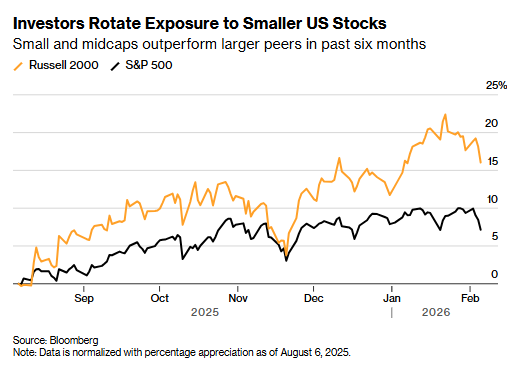
Group 1 - The core viewpoint is that as the U.S. midterm elections approach, the attractiveness of major tech companies is declining, making small and mid-cap stocks the best investment choice [1][2] - The U.S. Bank strategist team, led by Michael Hartnett, indicates that aggressive intervention policies by President Trump to lower costs in energy, healthcare, credit, housing, and electricity are putting pressure on energy giants, pharmaceutical companies, banks, and large tech sectors [1] - The report suggests a strategy of going long on the real economy sectors while shorting Wall Street financial sectors until Trump's approval ratings rise due to a shift towards livelihood issues [1] Group 2 - Investors are accelerating their exit from tech stocks due to concerns over the impact of artificial intelligence (AI) technology, seeking investments that will benefit from the Trump administration's cost-lowering measures [2] - The Nasdaq 100 index recorded its largest three-day decline since April, dropping 4.6%, while the S&P 500 index has underperformed its equal-weighted index by 4.2 percentage points year-to-date [2] - The Bank of America notes a significant shift in corporate business models from "light asset" to "heavy asset," posing a major threat to the market dominance of the so-called "seven giants" in tech [2] - It is projected that AI capital expenditures for large tech companies will reach approximately $670 billion this year, accounting for 96% of their cash flow, compared to only 40% in 2023 [2] - The era of large-scale stock buybacks for these companies is considered to be over, as their balance sheet advantages diminish [2] - Hartnett has been optimistic about international stocks since late 2024, a prediction that has proven to be highly prescient as U.S. stock performance continues to lag behind global markets [2]
Bank of America Announces Full Redemption of Its Series DD Preferred Stock and Related Depositary Shares
Prnewswire· 2026-02-05 21:15
Core Viewpoint - Bank of America Corporation will redeem all outstanding shares of its Fixed-to-Floating Rate Non-Cumulative Preferred Stock, Series DD, along with the corresponding depositary shares on March 10, 2026, at a redemption price of $1,000 per depositary share [1][2]. Group 1: Redemption Details - The redemption of the Preferred Stock and Depositary Shares will occur on the upcoming dividend payment date, March 10, 2026 [2]. - Declared dividends of $31.50 per depositary share for the current semi-annual period will be paid separately on the same date to holders of record as of February 15, 2026 [2]. - The redemption price does not include any accrued and unpaid dividends, which will cease to accrue on the Redemption Date [2]. Group 2: Redemption Process - The Depositary Shares are held through The Depository Trust Company (DTC) and will be redeemed according to DTC's procedures [3]. - Payment for the Depositary Shares will be managed by Computershare Inc. and Computershare Trust Company, N.A., acting as the redemption agent [3]. Group 3: Company Overview - Bank of America is a leading financial institution providing a full range of banking, investing, asset management, and financial services to individual consumers, small and middle-market businesses, and large corporations [4]. - The company serves nearly 70 million clients in the U.S. through approximately 3,600 retail financial centers and about 15,000 ATMs, along with a robust digital banking platform [4]. - Bank of America is recognized as a global leader in wealth management, corporate and investment banking, and trading across various asset classes [4].

Before Retiring, Warren Buffett Sold These 6 Stocks and Piled Into This High-Yield Investment
Yahoo Finance· 2026-02-05 12:05
Core Insights - Warren Buffett has stepped down as CEO of Berkshire Hathaway after over 65 years, transforming the company from a failing textile business into a diversified conglomerate with a wide range of subsidiaries and investments in publicly traded companies [1] Investment Strategy - Despite Buffett's famous quote about a "forever" holding period, he has been actively buying and selling stocks based on market valuations, being a net seller of stocks in every quarter leading up to his retirement at the end of 2025 [2] - In the most recent quarter, Berkshire Hathaway sold $12.5 billion worth of stocks, with specific details revealed in the SEC's form 13F filing [3] Stock Sales - Buffett has been reducing Berkshire's stakes in Apple and Bank of America due to their high valuations, with Apple trading at a P/E ratio comparable to faster-growing tech companies despite slow revenue growth [4] - Bank of America's share price has significantly increased since Buffett's initial investment, nearing twice its tangible book value by the end of 2025 [5] Unique Transactions - The sale of Verisign, which has exclusive rights to register .com and .net domain names, is notable as it reduced Berkshire's stake below 10%, triggering SEC disclosure requirements. Additionally, Berkshire has committed not to sell any remaining stake for at least one year [8]

Big US banks boost Washington lobbying muscle as policy fights heat up
Reuters· 2026-02-05 11:09
Core Insights - Major U.S. banks increased their lobbying expenditures by 12% last year, marking the highest growth in over a decade as they sought to adapt to significant policy changes in Washington under President Donald Trump's administration [1] Group 1: Lobbying Expenditures - The total lobbying spend by big U.S. banks reached a new high, reflecting their intensified efforts to influence policy decisions [1] - This increase in lobbying spending indicates a strategic response to the evolving regulatory landscape and potential changes in financial policies [1] Group 2: Political Environment - The political climate under President Trump has prompted banks to reassess their lobbying strategies to better navigate the shifting policy environment [1] - The heightened lobbying activity suggests that banks are prioritizing engagement with policymakers to safeguard their interests amid potential regulatory changes [1]

贵金属冰火两重天:黄金获投行力挺,白银遭集体谨慎对待
Jin Shi Shu Ju· 2026-02-05 09:07
Core Viewpoint - The recent volatility in precious metal prices, particularly gold and silver, has led investment banks to increase their bullish positions on gold while cautioning against heavy investments in silver [1][4]. Group 1: Gold Market Analysis - Gold prices experienced a significant drop, falling below $4,800, after a brief rebound earlier in the week [1]. - Despite the recent sell-off, many market observers, including UBS and Goldman Sachs, maintain a bullish outlook on gold, predicting prices could reach $6,200 next month and $5,900 by year-end [2][3]. - UBS identifies that the current sell-off is a normal fluctuation within a structural uptrend, with no signs of a bull market ending [2]. - Goldman Sachs forecasts a price of $5,400 per ounce by December 2026, supported by central banks increasing gold reserves and private investors boosting gold ETF purchases [2]. Group 2: Silver Market Analysis - Silver prices have seen a dramatic decline of over 30% from recent highs, with UBS suggesting that further declines are necessary for the metal to become attractive for investment [4][5]. - UBS highlights that silver's industrial demand complicates its price dynamics, as rising prices may suppress industrial usage [5]. - Analysts from Goldman Sachs express caution regarding silver due to liquidity issues in the London market, which exacerbate price volatility [5]. - American Bank also holds a cautiously optimistic view on silver but notes potential upward resistance from declining solar panel demand [5]. Group 3: Market Volatility and Investor Sentiment - The recent volatility in precious metals has created opportunities for investors seeking returns, despite the associated risks [2]. - UBS emphasizes the need for investors to carefully assess the expected returns on highly volatile assets like silver, which currently do not meet the required return thresholds [4]. - The market remains sensitive to geopolitical tensions and monetary policy changes, which could influence precious metal prices moving forward [1][3].

