
Barclays(BCS)

Search documents
英国巴克莱银行发生严重IT故障
Zhong Guo Ji Jin Bao· 2026-02-11 06:33
Core Viewpoint - Barclays Bank experienced a significant IT failure that disrupted services for customers over a three-day period, affecting online and mobile banking functionalities [3][4][8]. Group 1: Incident Details - The IT issue began on Friday and led to outdated balance displays and unprocessed payments for customers [3][4]. - Customers received notifications about the ongoing issues, with the bank acknowledging that the resolution took longer than expected [4]. - The failure was attributed to technical problems and was not related to a cyber attack [5]. Group 2: Customer Impact - The service disruption coincided with many customers' payday and the self-assessment tax return deadline, causing difficulties in making payments to HMRC [5]. - Reports indicated that over half (52%) of the issues reported were related to mobile banking, while 38% were linked to online banking [5]. - Barclays advised customers facing financial difficulties to seek support from friends and family and provided links to food bank resources [7]. Group 3: Resolution and Company Response - After three days, Barclays announced that the technical issues had been resolved, and delayed payments were being processed [8]. - The bank expressed apologies for the disruption and assured that no affected customers would incur financial losses [5][8]. - Barclays, one of the largest banks in the UK with over 20 million retail customers, confirmed that all services were back to normal [8].

缩表-“美联储财政部协议”-降息,这就是沃什的“阳谋”?
Hua Er Jie Jian Wen· 2026-02-11 03:44
Core Viewpoint - The article discusses the need for the Federal Reserve to adjust its balance sheet strategy by shifting from long-term to short-term Treasury securities to reduce duration risk and potentially lower policy interest rates [1][19]. Group 1: Current State of the Fed's Balance Sheet - As of early 2026, the Federal Reserve's balance sheet is approximately $6.6 trillion, significantly higher than pre-pandemic levels of $4.4 trillion and $0.9 trillion before the Global Financial Crisis (GFC) [2]. - The balance sheet structure is deemed "distorted" by some analysts, with reserves nearing $3 trillion, accounting for 12% of bank assets [2][16]. - The weighted average maturity (WAM) of the Fed's Treasury holdings is about 9 years, compared to only 3 years before the GFC, indicating a longer duration risk [2][11]. Group 2: Proposed Strategy for Duration Management - The proposed strategy involves the Fed reinvesting maturing securities into short-term Treasury bills (T-bills) instead of similar long-term assets, which could increase T-bill holdings from $289 billion to approximately $3.8 trillion over five years [23]. - This shift would reduce the Fed's portfolio duration from 9 years to about 4 years, aligning more closely with pre-GFC norms [23][24]. Group 3: Coordination with the Treasury - Successful implementation of this strategy requires coordination with the Treasury to avoid market disruptions. If the Treasury increases long-term debt issuance without Fed support, it could lead to a significant supply-demand imbalance in the long-term bond market [25]. - The ideal scenario would involve the Treasury maintaining long-term issuance levels while increasing T-bill issuance to meet the Fed's needs, stabilizing the market [28]. Group 4: Implications for Interest Rates and Market Dynamics - A shorter duration portfolio may lead to an increase in term premiums, necessitating a reduction in policy interest rates to maintain economic stability [29]. - Research indicates that to offset the effects of a shorter duration portfolio, the federal funds rate may need to be lowered by 25 to 85 basis points [29][36].

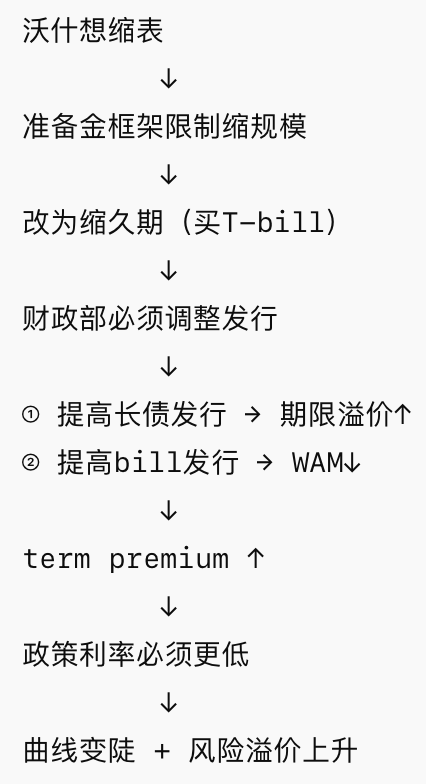
巴克莱:美联储缩表将耗时多年 或需降息对冲 五年市场需额外吸收1.7万亿美元10年期等价债务推高成本40——50基点
Sou Hu Cai Jing· 2026-02-10 23:36
Group 1 - The core viewpoint is that the transition to a smaller Federal Reserve balance sheet requires close coordination between the central bank and the Treasury to avoid excessive market volatility [1] - The normalization of the balance sheet is expected to be a multi-year process, with potential risk premiums demanded by investors during the transition [1][3] - The Federal Reserve's balance sheet peaked at approximately $8.9 trillion in June 2022, significantly expanded from $800 billion two decades ago, and is projected to decrease to $6.6 trillion by November 2025 [1] Group 2 - Barclays notes that the Federal Reserve could reduce its balance sheet by stopping the Reserve Management Purchases (RMP), but this may lead to renewed funding pressures [2] - To achieve meaningful balance sheet reduction, the demand for reserves by banks must be lowered, with current bank reserves at $2.94 trillion and a suggested reduction in the reserve ratio from 12% to 8-9% [2] - An alternative approach involves reinvesting maturing long-term government bonds and mortgage-backed securities into short-term government debt, which requires close coordination with the Treasury to avoid increasing long-term bond issuance costs [2] Group 3 - Both proposed outcomes are not ideal for the Treasury, and the Federal Reserve may ultimately need to lower policy rates to counteract the tightening market environment [3] - Significant balance sheet reduction is feasible, provided that the Federal Reserve and the Treasury have clear and aligned objectives to stabilize market expectations [3]
Barclays Q4 Earnings Increase Y/Y, Credit Impairment Charges Decline
ZACKS· 2026-02-10 18:35
Core Insights - Barclays reported a fourth-quarter 2025 net income of £1.19 billion ($1.63 billion), reflecting a 23.8% increase year-over-year, supported by revenue growth and a strong balance sheet [1][7] Financial Performance - Total income for the quarter was £7.08 billion ($9.65 billion), up 1.6% year-over-year [2] - Operating expenses (excluding litigation and conduct costs) rose to £4.61 billion ($6.28 billion), an increase of 3.1% year-over-year [2] - The cost-to-income ratio remained stable at 66% compared to the previous year [2] - Credit impairment charges decreased to £535 million ($729.7 million), down 24.7% year-over-year [2][7] - Pre-tax income was reported at £1.86 billion ($2.53 billion), an 11.9% increase from the prior-year quarter [2] Balance Sheet Strength - Total assets as of December 31, 2025, were £1,544.2 billion ($2,106.3 billion), a 1.7% increase from December 31, 2024 [3] - Total risk-weighted assets slightly decreased to £356.8 billion ($486.7 billion) as of December 31, 2025 [3] - The Common Equity Tier 1 (CET1) ratio improved to 14.3% from 13.6% a year earlier [3][7] Share Buyback and Capital Returns - Barclays announced a new share buyback plan of up to £1 billion concurrent with the earnings release [4] - The company plans to return at least £10 billion between 2024 and 2026 through dividends and share buybacks, with a preference for buybacks [9] - A multi-year capital return plan is subject to supervisory and board approvals [9] Future Guidance - For 2026, Barclays projects total income of £31 billion, up from a previous estimate of around £30 billion [5] - Net interest income (NII) is expected to exceed £13.5 billion, with Barclays U.K. projected to generate NII between £8.1 billion and £8.3 billion [5] - The cost-to-income ratio is anticipated to be in the high 50s percentage range [5] - The CET1 ratio is expected to remain between 13-14%, with a return on tangible equity (RoTE) estimated to exceed 12% [6] Long-term Outlook - Barclays expects total income to grow at a compound annual growth rate (CAGR) of more than 5% from 2025 to 2028 [10] - The cost-to-income ratio is projected to be in the low 50s, including gross efficiency savings of approximately £2 billion during 2026-2028 [10] - The loan loss rate is expected to remain stable at 50-60 basis points through the cycle [10]

Barclays(BCS) - 2025 Q4 - Annual Report
2026-02-10 17:42
Financial Performance - Barclays reported a net interest income (NII) of £12.5 billion for the year ended December 31, 2025, representing a 5% increase compared to £11.9 billion in 2024[12]. - Return on average allocated equity was reported at 12.2%, up from 11.5% in the previous year, indicating improved profitability[17]. - The bank's total income for 2025 was £29.1 billion, with a cost-to-income ratio of 61%[50]. - Barclays UK achieved a profit before tax of £3.4bn in 2025, with a return on equity (RoE) of 15.5% and operating expenses of £4.9bn[67]. - The UK Corporate Bank delivered a robust income growth of 16% in 2025, with total loan growth of £4.6bn and a RoE of 18.9%[70][72]. - The US Consumer Bank (USCB) reported a return on equity (RoE) of 9.5%, up from 8.1% in 2024, and a return on tangible equity (RoTE) of 11.0%, up from 9.1% in 2024[123]. Growth and Strategy - Barclays aims to achieve a return on tangible equity of 14% by 2028, supported by strategic cost-saving initiatives and business growth[18]. - The Group's total assets increased to £1.5 trillion, a 4% rise from £1.44 trillion in 2024, driven by growth in customer deposits and lending[12]. - Barclays plans to expand its market presence in Asia, targeting a 10% increase in market share by 2026 through strategic partnerships and product offerings[18]. - The bank's diversified model supports synergies across its five business areas, enhancing accountability and transparency for shareholders[50]. - Barclays plans to launch a new Singapore booking center in 2026 to enhance its international capabilities in the Middle East and Asia[96]. Technology and Innovation - The company is investing £1 billion in technology and innovation over the next three years to enhance digital banking services and improve customer experience[18]. - The bank's hybrid cloud strategy has nearly 90% of its estate in the cloud, enhancing resilience and operational performance[41]. - Barclays has invested in AI tools for approximately 100,000 colleagues, aiming to improve productivity and innovation[39]. - The digital capabilities enhancement led to approximately 50% of client interactions being self-served in 2025, up from 40% in 2024[73]. Sustainability and Social Responsibility - Barclays has set a target to reduce its carbon emissions by 50% by 2030, aligning with global sustainability goals[18]. - Barclays facilitated an additional $98.5 billion of Sustainable and Transition Financing in 2025, bringing the total to $260.7 billion since the beginning of the initiative[195]. - The bank aims to achieve net zero emissions by 2050 and has set 2030 financed emissions reduction targets for eight high-emitting sectors[199][201]. - Barclays is actively scaling climate tech companies through the Barclays Climate Tech Escalator, providing tailored support to help them grow[208]. - The bank recognizes the importance of balancing energy security with transition progress, continuing to provide capital to the conventional energy sector[207]. Customer Experience and Engagement - Client satisfaction scores increased to 66%, up four percentage points from 2024 and ten percentage points from 2023, reflecting improved client experience initiatives[78]. - The Net Promoter Score (NPS) for Barclays UK main current accounts improved to +25, the highest since tracking began in 2013, reflecting enhanced customer service[142]. - Barclays UK extended branch opening hours by approximately 33,500 hours per year to improve customer service[54]. - In 2025, Barclays UK attracted approximately 580 new clients, contributing to a 1% increase in lending market share compared to 2024[71]. Employee Engagement and Development - Barclays granted colleagues shares valued at approximately £500 in February 2025, with a similar award planned for 2026[162]. - By the end of 2025, almost 25,000 colleagues achieved accreditation through the Risk and Control Digital Credential program, enhancing risk management capabilities[166]. - In 2025, Barclays hired 1,595 graduates, 1,508 interns, and 213 apprentices globally, reinforcing its commitment to building a strong talent pipeline[168]. - Colleague engagement remained stable at 85% in 2025, four percentage points above the external benchmark[183]. - The Inclusion Index for 2025 was stable at 81%, reflecting consistent colleague sentiment regarding inclusion and respect[187].
Barclays(BCS) - 2025 Q4 - Annual Report
2026-02-10 17:37
Financial Performance - Barclays achieved a return on tangible equity (RoTE) of 11.3% in FY25, up from 10.5% in FY24, with earnings per share (EPS) increasing by 22% to 43.8p[19][22]. - Group profit before tax increased to £9.1bn in FY25, up 13% from £8.1bn in FY24, with a RoTE of 11.3% compared to 10.5% in FY24[32]. - Group income rose by 9% year-on-year to £29.1bn, with net interest income (NII) excluding Investment Banking and Head Office increasing by 13% to £12.8bn[28]. - Attributable profit was £6,175m, up from £5,316m in the previous year[35]. - Profit before tax decreased 5% to £3,413m[43]. - Profit before tax for Barclays Investment Bank increased 22% to £4,614m[55]. - Profit before tax for Q425 was £1,859m, down from £2,077m in Q325, reflecting a decrease of 10.6%[70]. Capital Distribution - Total capital distributions for FY25 amounted to £3.7 billion, a 23% increase from £3.0 billion in FY24, including a £1.0 billion share buyback[19][22]. - Barclays is targeting a RoTE of greater than 14% by 2028 and plans to distribute over £15 billion in capital to shareholders between 2026 and 2028[19][20]. - The company plans to return at least £10bn of capital to shareholders between 2024 and 2026, with a preference for share buybacks[29]. Cost Management - The cost-to-income ratio improved to 61% in FY25, down from 62% in FY24, reflecting ongoing cost discipline and operational efficiency[22]. - Barclays achieved £0.7 billion in cost efficiency savings in FY25, surpassing the guidance of approximately £0.5 billion[22]. - Total operating expenses for FY25 were £17.7 billion, reflecting a 6% year-on-year increase[24]. - Total operating costs increased by 5% to £17.0bn, reflecting business growth and inflation, partially offset by £0.7bn in cost efficiency savings[28]. - Total operating expenses rose to £17,745m, reflecting a 5% increase in operating costs to £17,040m, with £700m in cost efficiency savings[35]. Asset Quality and Impairment - The group reported a loan loss rate (LLR) of 52 basis points for FY25, compared to 46 basis points in FY24, remaining within the target range of 50-60 basis points[22]. - Credit impairment charges were £2.3bn, up from £2.0bn in FY24, with a loan loss rate (LLR) of 52bps compared to 46bps in FY24[28]. - Credit impairment charges increased to £305m from £123m in FY24, primarily due to a single name charge and macroeconomic uncertainty[60]. - The annualised loan loss rate was 52 basis points after a total impairment charge of £2.279 billion[112]. Capital Ratios - The common equity tier 1 (CET1) ratio stood at 14.3% as of December 31, 2025, which would adjust to 14.0% after accounting for the announced share buyback[19][22]. - CET1 ratio improved to 14.3% from 13.6% in December 2024, with risk-weighted assets (RWAs) at £356.8bn[28]. - The CET1 ratio increased to 14.3%, with a £2.5bn increase in CET1 capital to £51.1bn[35]. - The common equity tier 1 ratio improved to 14.3% in Q425, compared to 14.1% in Q325, indicating a stronger capital position[70]. Income Growth - Barclays UK Corporate Bank income grew by 16% to £2.1bn, driven by higher average deposit and lending balances[28]. - Group total income target for FY26 is approximately £31bn, with NII excluding Investment Banking and Head Office expected to exceed £13.5bn[29]. - Total income increased 5% to £8,708m, with net interest income (NII) rising 15% to £7,653m[43]. - Total income for Barclays UK Corporate Bank increased 16% to £2,064m[46]. - Total income increased by 11% to £13,055m, driven by strong performance in Global Markets and International Corporate Bank[58]. Economic Outlook - UK GDP is projected to grow by 1.5% in 2025, with a slight decline to 1.1% in 2026[156]. - US GDP is expected to remain stable at 2.0% from 2026 to 2029[156]. - UK unemployment rate is forecasted to rise to 4.9% in 2026, peaking at 4.8% in 2027[156]. - US unemployment rate is anticipated to increase to 4.5% in 2026, with a gradual decline to 4.4% by 2029[156]. Loan and Deposit Growth - Loans and advances to customers at amortised cost increased to £30.0bn, up from £25.4bn[52]. - Customer deposits at amortised cost increased to £88.7bn, up from £83.1bn[52]. - Total loans and advances at amortised cost reached £396.7 billion, with a coverage ratio of 1.4%[109]. - Total loans and advances at amortised cost including debt securities reached £429.998 billion[114]. Credit Quality and ECL - The total impairment allowance totals £5,289 million, with retail credit cards accounting for £3,329 million and corporate loans £1,326 million[118]. - The coverage ratio for total exposure is 1.4%, with retail credit cards having a significantly higher ratio of 8.3%[118]. - The total economic uncertainty adjustments for corporate loans in the UK are £39 million, while for corporate loans in the Rest of the World, they are £44 million[144]. - The ECL charge for the period totaled £2,279 million, with notable contributions from retail credit cards (£1,415 million) and corporate loans (£485 million)[128].
Barclays(BCS) - 2025 Q4 - Earnings Call Transcript
2026-02-10 15:32
Financial Performance - Barclays achieved a return on tangible equity (RoTE) of 11.3% and top-line income grew by 9% year-on-year to GBP 29.1 billion [2][3] - The cost-income ratio improved to 61%, and the group loan loss rate was 52 basis points, within the guidance of 50-60 basis points [2][3] - The CET1 ratio ended the year at 14.3%, with a capital generation of 173 basis points from profits [7][10] Business Lines and Key Metrics - The group plans to maintain broadly stable Investment Bank RWAs at around GBP 200 billion, with expectations of more than 5% loan growth annually to 2028 [5][6] - Structural hedge income increased by GBP 1.2 billion to GBP 5.9 billion, contributing 46% of 2025 group NII, excluding the Investment Bank [12][13] Market Data and Key Metrics - The deposit base increased by GBP 25 billion across customer segments, with strong corporate growth in the International Corporate Bank and improved market share in the UK Corporate Bank [12][13] - The average liquidity coverage ratio (LCR) was 170%, representing GBP 131 billion in excess of regulatory requirements [12] Company Strategy and Industry Competition - Barclays is focused on sustainable higher returns, simplifying processes, and exiting non-strategic businesses while prioritizing growth in high-returning UK businesses [3][4] - The company is exploring digital assets and tokenization to enhance client services and is actively engaged in the UK industry innovation [14][15] Management's Comments on Operating Environment and Future Outlook - Management is confident in delivering Group RoTE greater than 12% in 2026 and more than 14% in 2028, supported by stable income streams and planned efficiency savings [4][6] - The company emphasizes a disciplined capital allocation strategy, prioritizing regulatory capital, shareholder distributions, and selective investments [6][10] Other Important Information - Barclays is participating in the Sterling Tokenized Deposits pilot phase, aiming to bridge traditional and tokenized deposits [15] - The company is focused on maintaining robust capital ratios and has a light capital redemption profile for the year [11][12] Q&A Session Summary Question: Inorganic Growth Opportunities - Management highlighted recent transactions that align with their strategy, focusing on clear strategic fit, price, and avoiding complicated integrations [21][22][23] Question: Structural Hedge Balances - Management confirmed they are rolling 100% of hedgeable balances and are focused on protecting those through client propositions and technology [25][26] Question: SRT Constraints - Management views SRT as a risk management tool and focuses on maintaining appropriate hedge ratios across the portfolio [26][27] Question: Tier 2 Issuance - Management indicated that while they have a Tier 2 call coming up, they expect limited issuance activity [31][34] Question: Ratings and Upgrades - Management expressed optimism about potential ratings upgrades, emphasizing improved credit profiles and ongoing dialogue with rating agencies [32][35] Question: Private Credit Exposure - Management confirmed a disciplined approach to private credit, focusing on top managers and ensuring valuation rights [54][56]
Barclays(BCS) - 2025 Q4 - Earnings Call Transcript
2026-02-10 15:32
Barclays (NYSE:BCS) Q4 2025 Earnings call February 10, 2026 09:30 AM ET Company ParticipantsAnna Cross - Group Finance DirectorDan Fairclough - Group TreasurerGildas Surry - Managing DirectorLee Street - VPPaul Fenner-Leitão - Managing Director and Head of Financials Credit ResearchRobert Smalley - Managing DirectorConference Call ParticipantsDaniel David - Director and Senior AnalystOperatorWelcome to Barclays' full-year 2025 fixed income conference call. I'll now hand over to Anna Cross, Group Finance Dir ...
Barclays(BCS) - 2025 Q4 - Earnings Call Transcript
2026-02-10 15:30
Financial Performance - Barclays achieved a return on tangible equity (RoTE) of 11.3% and top-line income grew by 9% year-on-year to GBP 29.1 billion [2][3] - The cost-income ratio improved to 61%, and the group loan loss rate was 52 basis points, within the 50-60 basis points guidance [2][3] - The CET1 ratio ended the year at 14.3%, with a GBP 1 billion share buyback and a GBP 800 million final dividend [7][8] Business Lines and Key Metrics - The investment bank's risk-weighted assets (RWAs) are expected to remain stable at around GBP 200 billion, with a target to reduce investment bank RWAs as a percentage of the group to approximately 50% by 2028 [5][6] - The structural hedge contributed significantly to net interest income (NII), with gross structural hedge income increasing by GBP 1.2 billion to GBP 5.9 billion, accounting for 46% of 2025 group NII [12][13] Market Data and Key Metrics - The deposit base increased by GBP 25 billion across customer segments, with strong corporate growth in the International Corporate Bank and retail deposits in both UK and US markets [12][13] - The average liquidity coverage ratio (LCR) was 170%, representing GBP 131 billion in excess of regulatory requirements [12] Company Strategy and Industry Competition - Barclays is focused on sustainable higher returns, with plans to achieve a RoTE greater than 12% in 2026 and over 14% by 2028, supported by stable income streams from retail and corporate businesses [4][5] - The company is actively engaging in digital assets and tokenization, aiming to leverage technology to enhance client services and bridge developments between the US and UK [14][15][16] Management's Comments on Operating Environment and Future Outlook - Management expressed confidence in delivering strong financial results and maintaining a robust capital position, while also emphasizing the importance of regulatory clarity in future capital planning [6][25][47] - The company is committed to disciplined capital allocation, prioritizing regulatory capital, shareholder distributions, and selective investments [6][25] Other Important Information - Barclays is participating in the Sterling Tokenized Deposits pilot phase, exploring the potential of digital assets to transform financial services [14][15][16] - The company aims for its senior ratings to qualify as single A composite across all indices, indicating a focus on improving credit ratings [17] Q&A Session Summary Question: Appetite for Inorganic Growth - Management highlighted recent transactions that align with strategic goals, emphasizing the importance of price and integration complexity in future inorganic growth opportunities [20][21][24] Question: Structural Hedge Balances - Management confirmed the successful reinvestment of structural hedge balances and discussed the balance between commercial outcomes and protecting hedgeable balances [26][27] Question: SRT Constraints - Management explained that SRTs are viewed as a risk management tool, with a focus on maintaining appropriate hedge ratios across the portfolio [27][30] Question: Tier 2 Issuance - Management indicated that while there is a Tier 2 call coming up, issuance will be limited, reflecting a disciplined approach to capital management [32][34] Question: Ratings and Upgrades - Management expressed optimism about potential ratings upgrades, citing improved credit profiles and ongoing dialogue with rating agencies [33][35] Question: Private Credit Partnerships - Management acknowledged the success of private credit partnerships but noted they are not material to the overall business [62]
2025年业绩表现优异 巴克莱全行奖金池提高15%
Xin Lang Cai Jing· 2026-02-10 15:17
格隆汇2月10日|巴克莱银行从最高层到最初级的全体员工都因该行去年优异的业绩而受益。该行周二 表示,首席执行官CS Venkatakrishnan的薪酬为940万英镑(约合1280万美元),同比增长12%。与此同 时,该集团的奖金池增至22.1亿英镑,为至少五年来最高水平,较2024年增加15%。此外,更多初级员 工将获得价值500英镑的股票奖励。 来源:格隆汇APP ...