BioNTech SE(BNTX)

Search documents
Vaccine Stocks Fall After FDA Plans to Impose Stricter Vaccine Rules
ZACKS· 2025-12-02 15:41
Core Insights - Shares of major vaccine manufacturers including Moderna, BioNTech, Pfizer, Novavax, and Vaxcyte experienced declines following the FDA's announcement of new stringent vaccine requirements [1][7] Regulatory Changes - Dr. Vinay Prasad, head of the FDA's CBER, acknowledged in an internal memo that "COVID-19 vaccines have killed American children," citing at least 10 child deaths linked to COVID-19 vaccinations and myocarditis concerns [2][3] - The FDA plans to revise guidelines for various vaccines, including stricter safety requirements for vaccines administered to pregnant women and a reevaluation of the annual influenza vaccine framework [4][5] Market Reaction - Following the news, Moderna's shares fell by 7%, BioNTech by 6%, Pfizer by nearly 2%, Novavax by 5%, and Vaxcyte by over 8% [7] - Investor concerns are heightened regarding the potential for increased anti-vaccine sentiment due to the FDA's stricter regulatory focus [8] Industry Context - The developments align with the current leadership at the Department of Health and Human Services under Robert F. Kennedy Jr., known for his skepticism towards vaccines, raising questions about the independence of public health decision-making [9][11] - The upcoming CDC advisory committee meeting scheduled for December 4-5, 2025, will discuss the childhood vaccine schedule and hepatitis B shot, adding further pressure on vaccine manufacturers [8]





FDA Plans to Tighten Vaccine Approvals Weigh on These Stocks
Investopedia· 2025-12-01 20:50
Core Insights - Major vaccine manufacturers, including Moderna, Novavax, BioNTech, and Pfizer, experienced stock declines due to reports of potential stricter vaccine approval regulations from the FDA [1][7]. Regulatory Environment - An internal FDA memo indicated that new regulatory measures could be proposed, which may complicate the approval process for vaccines [1][4]. - The memo highlighted concerns regarding child deaths linked to COVID-19 vaccinations, suggesting a need for increased oversight and review processes [2][3]. Market Impact - Following the news, Moderna's shares fell nearly 7%, BioNTech's shares dropped close to 5%, and Pfizer's shares decreased by about 2% [5]. - Analysts from William Blair noted that the anticipated regulatory restrictions would create additional challenges for vaccine manufacturers, particularly for Moderna, Pfizer, and BioNTech [4].

Vaccine stocks take a hit as FDA official points to link between COVID-19 vaccines and rare heart condition in young men
MarketWatch· 2025-12-01 17:35
Core Insights - The memo highlights the inclusion of vaccines for flu and pneumonia, indicating a potential expansion in the company's healthcare offerings [1] Group 1 - The memo reportedly mentions vaccines for flu and pneumonia, suggesting a strategic focus on enhancing the company's product portfolio in the healthcare sector [1]

Moderna and Novavax Stocks Drop as FDA Proposes Stricter Vaccine Approvals
Barrons· 2025-12-01 14:59
Core Viewpoint - The FDA's top vaccine regulator has proposed changes to the vaccine evaluation process, aiming to enhance the efficiency and effectiveness of vaccine assessments [1] Group 1: Proposed Changes - The internal memo outlines specific modifications to the current vaccine evaluation framework [1] - Emphasis is placed on streamlining the review process to expedite vaccine approvals [1] - The proposed changes are expected to improve the overall response to public health emergencies [1]

行业周报:PD-1/VEGF双抗赛道临床进展迅速,四款进入注册临床-20251130
KAIYUAN SECURITIES· 2025-11-30 09:48
Investment Rating - The industry investment rating is "Positive" (maintained) [2] Core Insights - The PD-1/VEGF dual antibody track is progressing rapidly in clinical trials, with four drugs entering the registration clinical stage globally as of December 2025 [6][15] - In the fourth week of November, the pharmaceutical and biotechnology sector rose by 2.67%, outperforming the CSI 300 index by 1.03 percentage points, ranking 17th among 31 sub-industries [8][18] - The report recommends focusing on innovative drugs and their industrial chain (CXO + research services), with short-term attention on investment opportunities related to influenza [9] Summary by Sections Section 1: PD-1/VEGF Dual Antibody Clinical Progress - As of December 2025, four PD-1/VEGF dual antibodies have entered the registration clinical stage globally [15] - Shenzhou Cell is set to conduct a head-to-head registration Phase III clinical trial for SCTB14 against Pembrolizumab in first-line treatment for locally advanced or metastatic NSCLC [15] - Pfizer has registered over fifteen clinical trials for PD-1/VEGF dual antibodies globally from September to November 2025, including six global trials for SSGJ-707 [15] Section 2: Market Performance - The pharmaceutical and biotechnology sector increased by 2.67% in the fourth week of November, outperforming the CSI 300 index [18] - The raw material drug sector saw the highest increase of 4.9%, while the blood products sector experienced the largest decline of 0.45% [22] Section 3: Investment Recommendations - The report suggests a monthly investment portfolio including companies such as Sanofi, Innovent Biologics, and others, focusing on innovative drugs and related sectors [9][27]

三强争霸:PD-(L)1VEGF双抗的“速度与激情”
Ge Long Hui· 2025-11-28 04:09
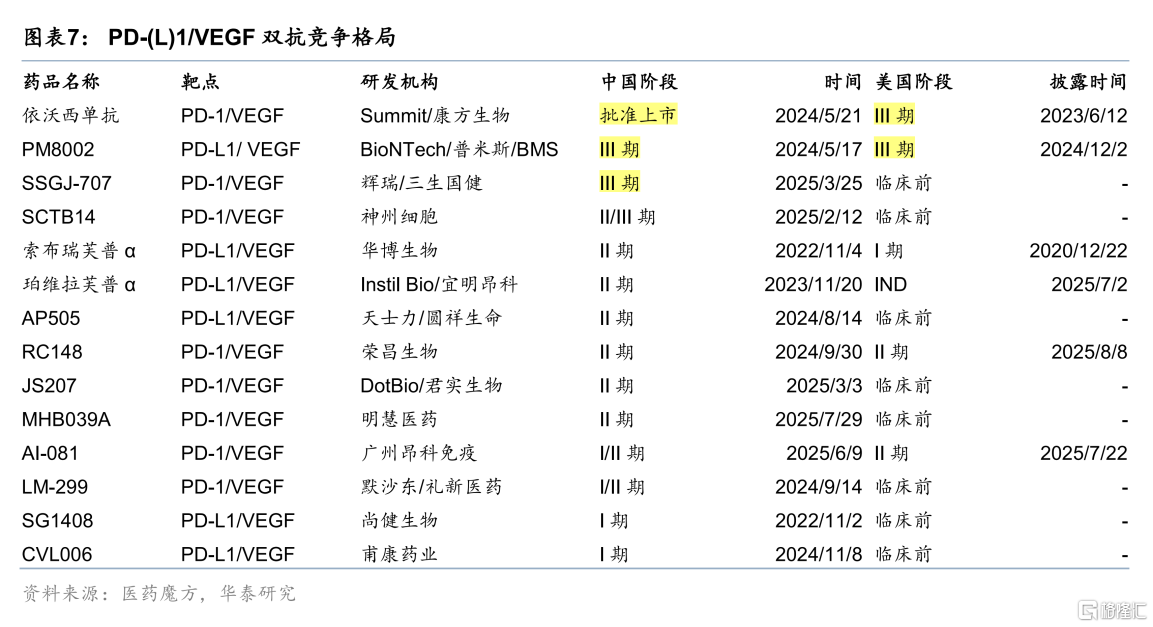
Core Insights - The focus in the PD-(L)1/VEGF bispecific antibody market has shifted from business development amounts to development efficiency and indication differentiation [1] - The competition is intensifying as multiple PD-(L)1/VEGF bispecific antibodies are entering Phase III clinical trials, emphasizing the importance of research speed and strategic indication planning [1] Domestic Indication Layout - The PD-(L)1/VEGF bispecific antibody market in China is characterized by rapid development and strategic positioning, with 康方生物/Summit’s Ivonescimab leading the way [2] - Ivonescimab has received approval for two indications in China, with projected sales of approximately 9 billion CNY in 2024 and 7.2 billion CNY in the first half of 2025, and a forecasted total sales exceeding 15 billion CNY in 2025 [2][3] Clinical Development and Market Potential - The first indication for Ivonescimab was approved in May 2024 for treating advanced non-squamous non-small cell lung cancer (nsq-NSCLC) after progression on EGFR-TKI therapy [3] - The second indication was approved in April 2025 for first-line treatment of PD-L1 positive (TPS≥1%) EGFR mutation negative and ALK negative advanced NSCLC [3] - The third indication for Ivonescimab is under review for first-line treatment of advanced squamous NSCLC [3] - The potential of the advanced lung cancer market is significant, with non-small cell lung cancer accounting for approximately 85% of all lung cancer cases [3] Competitive Landscape - The competitive landscape includes other key players such as BioNTech/BMS with PM8002 and Pfizer with SSGJ-707, both of which are also in late-stage clinical trials [5][6] - PM8002 is focusing on triple-negative breast cancer (TNBC) and small cell lung cancer (SCLC), while SSGJ-707 has initiated a head-to-head comparison with Keytruda for treating PD-L1 positive NSCLC [6][8] Global Market Dynamics - The global PD-(L)1/VEGF bispecific antibody market is dominated by three main players: 康方生物/Summit, BioNTech/BMS, and Pfizer, all of which are conducting Phase III clinical trials [8] - The strategies of these companies vary, with 康方生物 focusing on building a strong clinical barrier in the lung cancer market, BioNTech/BMS creating differentiation in TNBC and SCLC, and Pfizer leveraging its ADC advantages in colorectal cancer [18]

BioNTech Shares Progress on Exchange Offer for CureVac Shares and Highlights December 3, 2025, at 9:00 a.m. Eastern Time Expiration
Globenewswire· 2025-11-26 12:30
Core Viewpoint - BioNTech SE has received overwhelming approval from CureVac shareholders for its exchange offer, with over 99.16% voting in favor, and expects to complete the offer promptly [1][9]. Group 1: Offer Details - The exchange offer for CureVac shares is set to expire at 9:00 a.m. Eastern Time on December 3, 2025, with shareholders advised to tender their shares by 6:00 p.m. Eastern Time on December 2, 2025 [2][9]. - The exchange ratio is established at 0.05363 of a BioNTech American Depositary Share (ADS) for each CureVac share, based on a volume-weighted average price of $101.88 over the 10 trading days ending November 25, 2025 [3][9]. - BioNTech will recalculate the exchange ratio if the offer is extended and will announce the new ratio via press release [3]. Group 2: Tendering Process - CureVac shareholders holding shares through brokers should provide instructions to their brokers to tender shares, while other shareholders can follow the instructions in the Letter of Transmittal [4]. - Following the acceptance of tendered shares, BioNTech will initiate a subsequent offering period of not less than 10 business days [4]. Group 3: Conditions and Reorganization - The offer is contingent upon BioNTech acquiring at least 80% of the outstanding CureVac shares, with a potential reduction to 75% if certain conditions are met [5]. - Upon satisfaction of all conditions, non-tendering CureVac shareholders will receive BioNTech ADSs or cash in lieu of fractional ADSs, subject to a 15% Dutch dividend withholding tax [6]. Group 4: Regulatory and Market Context - The announcement of the exchange ratio serves as a pricing notice under EU regulations for the public offering of BioNTech ADSs to CureVac shareholders in several European countries [7][9]. - BioNTech is a biopharmaceutical company focused on developing innovative therapies for cancer and other serious diseases, leveraging its expertise in mRNA technology [10].



Pfizer Is Giving Up on BioNTech. Should You Ditch BNTX Stock Now Too?
Yahoo Finance· 2025-11-20 02:42
Core Insights - Pfizer has decided to sell its entire remaining stake in BioNTech, indicating a lack of confidence in BioNTech's Covid-19 vaccine and stock performance [1] - BioNTech has been experiencing significant financial losses, with its shares considered expensive despite potential in its drug pipeline [1][5] - The company's prominent drug candidates, BNT327 and BNT323, show potential but have notable weaknesses that may hinder revenue generation [1][6] Financial Performance - BioNTech's Covid-19 vaccine, Comirnaty, peaked at $37.8 billion in sales in 2022, but revenue has since declined significantly, with Q3 2025 revenue at $1.15 billion, a 19% year-over-year decrease [3] - The company reported a net loss of $719.9 million in 2024 and a net loss of $33.55 million in Q3 2025, although the latter was positively impacted by payments from Bristol-Myers Squibb [4] - Analysts project a loss per share of $4.10 in 2025 and $4.04 in 2026, with shares trading at a price-sales ratio of 8.3 times [5] Drug Pipeline - The two main drugs in BioNTech's pipeline are BNT327, an immuno-oncology treatment, and BNT323, a high-precision chemotherapy [6] - BioNTech is set to receive $1.5 billion in upfront payments from Bristol-Myers Squibb, along with potential additional payments totaling $2 billion through 2028, contingent on achieving specific milestones [4]
BioNTech SE (BNTX) Discusses Oncology Innovation Strategy, Combination Therapies and Personalized Cancer Immunotherapies Transcript
Seeking Alpha· 2025-11-17 23:17
Company Overview - The company is a multi-platform oncology firm with over 20 ongoing clinical Phase II and Phase III trials [3] Innovation Approach - The presentation aims to discuss the company's unique approach to innovation, including the scientific and medical concepts and their execution [2]

深夜,纳指大跌
财联社· 2025-11-14 00:19
Market Overview - The U.S. stock market experienced a significant decline, with major indices falling sharply due to heavy selling of key technology stocks, including AI leader Nvidia, amid a drop in interest rate cut expectations from the Federal Reserve [1][5]. - The Dow Jones Industrial Average fell by 797.60 points (1.65%) to 47,457.22, the Nasdaq dropped by 536.10 points (2.29%) to 22,870.36, and the S&P 500 decreased by 113.43 points (1.66%) to 6,737.49 [5]. Federal Reserve and Economic Data - Following a record 43-day government shutdown, the U.S. government resumed operations, which had previously raised investor concerns and disrupted economic data releases [2]. - The Federal Reserve officials have shown hesitation regarding further interest rate cuts, with market expectations for a December cut dropping to nearly 50% from 70% [2][5]. - Cleveland Fed President Loretta Mester emphasized the need for a restrictive interest rate policy to address ongoing inflation concerns [3]. - San Francisco Fed President Mary Daly stated it is too early to determine if a rate cut is warranted at the December meeting [4]. Sector Performance - In the S&P 500, the consumer discretionary sector fell by 2.73%, and the information technology sector declined by 2.37%, while the energy sector was the only one to gain, rising by 0.31% [6]. - Among industry ETFs, the semiconductor ETF dropped by 3.01%, and various technology-related ETFs fell between 2.55% and 2% [6]. Notable Stock Movements - Major tech stocks mostly declined, with Nvidia down 3.58%, Google A down 2.84%, Amazon down 2.71%, and Microsoft down 1.54%, while Meta saw a slight increase of 0.14% [7]. - Tesla experienced a significant drop of 6.64% due to a recall of approximately 10,500 Powerwall 2 battery systems over safety concerns [8]. - Cisco saw a notable increase of 4.6% after raising its full-year profit and revenue forecasts, benefiting from strong demand for network equipment in AI data centers [9]. - Disney's stock fell by 7.8% amid warnings of potential long-term channel conflicts with YouTube TV, raising concerns about its cable network cash flow [10]. - BioNTech's shares dropped by 7% as Pfizer announced plans to sell its remaining stake in the company, potentially raising about $508 million [10]. - Most Chinese concept stocks declined, with the Nasdaq Golden Dragon China Index down 1.59%, while Alibaba and Huya saw slight gains [10].