Intel(INTC)

Search documents
RAD Intel Launches RAD Amplify as Standalone Operating Company
Businesswire· 2026-02-23 15:05
Core Insights - RAD Intel has launched RAD Amplify as a standalone company to enhance marketing decision-making for advertisers through real-time intelligence and audience matching [1][2] - RAD Amplify combines creator strategy, audience intelligence, and media performance to optimize advertising budgets and campaign effectiveness [2][4] Company Overview - RAD Amplify serves Fortune 1000 brands and global agency networks, providing AI-powered audience and cultural intelligence for media planning and execution [6] - The company aims to deliver measurable performance outcomes and reduce inefficiencies in marketing strategies [2][5] Leadership - Rick Song has been appointed as CEO of RAD Amplify, bringing over 25 years of experience in digital media and advertising [3] - Emily Duban will serve as President, focusing on enterprise expansion and leveraging her experience in high-stakes marketing decisions [4] Market Positioning - RAD Amplify is positioned to help advertisers act on real-time audience insights, addressing the challenges of a fast-moving and fragmented marketing landscape [4][5] - The company aims to provide real-time intelligence that reflects current audience engagement, moving away from reliance on static data [5]



AppLovin Surges 11% While Tempus AI and Micron Also Outpace Most AI Stocks
247Wallst· 2026-02-23 12:46
Core Insights - AppLovin shares surged 11.2% last week, driven by Bank of America's defense of the stock after a post-earnings sell-off [1] - Tempus AI also saw an 11% increase, attributed to a preliminary Q4 report showing an 83% year-over-year revenue growth [1] - Micron Technology gained 4.01% as Bank of America raised its price target due to increasing AI memory demand [1] AppLovin - AppLovin's stock price increased significantly after Morgan Stanley raised its price target to $800, maintaining an Overweight rating [1] - The company reported Q4 2025 revenue of $1.66 billion, a 66% increase year-over-year, with an adjusted EBITDA margin of 84% [1] - Despite the recent gains, AppLovin is still down approximately 38% year-to-date from January highs, leading to discussions about its valuation among investors [1] Tempus AI - Tempus AI's stock rose following a preliminary Q4 2025 report indicating revenue of $367 million, an 83% increase year-over-year, and a record total contract value exceeding $1.1 billion [1] - The diagnostics segment experienced a remarkable growth of 121% year-over-year [1] - CEO Eric Lefkofsky expressed confidence in the company's strong position entering 2026, with a net revenue retention rate of 126% [1] Micron Technology - Micron's stock price increased after Bank of America raised its price target, citing accelerating demand for high-bandwidth memory in AI infrastructure [1] - The company reported cloud memory revenue of $5.28 billion in fiscal Q1 2026, nearly doubling year-over-year, with a gross margin of 66% [1] - Micron is recognized as one of the few companies capable of supplying high-bandwidth memory at scale, with 37 out of 43 analysts rating the stock as a buy or strong buy [1] AI Sector Overview - The VanEck Semiconductor ETF rose 1.8%, indicating a positive trend in the AI sector, particularly in semiconductors [1] - Software stocks are struggling, while segments like memory and networking are experiencing strong gains [1] - The broader AI market is characterized by significant divergence, with semiconductors leading the performance [1]



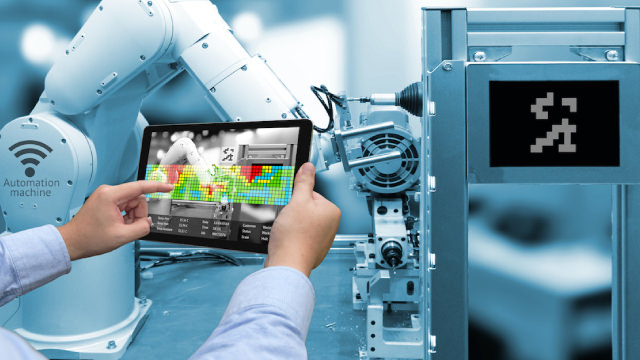
酷睿200s全大核新品规格曝光 但游戏玩家用不了
Xin Lang Cai Jing· 2026-02-23 04:16
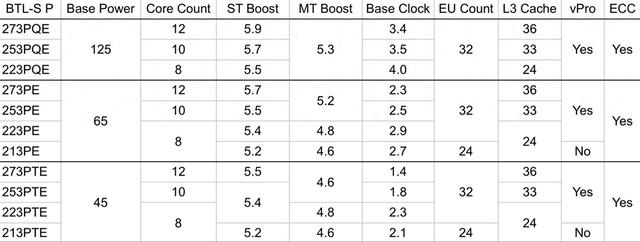
全系列提供8核、10核、12核三种规格,均支持超线程,对应16、20、24线程。PE与PTE系列的部分型 号不支持 vPro与ECC内存,而高功耗的PQE系列则全部标配vPro和ECC内存。 目前可以知道的是,英特尔不会为游戏玩家在LGA?1700平台上官方支持这些 CPU。尽管部分主板厂商 可能会为自家LGA?1700主板推出BIOS更新以提供兼容,但面向消费级市场的正式发布已彻底取消。 (11381772) 高端PQE系列:125W基础功耗,高主频版本。 中端PE系列:65W设计,频率更低。 入门PTE系列:45W TDP,更适合对功耗 / 能效要求极高的边缘场景 最近Jaykihn在X平台发布了一份Bartlett Lake-S系列的规格表格,本来推测是用在现在的LGA1700主板 上(支持 12/13/14代酷睿),而且是纯大核、游戏性能很强的型号。但很可惜,英特尔已经取消了这款 备受玩家期待的游戏CPU的上市计划,仅将其面向边缘计算与嵌入式领域供货。 | BTL-S P | Base Power | Core Count | ST Boost | MT Boost | | Base Clock EU ...
全球半导体TOP10,谁主沉浮
3 6 Ke· 2026-02-23 04:03
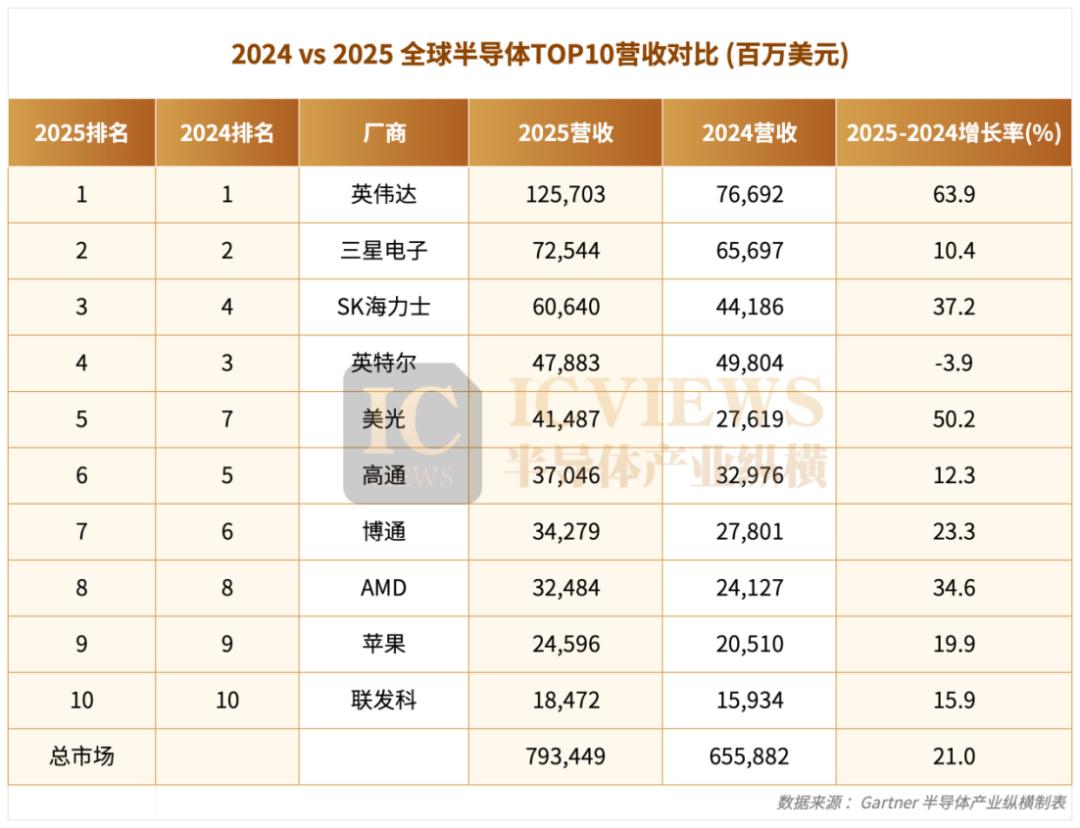
2025年,全球半导体产业迎来一个历史性拐点。 根据Gartner统计,全球半导体总营收达到7930亿美元,同比增长21%。这一强劲反弹不仅终结了此前的周期性低迷,更昭示着行业增长逻辑的根本转向。 过去十年由"移动互联网+云计算"主导的叙事正在退场,取而代之的是以AI基础设施为核心的新引擎。AI处理器、高带宽内存(HBM)和高速互连芯片, 正以前所未有的速度重塑产业版图。曾经稳坐钓鱼台的巨头悄然滑落,而押中AI赛道的玩家则一飞冲天。全球半导体TOP10的座次变动,已不再是简单的 数字游戏,而是一场关于生态、战略与时代判断的深度洗牌。 01 2024 vs 2025,新王加冕 2025年的榜单,最震撼的不是谁上榜,而是差距被拉得如此之大。英伟达不仅稳坐头把交椅,更以一骑绝尘的姿态,将第二名远远甩在身后。 | 2025排名 | 2024排名 | 厂商 | 2025营收 | 2024营收 | 2025-2024增长率(%) | | --- | --- | --- | --- | --- | --- | | 1 | 1 | 英伟达 | 125,703 | 76,692 | 63.9 | | 2 | 2 | 三星电子 ...


酷睿200E参数曝光:12大核超强性能
Xin Lang Cai Jing· 2026-02-23 03:10
酷睿200E系列按功耗分为三档,125W PQE系列主打极致性能,支持vPro和ECC内存;65W PE系列兼顾 性能与功耗;45W PTE系列为节能版,针对边缘计算优化。全系覆盖8、10、12核版本,且均支持超线 程技术。其中旗舰型号Core 9 273 PQE为12核24线程,配备36M BL3缓存与32EU Xe-LP核显,基频 3.4GHz、全核5.7GHz,单核睿频5.9GHz,频率追平上代i9-14900K。 该系列纯大核+高主频的设计契合DIY玩家需求,不过英特尔已调整上市计划,取消酷睿200E的消费级 市场布局,将其仅面向边缘计算与嵌入式产品领域。据悉,英特尔消费级处理器的研发重心已转向 LGA-1851接口的Arrow Lake Refresh,以及桌面版Nova Lake-S系列,新一代游戏处理器将从这两大系列 中落地。 (11381661) 英特尔Bartlett Lake-S平台旗下酷睿200E系列处理器核心参数遭海外媒体曝光,该系列采用纯性能核设 计,最高配备12颗P核,单核睿频达5.9GHz,且兼容现有LGA-1700插槽,被视作这一接口的收官之 作。 ...
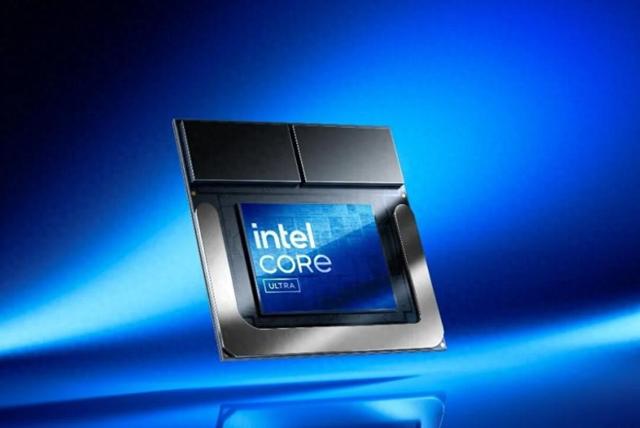
2 Overvalued Tech Stocks Boomers Are Still Buying
The Motley Fool· 2026-02-22 07:30
分组1: Tesla - Tesla's EV business is experiencing a decline, with vehicle sales down 11% year over year, accounting for 77% of total results [7] - The company maintains a $1 trillion market cap, largely due to CEO Elon Musk's influence and its association with prominent tech companies [4] - Major challenges include the expiration of EV tax credits, decreasing popularity among certain customer segments, and intense competition in the EV market, particularly in China [7] - The potential for high-margin services like Cybercabs and Optimus robots exists, but tangible sales results are lacking to justify the current valuation [6][8] 分组2: Intel - Intel is viewed as a speculative turnaround story, appealing to older investors, especially after the U.S. government acquired a 10% stake, which has contributed to a nearly doubled stock price since mid-September [9] - Despite government support, there is no guarantee of a successful transformation, and the stock may not sustain its gains [11] - Intel has invested $108 billion in capital and $79 billion in R&D over the past five years to enhance U.S.-based manufacturing, yet the stock has dropped over 25% during this period [12] - Revenue growth has stagnated, with some quarters showing year-over-year declines, indicating uncertainty about Intel's future performance [13]
2026年2000元价位,酷睿平台性价比主板推荐
Xin Lang Cai Jing· 2026-02-22 04:34
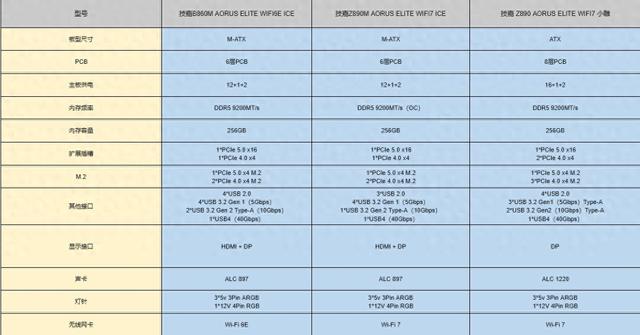
Core Insights - From mid-2025, memory prices have surged, impacting the prices of hardware components like hard drives and graphics cards, forcing gamers to adjust their motherboard budget [1] Group 1: Product Overview - Three motherboards are highlighted within the price range of 1000-2000 yuan: Gigabyte B860M AORUS ELITE WIFI6E ICE, Gigabyte Z890M AORUS ELITE WIFI7 ICE, and Gigabyte Z890 AORUS ELITE WIFI7 [1] - The B860M AORUS ELITE WIFI6E ICE features a 12+1+2 power supply module and supports up to 256GB of memory with a frequency of 9200MT/s, designed for high performance and stability [5][7] - The Z890M AORUS ELITE WIFI7 ICE offers a 12+1+2 power supply and supports DDR5 memory with a default frequency of 6400MT/s, capable of overclocking to 9200MT/s, suitable for high-end processors [11][13] - The Z890 AORUS ELITE WIFI7 is designed for the high-end Core Ultra 200S processor, featuring a robust 16+1+2 power supply and advanced cooling solutions [18] Group 2: Performance Testing - The B860M AORUS ELITE WIFI6E ICE motherboard demonstrated excellent power and thermal management, maintaining an average CPU temperature of 82°C under full load with a power consumption of approximately 250W [7] - The Z890M AORUS ELITE WIFI7 ICE achieved a memory read speed of 95696MB/s and improved gaming performance in titles like CS2 and Forza Horizon 5, showcasing its capability for multitasking and high-performance gaming [13] - The Z890 AORUS ELITE WIFI7 showed a memory read speed of 123.11GB/s with significant performance boosts in multi-core benchmarks, making it ideal for gamers and content creators [19]
玻璃,革命芯片?
Zhi Tong Cai Jing· 2026-02-22 02:17
Core Insights - The semiconductor industry is shifting focus from miniaturization of individual chips to the integration of multiple smaller units, known as Chiplets, due to physical limitations in chip size and yield issues [2][6][9] - The demand for larger AI models necessitates an increase in transistor count on chips, leading to a need for larger chip sizes, which is constrained by current lithography technology [5][6] - The industry is exploring new materials and architectures, particularly glass substrates, to overcome the limitations of organic substrates and silicon interconnects [24][28][33] Group 1: Chiplet Architecture - Chiplet architecture allows for the assembly of smaller chips, improving yield and reducing costs while enabling the use of different manufacturing processes for various components [9][10] - The communication between Chiplets must be efficient; otherwise, the benefits of separating chips could be negated [10][11] - Companies like NVIDIA and Intel are already implementing Chiplet designs in their products, such as NVIDIA's Blackwell and Intel's Ponte Vecchio [9] Group 2: Material Limitations - Organic substrates have dominated the market for 25 years but are now facing challenges in high-performance applications, particularly in AI chips [15][16][20] - Silicon interconnects provide superior performance but come with high costs and resource constraints, leading to a bottleneck in production capacity [21][22][49] - Glass substrates are being explored as a potential solution, offering advantages in thermal expansion matching and signal integrity [28][29][30] Group 3: Glass Substrate Development - Two main approaches for glass substrates are emerging: replacing the interconnect layer with glass and using glass as a substrate itself [26][27] - Glass has shown superior performance in thermal expansion and signal loss compared to organic materials, making it a promising alternative [28][29] - However, challenges such as fragility, thermal conductivity, and power noise must be addressed before glass can be widely adopted [31][32][33] Group 4: Competitive Landscape - Intel has invested heavily in glass substrate technology and holds a significant number of patents, but recent leadership changes raise questions about its future in this space [36][38] - Samsung is pursuing a vertically integrated approach to glass substrate production, but quality issues have been reported with their prototypes [39] - Other companies, such as Absolics, are also entering the market but face challenges in securing large customers for their products [40] Group 5: Industry Dynamics - The semiconductor industry is at a crossroads, with multiple technologies competing for dominance in the substrate and interconnect space [52][53] - The future will depend on the ability to achieve high production yields and meet the demands of AI chip growth, with no clear winner emerging yet [35][58] - The ongoing developments in both glass and organic materials will shape the competitive landscape, with significant implications for production capabilities and market dynamics [57][60]


Can We Use 2 Standard Deviation Implied Volatility When Portfolio Overwriting?
Thebluecollarinvestor· 2026-02-21 11:47
Can We Use 2 Standard Deviation Implied Volatility When Portfolio Overwriting? click ↑ 4 FeaturedPortfolio overwriting is a form of covered call writing where share retention, capital preservation and generation of modest cash flow are specified goals. We are looking to generate an additional option premium income stream while retaining the underlying shares. The risk of exercise and sale of our shares will always be present, but we can craft our trades in such a manner that the risk becomes much less than ...

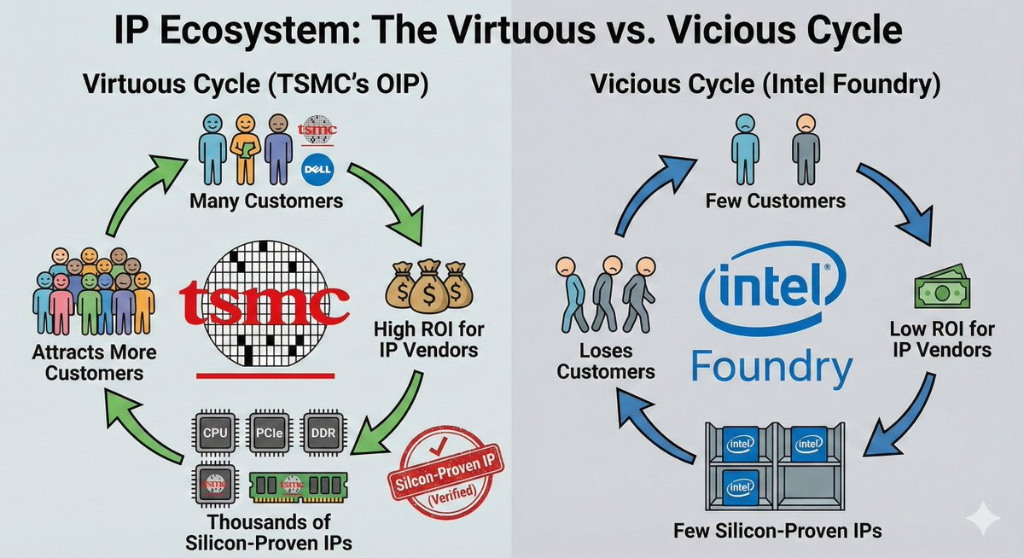
英特尔代工--最后的“机会窗口”
Hua Er Jie Jian Wen· 2026-02-20 07:13
Core Insights - Intel's foundry business is at a critical juncture, facing significant financial losses and a lack of external customers, which poses a structural challenge to its operations [1][2] - The company has made aggressive technological bets, particularly with the 18A process node, but has yet to secure meaningful external client orders [1][2] Financial Performance - In Q4 2025, Intel's foundry business reported revenues of $4.5 billion but incurred an operating loss of $2.5 billion [1] - CEO Lip-Bu Tan acknowledged that the company has "invested too much, too fast" amid insufficient demand [1] Market Dynamics - The focus for investors has shifted from technological blueprints to the execution of Intel's strategies, particularly within a narrow "opportunity window" from 2026 to 2027 [2] - If Intel fails to establish a positive business cycle during this period, its foundry strategy may face irreversible contraction [2] Technological Barriers - The core barrier in the foundry business is not just technology but systemic barriers built over time, including the correlation between process design kits (PDK) and model hardware [3] - Intel's 18A PDK is not expected to be released until July 2024, which lags behind competitors like TSMC [3] Manufacturing Challenges - Best Known Methods (BKM) accumulation relies on scale, and Intel's current reliance on its x86 processors limits its experience with diverse designs [5] - The economic implications of low yield and capacity utilization are significant, with wafer costs exceeding $20,000 and yield improvements directly impacting chip costs [7] Competitive Landscape - Intel's 18A process is set to enter production in late 2025, but its success hinges on external customer validation, which is not expected until 2026 [10] - In direct competition with TSMC's N2 process, Intel claims advantages in performance and efficiency but faces challenges in transistor density [13] Client Acquisition Strategies - Intel's last chance may lie in securing contracts with fabless clients like Apple and Nvidia, who are exploring partnerships to diversify their supply chains [18][21] - Apple is reportedly testing Intel's 18A-P PDK, with potential plans to use Intel for entry-level chips in 2026 [18] - Nvidia has invested in Intel but remains cautious about collaboration, exploring a mixed approach to chip manufacturing [21] Time Sensitivity - Intel's time window is closing as TSMC and Samsung ramp up production capacity, which could dilute Intel's current advantages in U.S. manufacturing [22] - The success of the 18A-P process in attracting external customers is critical for Intel to initiate a positive feedback loop in yield learning and secure its future in the foundry market [22]