Intel(INTC)

Search documents
中概股全线走低、美股全线大跌,有色金属、半导体芯片、苹果重挫
Sou Hu Cai Jing· 2026-02-14 04:30
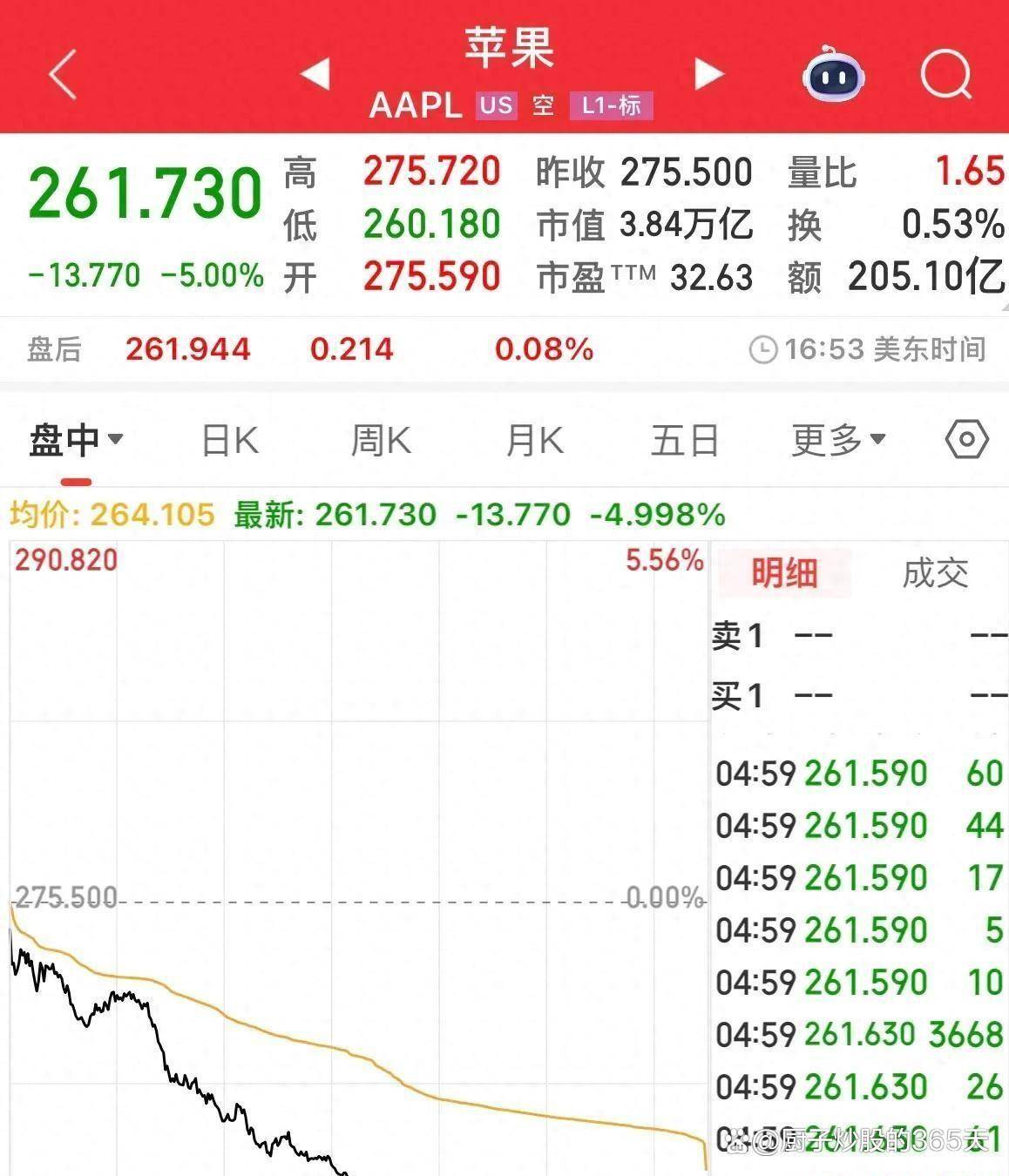
Market Overview - The US stock market experienced a significant decline, with the Dow Jones Industrial Average dropping 669.42 points (1.34%) to close at 49,451.98 points, the Nasdaq Composite falling 469.32 points (2.03%) to 22,597.15 points, and the S&P 500 decreasing by 108.71 points (1.57%) to 6,832.76 points [1][2][3] Market Sentiment - Over 4,100 stocks declined, indicating widespread market panic as investors rushed to sell assets, particularly in the tech and growth sectors. The VIX index surged, reflecting heightened risk aversion [2][3] Sector Performance - The sell-off affected nearly all sectors, with notable declines in precious metals and semiconductor stocks. The precious metals sector saw significant drops, with gold futures down 3.08% and silver futures plummeting 10.62% [4][5][6][8] - The Philadelphia Semiconductor Index fell by 2.5%, with individual stocks like AEHR Test Systems down 17.58% and Intel down over 3% [8][10] Major Companies - Apple Inc. experienced a substantial drop of 5.00%, resulting in a market cap loss of over $120 billion, attributed partly to regulatory concerns [12] - Other major tech companies also faced declines, with Tesla down 1.62%, Amazon down 2.20%, and Meta Platforms down nearly 3% [12] Financial Sector - Bank stocks fell across the board, with JPMorgan Chase down over 2%, Goldman Sachs down over 4%, and Citigroup down over 5%, driven by concerns over AI disrupting traditional wealth management [13][14] Economic Indicators - Recent economic data, including a drop in initial jobless claims and lower-than-expected existing home sales, contributed to market anxiety about potential economic overheating and prolonged high interest rates [24][25][26] Global Market Impact - The sell-off in the US markets had a ripple effect on global markets, with European indices also closing lower after initially opening higher, indicating a widespread sentiment of fear [18][19][20] AI Concerns - The market's decline was exacerbated by fears regarding the disruptive impact of AI technologies on various industries, leading to significant stock price drops in sectors perceived to be at risk [21][22][30] Storage Chip Sector - In contrast to the overall market trend, storage chip stocks saw gains, with companies like SanDisk and Seagate Technology rising significantly, reflecting a belief that AI's growth will increase demand for data storage [29]


近50家芯片大厂最新业绩:谁在赚钱,谁还在复苏?
芯世相· 2026-02-14 04:07
Core Viewpoint - The semiconductor industry is expected to recover in 2025, with significant revenue growth driven by rising storage prices and increasing demand from data centers, leading to improved performance for major chip manufacturers [3][4]. Group 1: Semiconductor Sales and Growth - Global semiconductor sales are projected to reach $791.7 billion in 2025, a 25.6% increase from $630.5 billion in 2024, with further growth expected towards $1 trillion in 2026 [3]. - The recovery is attributed to strong demand from emerging technologies such as AI, IoT, 6G, and autonomous driving [3]. Group 2: Chip Design and IDM - Texas Instruments (TI) is expected to achieve approximately $17.68 billion in revenue for 2025, reflecting a 13% year-over-year growth, with significant contributions from industrial and automotive sectors [6]. - STMicroelectronics (ST) anticipates a revenue decline of 11% to around $11.8 billion, with Q4 showing slight improvement driven by personal electronics [8]. - NXP's revenue is projected at $12.27 billion, down 3%, with automotive and industrial sectors remaining stable [10]. - Renesas reported a revenue drop of 2% to 1.3212 trillion yen, marking its first loss in six years due to significant impairment losses [12]. - Microchip Technology expects growth in both year-over-year and quarter-over-quarter sales, with a projected revenue of $1.186 billion for Q3 2026 [12]. - Qorvo's revenue exceeded expectations at $993 million, with an 8.4% year-over-year increase [12]. - Infineon's revenue is projected at €14.662 billion, down 2%, but with strong demand in AI driving growth [14]. Group 3: Memory Chips - Samsung's revenue is expected to reach 333.6059 trillion won (approximately $233.8 billion), a 10.9% increase, with the semiconductor division achieving 130.1 trillion won in revenue [29]. - SK Hynix anticipates a record revenue of 97.15 trillion won (approximately $681.6 billion), a 47% increase year-over-year [31]. - Micron's revenue is projected to rise from $25.11 billion to $37.38 billion, with HBM chip capacity sold out for 2026 [33]. - GigaDevice expects a revenue increase of approximately 25% to 9.203 billion yuan [35]. Group 4: Wafer Foundry - TSMC's revenue is projected to reach approximately 3.8 trillion new Taiwan dollars (around $122.42 billion), a 31.6% increase, with advanced processes contributing significantly [47]. - UMC expects a slight revenue increase of 2.3% to 237.55 billion new Taiwan dollars, with a focus on mature process technologies [49]. - SMIC anticipates a record revenue of $9.3268 billion, a 16.2% increase, with improved profitability driven by increased wafer sales [51]. Group 5: Testing and Packaging - ASE Group's revenue is expected to reach 645.388 billion new Taiwan dollars, an 8.4% increase, with advanced packaging services contributing significantly [57]. - Amkor's revenue is projected at $6.71 billion, a 6% increase, with strong performance in advanced packaging and computing business [59]. Group 6: Equipment - ASML's total net sales are expected to reach €32.667 billion, a 15.6% increase, with a record order backlog reflecting strong demand for AI-related technologies [61]. - Lam Research anticipates a record year with significant growth driven by advanced process technologies [63]. Group 7: Distribution - WPG Holdings expects a revenue of 999.12 billion new Taiwan dollars, a 13.4% increase, driven by AI and high-performance computing demand [66]. - WPG's revenue is projected to exceed 1 trillion new Taiwan dollars, marking a significant milestone [68].



英特尔,能做到吗
半导体行业观察· 2026-02-14 01:37
Core Viewpoint - The semiconductor industry in the U.S. is investing hundreds of billions in advanced manufacturing facilities, supported by federal funding, but these new fabs rely on Asian-developed technologies, raising concerns about the U.S.'s ability to innovate independently in the future [2][3]. Group 1: Investment and Manufacturing Challenges - Semiconductor manufacturers are spending hundreds of billions to build advanced fabs in Arizona and Texas, with federal support to reduce reliance on overseas technology [2]. - New fabs, referred to as wafer fabs, depend on manufacturing technologies developed in Asia, which could lead to a disconnect in innovation if geopolitical issues arise [2]. - Intel, once a leader in chip manufacturing, has faced setbacks due to past mismanagement and is now trying to regain its position through advancements in technology, particularly with its new 18A process [2][3]. Group 2: Intel's Market Position and Strategy - Intel has struggled to secure large external customers for its chips, even outsourcing some designs to competitors like TSMC, which has led to significant layoffs and a warning about abandoning its 14A technology if it cannot attract clients [3][4]. - The company has laid off 6,000 employees in Oregon and is facing challenges in maintaining its workforce and innovation capabilities due to budget cuts and a shrinking market for its products [4][6]. - Despite recent investments from the government and private sector, Intel's ability to attract major clients remains uncertain, as no significant contracts have been signed yet [8][12]. Group 3: Innovation and Workforce Concerns - Intel's recent layoffs and budget cuts have raised concerns about its innovation capacity, with a significant reduction in R&D spending by 16% last year, the largest cut in two decades [6][8]. - The company has postponed plans for a major R&D center expansion, which could have boosted its innovation capabilities and local economic development [7]. - There is a growing sentiment among students and researchers that Intel is no longer an attractive employer, with many opting for opportunities at emerging companies instead [10][13]. Group 4: Future Outlook and Market Sentiment - Wall Street appears willing to give Intel time to prove its technology capabilities, with stock prices doubling in the past six months amid speculation of potential agreements with major tech companies [12]. - Analysts express skepticism about Intel's ability to deliver on its new chip technologies, citing slow yield improvements and high manufacturing costs as significant challenges [12]. - Intel's leadership insists on a commitment to its 14A project, emphasizing the importance of meeting customer expectations to drive internal technological revival [13][14].

Tether 宣布对 Dreamcash 运营主体 Supreme Liquid Labs 进行战略投资
Xin Lang Cai Jing· 2026-02-13 22:46
Group 1 - Tether announced a strategic investment in Supreme Liquid Labs, the operator of Dreamcash [1] - Tether is collaborating with Selini Capital to launch the first HIP-3 RWA perpetual contract market based on USDT0 on Hyperliquid [1] - The market currently offers contracts for USA500 (S&P 500), gold, silver, and 10 other assets including Tesla, Nvidia, Google, Amazon, Meta, Robinhood, Intel, and Microsoft [1]




英特尔2026年多项业务进展与市场竞争动态前瞻
Jing Ji Guan Cha Wang· 2026-02-13 21:31
Product Development - Intel plans to officially launch the next-generation desktop processor, codenamed Nova Lake, in Q4 2026, along with the 900 series chipset motherboards, which will involve interface changes and performance enhancements [1] Project Progress - The collaboration with customers for Intel's 14A process is expected to be finalized in the second half of 2026, which may drive growth in the foundry business [2] Business and Technology Development - Intel is collaborating with SoftBank subsidiary SAIMEMORY to develop a new type of memory technology called ZAM, aimed for debut in 2027, to enhance competitiveness in AI and high-performance computing [3] Industry Status - The competition between AMD and Intel in the CPU market is intensifying in 2026, with AMD publicly questioning the performance claims of Intel's Panther Lake and other new products [4] Financial Trends - Citigroup reports that Intel's capital expenditures are expected to stabilize in the range of $15 billion to $16 billion in 2026, supported by improvements in the foundry customer pipeline [5] Industry and Risk Analysis - Samsung plans to achieve large-scale production of glass substrate chip packaging by 2026, which may pose competition to Intel in the advanced packaging sector [6]
Intel: AI Momentum Builds, But Margins Lag (NASDAQ:INTC)
Seeking Alpha· 2026-02-13 18:46
Intel ( INTC ) is trying to reinvent itself as an edge platform for AI rather than just a PC-related business. It’s a good strategy, given the potential benefits of moving cloud-based AI workloads down toPythia Research focuses on multi-bagger stocks, primarily in the technology sector. Our approach combines financial analysis, behavioral finance, psychology, social sciences, and alternative metrics to assess companies with high conviction and asymmetric risk-reward potential. By leveraging both traditional ...
AMD Taking PC, Server Market Share From Intel
Investors· 2026-02-13 18:31
AMD continues to grab market share from Intel in PC and server processors, a Wall Street analyst says. AMD stock rose Friday. ...
算力为王:AI数据中心万亿赛道的产业链争霸与投资风暴
QYResearch· 2026-02-13 09:30
Core Insights - The article emphasizes the accelerated global construction of AI-driven data centers, highlighting significant investments from major tech companies like Meta and Mistral AI, which reflect the strategic importance of AI computing power deployment [2][3] - Data centers are not only foundational for AI applications but also serve as critical support for profit growth and technological competition across the industry [4] Market Size and Policy Environment by Region - North America: Projected market size of approximately $95-100 billion by 2026 and $300-350 billion by 2030, with a CAGR of ~28%. The region benefits from supportive AI innovation policies and strict data privacy regulations [6] - Europe: Expected market size of around $40-45 billion by 2026 and $120-150 billion by 2030, with a CAGR of ~25%. The region faces strict GDPR compliance and has a strong demand for localized data centers [6] - China: Anticipated market size of about $50-55 billion by 2026 and $160-200 billion by 2030, with a CAGR of ~27%. The government encourages AI and computing infrastructure development [6] - South Korea: Estimated market size of $5-6 billion by 2026 and $20-25 billion by 2030, with a CAGR of ~30%. The government promotes AI strategies and local semiconductor advantages [6] - Japan: Projected market size of $6-7 billion by 2026 and $18-22 billion by 2030, with a CAGR of ~23%. The region's stable demand comes from high-end manufacturing and finance sectors [6] - India: Expected market size of $3-4 billion by 2026 and $12-15 billion by 2030, with a CAGR of ~28-30%. The region shows rapid growth in cloud computing and AI applications [6] Key Industry Chain and Leading Companies - AI Chips/Accelerators: Key players include NVIDIA, AMD, Intel, and Google, focusing on high-performance AI training and inference [8] - Data Center Infrastructure: Major operators like Equinix and Digital Realty, along with self-built centers from Meta, AWS, and Microsoft, dominate the market [8] - Cloud Services/AI Platforms: AWS, Microsoft Azure, and Google Cloud are leading providers of AI services and solutions [8] - Storage/Memory: Companies like Samsung and SK Hynix are crucial for high-speed storage demands [9] - Network Equipment: Cisco and Arista Networks are essential for data center connectivity [9] - Energy and Cooling: Schneider Electric and Vertiv lead in providing reliable power and cooling solutions [9] - Data Center Software: VMware and HashiCorp/Red Hat offer critical management tools for data centers [9] Investment Opportunities - Upstream Chips: Investment in GPU/TPU/accelerators offers high margins and long-term contracts [10] - Data Center Operations: Focus on self-built or managed centers in high-demand regions like North America, China, and South Korea for stable rental income [10] - Cloud Service Platforms: High-growth subscription revenue opportunities in AI SaaS/IaaS [10] - Storage/Memory: Long-term supply agreements with major operators for HBM/SSD [10] - Network Equipment: Targeting AI-optimized and low-latency products for mid to long-term replacement [10] - Energy/Cooling: Building green data centers to leverage policy benefits [10] - Software/Operations: Providing intelligent operation and monitoring services for high profit margins [10] Conclusion and Strategic Recommendations - AI data centers are positioned as the core hub of the global tech industry over the next decade, with understanding technology trends and market opportunities being crucial for competitive advantage and long-term returns [12][14] - Regional market differences indicate that North America and China have large, stable markets, while South Korea and Southeast Asia show rapid growth [14] - Investment strategies should focus on leveraging these regional insights for optimal positioning in the evolving landscape [14]



中国半导体行业展望
Zhong Cheng Xin Guo Ji· 2026-02-13 09:14
Investment Rating - The semiconductor industry is rated as "stable improvement" for the next 12 to 18 months, with potential for upward adjustments based on demand growth from automotive electronics and artificial intelligence [5][7]. Core Insights - The semiconductor industry in China is expected to benefit from effective industrial support policies, accelerating domestic substitution processes, and a stable upward trend in credit quality [5][8]. - The competition in the semiconductor industry remains a key national focus, with ongoing support for high-end breakthroughs and supply chain management [7][9]. - The recovery of the semiconductor industry is driven by the mild recovery in consumer electronics and rapid development in automotive electronics and artificial intelligence [19][24]. - The global semiconductor sales reached approximately $697.18 billion in 2025, with a year-on-year growth of 11.22%, indicating a new recovery cycle after a previous downturn [20][24]. - The domestic semiconductor market in China is projected to reach $210.88 billion in 2025, growing by 14.68% year-on-year, driven by AI and automotive electronics [24]. Industry Fundamentals Analysis - The semiconductor industry is supported by a comprehensive policy framework that includes national and local government initiatives aimed at enhancing self-sufficiency and technological breakthroughs [9][10]. - The production of integrated circuits in China reached 484.3 billion units in 2025, a year-on-year increase of 87.28%, with exports also showing significant growth [11][24]. - The industry is characterized by a high degree of concentration, with the top ten chip design companies holding over 65% of the market share globally, predominantly led by U.S. firms [30][31]. Credit Performance of Industry Enterprises - The overall financial performance of the semiconductor industry has improved, with revenue, profit, and operating cash flow showing growth, while debt levels remain manageable [29]. - The industry has not experienced any bond extensions or defaults, indicating a stable credit environment [29]. - The chip design sector has seen rapid growth, particularly in AI chip manufacturers, which have outperformed other segments [31].



Intel Corporation (NASDAQ:INTC) Stock Update and Investment Moves
Financial Modeling Prep· 2026-02-13 04:12
Core Viewpoint - Intel Corporation is facing mixed investor sentiment, with some reducing their stakes while others are increasing their investments, reflecting differing views on the company's future performance [2][3][5]. Group 1: Stock Performance - Intel's current stock price is $46.48, which represents a decrease of 3.75% or $1.81 from the previous trading session [4]. - The stock has traded within a range of $46.20 to $48.95 on the day, with a yearly high of $54.60 and a low of $17.67 [4]. - Intel has a market capitalization of $232.17 billion and a trading volume of 87.85 million shares, indicating its significant presence in the technology sector [4]. Group 2: Analyst Insights - D.A. Davidson has set a price target of $45 for Intel, which is slightly below its current trading price of $46.48, indicating a potential decline in expectations [5]. - The price target reflects a -3.18% difference from the current stock price, suggesting cautious sentiment from analysts [1][5]. Group 3: Investor Actions - Caisse Des Depots ET Consignations has reduced its Intel holdings by 15.9%, selling 41,611 shares and leaving them with 220,030 shares valued at $7.38 million, which may indicate concerns about Intel's future performance [2]. - Conversely, Savvy Advisors Inc. has increased its holdings by 25.3%, adding 16,330 shares for a total of 80,857 shares valued at $2.71 million, reflecting confidence in Intel's potential [3]. - Allegheny Financial Group has also acquired a new stake worth $249,000, further indicating positive sentiment from some investors [3].