
Intuit(INTU)

Search documents
UniCredit CEO says talks with Generali are on commercial ties
Reuters· 2026-02-09 10:40
Any discussions with Generali are connected to the commercial partnerships tying Italy's biggest insurer to UniCredit , the bank's Chief Executive Andrea Orcel said on Monday. ...



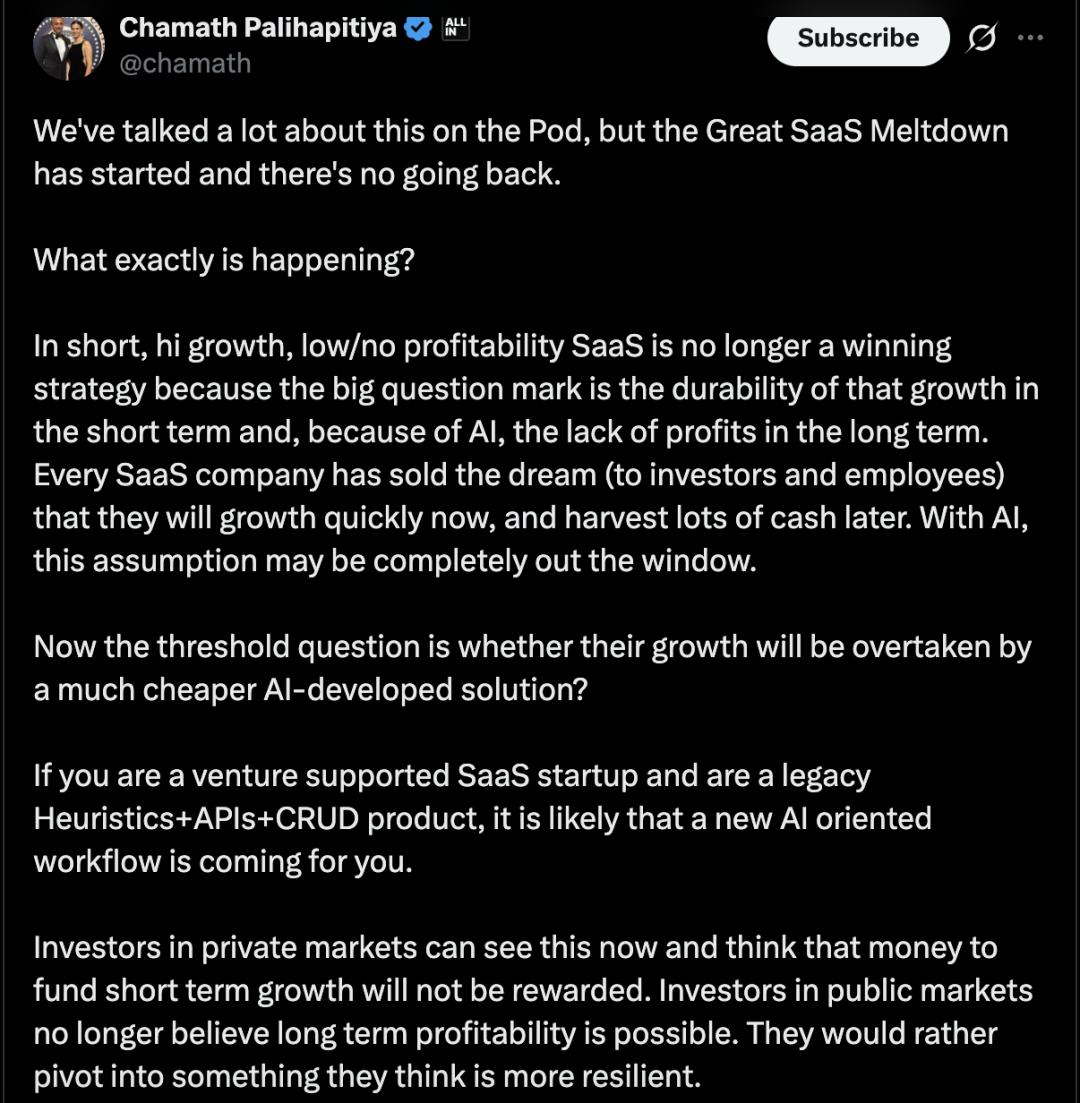
3000亿美元因Agent一夜蒸发,纳德拉、MongoDB CEO等宣告:传统SaaS已走到拐点
3 6 Ke· 2026-02-09 05:19
Core Insights - The market capitalization of SaaS, data, and software investment companies has evaporated by approximately $300 billion due to the release of an AI product, rather than disappointing earnings or macroeconomic shocks [1] - The IGV software index has dropped about 30% from its peak in late September, with significant declines in stock prices for major companies like Salesforce, ServiceNow, Adobe, and Workday, which fell around 7%, and Intuit, which plummeted nearly 11% [2] - The average expected price-to-earnings ratio for software companies has sharply decreased from about 39 times to approximately 21 times in just a few months [2] Group 1: Market Dynamics - The crisis in the SaaS sector has been ongoing for several months, with a recent acceleration in the speed of market reactions [2] - Short sellers have profited over $20 billion by betting against traditional SaaS businesses, indicating a significant loss of confidence in the sector [2] - The core assumption being challenged is the sustainability of traditional SaaS growth models, which have been supported by predictable recurring revenues and high switching costs [3][4] Group 2: AI Impact - AI is fundamentally testing the logic behind traditional SaaS models, as modern AI systems can replace many human workflows across various applications [6] - Investors are increasingly concerned that the growth of many SaaS companies may be rapidly supplanted by lower-cost, AI-driven solutions [8] - The emergence of AI-driven workflows is seen as a significant threat to the high-growth, low-profit SaaS development path, leading to a loss of market trust [7] Group 3: Future Outlook - High-profile figures like Chamath Palihapitiya and Microsoft CEO Satya Nadella have expressed that the SaaS model is becoming obsolete, predicting a shift towards AI-driven platforms [12][9] - Goldman Sachs predicts that by the end of the decade, AI agents will capture a disproportionate share of profits in the software market, with over 60% of software economic benefits potentially realized through agent systems rather than traditional SaaS services [15][18] - The transition from static applications to adaptive systems is expected to weaken the economic benefits of traditional software, although overall market growth is anticipated [18][19] Group 4: Investment Sentiment - The private equity and credit markets are reacting to the changing landscape, with investors recognizing that continued funding for short-term growth may not yield returns [8][20] - The prevailing investment logic in the software industry, based on predictable revenues and low customer churn, is being recalibrated in light of AI advancements [20] - MongoDB's CEO emphasizes that true platforms, rather than mere products, will endure in the evolving software landscape, highlighting the importance of adaptability and speed in technology transitions [21][26]



Intuit Stock: AI Fears Are Likely Overdone (NASDAQ:INTU)
Seeking Alpha· 2026-02-08 13:06
分组1 - Intuit's stock has declined approximately 45% since its 52-week high of $813 due to concerns over potential disruptions from artificial intelligence [1] - The stock sell-off began in July 2025, indicating a significant market reaction to AI-related fears [1] - David, a long-term investor, emphasizes the importance of investing in high-quality growth stocks that are reasonably priced and likely to outperform the market [1] 分组2 - David's investment strategy includes focusing on growth and momentum stocks, utilizing options for strategy [1] - He previously advised investors to buy at the bottom of the financial crisis in March 2009, leading to substantial gains in the S&P 500 and Nasdaq over the following decade [1]

Intuit: AI Fears Are Likely Overdone
Seeking Alpha· 2026-02-08 13:06
分组1 - Intuit's stock has declined approximately 45% since its 52-week high of $813 due to concerns over potential disruptions from artificial intelligence [1] - The stock sell-off began in July 2025, indicating a significant market reaction to AI-related fears [1] - David, a long-term investor, emphasizes the importance of investing in high-quality growth stocks that are reasonably priced and likely to outperform the market [1] 分组2 - David's investment strategy includes focusing on growth and momentum stocks, utilizing options for strategy [1] - He successfully advised investors to buy at the bottom of the financial crisis in March 2009, leading to substantial gains in the S&P 500 and Nasdaq over the following decade [1]

There's a Rout in Tech Stocks. What's Going On?
Yahoo Finance· 2026-02-07 19:38
Core Viewpoint - The technology sector has experienced significant losses over the past week, with major companies facing double-digit declines, marking a three-month downturn in tech stocks [1][2]. Group 1: Market Trends - The slump in U.S. technology stocks has persisted for three months, primarily affecting growth stocks, which are companies that typically increase earnings faster than the market average [2]. - Investors have shifted their preference from growth stocks to value stocks, which are less volatile and often have cheaper valuations relative to their earnings and long-term growth potential [3]. - The Russell 1000 Value index has increased by 8.4% since Halloween, while the tech-heavy Russell 1000 Growth index has decreased by 3.7% [4]. Group 2: Investor Sentiment - There has been a notable decline in investor optimism regarding artificial intelligence, which had previously driven technology stock prices higher [6]. - The recent downturn in tech stocks has been exacerbated by a lack of confidence in AI's ability to significantly enhance corporate financial performance and the broader economy [6]. - The rapid rise in tech stock prices has made them vulnerable to sharp declines upon any signs of disappointment, as evidenced by Microsoft's recent stock drop despite beating Wall Street expectations [7]. Group 3: Company-Specific Performance - Advanced Micro Devices (AMD) has seen a decline of almost 21%, Intuit (INTU) is down more than 17%, Micron Technology (MU) has dropped nearly 13%, Microsoft (MSFT) is down about 7%, Nvidia (NVDA) has fallen 9%, and Salesforce (CRM) has decreased by 12.5% [8]. - Microsoft experienced its largest one-day stock drop since March 2020, falling 11% due to signs of slowing cloud revenue, which is closely tied to AI [9].


This TSX top gainer is up 56% this year, with even 'more meaningful upside,' analysts say
Financialpost· 2026-02-06 23:20
Core Insights - Investors have withdrawn hundreds of billions of dollars from software stocks following the release of an AI tool by Anthropic that automates legal work, significantly impacting the legal software sector [1] - Software stocks have declined by 18% this year, with estimated losses in the sector exceeding US$1 trillion when considering market capitalization, bonds, and loans [1] - The shift in investor focus towards blue-chip companies indicates the beginning of AI's transformative impact on the investment landscape [1] Company-Specific Developments - Celestica Inc. (CLS:TSX) saw its stock rise nearly 10%, making it one of the top gainers, with analysts from TD Cowen maintaining a price target of $451 due to its connections with Google's AI initiatives [1] - Desjardins Group Capital Markets analysts have reduced their price targets for several TSX tech companies, including Constellation Software Inc. (CSU:TSX) from $5,300 to $3,900, with shares trading at $2,380 [1] - Price targets for Topicus.com Inc. were cut from $190 to $140, and for Lumine Group Inc. from $52 to $36, with shares closing at $94.72 and $20.00 respectively [1] Industry Trends - The decline in software stocks is attributed to the perception that AI may replace existing business models rather than a traditional market bubble burst [1] - Major U.S. software companies such as ServiceNow Inc., Salesforce Inc., Intuit Inc., and Oracle Corp. have experienced stock declines ranging from 20% to 30% year to date [1]


两周搓出的Claude Cowork,让硅谷一夜蒸发2万亿,AI真要杀死软件?
虎嗅APP· 2026-02-06 14:10
Core Viewpoint - The article discusses a significant sell-off in the software sector, triggered by the introduction of AI capabilities by Anthropic, which threatens traditional software companies and their business models [4][6][19]. Group 1: Market Reaction - The global capital market has indiscriminately sold off software stocks, with major companies like Salesforce, Workday, and Intuit losing nearly $258 billion in market value in a single day [4]. - The North American software index experienced a 15% decline in January, marking the worst monthly performance since 2008 [4]. - The sell-off has spread to the Asia-Pacific market, leading to sharp declines in the stock prices of several industry leaders [4]. Group 2: AI's Impact on Software - Anthropic's AI application, Claude Cowork, has introduced capabilities that allow it to perform tasks traditionally done by humans, such as managing files and operating software [8][10]. - The release of specific plugins for various industries, including law and finance, indicates a shift where AI is not just a tool but a competitor to traditional software providers [11][13]. - Analysts predict that up to 50% of entry-level white-collar jobs may be impacted by AI within the next 1 to 5 years, posing a threat to companies that provide software tools for these roles [13]. Group 3: Software Industry Challenges - Software vendors are in a precarious position, needing to demonstrate revenue growth to alleviate concerns about AI's impact [15]. - Major companies are announcing layoffs, indicating a tightening of corporate budgets and a reluctance to invest in traditional software when AI can perform tasks at a lower cost [16]. - The trend of "downgrading" software is emerging, as companies reconsider the necessity of expensive SaaS solutions in light of AI capabilities [16]. Group 4: Future of Software Companies - The software industry is expected to split into two categories: "tool-based" software that will likely be eliminated and "system-based" software that must adapt to survive [24][25]. - Future software companies will need to shift from a per-user pricing model to a results-based pricing model, as AI agents reduce the need for human users [27]. - Gartner predicts that by the end of 2026, 40% of enterprise SaaS will incorporate outcome-based pricing elements, marking a significant shift in the industry [27].

“软件股末日”论调席卷华尔街之际 “AI重塑软件盈利”的增长叙事悄然扩散
智通财经网· 2026-02-05 10:48
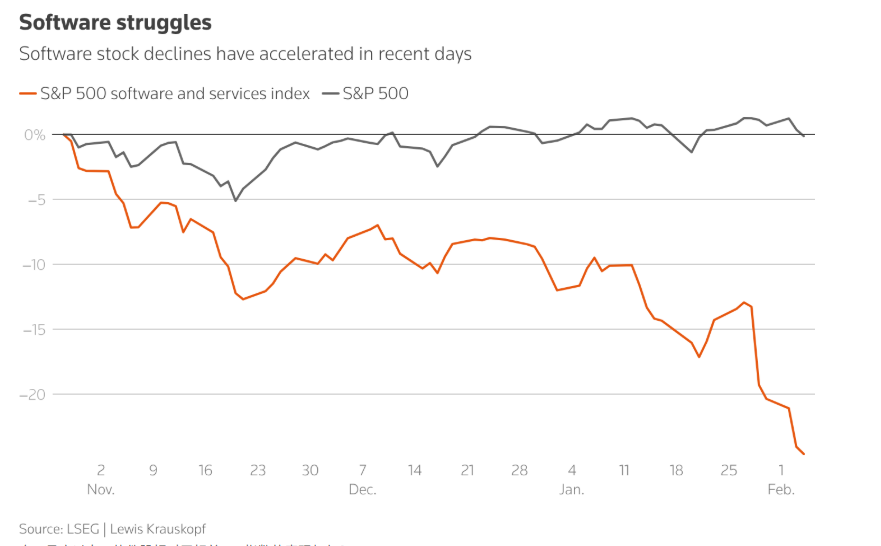
Group 1: Market Overview - The narrative of "Software-mageddon" is gaining traction among global investors, with debates on whether to initiate bullish calls on recently battered software stocks [1] - Large institutional investors are beginning to enter the market to buy the dip in software stocks that have experienced significant declines, with some supporting optimistic views on AI-focused software giants [1][3] - The S&P 500 Software and Services Index has dropped approximately 25% since its recent peak at the end of October, while the overall S&P 500 index has remained relatively stable [3][4] Group 2: Impact of AI Tools - The launch of Anthropic's AI programming tool, Claude Cowork, has intensified fears of AI agents disrupting the SaaS software industry, leading to a collective sell-off in software stocks [2] - The S&P 500 Software and Services Index experienced its worst performance since May 2002, with a significant market cap loss exceeding $800 billion [4] Group 3: Investor Reactions and Divergence - Institutional investors are showing mixed reactions, with some cautiously buying while others remain hesitant, indicating a divide in sentiment regarding the software sector [8] - Some portfolio managers are starting to see long-term value in certain software stocks, while others are waiting for stronger catalysts, such as robust AI-related revenue reports, before making aggressive purchases [8][9] Group 4: Future Outlook and AI Integration - The market is reassessing the value chain in the software industry, with AI potentially redistributing profits rather than completely replacing existing software infrastructure [11][12] - The current sell-off is seen as a response to the question of how much profit pools will be redistributed among SaaS vendors due to AI advancements, with a focus on real deployment and revenue growth from AI-related products [12][13]


Why the Market Dipped But Intuit (INTU) Gained Today
ZACKS· 2026-02-04 23:46
Company Performance - Intuit (INTU) closed at $444.98, with a daily increase of +2.51%, outperforming the S&P 500's loss of 0.51% on the same day [1] - The stock has decreased by 32.93% over the past month, significantly underperforming the Computer and Technology sector's loss of 0.27% and the S&P 500's gain of 0.93% [1] Upcoming Earnings - Intuit's earnings report is scheduled for February 26, 2026, with projected earnings of $3.65 per share, reflecting a year-over-year growth of 9.94% [2] - Revenue is anticipated to be $4.53 billion, indicating a 14.22% increase from the same quarter last year [2] Full Year Projections - For the full year, earnings are projected at $23.13 per share and revenue at $21.13 billion, representing increases of +14.79% and +12.21% respectively from the prior year [3] - Recent adjustments to analyst estimates indicate evolving short-term business trends, with positive revisions suggesting analyst optimism regarding Intuit's business and profitability [3] Zacks Rank and Valuation - Intuit currently holds a Zacks Rank of 4 (Sell), with the Zacks Consensus EPS estimate having increased by 0.24% over the past month [5] - The company has a Forward P/E ratio of 18.76, which is higher than the industry's Forward P/E of 18.28, and a PEG ratio of 1.32 compared to the industry average of 1.47 [6] Industry Context - The Computer - Software industry, part of the Computer and Technology sector, ranks in the top 37% of all industries according to the Zacks Industry Rank [7] - The strength of individual industry groups is measured by the Zacks Industry Rank, with the top 50% rated industries outperforming the bottom half by a factor of 2 to 1 [7]

Jim Cramer on Intuit: “This Is a Very Good Company”
Yahoo Finance· 2026-02-04 18:54
Company Overview - Intuit Inc. (NASDAQ:INTU) is a significant player in the S&P 500, known for its financial management, tax preparation, marketing, and personal finance solutions, including products like TurboTax and QuickBooks [1][3]. Market Performance - Intuit was the second worst performer in the S&P 500 last month, experiencing a decline of nearly 25% in January [1]. - The company's forward price-to-earnings multiple has decreased from just over 30 times forward earnings at the end of 2024 to just under 20 times earnings currently [1]. Analyst Insights - Jim Cramer noted that many software companies, including Intuit, are facing challenges due to AI-related concerns that are compressing price-to-earnings multiples [1]. - Cramer expressed a belief that Intuit, as an enterprise software company, should perform better and indicated a willingness to buy the stock despite its current heavy market sentiment [3].