NextEra Energy(NEE)

Search documents
NextEra Energy vs. GE Vernova: Which Energy Transition Stock Wins?
ZACKS· 2026-02-23 13:21
Core Insights - The global shift towards renewable energy sources is being driven by decarbonization goals, stricter emissions standards, and expanding clean-energy mandates, leading to increased investor interest in companies like NextEra Energy (NEE) and GE Vernova (GEV) [1] Industry Overview - The share of renewable energy in global power generation is rising, replacing fossil fuels and aiding in climate goals. Factors such as long-term power purchase agreements, stable revenue, and advanced technology are enhancing the financial attractiveness of the renewable sector [2] Company Profiles - NextEra Energy is a leading regulated utility and one of the largest renewable energy developers, providing stable earnings and exposure to clean energy growth. GE Vernova focuses on power generation equipment and grid modernization, positioning itself as a key player in electrification and decarbonization [3][18] NextEra Energy (NEE) Highlights - NEE's long-term earnings per share (EPS) growth outlook through 2028 is supported by the addition of renewable assets and strong execution across business segments, projecting a compound annual growth rate of over 8% through 2035 [5][10] - The company plans to add 76.5-107.6 gigawatts (GW) of new renewable capacity from 2026 to 2032, with a current backlog of 29.8 GW in signed contracts [6] GE Vernova (GEV) Highlights - GEV is focused on energy transition, with a diversified portfolio across Power, Wind, and Electrification, serving the entire electricity value chain [7][18] - The launch of GridOS for Distribution in February 2026 aims to enhance utilities' management of distribution grids, increasing recurring software revenue potential. GEV also completed the acquisition of Prolec GE, expanding its North American presence [8] Financial Estimates - The Zacks Consensus Estimate for NEE indicates a year-over-year EPS increase of 7.82% for 2026 and 8.9% for 2027 [9] - For GEV, the 2026 EPS estimate shows a decline of 21.09%, while the 2027 estimate suggests a recovery with a 55.01% increase [11] Dividend and Valuation - NEE has a current dividend yield of 2.46%, compared to GEV's 0.24%, with the S&P 500 composite at 1.08% [13] - NEE's forward Price/Earnings (P/E) ratio is 22.73X, while GEV's is significantly higher at 55.07X, making NEE more attractive from a valuation perspective [14] Return on Equity (ROE) - NEE's current ROE is 12.18%, while GEV boasts a much higher ROE of 46.91%, indicating different efficiency levels in utilizing shareholders' funds [15] Stock Performance - Over the past six months, GEV shares have increased by 37.9%, while NEE shares have risen by 22.4% [16] Investment Recommendation - Currently, NextEra Energy is favored due to its stronger earnings growth, higher dividend yield, and more attractive valuation compared to GE Vernova, with both companies holding a Zacks Rank of 3 (Hold) [19]



避险又蹭AI!美股公用事业板块从“沉闷蓝筹”变身投资香饽饽
智通财经网· 2026-02-19 12:12
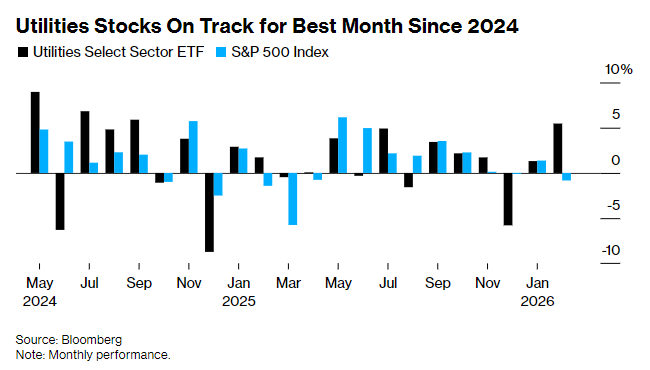
Group 1 - The core viewpoint is that the utility sector is experiencing significant growth driven by increased electricity demand from AI, leading to a surge in stock prices and making utility stocks a staple asset for investment institutions [1][2] - The largest utility sector ETF in the US has risen by 6.8% this year, outperforming the broader market, indicating strong market demand [1] - Analysts warn that the sector is experiencing an "extreme buying frenzy," with valuations detaching from fundamentals, suggesting a buildup of potential correction risks [1] Group 2 - Some investors are cautious about entering the market at current levels, with concerns that the opportunity window has closed for those who have not yet invested [2] - There is a shift in investor sentiment from high-growth tech stocks to safer sectors like utilities, healthcare, and consumer staples due to worries about overvaluation in tech [2] - Analysts believe that the utility sector will benefit from increased capital expenditures and improved profit growth expectations driven by AI adoption, alongside declining interest rates [3] Group 3 - Utility companies are positioned as direct beneficiaries of accelerated capital expenditures in power plants and transmission infrastructure, contrasting with other economic sectors that may be adversely affected [3] - The recent decline in long-term US Treasury yields has contributed to the rise in utility stocks, as lower borrowing costs favor utility companies that rely on debt for infrastructure investments [3] - The future performance of the utility sector is closely tied to the movements of US Treasury yields [3]
Retirees Should Know The XLU Utility ETF Has Paid Dividends Every Year Since 1999 Without Interruption
247Wallst· 2026-02-19 11:37
Core Viewpoint - The Utilities Select Sector SPDR Fund (XLU) has consistently paid dividends since 1999, yielding 2.75% and delivering a total return of 20.41% over the past year, making it an attractive option for income-focused investors [1]. Group 1: Dividend Consistency and Holdings - XLU has a 2.75% yield with uninterrupted dividend payments since 1999, indicating strong reliability for income-focused investors [1]. - NextEra Energy constitutes 14.06% of XLU's holdings, with a payout ratio of 69.1%, supporting a 10% annual dividend growth [1]. - Southern Company and Duke Energy have also raised dividends, reflecting their status as regulated utilities with a history of consistent payments [1]. Group 2: Financial Health and Dividend Sustainability - NextEra Energy's conservative capital allocation strategy allows for a sustainable dividend, with earnings growth of 25.8% providing flexibility for shareholder rewards and infrastructure investments [1]. - Southern Company increased its quarterly payment from $0.72 to $0.74, while Duke Energy raised its payment from $1.045 to $1.065, both maintaining manageable payout ratios [1]. Group 3: Market Context and Total Returns - The interest rate environment has shifted favorably for dividend-paying utilities, with the 10-year Treasury yield decreasing from 4.58% to 4.09%, reducing the opportunity cost of holding dividend stocks [1]. - XLU's total returns of 20.41% over the past year highlight the growing recognition of the value proposition in utilities [1]. - The projected dividend payments for 2025 are expected to be around $2.00 annually, down from $2.24 in 2024, reflecting portfolio rebalancing rather than fundamental weakness [1].



Beyond Tech Stocks: This Utility is Powering the Data Center Boom.
Yahoo Finance· 2026-02-17 19:42
Group 1: Investment in Data Centers - Technology giants like Alphabet and Meta Platforms are significantly increasing their capital expenditures to support cloud computing and AI growth, with Alphabet planning to invest $175 billion-$185 billion by 2026 and Meta increasing its capex by 73% to $115 billion-$135 billion this year [1] - Large tech companies are expected to invest over $500 billion in total this year to enhance their data center capabilities [1] Group 2: Utility Sector Benefits - Utilities are also benefiting from the data center spending boom, as AI data centers require substantial power for specialized chips and cooling systems [2] - NextEra Energy is a leading utility in this sector, building power generation capacity and developing powered data center hubs to support the growth of data centers [2] Group 3: NextEra Energy's Projects - NextEra Energy originated 13.5 gigawatts (GW) of new generation and battery storage projects last year, marking its best year for new project originations, and currently has a backlog of 30 GW of projects [3] - The utility has signed power purchase agreements with Meta Platforms totaling 2.5 GW of clean power capacity, in addition to the 500 megawatts it already supplies [4] Group 4: Development of Data Center Campuses - NextEra Energy is developing data center campuses with associated power generation, partnering with Alphabet's Google to create multiple new GW-scale data center campuses [5] - The partnership with Google includes contracts to supply 3.5 GW of power, which involves plans to restart the dormant Duane Arnold nuclear power plant in Iowa [5]
NEE Stock Outpaces Industry in a Month: Time to Buy, Hold or Sell?
ZACKS· 2026-02-16 18:01
Core Viewpoint - NextEra Energy (NEE) has shown strong performance with a 12.2% increase in share price over the past month, outperforming the Zacks Utility - Electric Power industry and the broader market [1][9]. Financial Performance - NEE's share price increase is attributed to solid operational performance and an expanding customer base, leading to higher demand for its services [2]. - The company plans to invest approximately $94.2 billion from 2026 to 2030, with $58.6 billion allocated to its Florida Power & Light (FPL) segment and $35.6 billion to the Energy Resource segment [12][9]. - Earnings per share (EPS) for 2026 is projected to be between $3.92 and $4.02, with expected annual growth of 8% through 2032 [15]. Market Position - NEE is currently trading above its 50 and 200-day simple moving averages, indicating a bullish trend [7]. - The company's trailing 12-month return on equity (ROE) stands at 12.18%, surpassing the industry average of 10.7%, indicating efficient use of shareholders' equity [19]. Dividend Policy - NEE has raised its quarterly dividend to 62.32 cents per share, with plans to increase the dividend rate by 10% annually at least through 2026 [22]. Strategic Initiatives - The company is pursuing strategic acquisitions, including the acquisition of Symmetry Energy Solutions and a portion of Consolidated Edison's interest in the Mountain Valley Pipeline, to enhance its operational capabilities [13]. - NEE's Energy Resources subsidiary is focused on long-term investments in clean energy, with a renewable backlog exceeding 29.8 gigawatts [14]. Economic Environment - Florida's expanding economy, characterized by strong job growth and population inflows, is driving higher electricity demand, benefiting NEE's operations [11].

NextEra Energy(NEE) - 2025 Q4 - Annual Report
2026-02-13 21:19
Generation Capacity and Resources - NEE has approximately 80 gigawatts of net generation and storage capacity, primarily from natural gas, wind, solar, and nuclear sources as of December 31, 2025[16]. - FPL's net generating capacity is 35,963 MW, with approximately 93,000 circuit miles of transmission and distribution lines[20]. - NEER has a total net generating capacity of approximately 37,505 MW as of December 31, 2025, making it one of the largest wholesale generators in the U.S.[59]. - NEER's generation assets include approximately 12,794 MW of solar facilities and 27,855 MW of wind facilities as of December 31, 2025[78]. - NEER has a net generating capacity of approximately 1,584 MW from natural gas generation facilities as of December 31, 2025[82]. - NEER added approximately 1,799 MW of battery storage capacity during 2025, bringing total net ownership interests in battery storage to approximately 5,177 MW across 18 states in the U.S. and 1 province in Canada[83]. - FPL plans to expand its SolarTogether program by constructing an additional 1,788 MW of solar generation from 2022 through 2025[55]. Regulatory Framework and Financials - FPL's regulatory framework includes oversight from the FPSC, FERC, and NRC, impacting rates and operational standards[44]. - FPL's base rates, effective from January 2026 through December 2029, are designed to recover costs and provide a reasonable return on invested capital[47]. - FPL's authorized regulatory ROE is 10.95%, with a range of 9.95% to 11.95%, allowing for retail base rate relief if the earned ROE falls below 9.95%[49]. - FPL is authorized to implement a rate stabilization mechanism (RSM) up to approximately $1.5 billion after tax, subject to conditions[49]. - FPL's operating revenues from wholesale and industrial electric customers represented approximately 5% of total operating revenues in 2025[29]. - FPL's base rate increases in 2024 and 2025 will be associated with the addition of 894 MW of new solar generation[55]. Environmental and Regulatory Risks - Compliance with environmental laws may result in significant capital expenditures and increased operating costs, affecting overall profitability[136]. - New greenhouse gas emission limits could impose additional costs on NEE and FPL, potentially affecting their financial performance[140]. - Regulatory compliance failures could lead to substantial monetary penalties and increased operational costs for NEE and FPL[141]. - The evolving regulatory landscape may require additional approvals, impacting the timeline and costs of energy projects[134]. - Political and economic factors may adversely affect regulatory decisions, potentially leading to delays or cancellations of planned projects[128]. - Changes in governmental incentives for clean energy could hinder the development and financing of new projects, impacting NEE and FPL's business[130]. Operational and Market Risks - Weather conditions and severe weather events can significantly impact demand for electricity and natural gas, affecting revenue and operational costs[156]. - Changes in weather can affect electricity production at NEER's wind and solar facilities, leading to variable financial results[159]. - Cyberattacks and geopolitical factors pose risks to NEE's and FPL's operations and financial condition[160]. - The use of AI technologies presents risks that could adversely affect NEE's and FPL's business and operational efficiency[155]. - Disruptions in power transmission or natural gas operations could limit NEE and FPL's ability to sell and deliver energy, materially affecting their business[171]. - Employee strikes or work stoppages could disrupt operations, leading to revenue loss and increased personnel costs due to inflation and competitive pressures[185]. Financial Performance and Market Conditions - NEE's revenue is primarily derived from the output of its generation facilities, with a focus on providing structured and customized power and fuel products[109]. - NEE's common stock price is subject to fluctuations due to disruptions in credit and capital markets, which may adversely affect its market price[210]. - A prolonged period of low natural gas and oil prices could lead to delays or cancellations of production projects, negatively affecting NEE's business and financial performance[164]. - NEE's defined benefit pension plan is sensitive to market performance and interest rates, which could increase funding requirements and adversely affect financial condition[201][202]. Cybersecurity Measures - NEE operates a comprehensive cybersecurity risk management program to protect its information systems and operations from cybersecurity threats[212]. - The cybersecurity program includes controls to mitigate risks and is regularly assessed by outside experts for effectiveness[213]. - NEE conducts periodic cybersecurity drills and participates in industry forums to enhance its incident preparedness capabilities[214]. - Third parties assess NEE's cybersecurity protocols to ensure alignment with U.S. Department of Energy standards and regulatory requirements[215]. - NEE has implemented a cybersecurity training program to educate employees on risks and data protection[215]. Competition and Market Position - FPL faces limited competition in Florida's retail electricity market, but any changes in regulations could adversely affect its business[132]. - NEE faces significant competition for acquisition opportunities due to the consolidation of the energy industry, which may hinder its ability to identify and integrate acquisitions successfully[186][187]. - NEE and FPL's nuclear generation facilities are subject to environmental, health, and financial risks, which could lead to increased costs and capital expenditures[188].
NextEra Energy Transmission and Exelon Welcome PJM Board Vote to Advance Grid Reliability Project
Prnewswire· 2026-02-13 21:09
Core Insights - NextEra Energy Transmission and Exelon have received approval from the PJM Board for a proposed ~220-mile, 765-kV transmission line aimed at enhancing electric reliability and affordability in West Virginia, Pennsylvania, and the MidAtlantic region [1] Project Significance - The project addresses reliability risks and ensures long-term grid stability, which is crucial as electricity supply struggles to meet rising demand [1] - The PJM Board's decision indicates that localized upgrades are insufficient to tackle extraordinary demand growth, necessitating comprehensive solutions [1] Benefits of the Transmission Line - The project is expected to create good-paying jobs during construction and beyond [1] - It will attract industrial investment and promote economic development in the region [1] - The transmission line will ensure a supply of affordable electricity for families and small businesses [1] - It enables new generation sources to connect to the grid, adding critically-needed capacity to meet rising demand [1] Company Statements - Matt Valle, president of NextEra Energy Transmission, emphasized that the transmission line will provide long-term safe, reliable, and affordable power, benefiting both residents and the local economy [1] - Carim Khouzami, executive vice president of Exelon, highlighted the importance of this investment in meeting the energy needs of families and small businesses while maintaining customer affordability [1] Next Steps - NextEra Energy Transmission and Exelon plan to engage transparently with community members and hold open houses later this year to minimize impacts on landowners and the broader community [1] Company Profiles - NextEra Energy Transmission is a leading competitive transmission company in North America, operating over 3,100 miles of transmission lines across 18 states and Canada [1] - Exelon is a Fortune 200 company serving nearly 11 million customers through six regulated utilities, focusing on reliable and efficient energy delivery [1]


AES vs. NEE: Which Stock Is the Better Value Option?
ZACKS· 2026-02-10 17:40
Core Viewpoint - AES is currently viewed as a superior value opportunity compared to NextEra Energy based on various valuation metrics [7] Valuation Metrics - AES has a forward P/E ratio of 6.65, significantly lower than NEE's forward P/E of 22.36 [5] - AES's PEG ratio stands at 0.60, while NEE's PEG ratio is 2.77, indicating AES's better valuation relative to its expected earnings growth [5] - AES has a P/B ratio of 1.36 compared to NEE's P/B of 2.8, further supporting AES's position as a more attractive investment [6] Earnings Outlook - Both AES and NEE hold a Zacks Rank of 2 (Buy), indicating a positive earnings outlook due to favorable analyst estimate revisions [3] - The Zacks Rank strategy targets companies with improving earnings estimates, which applies to both AES and NEE [2]


Top 3 Utilities Stocks That May Implode This Quarter - Brookfield Infr Partners (NYSE:BIP), Clearway Energy (NYSE:CWEN)
Benzinga· 2026-02-09 11:21
Core Insights - Three stocks in the utilities sector are signaling potential warnings for momentum-focused investors as of February 9, 2026 [1] Group 1: Momentum Indicators - The Relative Strength Index (RSI) is a key momentum indicator that compares a stock's performance on days with price increases to days with price decreases, helping traders gauge short-term performance [2] - A stock is generally considered overbought when its RSI exceeds 70, indicating potential caution for investors [2] Group 2: Company-Specific Information - Clearway Energy Inc (NYSE:CWEN), Brookfield Infrastructure Partners L.P. (NYSE:BIP), and NextEra Energy Inc (NYSE:NEE) are identified as major overbought stocks in the utilities sector [2] - NextEra Energy reported mixed quarterly results on January 27, with its stock increasing approximately 13% over the past month, reaching a 52-week high of $90.99 [3] - The RSI for NextEra Energy is recorded at 70.3, with its shares closing at $89.47 after a 0.3% gain on the last trading day [3]



Top 3 Utilities Stocks That May Implode This Quarter
Benzinga· 2026-02-09 11:21
Core Insights - Three stocks in the utilities sector are signaling potential warnings for momentum-focused investors as of February 9, 2026 [1] Group 1: Momentum Indicators - The Relative Strength Index (RSI) is a key momentum indicator that compares a stock's performance on days with price increases to days with price decreases, helping traders gauge short-term performance [2] - A stock is generally considered overbought when its RSI exceeds 70, indicating potential caution for investors [2] Group 2: Company Performance - Clearway Energy Inc (NYSE:CWEN), Brookfield Infrastructure Partners L.P. (NYSE:BIP), and NextEra Energy Inc (NYSE:NEE) are identified as major overbought stocks in the utilities sector [2] - NextEra Energy reported mixed quarterly results on January 27, with its stock increasing approximately 13% over the past month, reaching a 52-week high of $90.99 [3] - The RSI for NextEra Energy is recorded at 70.3, with shares closing at $89.47 after a 0.3% gain [3]