NIO(NIO)

Search documents
美股三大指数周线齐跌
财联社· 2026-02-14 00:39
Market Overview - The three major indices showed mixed performance, with the Dow Jones up 0.10% to 49,500.93 points, the S&P 500 up 0.05% to 6,836.17 points, and the Nasdaq down 0.22% to 22,546.67 points [3] - All three indices recorded weekly declines, with the S&P 500 down 1.4%, the Dow down 1.2%, and the Nasdaq down 2.1% [3] Economic Indicators - The U.S. Bureau of Labor Statistics reported that the January CPI rose 2.4% year-over-year and 0.2% month-over-month, both below market expectations [3] - The core CPI, excluding volatile food and energy prices, increased by 2.5% year-over-year and 0.3% month-over-month, aligning with market expectations [3] - Phil Blancato, Chief Market Strategist at Osaic, indicated that this data could pave the way for interest rate cuts and inflation control if the trend continues [3] Sector Performance - Concerns over AI disruption led to market sell-offs, affecting various sectors including software, real estate, trucking, and financial services [6] - Financial stocks such as Charles Schwab and Morgan Stanley fell by 10.8% and 4.9%, respectively, while software company Workday dropped 11% and commercial real estate firm CBRE fell 16% [6] - The media sector was also impacted, with Disney down approximately 3% and Netflix down 6% [7] Technology Stocks - Major tech stocks mostly declined, with Nvidia down 2.21%, Apple down 2.27%, Microsoft down 0.13%, Google down 1.06%, and Amazon down 0.41% [7] - Tesla saw a slight increase of 0.09%, while Oracle rose by 2.34% and Netflix increased by 1.33% [7] Chinese Stocks - The Nasdaq Golden Dragon China Index fell by 0.10%, with Alibaba down 1.89%, JD.com down 1.38%, and Pinduoduo up 0.06% [7] - NIO remained flat, while Xpeng rose by 1.36% and Li Auto fell by 1.81% [7]



花旗集团(C.US)四季度13F曝光:英伟达(NVDA.US)为第一大重仓股 大幅减持美国银行(BAC.US)
智通财经网· 2026-02-13 23:21
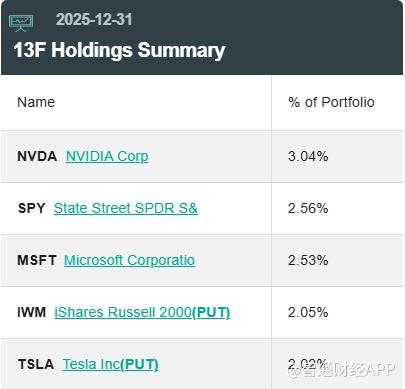
Core Insights - Citigroup has submitted its 13F holdings report to the SEC for the fourth quarter ending December 31, 2025, indicating a portfolio primarily focused on U.S. stocks and ETFs, with some allocation to options and debt instruments [1][2]. Holdings Summary - The largest holding in Citigroup's portfolio is NVIDIA (NVDA), accounting for 3.04% of the total [1][2]. - The second-largest holding is the SPDR S&P 500 ETF (SPY), representing 2.56% of the portfolio [1][2]. - Microsoft (MSFT) ranks third with a 2.53% allocation [1][2]. - Other significant positions include iShares Russell 2000 Index ETF put options (IWM) at 2.05% and Tesla (TSLA) put options at 2.02% [1][2]. New Positions - Citigroup has added several debt and convertible securities in Q4, including positions in Evercore Energy (EVRG), Snowflake (SNOW), Nutanix (NTNX), Align Technology (ALGN), Mara Holdings (MARA), and IonQ Inc (IONQ), with individual additions generally ranging from 5 million to 13 million shares [3]. - A notable new position is in the energy company Total (TTE), with approximately 6.86 million shares valued at about $448 million, representing 0.20% of the portfolio [3]. Exits and Reductions - Citigroup has completely exited several small-cap and illiquid stocks, primarily in healthcare, consumer discretionary, finance, and industrial sectors, including MHUAF, REVB, KEQU, BYFC, CSWC, RDI, and RAIN, reducing these holdings to zero [4][5]. - The firm has significantly reduced its positions in financial stocks, notably decreasing its stake in Bank of America (BAC) by approximately 29.29 million shares, a reduction of 54.86%, lowering its portfolio share from 1.23% to 0.59% [8][9]. Increases in Holdings - Citigroup has notably increased its holdings in the Consumer Staples ETF (XLP), raising its position by approximately 17.63 million shares, increasing its portfolio share from 0.18% to 0.78% [6][7]. - The firm has also significantly increased its positions in various debt and preferred securities, including Akamai (AKAM), JD.com (JD), CMS Energy (CMS), JetBlue Airways (JBLU), and others, with increases generally in the range of 7 million to 12 million shares [6][7]. Summary of Changes - Citigroup has made substantial reductions in options positions, including a 42.31% decrease in iShares iBoxx High Yield Bond ETF put options (HYG) and a reduction of over 90% in the industrial sector ETF put options (XLI) [8][9].




蔚来首次实现季度盈利,换电网络加速扩张
Jing Ji Guan Cha Wang· 2026-02-13 18:07
Core Viewpoint - NIO is expected to achieve its first quarterly adjusted operating profit of 700 million to 1.2 billion yuan in Q4 2025, ending 11 years of continuous losses [1][2] Group 1: Financial Performance - NIO's Q4 2025 delivery reached 124,800 vehicles, a historical high, representing a year-on-year increase of 71.7% [2] - The company aims for a gross margin target of around 18% for Q4 2025, with the gross margin for Q3 2025 already at 14.7% [2] - The adjusted operating profit forecast of 700 million to 1.2 billion yuan is driven by sales growth, product structure optimization, and cost reduction [2] Group 2: Operational Developments - NIO achieved a milestone of 100 million battery swap services, with an average of over 100,000 swaps per day [1] - The company plans to add 1,000 battery swap stations in 2026, bringing the total to over 4,600 by year-end [1] - In January 2026, NIO delivered 27,182 new vehicles, a year-on-year increase of 96.1%, but a month-on-month decrease of 43.53% [1] Group 3: Market and Stock Performance - NIO's stock price in Hong Kong fluctuated between 38.90 and 39.46 HKD, with a slight increase of 0.92% over five days [3] - The stock price in the US ranged from 4.89 to 5.02 USD, showing a slight decrease of 0.40% during the same period [3] - The overall valuation remains low, with a TTM P/E ratio of -3.89 for Hong Kong shares and -3.45 for US shares [3] Group 4: Analyst Opinions - CICC's report indicates that NIO's Q4 2025 profit exceeded market expectations, primarily due to improved gross margins on the ES8 model and cost reduction efforts [4] - The target price has been adjusted to 50 HKD or 6.5 USD, while maintaining an outperform rating despite competitive market risks [4] - Analysts note the strong product cycle with plans to launch three new models in 2026, but caution regarding the recall incident and a high debt-to-asset ratio of 89.2% [4]
新能源汽车迎春运“大考”:力保充电、救援无忧
Zheng Quan Ri Bao· 2026-02-13 15:42
随着春节假期临近,各地返乡流与旅游流叠加,新能源汽车出行需求呈爆发式增长。作为关键节点之一 的充电服务压力陡增,对保障响应速度与服务品质提出了更高要求。 2月13日,蔚来、极氪、理想等多个新能源汽车品牌工作人员向《证券日报》记者表示:"这个春节,公 司不打烊,24小时道路救援已就位。" 据交通运输部发布的信息,新能源汽车的充电保障备受关注,也是近几年节假日、春运交通运输服务保 障的重点。截至2025年底,全国高速公路服务区已建成电动汽车充电枪7.15万个,其中2025年新增2万 个,高速公路服务区充电服务保障能力有了明显提升。 面对春节电动出行高峰,各家新能源汽车公司纷纷打响"续航保卫战"——加速充电网络布局、升级服务 保障,用技术与服务缓解车主长途补能焦虑。 2月10日,小米集团创始人、董事长兼CEO雷军透露,小米汽车2026年春节假期出行暖心服务已就位, 即日起至3月3日(元宵节),小米汽车支持所有车主24小时免费道路救援。 同日,理想汽车宣布,第4000座理想5C超充站——京哈高速凌海服务区站正式上线。目前,理想汽车 已建成拥有22173根超充枪的自建超充网络,覆盖全国31个省份、289个城市。其中,全 ...

蔚来美股盘前短线下跌2%,报4.85%
Jin Rong Jie· 2026-02-13 14:07
Group 1 - NIO's stock price fell by 2% in pre-market trading, reaching $4.85 [1]
X @BSCN


BSCN· 2026-02-13 14:06
🚨JUST IN: PENTAGON BLACKLISTS ALIBABA AND MAJOR CHINESE COMPANIES SUPPORTING MILITARYThe U.S. Department of Defense has added six major Chinese companies, including tech and EV giants, to its military-linked blacklist.Designated firms face heightened scrutiny, U.S. investment restrictions, and potential federal contracting bans.The Chinese firms included are:Alibaba ( $BABA)BYD ( $BYDDY)Baidu ( $BIDU)COSCO (https://t.co/AZeXGlOBWu)Huawei (private)NIO Inc ( $NIO) ...
美股中概股盘前涨跌互现,携程跌1%
Jin Rong Jie· 2026-02-13 09:20
Group 1 - The core viewpoint of the article indicates mixed performance among Chinese concept stocks in the US pre-market trading, with NIO showing a slight increase while Alibaba, JD.com, Ctrip, and Manbang experienced declines [1][2] Group 2 - NIO's stock increased by 0.6% in pre-market trading [1] - Alibaba's stock decreased by 0.2% in pre-market trading [1] - JD.com, Ctrip, and Manbang all saw a decline of 1% in their stock prices [1]

2026车企新车规划盘点 这些新车值得关注
Zhong Guo Zhi Liang Xin Wen Wang· 2026-02-13 06:54
Industry Overview - The domestic automotive industry is entering a new phase focused on quality and efficiency, moving away from price competition to technology innovation and product upgrades to attract consumers [1] - In 2025, domestic passenger car production and sales are expected to reach new highs, with various automakers announcing new vehicle plans across different segments [1] BMW Group - BMW Group plans to launch approximately 20 new models across its three brands by 2026, including the locally produced BMW iX3 long-wheelbase version [2] - The new models will incorporate advanced technologies such as BMW's new generation electric drive technology and AI integration [2][4] Mercedes-Benz - Mercedes-Benz will introduce over 15 new and updated products in 2026, adhering to a strategy of "oil-electric homogeneity" and "oil-electric intelligence" [5] - The lineup will include new models like the long-wheelbase pure electric GLC SUV and the next-generation S-Class sedan [5][7] FAW-Volkswagen - FAW-Volkswagen plans to launch up to 13 new models in 2026, covering fuel, hybrid, and pure electric vehicles [9] - New models will include the all-new Sagitar S, Tayron S, and several Audi models, with a focus on advanced intelligent cockpit and driving assistance systems [9] SAIC Volkswagen - SAIC Volkswagen aims to release at least 7 new energy vehicles in 2026, emphasizing a strategy of "oil-electric co-progression" [11] - The ID.ERA 9X will be the first model in the new ID.ERA series, marking a significant step in the brand's transition to new energy [11] BYD - BYD plans to launch multiple new models across its various brands in 2026, including flagship models in the Dynasty and Ocean series [13] - The company will hold 12 product launch events throughout the year, covering high-end SUVs, performance supercars, and sedans [13] Geely - Geely is expected to introduce over 10 new energy models in 2026, covering various segments such as sedans, SUVs, and MPVs [15] - The Galaxy series will see the addition of new mid-to-large sedans and SUVs, while the Zeekr brand will focus on high-end models [15] Leap Motor - Leap Motor plans to launch 4 new models targeting the mainstream and high-end markets, including a small pure electric SUV and a flagship MPV [17] NIO - NIO will introduce several new models across its three brands, including the flagship ES9 SUV and the L80, a "super five-seat SUV" [18] XPeng Motors - XPeng Motors will launch 7 new "dual-energy" models in 2026, including the new AI luxury SUV [20] - The company emphasizes the integration of self-developed technologies in its new models [20] Hongmeng Zhixing - Hongmeng Zhixing plans to launch 12 new models in 2026, covering a wide price range from family cars to ultra-luxury vehicles [22] - The lineup will include new SUVs and MPVs, with a focus on differentiating market segments [22]

中国汽车:市场反馈及行业预期下调 -1 月季节性表现弱于往常,且物料成本通胀加剧-China Automobiles_ Marketing feedback & lowering estimates for the sector on weaker-than-usual Jan seasonality with BOM cost inflation
2026-02-13 02:18
Summary of Conference Call Notes on the Automotive Industry Industry Overview - **Industry**: Automotive, specifically focusing on electric vehicles (EVs) and new energy vehicles (NEVs) in China - **Current Market Sentiment**: Investor positioning in the automotive sector is underweight as of early 2026, with concerns about demand and cost inflation impacting outlooks [1][2] Key Points 1. Industry Volume Trajectory - **January 2026 Performance**: Domestic passenger vehicle retail volume decreased by 20% month-over-month (mom), compared to a 14% decrease in January 2024 [3] - **Market Expectations**: Anticipation of continued volume decline into February 2026, attributed to the Chinese New Year holiday and reduced stimulus effects [3] - **Future Outlook**: Expected recovery in consumer demand starting March 2026, coinciding with new product launches from BYD and the Beijing Auto Show [3] 2. Raw Material and Memory Cost Inflation - **Cost Increases**: Year-to-date increases in commodity prices (lithium, copper, aluminum) range from 27% to 85% year-over-year [4][18] - **Impact on BOM Costs**: Estimated average increase in Bill of Materials (BOM) costs for EVs is approximately Rmb4,000, leading to a gross margin decline of 2.0% and a net margin decline of 1.7% [4][11] - **OEM Negotiations**: OEMs are negotiating cost-sharing with suppliers, but are expected to absorb 100% of memory cost increases [4] 3. Potential Policy Stimulus - **Government Support Expectations**: Investors anticipate additional government support if demand remains weak, including subsidies for Level 3 vehicles and domestic chip usage [7] - **Economic Contribution**: Passenger vehicles accounted for about 5% of GDP in 2025, indicating the sector's significance to the economy [7] 4. Sensitivity Analysis on Costs - **Margin Concerns**: Rising raw material and memory costs are raising concerns about potential margin impacts for OEMs [8] - **Cost Pass-Through Assumptions**: Analysis assumes a 50/50 cost pass-through ratio for battery and metals, while memory costs are fully absorbed by OEMs [9][12] 5. Target Price Adjustments - **Price Target Reductions**: Target prices for covered OEMs and suppliers have been cut by up to 12% due to weaker demand and higher costs, with average estimates lowered by approximately 16% [2][24] - **Specific Company Adjustments**: - **BYD**: Target price reduced from Rmb144 to Rmb137 due to weaker delivery volumes and higher BOM costs [25] - **Li Auto**: Target price reduced from US$27 to US$24, reflecting lower sales and higher costs [25] - **XPeng**: Target price reduced from US$25 to US$22, driven by weaker sales and pricing pressures [25] - **NIO**: Target price reduced from US$7.0 to US$6.6, impacted by BOM cost inflation [25] 6. Long-term Projections - **Revenue and Net Income Changes**: Projections for revenue and net income have been adjusted downward for several companies, reflecting anticipated market conditions through 2030 [24][30] Additional Insights - **Investor Concerns**: There is a growing concern among investors regarding the sustainability of margins in light of rising costs and competitive pressures [8] - **Market Dynamics**: The automotive sector is facing significant challenges from both internal cost pressures and external market conditions, necessitating close monitoring of policy developments and consumer demand trends [7][8] This summary encapsulates the critical insights from the conference call, highlighting the automotive industry's current challenges and future outlook.



苹果大跌5%
财联社· 2026-02-12 23:41
Core Viewpoint - Concerns over the disruptive potential of artificial intelligence (AI) have led to a decline in major stock indices, with the Nasdaq falling by 2% and the S&P 500 and Dow Jones also experiencing significant drops [1][4]. Group 1: Market Performance - The Dow Jones index closed down 1.34% at 49,451.98 points, the S&P 500 index fell 1.57% to 6,832.76 points, and the Nasdaq index dropped 2.03% to 22,597.15 points [4]. - Major technology stocks saw declines, with Apple down 5%, erasing its gains for the year, and Nvidia down 1.64% [9]. Group 2: Sector Impact - The introduction of AI tools has negatively impacted various sectors, including software companies, publishers, and financial services, raising concerns about potential business model replication and profit margin erosion [5]. - Financial stocks, such as Morgan Stanley, faced pressure due to fears that AI could disrupt wealth management services [5]. - Trucking and logistics companies, like C.H. Robinson, saw a 14% drop in stock price as AI is expected to optimize freight operations, potentially reducing revenue sources [5]. Group 3: Real Estate and Defensive Sectors - The real estate sector is also affected, with concerns that higher unemployment rates will reduce demand for office space, leading to declines in stocks like CBRE and SL Green Realty [6]. - Investors are shifting towards more defensive sectors, with Walmart and Coca-Cola seeing stock price increases of 3.8% and 0.5%, respectively [7]. - In the S&P 500, the consumer staples and utilities sectors outperformed, both rising over 1%, with the consumer staples sector reaching a historical closing high [8].