
NIO(NIO)

Search documents
【月度排名】2026年1月厂商销量排名快报
乘联分会· 2026-02-14 08:39
Core Viewpoint - The domestic narrow passenger car market in China experienced a retail sales decline of 13.9% year-on-year in January 2026, with sales reaching 1.544 million units, attributed to the end of the 12-year new energy vehicle purchase tax exemption policy, leading to a temporary dip in demand [2][4]. Sales Data Summary Wholesale Sales Rankings (January 2026) - Geely Automobile led with 270,167 units sold, a 1.3% increase, capturing 13.7% market share - BYD Automobile followed with 205,518 units, down 30.7%, holding 10.4% market share - Chery Automobile sold 193,969 units, down 12.0%, with a 9.8% market share - Volkswagen sold 128,001 units, down 1.7%, with a 6.5% market share - SAIC Passenger Vehicle sales increased by 53.6% to 77,421 units, capturing 3.9% market share [6]. Retail Sales Rankings (January 2026) - Geely Automobile again led with 209,661 units sold, down 12.6%, holding 13.6% market share - Volkswagen sold 132,300 units, down 3.5%, with an 8.6% market share - BYD's retail sales dropped significantly by 53.0% to 94,176 units, capturing 6.1% market share - SAIC Volkswagen sold 89,600 units, down 9.3%, with a 5.8% market share - Changan Automobile's sales decreased by 33.5% to 81,074 units, holding 5.2% market share [7]. New Energy Vehicle (NEV) Wholesale Sales Rankings (January 2026) - BYD led NEV sales with 205,518 units, down 30.7%, capturing 23.8% market share - Geely followed with 124,252 units, up 2.6%, holding 14.4% market share - Tesla China sold 69,129 units, up 9.3%, with an 8.0% market share - Chery sold 46,802 units, down 14.9%, with a 5.4% market share - SAIC Passenger Vehicle saw a significant increase of 576.9% to 28,179 units, capturing 3.3% market share [9]. New Energy Vehicle (NEV) Retail Sales Rankings (January 2026) - BYD again led with 94,176 units sold, down 53.0%, holding 15.8% market share - Geely sold 92,135 units, down 21.6%, with a 15.5% market share - Hongmeng Zhixing saw a significant increase of 65.5% to 57,915 units, capturing 9.7% market share - SAIC's sales increased by 83.3% to 40,016 units, holding 6.7% market share - Xiaomi Automobile sold 39,002 units, up 70.3%, with a 6.5% market share [10].






美国防部1260H清单更新:78家中企被列入,12家被移除及影响解析
制裁名单· 2026-02-14 05:07
Group 1 - The U.S. Department of Defense released the latest "China Military Enterprises List" (1260H List) on February 13, 2026, including 78 Chinese companies while removing 12 others, marking the fifth update since its initial release in June 2021 [1] - The newly listed companies span critical sectors such as internet, new energy, semiconductors, aerospace, and telecommunications, including major firms like Alibaba, Baidu, Tencent, BYD, CATL, NIO, SMIC, Huawei, DJI, AVIC, and CASIC [1] - Alibaba has publicly stated that its inclusion is baseless, asserting it is not a military enterprise and may consider legal action in response [1] Group 2 - The 12 companies removed from the list include Changxin Storage (CXMT) and Yangtze Memory Technologies (YMTC), primarily involved in electronics, chemicals, and transportation [2] - Being listed does not trigger comprehensive sanctions directly, but it will significantly impact the operations of Chinese companies, particularly with the U.S. Department of Defense prohibiting new procurement contracts with listed companies starting June 30, 2026 [2] - The indirect effects include potential capital market volatility, restricted financing channels for Chinese companies, and challenges in global supply chains due to the risk of technology supply cuts and reduced cooperation from partners [2] Group 3 - Companies on the list may face further inclusion in more stringent U.S. sanctions lists, leading to stricter financial and technological restrictions [3] - The U.S. legislation requires consideration of including other companies from existing U.S. sanctions lists in future updates, potentially expanding the scope of sanctions [3] - The Chinese government has repeatedly opposed the U.S. approach, viewing the list as a continuation of efforts to curb China's technological and economic growth, while Chinese companies are actively seeking to mitigate the negative impacts through appeals and legal actions [3]





中概股全线走低、美股全线大跌,有色金属、半导体芯片、苹果重挫
Sou Hu Cai Jing· 2026-02-14 04:30
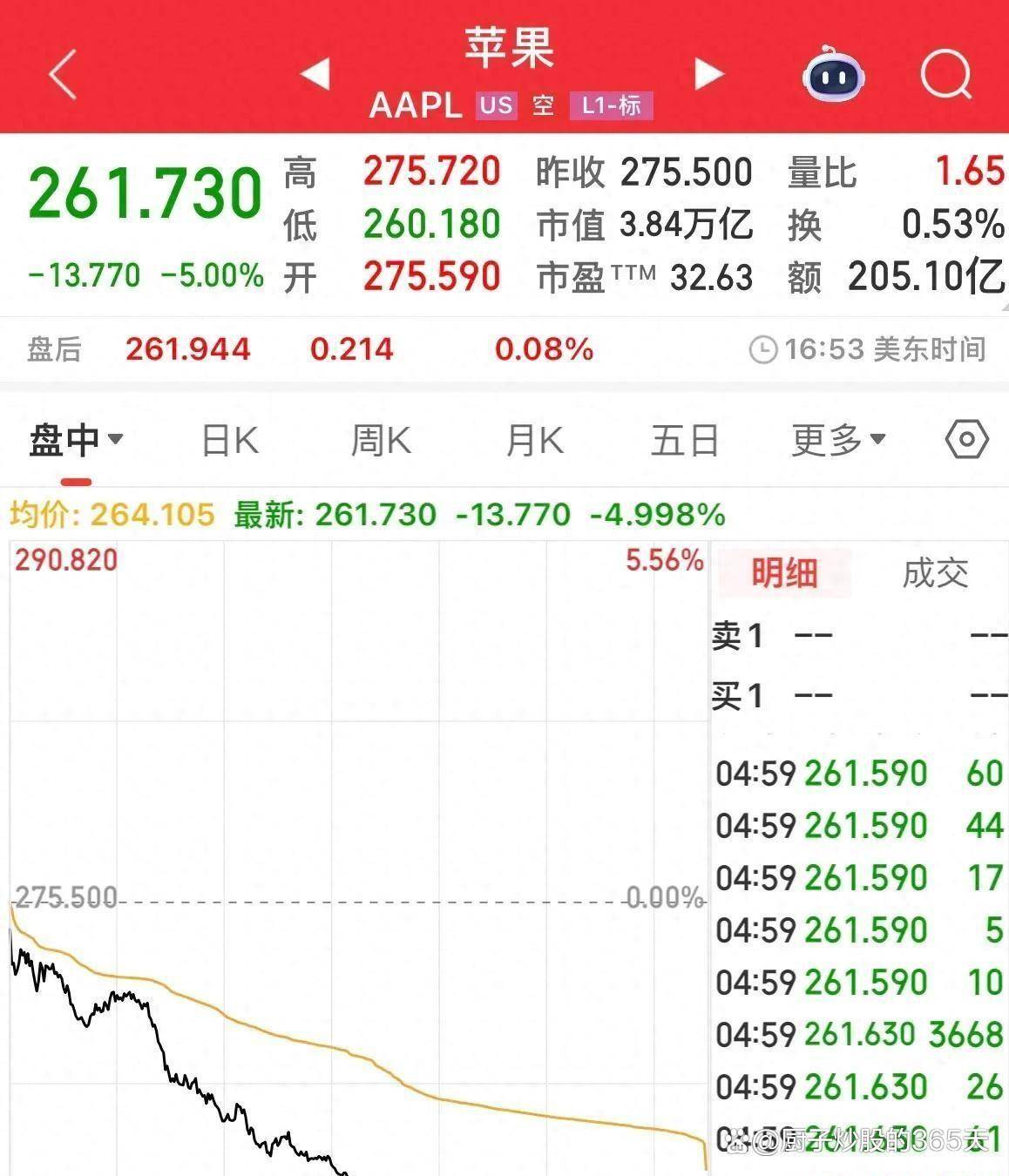
Market Overview - The US stock market experienced a significant decline, with the Dow Jones Industrial Average dropping 669.42 points (1.34%) to close at 49,451.98 points, the Nasdaq Composite falling 469.32 points (2.03%) to 22,597.15 points, and the S&P 500 decreasing by 108.71 points (1.57%) to 6,832.76 points [1][2][3] Market Sentiment - Over 4,100 stocks declined, indicating widespread market panic as investors rushed to sell assets, particularly in the tech and growth sectors. The VIX index surged, reflecting heightened risk aversion [2][3] Sector Performance - The sell-off affected nearly all sectors, with notable declines in precious metals and semiconductor stocks. The precious metals sector saw significant drops, with gold futures down 3.08% and silver futures plummeting 10.62% [4][5][6][8] - The Philadelphia Semiconductor Index fell by 2.5%, with individual stocks like AEHR Test Systems down 17.58% and Intel down over 3% [8][10] Major Companies - Apple Inc. experienced a substantial drop of 5.00%, resulting in a market cap loss of over $120 billion, attributed partly to regulatory concerns [12] - Other major tech companies also faced declines, with Tesla down 1.62%, Amazon down 2.20%, and Meta Platforms down nearly 3% [12] Financial Sector - Bank stocks fell across the board, with JPMorgan Chase down over 2%, Goldman Sachs down over 4%, and Citigroup down over 5%, driven by concerns over AI disrupting traditional wealth management [13][14] Economic Indicators - Recent economic data, including a drop in initial jobless claims and lower-than-expected existing home sales, contributed to market anxiety about potential economic overheating and prolonged high interest rates [24][25][26] Global Market Impact - The sell-off in the US markets had a ripple effect on global markets, with European indices also closing lower after initially opening higher, indicating a widespread sentiment of fear [18][19][20] AI Concerns - The market's decline was exacerbated by fears regarding the disruptive impact of AI technologies on various industries, leading to significant stock price drops in sectors perceived to be at risk [21][22][30] Storage Chip Sector - In contrast to the overall market trend, storage chip stocks saw gains, with companies like SanDisk and Seagate Technology rising significantly, reflecting a belief that AI's growth will increase demand for data storage [29]


晚间暴雷!黄金、白银、原油、美股全线崩盘,42只中概集体下跌
Sou Hu Cai Jing· 2026-02-14 04:22
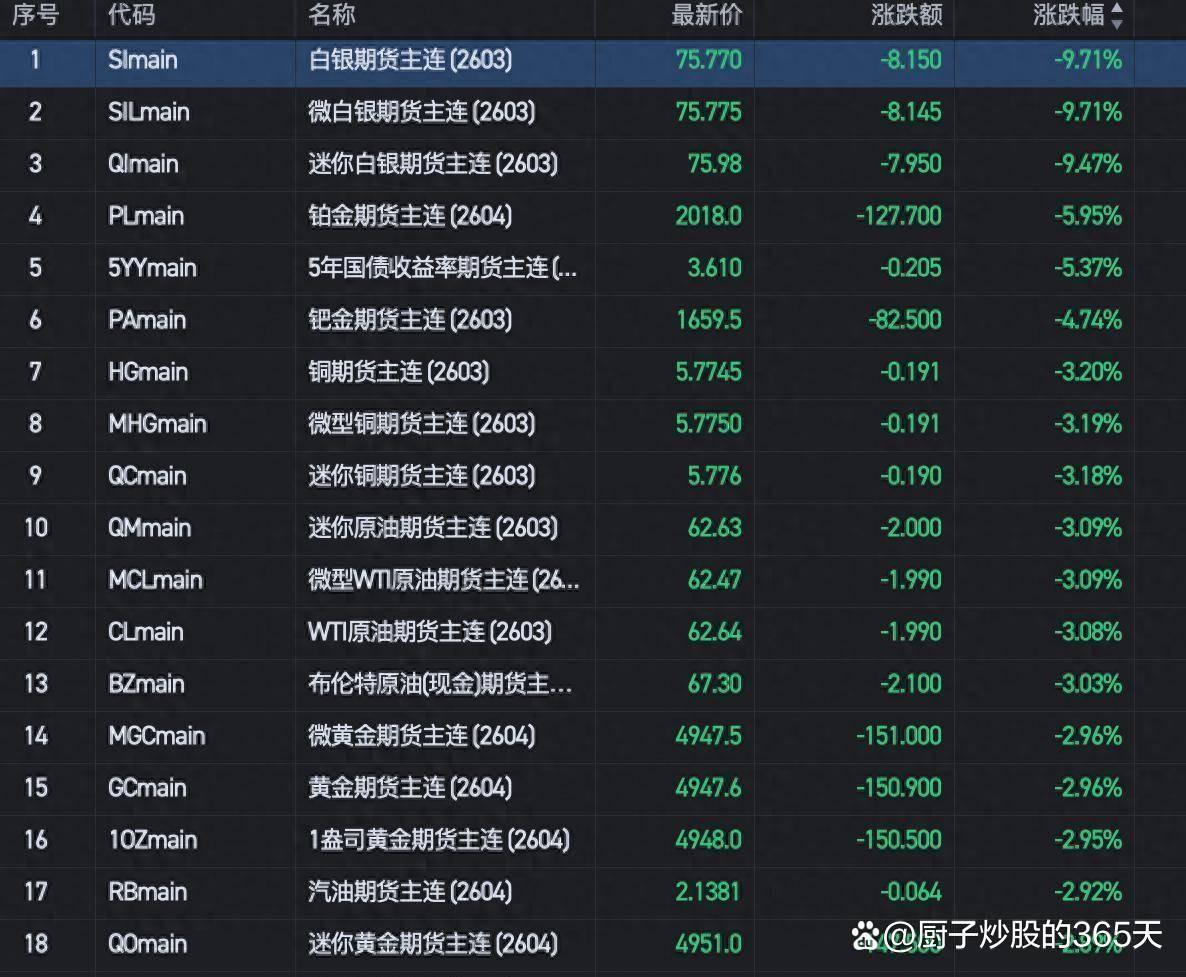
Market Overview - On February 13, 2026, a significant asset sell-off occurred in global financial markets, particularly impacting U.S. stock indices. The Dow Jones Industrial Average fell by 669.42 points (1.34%) to close at 49,451.98, while the Nasdaq Composite Index dropped 469.32 points (2.03%) to 22,597.15. The S&P 500 Index also declined by 108.71 points (1.57%) to 6,832.76 [1]. Commodity Market Impact - The sell-off extended to the commodity markets, with gold and silver experiencing substantial declines. COMEX gold futures fell by 3.08% to $4,941.4 per ounce, while COMEX silver futures plummeted by 10.62% to $75.01 per ounce [2][3]. Technology Sector Reaction - Major technology companies were severely affected, with Apple’s stock price dropping by 5%, resulting in a market value loss of over $120 billion (approximately 800 billion RMB). Other tech giants like Microsoft, Amazon, Tesla, Meta, and Nvidia also saw significant declines [3][4]. Chinese Concept Stocks - The Nasdaq Golden Dragon China Index, which includes many Chinese concept stocks, fell by 3% on the same day, indicating a collective sell-off in this sector. Over 40 Chinese concept stocks experienced substantial declines, with Tencent Music down 10.57% and Alibaba down 3.40% [3][4][6]. Employment Data Influence - The catalyst for this market turmoil was a strong U.S. employment report released on February 11, showing a non-farm payroll increase of 130,000 in January, significantly above the expected 70,000. This led to a shift in market expectations regarding Federal Reserve interest rate cuts, with the probability of a March rate cut dropping from 19.6% to 6% [5][6]. Capital Expenditure Concerns - Major tech companies announced aggressive capital expenditure plans for 2026, with Alphabet projecting $175 billion to $185 billion and Amazon estimating $200 billion, both nearly doubling their 2025 expenditures. This raised investor concerns about the return on such investments, especially as many companies reported record profits but saw stock price declines [10][11]. Market Sentiment and Volatility - The market's fear and volatility increased sharply, with the VIX index rising significantly. The sell-off was exacerbated by algorithm-driven trading, which triggered stop-loss orders and led to extreme price movements [15][16][17]. Global Market Impact - The financial turmoil that began in Wall Street quickly spread to global markets, with Asian and European stock markets opening lower in response to the U.S. declines [18].



美股三大指数周线齐跌
财联社· 2026-02-14 00:39
Market Overview - The three major indices showed mixed performance, with the Dow Jones up 0.10% to 49,500.93 points, the S&P 500 up 0.05% to 6,836.17 points, and the Nasdaq down 0.22% to 22,546.67 points [3] - All three indices recorded weekly declines, with the S&P 500 down 1.4%, the Dow down 1.2%, and the Nasdaq down 2.1% [3] Economic Indicators - The U.S. Bureau of Labor Statistics reported that the January CPI rose 2.4% year-over-year and 0.2% month-over-month, both below market expectations [3] - The core CPI, excluding volatile food and energy prices, increased by 2.5% year-over-year and 0.3% month-over-month, aligning with market expectations [3] - Phil Blancato, Chief Market Strategist at Osaic, indicated that this data could pave the way for interest rate cuts and inflation control if the trend continues [3] Sector Performance - Concerns over AI disruption led to market sell-offs, affecting various sectors including software, real estate, trucking, and financial services [6] - Financial stocks such as Charles Schwab and Morgan Stanley fell by 10.8% and 4.9%, respectively, while software company Workday dropped 11% and commercial real estate firm CBRE fell 16% [6] - The media sector was also impacted, with Disney down approximately 3% and Netflix down 6% [7] Technology Stocks - Major tech stocks mostly declined, with Nvidia down 2.21%, Apple down 2.27%, Microsoft down 0.13%, Google down 1.06%, and Amazon down 0.41% [7] - Tesla saw a slight increase of 0.09%, while Oracle rose by 2.34% and Netflix increased by 1.33% [7] Chinese Stocks - The Nasdaq Golden Dragon China Index fell by 0.10%, with Alibaba down 1.89%, JD.com down 1.38%, and Pinduoduo up 0.06% [7] - NIO remained flat, while Xpeng rose by 1.36% and Li Auto fell by 1.81% [7]



花旗集团(C.US)四季度13F曝光:英伟达(NVDA.US)为第一大重仓股 大幅减持美国银行(BAC.US)
智通财经网· 2026-02-13 23:21
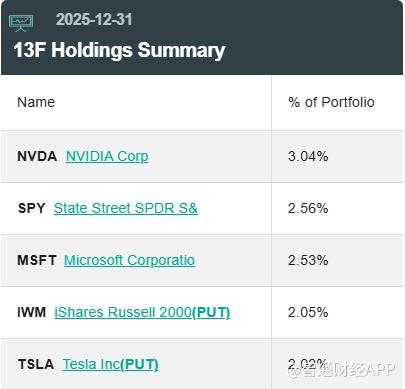
Core Insights - Citigroup has submitted its 13F holdings report to the SEC for the fourth quarter ending December 31, 2025, indicating a portfolio primarily focused on U.S. stocks and ETFs, with some allocation to options and debt instruments [1][2]. Holdings Summary - The largest holding in Citigroup's portfolio is NVIDIA (NVDA), accounting for 3.04% of the total [1][2]. - The second-largest holding is the SPDR S&P 500 ETF (SPY), representing 2.56% of the portfolio [1][2]. - Microsoft (MSFT) ranks third with a 2.53% allocation [1][2]. - Other significant positions include iShares Russell 2000 Index ETF put options (IWM) at 2.05% and Tesla (TSLA) put options at 2.02% [1][2]. New Positions - Citigroup has added several debt and convertible securities in Q4, including positions in Evercore Energy (EVRG), Snowflake (SNOW), Nutanix (NTNX), Align Technology (ALGN), Mara Holdings (MARA), and IonQ Inc (IONQ), with individual additions generally ranging from 5 million to 13 million shares [3]. - A notable new position is in the energy company Total (TTE), with approximately 6.86 million shares valued at about $448 million, representing 0.20% of the portfolio [3]. Exits and Reductions - Citigroup has completely exited several small-cap and illiquid stocks, primarily in healthcare, consumer discretionary, finance, and industrial sectors, including MHUAF, REVB, KEQU, BYFC, CSWC, RDI, and RAIN, reducing these holdings to zero [4][5]. - The firm has significantly reduced its positions in financial stocks, notably decreasing its stake in Bank of America (BAC) by approximately 29.29 million shares, a reduction of 54.86%, lowering its portfolio share from 1.23% to 0.59% [8][9]. Increases in Holdings - Citigroup has notably increased its holdings in the Consumer Staples ETF (XLP), raising its position by approximately 17.63 million shares, increasing its portfolio share from 0.18% to 0.78% [6][7]. - The firm has also significantly increased its positions in various debt and preferred securities, including Akamai (AKAM), JD.com (JD), CMS Energy (CMS), JetBlue Airways (JBLU), and others, with increases generally in the range of 7 million to 12 million shares [6][7]. Summary of Changes - Citigroup has made substantial reductions in options positions, including a 42.31% decrease in iShares iBoxx High Yield Bond ETF put options (HYG) and a reduction of over 90% in the industrial sector ETF put options (XLI) [8][9].


蔚来首次实现季度盈利,换电网络加速扩张
Jing Ji Guan Cha Wang· 2026-02-13 18:07
Core Viewpoint - NIO is expected to achieve its first quarterly adjusted operating profit of 700 million to 1.2 billion yuan in Q4 2025, ending 11 years of continuous losses [1][2] Group 1: Financial Performance - NIO's Q4 2025 delivery reached 124,800 vehicles, a historical high, representing a year-on-year increase of 71.7% [2] - The company aims for a gross margin target of around 18% for Q4 2025, with the gross margin for Q3 2025 already at 14.7% [2] - The adjusted operating profit forecast of 700 million to 1.2 billion yuan is driven by sales growth, product structure optimization, and cost reduction [2] Group 2: Operational Developments - NIO achieved a milestone of 100 million battery swap services, with an average of over 100,000 swaps per day [1] - The company plans to add 1,000 battery swap stations in 2026, bringing the total to over 4,600 by year-end [1] - In January 2026, NIO delivered 27,182 new vehicles, a year-on-year increase of 96.1%, but a month-on-month decrease of 43.53% [1] Group 3: Market and Stock Performance - NIO's stock price in Hong Kong fluctuated between 38.90 and 39.46 HKD, with a slight increase of 0.92% over five days [3] - The stock price in the US ranged from 4.89 to 5.02 USD, showing a slight decrease of 0.40% during the same period [3] - The overall valuation remains low, with a TTM P/E ratio of -3.89 for Hong Kong shares and -3.45 for US shares [3] Group 4: Analyst Opinions - CICC's report indicates that NIO's Q4 2025 profit exceeded market expectations, primarily due to improved gross margins on the ES8 model and cost reduction efforts [4] - The target price has been adjusted to 50 HKD or 6.5 USD, while maintaining an outperform rating despite competitive market risks [4] - Analysts note the strong product cycle with plans to launch three new models in 2026, but caution regarding the recall incident and a high debt-to-asset ratio of 89.2% [4]
新能源汽车迎春运“大考”:力保充电、救援无忧
Zheng Quan Ri Bao· 2026-02-13 15:42
随着春节假期临近,各地返乡流与旅游流叠加,新能源汽车出行需求呈爆发式增长。作为关键节点之一 的充电服务压力陡增,对保障响应速度与服务品质提出了更高要求。 2月13日,蔚来、极氪、理想等多个新能源汽车品牌工作人员向《证券日报》记者表示:"这个春节,公 司不打烊,24小时道路救援已就位。" 据交通运输部发布的信息,新能源汽车的充电保障备受关注,也是近几年节假日、春运交通运输服务保 障的重点。截至2025年底,全国高速公路服务区已建成电动汽车充电枪7.15万个,其中2025年新增2万 个,高速公路服务区充电服务保障能力有了明显提升。 面对春节电动出行高峰,各家新能源汽车公司纷纷打响"续航保卫战"——加速充电网络布局、升级服务 保障,用技术与服务缓解车主长途补能焦虑。 2月10日,小米集团创始人、董事长兼CEO雷军透露,小米汽车2026年春节假期出行暖心服务已就位, 即日起至3月3日(元宵节),小米汽车支持所有车主24小时免费道路救援。 同日,理想汽车宣布,第4000座理想5C超充站——京哈高速凌海服务区站正式上线。目前,理想汽车 已建成拥有22173根超充枪的自建超充网络,覆盖全国31个省份、289个城市。其中,全 ...
蔚来美股盘前短线下跌2%,报4.85%
Jin Rong Jie· 2026-02-13 14:07
Group 1 - NIO's stock price fell by 2% in pre-market trading, reaching $4.85 [1]
美股中概股盘前涨跌互现,携程跌1%
Jin Rong Jie· 2026-02-13 09:20
Group 1 - The core viewpoint of the article indicates mixed performance among Chinese concept stocks in the US pre-market trading, with NIO showing a slight increase while Alibaba, JD.com, Ctrip, and Manbang experienced declines [1][2] Group 2 - NIO's stock increased by 0.6% in pre-market trading [1] - Alibaba's stock decreased by 0.2% in pre-market trading [1] - JD.com, Ctrip, and Manbang all saw a decline of 1% in their stock prices [1]
