NIO(NIO)

Search documents
Nio Strategic Metals Announces Updates on Its Non-Brokered Private Placement
TMX Newsfile· 2026-02-03 13:30
Core Viewpoint - Nio Strategic Metals Inc. is conducting a non-brokered private placement to raise funds for its operations, with strong demand leading to an expected oversubscription of shares [1][3]. Group 1: Private Placement Details - The company announced a proposed private placement of up to 27,002,255 common shares at a price of $0.155 per share, aiming for gross proceeds of up to $4,185,350 [2]. - Due to high demand, the company anticipates issuing an additional 5,255,810 common shares, potentially raising total gross proceeds to $5,000,000 by issuing up to 32,258,065 common shares [3]. - The closing of the transaction is expected in February 2026, subject to customary closing conditions, and the shares will be subject to a four-month hold period [4]. Group 2: Company Overview - Nio Strategic Metals is focused on becoming a ferroniobium producer and holds niobium properties in Oka and near Mont-Laurier, as well as another exploration property in Quebec [7].



新势力格局生变:问界、小米、零跑成新第一梯队
Jing Ji Guan Cha Wang· 2026-02-03 12:42
据经济观察报-经济观察网 2026年1月,新势力车企销量格局发生显著变化。问界汽车、小米汽车和零 跑汽车以3万辆至4万辆的交付量,形成了新的"第一梯队"。具体来看,问界汽车1月交付约4万辆,同比 增长83%;小米汽车1月交付超3.9万辆,去年同期为超2万辆;零跑汽车1月全系交付达3.21万辆,同比 增长27%。与此同时,理想汽车、蔚来汽车和小鹏汽车1月销量在2万辆到3万辆之间,变为"第二梯 队"。蔚来1月交付新车2.72万辆,同比增长96.1%;理想汽车交付2.77万辆,同比下滑7.55%;小鹏汽车 交付2万辆,同比下滑34.07%。问界、小米与蔚来同比增幅显著。 ...



同比普涨、环比普跌,1月车企销量“开门红”成色不足
经济观察报· 2026-02-03 12:15
进入2026年1月后,新能源汽车购置税开始减半征收,车企购 置税兜底政策也随之结束。另外,1月各地具体的购车补贴细 则尚未全部出台,导致消费者存在观望情绪,影响了车市终端 销售情况。 作者:王帅国 封图:图虫创意 2月1日,各家车企相继发布了1月销量。从整体上看,汽车行业实现2026年"开门红",大多数车 企1月销量同比取得正增长,但这一同比增长是由于2025年春节在1月,去年同期的新车销售基数 较低。 环比数据上,大多数车企1月销量下滑明显,主要原因在于2025年12月新能源汽车还享受购置税 全额减免政策,同时车企为年底冲量,在12月出台了许多其他优惠政策。进入2026年1月后,新 能源汽车购置税开始减半征收,车企购置税兜底政策也随之结束。另外,1月各地具体的购车补贴 细则尚未全部出台,导致消费者存在观望情绪,影响了车市终端销售情况。 广汽集团1月销量为11.66万辆,同比增长18.47%,环比下滑37.79%。其中自主品牌销量超4.9 万辆,同比增长87.58%;海外销量同比增长68.59%。分品牌来看,昊铂+埃安销量2.16万辆, 同比大增171.63%;传祺品牌销量2.77万辆,同比增长51.06%; ...



“光伏+交通”新范本,隆基与蔚来携手打造光储充换一体化项目
中国能源报· 2026-02-03 11:47
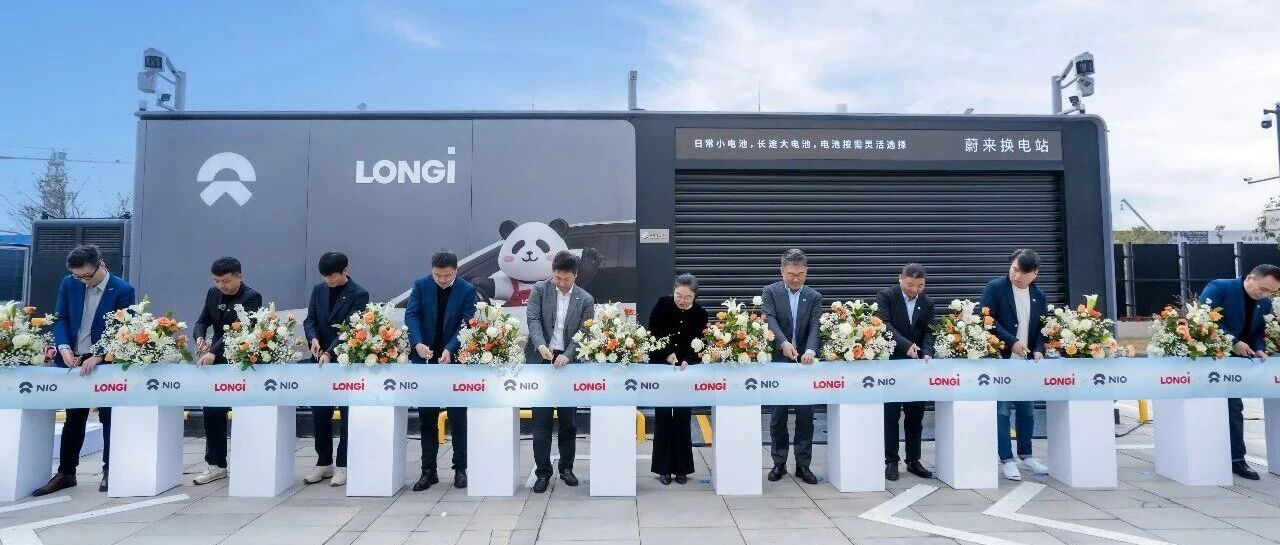
Core Viewpoint - The collaboration between Longi Green Energy and NIO aims to create an integrated energy solution that combines photovoltaic power generation, energy storage, and electric vehicle charging, contributing to low-carbon transportation and serving as a replicable model for sustainable energy systems [2][3][12]. Group 1: Project Overview - The "NIO Battery Swap Station | Longi Global Distributed R&D Center" project integrates photovoltaic canopies, walls, and noise barriers, creating a comprehensive energy system that alleviates grid pressure and meets user charging needs [3][5]. - The project features three photovoltaic facilities: a solar canopy, a solar wall, and a solar noise barrier, ensuring green and stable power supply while minimizing carbon emissions [3][5]. Group 2: Technological Innovations - The photovoltaic noise barrier combines high-efficiency solar components with noise reduction capabilities, providing a dual function of energy generation and traffic noise mitigation [5]. - The solar canopy employs patented installation technology and a dual-layer waterproof design, ensuring safety during extreme weather while converting parking spaces into efficient green energy stations [6]. Group 3: Strategic Implications - The successful first battery swap by the NIO ET9 at the new station signifies a complete link from green energy generation to high-end green transportation [8]. - The project is part of NIO's long-term strategy to build a nationwide clean energy network, promoting similar "solar-storage-charging" demonstration projects to enhance user experience and support carbon neutrality in transportation [10][12]. Group 4: Future Collaboration - Longi and NIO plan to deepen their collaboration to promote the integration of "photovoltaics + battery swapping + energy storage" in transportation networks and explore innovative projects related to grid interaction [12].

【新能源周报】新能源汽车行业信息周报(2026年1月26日-2月1日)
乘联分会· 2026-02-03 10:48
Industry Information - By 2028, Yunnan aims for its non-ferrous metal industry output to exceed 600 billion yuan, with new energy battery and phosphorus industries becoming new trillion-level industries [13] - As of January 2025, the number of new energy vehicles in China reached 43.97 million, accounting for 12.01% of total vehicles, with pure electric vehicles making up 68.74% of new energy vehicles [7] - Global production of lithium manganese phosphate is expected to reach 70,000 tons by 2026, up from 28,500 tons last year, reflecting a growth of 206.5% [8] - The global sales of pure electric vehicles are projected to exceed 12.1 million units by 2025, with BYD expected to surpass Tesla in sales [10] - The total number of electric vehicle charging facilities in China reached 20.09 million by the end of 2025, marking a 49.7% year-on-year increase [18] Policy Information - The Ministry of Transport announced that over 10,000 charging guns will be added in service areas in 2026, enhancing the convenience of charging for new energy vehicles [15] - A new mandatory national standard for automotive steering systems will be implemented starting July 1, 2026, which will clarify safety boundaries for new technologies [24] - Jiangsu Nanjing has launched a plan to build smart energy application scenarios, focusing on energy integration and digital transformation [25] Company Information - Li Auto's MEGA has achieved 30,000 deliveries [39] - Xiaopeng Motors has launched 1,000 mobile charging stations to assist with vehicle-to-vehicle charging during the Spring Festival [40] - NIO has opened its first national dealership in Hungary, marking a significant milestone in its European expansion [41] - BYD has signed an agreement to build an electric vehicle battery factory in Vietnam with a total investment of 130 million USD [41]




在销量最冷的季节,为什么国产豪华车反而卖得更好?
3 6 Ke· 2026-02-03 10:31
Group 1: Market Trends - The Chinese automotive industry is experiencing a seasonal overall decline, with major automotive groups like BYD and Chery reporting a year-on-year sales drop of 30% and nearly 11% respectively in January [1] - New energy vehicle sales from companies like XPeng and Li Auto also saw significant declines, with year-on-year decreases of 34% and 7.5% respectively [1] - Despite some companies achieving year-on-year growth, the growth rates have significantly narrowed, with declines of 30%-60% observed in month-on-month comparisons [1] Group 2: Luxury Vehicle Demand - The luxury vehicle segment is witnessing a "golden age," with NIO's ES8 model showing a remarkable year-on-year delivery increase of 96.1% in January, contributing to nearly 64.9% of NIO's total deliveries [3] - The demand for high-priced models is driven by new national subsidy policies favoring vehicles priced above 16.67 million yuan, which incentivizes consumers to opt for higher-end models [4] - The trend is reflected across various brands, with BYD's high-end models like the Fangchengbao experiencing a 247% increase in sales, while GAC's premium brand Aion also saw a 171.63% growth [6] Group 3: Supply Chain Challenges - The automotive industry is facing rising costs for key components and electronic parts, with memory chip prices expected to significantly impact profit margins [12] - The price of essential raw materials such as copper, aluminum, and lithium carbonate has also surged, potentially leading to increased vehicle prices or reduced profit margins for manufacturers [14] - Companies are aware that the rising costs may not be fully absorbed by the supply chain, leading to potential price hikes or margin compression if sales volumes do not stabilize [14] Group 4: Future Product Plans - Several automotive companies have announced new product plans for their 8-series and 9-series models in 2026, indicating a continued focus on high-end offerings [10] - NIO plans to launch the ES9, while other brands like Zeekr and Xiaomi are also preparing to introduce new high-end models [10] - The introduction of L3-level assisted driving technology and changes in subsidy policies are expected to further benefit high-end vehicle market penetration [14]

部分造车新势力1月交付数据丨鸿蒙智行57915台 小米、零跑超3万台
Cai Jing Wang· 2026-02-03 09:19
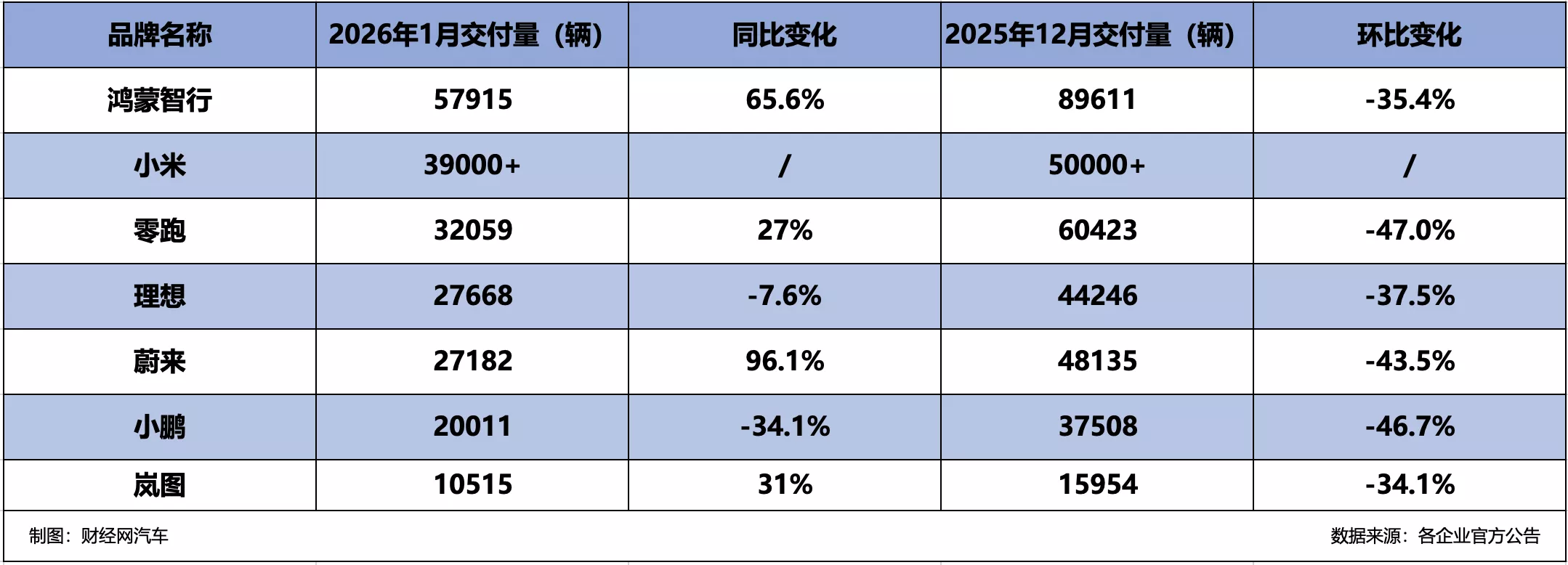
Core Insights - New energy vehicle companies in China reported mixed delivery results for January, with some experiencing significant growth while others faced declines in both year-over-year and month-over-month metrics [1][4]. Delivery Data Summary - Hongmeng Zhixing led the delivery rankings with 57,915 units, a year-over-year increase of 65.6% [5]. - Xiaomi delivered over 39,000 units, marking a 95% increase compared to January 2025 [5]. - Leap Motor delivered 32,059 units, a year-over-year increase of 27% but a month-over-month decline of 47% [5][6]. - Li Auto delivered 27,668 units, down 7.6% year-over-year and 37.5% month-over-month [7]. - NIO delivered 27,182 units, showing a 96.1% year-over-year increase but a 43.5% month-over-month decline [8]. - XPeng delivered 20,011 units, down 34.1% year-over-year and 46.7% month-over-month [10]. - Lantu delivered 10,515 units, a year-over-year increase of 31% [11]. Market Trends and Insights - The overall retail sales of passenger vehicles in China dropped by 28% year-over-year and 37% month-over-month, with new energy vehicles experiencing a notable decline [4]. - The penetration rate of new energy vehicles fell from 59.1% in December to 45.9% in January [4]. - A new energy vehicle company executive attributed the market downturn to the traditional off-peak season and the expiration of tax exemption policies, which led to demand being pulled forward [4][11].
安徽全省一盘棋发力汽车产业
Ren Min Ri Bao· 2026-02-03 07:45
Core Viewpoint - Anhui Province is rapidly developing its automotive industry, particularly in the electric vehicle sector, aiming for a production target of 3.6865 million vehicles by 2025, with 1.7941 million being electric vehicles, both leading the nation [2][3]. Group 1: Industry Growth and Development - The automotive industry in Anhui has grown significantly, with production increasing from 1.161 million vehicles in 2020 to a projected 3.6865 million in 2025, moving from eighth to first in national rankings [3][4]. - The province has attracted seven major vehicle manufacturers and over 3,000 automotive parts companies, with the automotive industry chain's revenue expected to exceed 1.5 trillion yuan in 2024, marking a continuous growth of over 20% for two consecutive years [6][8]. Group 2: Government Support and Investment - The local government has played a crucial role in supporting the automotive industry, exemplified by a 7 billion yuan investment in NIO to stabilize its funding and attract other manufacturers like BYD and Volkswagen [5][6]. - The establishment of the "Automobile Office" by the Anhui Provincial Development and Reform Commission aims to provide comprehensive support for the automotive industry, enhancing market efficiency through government initiatives [6][8]. Group 3: Collaborative Innovation - A framework agreement was signed among major local car manufacturers, including Chery and NIO, to promote collaborative innovation in vehicle and key component development, resource sharing, and localized chip development [9][11]. - Chery has established a global network of R&D centers and invests approximately 20 billion yuan annually in research, focusing on engine efficiency and innovation [10][11]. Group 4: Regional Development and Integration - The province is implementing a dual-core strategy with Hefei and Wuhu as the main hubs, while supporting other cities to develop complementary automotive industries, leading to a projected revenue of 20.26 billion yuan for the automotive industry in Huainan by 2025 [7][8]. - All 16 cities in Anhui have developed unique and competitive automotive parts clusters, contributing to the overall growth of the province's automotive industry [7][8].
2026年1月季节性淡季致内需承压,静待地方政策落地与需求回补
BOCOM International· 2026-02-03 05:20
Investment Rating - The report assigns a "Buy" rating to several companies in the automotive sector, indicating an expectation of total returns exceeding the relevant industry over the next 12 months [8]. Core Insights - The automotive market in January 2026 experienced a seasonal downturn, with a notable decline in demand due to the impact of subsidy policies and adjustments in purchase tax. Most new energy vehicle manufacturers saw a significant month-on-month sales drop of 43.9% [3][4]. - Despite the overall weak performance in the first quarter of 2026, the continuation of the vehicle replacement policy is expected to support market recovery as local subsidy details are finalized [4]. - Companies to watch include: - Xpeng Motors (9868 HK/XPEV US) with new models launching and increasing overseas production [4]. - Geely Automobile (175 HK) focusing on internal resource integration post-privatization of Zeekr [4]. - BYD (1211 HK) benefiting from increased overseas production capacity and high growth in international sales [4]. Summary by Relevant Sections Sales Performance - BYD's January sales were 205,518 units, down 30.7% year-on-year and 50.4% month-on-month. However, exports surged by 43.3% to 100,009 units, with overseas sales accounting for 47.6% of total sales [6][7]. - NIO delivered 27,182 vehicles in January, a 96.1% year-on-year increase but a 43.5% month-on-month decline. The introduction of new financing options is expected to ease purchasing barriers [6][7]. - Xpeng delivered 20,011 vehicles, down 34.1% year-on-year and 46.6% month-on-month, with the new X9 model showing significant growth [6][7]. - Li Auto's deliveries were 27,668 units, reflecting a slight decline due to product cycle impacts [6][7]. - Xiaomi's deliveries exceeded 39,000 units, marking a 95% year-on-year increase [6][7]. Company Ratings and Price Targets - The report includes various companies with their respective ratings and target prices, indicating potential upside: - BYD (1211 HK) with a target price of 133.00, representing a 36.06% upside [8]. - NIO (9866 HK) with a target price of 62.75, indicating a 62.48% upside [8]. - Xpeng (9868 HK) with a target price of 134.69, suggesting an 87.98% upside [8].
1月车市环比多暴跌,出口成“救命稻草”
Xin Lang Cai Jing· 2026-02-03 04:12
Core Viewpoint - The automotive market in January 2026 showed a slight year-on-year increase but a significant month-on-month decline, primarily due to policy changes and demand exhaustion, with exports becoming a crucial growth driver for companies [1][22]. Group 1: Market Performance - The overall automotive market experienced a year-on-year increase but a month-on-month decline, with some companies facing drastic reductions in sales [1]. - The core reasons for the market's sluggish start include the reduction of the new energy vehicle purchase tax and a mismatch in demand due to the timing of the Spring Festival [1]. - Exports have emerged as a vital growth area for automotive companies, helping to offset domestic market fluctuations [1][6]. Group 2: Company Sales Data - BYD sold 210,100 vehicles in January, a year-on-year decline of 30.11% and a month-on-month decline of 50.04%, heavily impacted by the new energy vehicle tax policy [3][5]. - Geely's sales reached 270,200 units, showing a year-on-year increase of 1.29% and a month-on-month increase of 14.08%, with significant export growth [5][6]. - SAIC Group reported sales of 327,000 units, a year-on-year increase of 23.9%, with a notable increase in overseas sales [8]. Group 3: New Energy Vehicle Trends - The new energy vehicle market is facing challenges due to policy changes, leading to a cautious consumer sentiment [1][3]. - Companies are increasingly relying on exports to sustain growth in the new energy vehicle segment, as domestic competition intensifies [6][22]. Group 4: Competitive Strategies - Companies are engaging in aggressive promotional strategies, including long-term financing options and price reductions, to stimulate sales amid a cooling market [15][17]. - The automotive industry is shifting towards a more competitive landscape, focusing on comprehensive service offerings beyond just product pricing [17][22]. - Traditional luxury brands are facing pressure from the rise of domestic electric vehicle manufacturers, leading to significant price reductions to maintain market share [20][22].