
NIO(NIO)

Search documents
一代“神车”本田飞度跌破7万元上市,但这个市场早已不属于它
Xin Lang Cai Jing· 2026-01-21 04:07
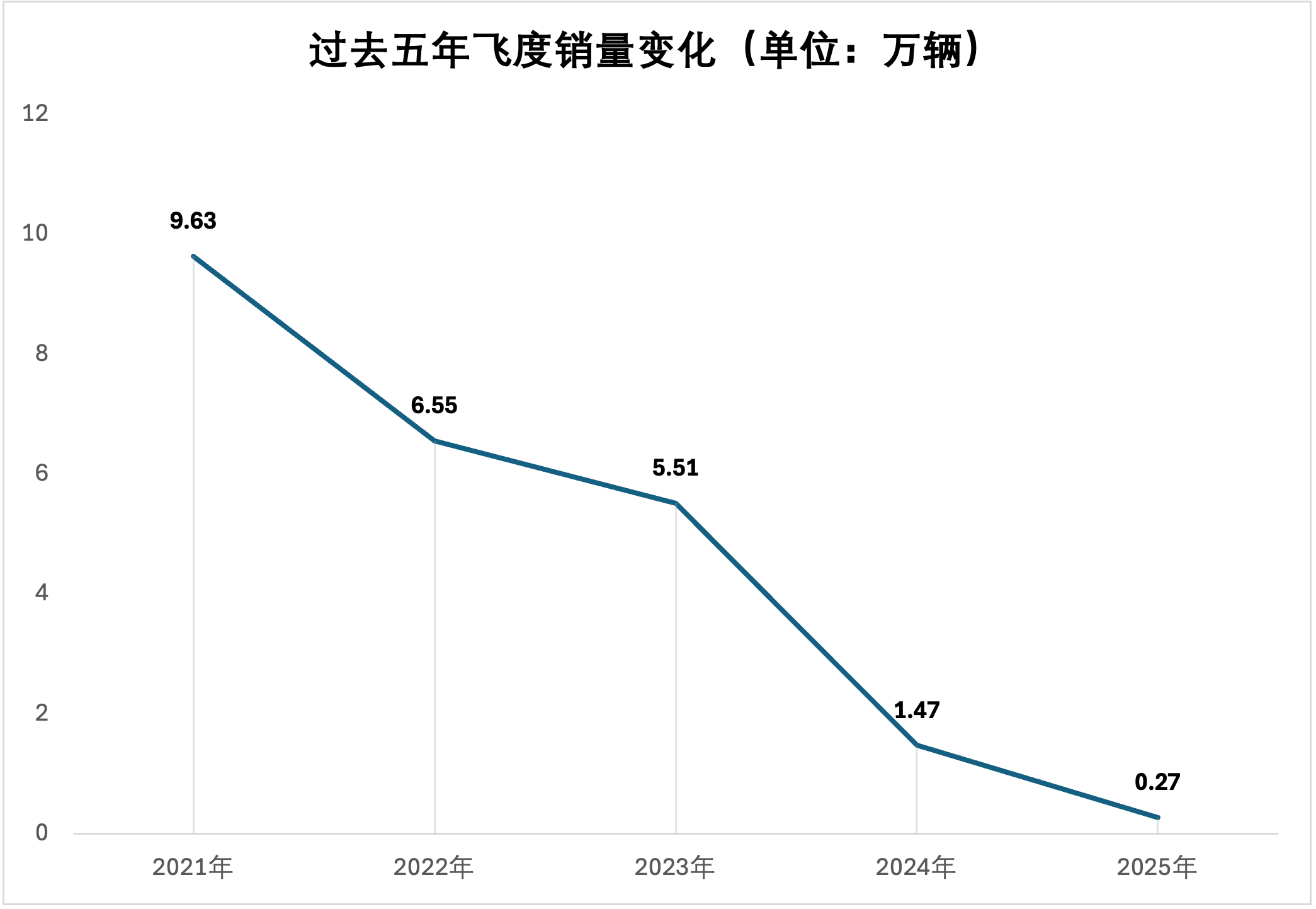
Core Viewpoint - Honda Fit is attempting to regain market attention through price reductions and limited marketing strategies, launching a new model priced at 66,800 yuan with a limited release of 3,000 units, despite only selling 2,695 units in 2025, which is less than the new model's release quantity [1][2] Group 1: Honda Fit's Market Position - The new Honda Fit has not changed in body size or power parameters compared to the 2024 model, with updates primarily in interior features, including a new 10.1-inch central control screen and standard Bluetooth and CarPlay functions [1] - The previous market dominance of the Fit was due to its competitive advantages in the fuel vehicle era, offering better interior space and fuel economy in the 100,000 yuan price range, making it a preferred choice for young consumers [1] - In 2018, the Fit achieved peak annual sales of 129,200 units in China, but by 2024, its sales plummeted over 70% to 14,700 units, dropping to eighth place in its segment [2] Group 2: Competitive Landscape - BYD has quickly filled the market gap left by the declining Fit, with its Dolphin and Seagull models dominating the small car market, achieving sales of 453,600 units for the Seagull in 2024, nearly double that of the second-place Wuling Bingo [4] - In 2025, Geely's Star Wish surpassed BYD's Seagull with sales of 465,800 units, becoming the new leader in the small car market and the overall sales champion in the Chinese passenger car market [4][5] - The small car market is highly concentrated, with only two to three models actively competing, making it crucial for brands to maintain a presence in consumer purchase intentions [5] Group 3: Challenges for Other Brands - Great Wall's Ora brand has seen a decline in market share, with sales dropping from 73,600 units in 2023 to 29,300 units in 2025, due to a strategic focus on profitability and reduced investment in the Ora brand [6] - The new Ora 5 model, launched after a three-year hiatus, is positioned as a compact SUV with a higher price range of 99,800 to 133,800 yuan, moving away from the small car segment [7] - The shift in branding strategy for Ora, moving from a female-focused identity to a broader market appeal, raises questions about the effectiveness of this change in a competitive environment [7] Group 4: Emerging Trends in the Small Car Market - The market for premium small cars, represented by brands like BMW MINI and NIO's Firefly, focuses on design and brand positioning rather than scale, achieving higher price points and brand premiums [10] - NIO's Firefly has captured 61% of the high-end small car market share, with plans for international expansion, including a launch in Singapore [11] - In contrast, Smart's sales have declined from 42,300 units in 2023 to 30,800 units in 2025, as its product strategy lacks focus, failing to maintain its classic small car appeal in the electric era [12] Group 5: Policy and Market Dynamics - The new subsidy policies for electric vehicles will limit the financial incentives for low-priced models, making it essential for companies to compete based on real value and product strength [13] - The small car market is expected to face overall declines in 2026 due to the dual pressures of subsidy reductions and tax changes, necessitating a balance between sales volume and profitability for all participants [13]




蔚来全新ES8交付超5万辆,上汽MG7智能化升级|一周车闻
Di Yi Cai Jing· 2026-01-21 01:01
Group 1 - Chinese brands are accelerating their scale layout in the high-end and segmented markets, particularly in the high-end electric vehicle sector [1][2] - NIO delivered its 50,000th new ES8 vehicle in just 120 days since the launch, achieving a retail sales volume of 22,258 units by December 2025, ranking first in insurance volume among large SUVs in 46 cities [2] - The strong sales performance of NIO is attributed to its internal "efficiency revolution," but the company faces challenges in converting this into stable annual profitability to cover high R&D and infrastructure investments [2] Group 2 - SAIC's MG brand launched the 2026 MG7 with a starting price of 116,900 yuan, targeting the competitive 100,000 to 150,000 yuan sports sedan market, featuring significant upgrades in intelligence [3] - The 2026 MG7 aims to compete with models like Lynk & Co 03 and Honda Civic, leveraging "beyond-class" configurations to attract consumers [3] - SAIC-GM Wuling introduced its first rugged SUV, the Starlight 560, with a price range of 59,800 to 95,800 yuan, offering fuel, plug-in hybrid, and pure electric options [4] - The Starlight 560's fuel version features a 1.5T engine with a maximum torque of 290 Nm, while the pure electric version boasts a range of 500 km and a consumption of 13.1 kWh/100 km [4] - Wuling aims to achieve a total output value exceeding 100 billion yuan by 2025, with a year-on-year growth of 24%, and expects its new energy vehicle sales to surpass 1 million units, reflecting a 31.9% increase [4] Group 3 - Geely Galaxy launched its first large MPV, the Galaxy V900, with a starting price of 269,800 yuan, filling a gap in the MPV segment for Geely [5] - The Galaxy V900 features a range-extended power system with a 1.5T engine and dual motors, offering a pure electric range of 260 km and a combined range of 1,220 km [5] - The year 2026 is anticipated to be significant for MPV products, with other models like the Zhijie V9 and Leap Motor D99 expected to debut [5]

美股大跌,科技股全线下挫,热门中概股普跌
Di Yi Cai Jing Zi Xun· 2026-01-20 23:31
Group 1 - The global market risk appetite has significantly decreased following President Trump's renewed tariff threats towards Europe, leading to a sell-off in major stock indices [2][3] - The Dow Jones Industrial Average fell by 870.74 points, a decline of 1.76%, closing at 48,488.59 points; the S&P 500 dropped by 143.15 points, down 2.06%, at 6,796.86 points; and the Nasdaq Composite decreased by 561.07 points, a 2.39% drop, ending at 22,954.32 points, marking the worst single-day performance since October 10 of the previous year [2] - Major tech stocks experienced declines, with Nvidia down 4.32%, Apple down 3.45%, and Microsoft down 1.16%, among others [2] Group 2 - The CBOE Volatility Index (VIX), often referred to as the "fear index," rose to a two-month high, reflecting increased market anxiety [3] - Trading volume on U.S. stock markets reached approximately 20.6 billion shares, significantly above the 20-day average of 17.01 billion shares, indicating concentrated selling pressure [3] - Analysts suggest that the current geopolitical tensions regarding tariffs are more of an emotional shock rather than a fundamental change that would trigger a deep market correction [3] Group 3 - The global bond market is also experiencing spillover effects, with upward pressure on some European government bonds due to potential increases in defense spending [4] - The yield on the U.S. 10-year Treasury note reached a high of 4.313%, the highest since late August, closing at 4.287% after a rise of 5.6 basis points [5] - Market expectations for interest rate cuts by the Federal Reserve have been adjusted downward, with projections for a reduction of approximately 47 basis points in 2026, down from 53 basis points at the end of the previous year [5] Group 4 - Netflix reported fourth-quarter revenue of $12.1 billion, exceeding market expectations of $11.97 billion, with adjusted earnings per share of $0.56, also slightly above forecasts [6] - The company anticipates full-year revenue for 2026 to reach between $50.7 billion and $51.7 billion, with expectations for advertising revenue to potentially double in the future [6] - Following the announcement, Netflix's stock price fell by 4.9% in after-hours trading, influenced by merger financing and market sentiment [7] Group 5 - Gold prices surged significantly, with spot gold rising approximately 2% to $4,757.33 per ounce, reaching a historical high of $4,756.93 during the session [7] - Silver prices experienced a slight decline of 0.3%, settling at $94.38 per ounce, after hitting a record high of $95.87 [7] - Oil prices showed volatility, with light crude oil futures for February delivery rising by $0.90 to $60.34 per barrel, a 1.51% increase [8]



从第一台到第100万台,ES8为蔚来兜住了底
Tai Mei Ti A P P· 2026-01-20 12:25
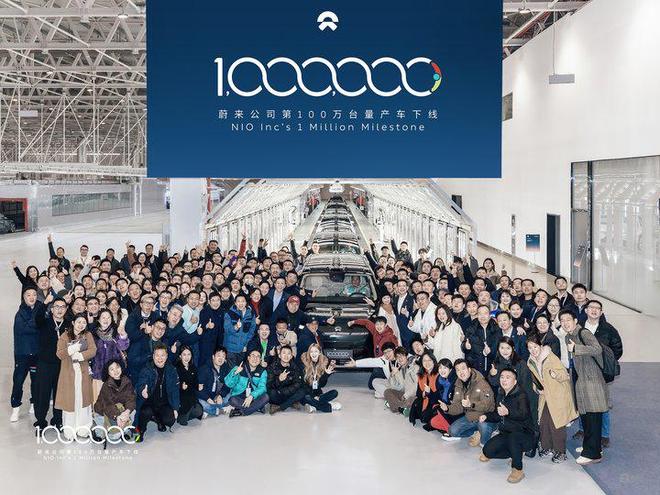
Core Insights - NIO has achieved a significant milestone by producing its one millionth vehicle, specifically the ES8, which symbolizes a turning point for the company and the electric vehicle market [2][3] - The ES8 has set new sales records in the high-end SUV segment, demonstrating a shift in consumer preferences from traditional luxury brands to electric vehicles [4][6] Group 1: Sales Performance - The new ES8 delivered 50,000 units within 120 days, achieving a monthly retail sales record of 22,258 units, surpassing previous records for vehicles priced over 400,000 yuan [3][4] - NIO's one million vehicles sold have an average price exceeding 300,000 yuan, indicating a strong brand premium compared to competitors who often rely on lower-priced models to reach similar sales figures [3][4] Group 2: Market Dynamics - A notable 62.4% of new ES8 orders come from customers replacing traditional luxury fuel vehicles, indicating a shift in consumer behavior towards electric vehicles [6] - The transition from fuel vehicles to electric vehicles is gaining momentum, with the market for large electric SUVs expected to grow significantly [7][8] Group 3: Competitive Landscape - NIO's success with the ES8 is causing traditional luxury brands, such as BMW and Mercedes-Benz, to reassess their market positions as they face increased competition from electric vehicles [6][12] - The company maintains a premium pricing strategy, which allows it to avoid engaging in price wars while still achieving high sales volumes [6][12] Group 4: Future Outlook - NIO aims to achieve a growth rate of 40% to 50% annually in the coming years, despite the challenges of maintaining brand loyalty and addressing consumer price sensitivity [14] - The company is under pressure to achieve profitability by 2026, as it navigates a complex multi-brand strategy and seeks to solidify its position in the high-end market [12][14][15]
卡倍亿:在新能源汽车领域,公司已进入比亚迪等整车厂商的供应链
Zheng Quan Ri Bao· 2026-01-20 12:16
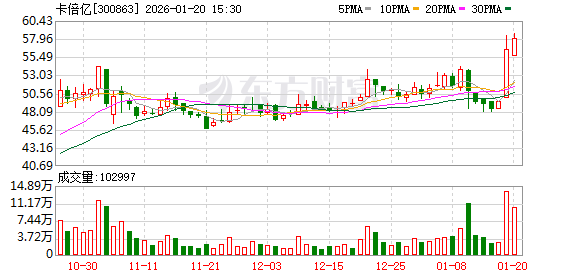
Group 1 - The company, Kabeiyi, has entered the supply chains of major electric vehicle manufacturers including BYD, Tesla, Geely, NIO, Li Auto, Xpeng, and Xiaomi in the new energy vehicle sector [2]


2026 中国新能源汽车与动力电池手册_从自动驾驶到人工智能-2026 China EV & EV Battery Handbook_ From Autonomous Driving to AI
2026-01-20 01:50
Summary of Key Points from the Conference Call Industry Overview: Greater China Auto, EV, and EV Battery Industry Forecasts - **China's Auto Industry**: Expected to face challenges in 2026 with a forecasted decline in auto wholesales by **1.6% YoY** compared to a **10% YoY** increase in 2025. This decline is attributed to front-loaded demand in 2025 [1] - **Domestic EV Sales**: Anticipated to grow only **7% YoY** in 2026 due to a **5% increase in purchase tax** and reduced trade-in subsidies [1] - **Export Sales**: Projected to increase by **12% YoY**, reaching **7.9 million units** in 2026, with EV exports expected to surge by **40% YoY** [1] - **Competition Dynamics**: Shift from price competition to configuration-based competition, necessitating more investment in autonomous driving (AD) and smart cabin technologies [1] Key Automotive/EV Themes for 2026 Theme 1: Export Growth - **Export Growth**: Companies like Chery and BYD are expected to benefit significantly from exports, especially with the EU's minimum EV price replacing tariffs [2] Theme 2: Autonomous Driving Development - **ADAS to AD Transition**: L3 permits issued to Changan and BAIC, with highway/city NOA penetration expected to exceed **40%** in 2026 and **85%** by 2030. L4/L5 penetration is projected to reach **8%** by 2030 [3] Theme 3: Cost Concerns - **Battery and Memory Costs**: Rising costs and supply stability of memory are key concerns for auto OEMs [3] Key Battery Themes for 2026 Theme 1: Energy Storage Systems (ESS) - **ESS Demand**: Global battery ESS installations expected to grow by **33% YoY** in 2026, with shipments increasing by **41% YoY** [4] Theme 2: Global Expansion - **Overseas Capacity Expansion**: Chinese battery manufacturers are accelerating their overseas capacity expansion, particularly in Europe and Southeast Asia, in response to rising tariffs and trade tensions [4] Theme 3: VAT Rebate Changes - **Export VAT Rebate Cut**: Anticipated to lead to a rush in battery production and shipment in Q1 2026, potentially increasing raw material prices and exerting cost pressure on battery makers and auto OEMs [5] Theme 4: Technological Innovation - **Sodium-Ion Battery**: Launch of Gen-2 sodium-ion battery expected, with ASSB (all-solid-state battery) small-batch production anticipated to start in 2027 and scale up significantly post-2029 [5] Investment Recommendations - **Top Picks**: - **XPeng**: Launch of Mona SUV and HR in 2H26, with a focus on AI-related businesses [6] - **CATL**: Growth driven by CEV, ESS, and overseas capacity despite short-term cost pressures [6] - **Tuopu**: Major supplier for humanoid robots with overseas expansion [6] - **Minth**: Resilient earnings growth supported by high overseas market exposure [6] - **Hesai**: Increased LiDAR adoption in China alongside L3 ADAS development [6] Additional Insights - **Market Dynamics**: The shift in competition and the focus on technological advancements highlight the evolving landscape of the automotive and EV sectors in China, emphasizing the need for companies to adapt to changing consumer preferences and regulatory environments [1][3][4][5]




英伟达正在被中国车企抛弃
阿尔法工场研究院· 2026-01-20 00:08
Core Viewpoint - The automotive industry is shifting from reliance on NVIDIA's chips to self-developed solutions, as companies like Xiaopeng and NIO are moving towards their own chip development to reduce costs and enhance performance [2][5][20]. Group 1: Market Dynamics - Xiaopeng has released four new models equipped with its self-developed Turing driving chip, marking a complete departure from NVIDIA's chips [2]. - NIO is transitioning to its self-developed Shenqi chip, which is expected to significantly reduce costs compared to purchasing NVIDIA chips [2][8]. - NVIDIA's market share in China's high-end driving chip sector is projected to decline from 39% in 2024 to 25% in 2025, indicating a significant shift in the competitive landscape [2][9]. Group 2: Competitive Landscape - In 2024, NVIDIA's Orin-X chip held a 39.8% market share with 2.1 million units, but competitors like Horizon are gaining ground with lower-cost alternatives [5][6]. - Horizon's J5 chip has secured contracts with over nine automakers, including major brands like BYD and SAIC, highlighting the increasing competition in the market [6][9]. - By 2025, NVIDIA's partnerships with major clients like NIO and Xiaopeng have diminished, indicating a loss of influence in the market [6][8]. Group 3: Financial Performance - In the first three quarters of fiscal year 2025, NVIDIA reported $147.8 billion in total revenue, with only $1.7 billion (approximately 1%) coming from automotive business, underscoring the limited impact of automotive sales on overall performance [14][16]. - The automotive segment's revenue is significantly overshadowed by NVIDIA's data center business, which accounts for nearly 90% of its income [14][16]. Group 4: Future Outlook - NVIDIA is attempting to pivot from being a chip supplier to a comprehensive smart driving solution provider, but this transition faces challenges as competitors strengthen their positions [20]. - The launch of NVIDIA's open-source VLA model, aimed at assisting automakers lacking full-stack development capabilities, reflects its strategy to maintain relevance in the evolving market [20][21]. - However, the practical utility of the VLA model has been questioned, indicating potential hurdles in its adoption and effectiveness [21].


最新公布!他们向蔚来赔偿、道歉
Mei Ri Jing Ji Xin Wen· 2026-01-19 10:30
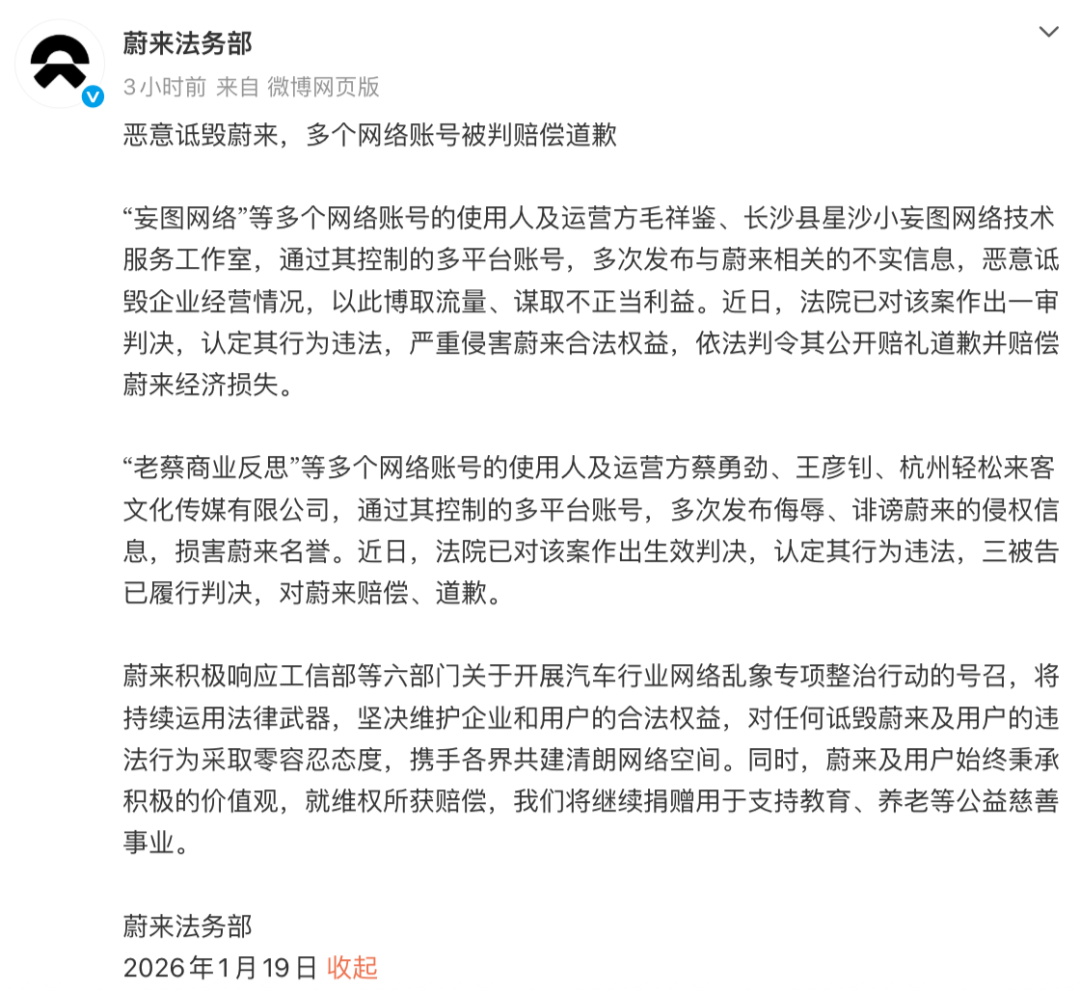
Group 1 - The legal department of NIO announced that multiple online accounts, including "Mengtui Network," have been spreading false information about the company, damaging its business reputation for improper gains. A court has ruled against these actions, ordering public apologies and compensation for economic losses [1] - Another case involving accounts like "Lao Cai Business Reflection" has also resulted in a court ruling that recognized the defamatory actions against NIO, with the defendants fulfilling the judgment by compensating and apologizing to the company [1] - NIO is actively responding to a call from the Ministry of Industry and Information Technology and other departments to address online chaos in the automotive industry, committing to legal actions against any defamatory behavior and promoting a clean online environment [1] Group 2 - On January 6, 2026, NIO celebrated the production of its one millionth vehicle at its advanced manufacturing facility in Hefei, Anhui. The CEO stated that the company aims for annual sales growth of 40% to 50% and plans to exceed 10,000 charging and battery swap stations by 2030 [3]
【联合发布】2025年12月OTA监测月报
乘联分会· 2026-01-19 09:07
Core Insights - The article discusses the monthly OTA (Over-The-Air) monitoring report released by the China Automobile Circulation Association and Guangzhou Weirbo Information Technology Co., highlighting the trends and updates in the automotive OTA landscape [2]. Industry Overview - In December 2025, the industry updated a total of 1,257 features, a significant increase from 954 in the previous month, with 27 brands participating in OTA updates. The focus of upgrades was on driving assistance and voice functionalities [8]. - Throughout the year, the automotive industry shifted from "wild growth" to a "compliant expansion" model under regulatory constraints, emphasizing "safer, more inclusive, and practical" advancements. The total number of upgraded features increased by 36.7% compared to 2024 [8]. New Forces - New force brands updated a total of 216 features in December 2025, up from 177 the previous month, indicating a slight increase. Brands like Li Auto and Xpeng experienced major version upgrades, enhancing their level of intelligence [7]. - The frequency of upgrades for new force brands decreased due to regulatory impacts, transitioning from "high frequency" to "low frequency with high quality," while still maintaining a high level of overall upgrade functionality [9]. Domestic Brands - Domestic brands updated 1,005 features in December 2025, a significant rise from 728 in the previous month. This year was crucial for domestic brands to catch up with the leading tier in intelligence, focusing on "more inclusive and practical" strategies [14]. - The total number of upgraded features for domestic brands increased by 73% compared to 2024, with over 20% of upgrades in intelligent driving and vehicle control modules, which are key areas for catching up [14]. Joint Venture & Luxury Brands - Joint venture and luxury brands updated 36 features in December 2025, a slight decrease from 49 in the previous month. However, the total number of upgraded features increased by 31.6% compared to 2024, with expansions into overall vehicle experience and intelligent driving modules [15]. - The upgrades in intelligent driving increased by 6.88% compared to 2024, and vehicle control features saw a 3.25% increase, indicating a shift from passive following to active participation in the intelligentization field [15]. OTA Activity Highlights - Li Auto adjusted its OTA internal testing project to a priority experience project, focusing on concentrated information release and enhancing user engagement through various promotional activities [26][32]. - The article outlines various promotional activities and user engagement strategies employed by Li Auto, including topic operations and rewards for user participation, aimed at increasing interaction with new features [33][38]. Future OTA Updates - The article provides a forecast of upcoming OTA updates for various brands, detailing expected upgrade contents and timelines, indicating a continuous evolution in the automotive OTA landscape [37][39].
蔚来:多个账号因恶意诋毁被判赔偿道歉 维权所得全部捐献
Feng Huang Wang· 2026-01-19 07:23
Core Viewpoint - NIO has successfully taken legal action against multiple online accounts that disseminated false information about the company, resulting in a court ruling that recognizes the infringement of NIO's rights and mandates public apologies and compensation for economic losses [1][2]. Group 1: Legal Actions and Outcomes - The court has ruled against several online accounts, including "妄图网络," for spreading false information that maliciously defamed NIO's business operations, leading to a requirement for public apology and compensation [2]. - Another ruling involved accounts operated by "老蔡商业反思," which were found to have published defamatory content against NIO, resulting in a court-ordered compensation and apology from the defendants [2]. Group 2: Company Response and Future Actions - NIO is committed to using legal means to protect its and its users' rights, adopting a zero-tolerance policy towards any defamatory actions against the company [2]. - The company plans to donate any compensation received from legal actions to support education and elderly care charitable initiatives [1][2].
