PDD(PDD)

Search documents
中概股全线走低、美股全线大跌,有色金属、半导体芯片、苹果重挫
Sou Hu Cai Jing· 2026-02-14 04:30
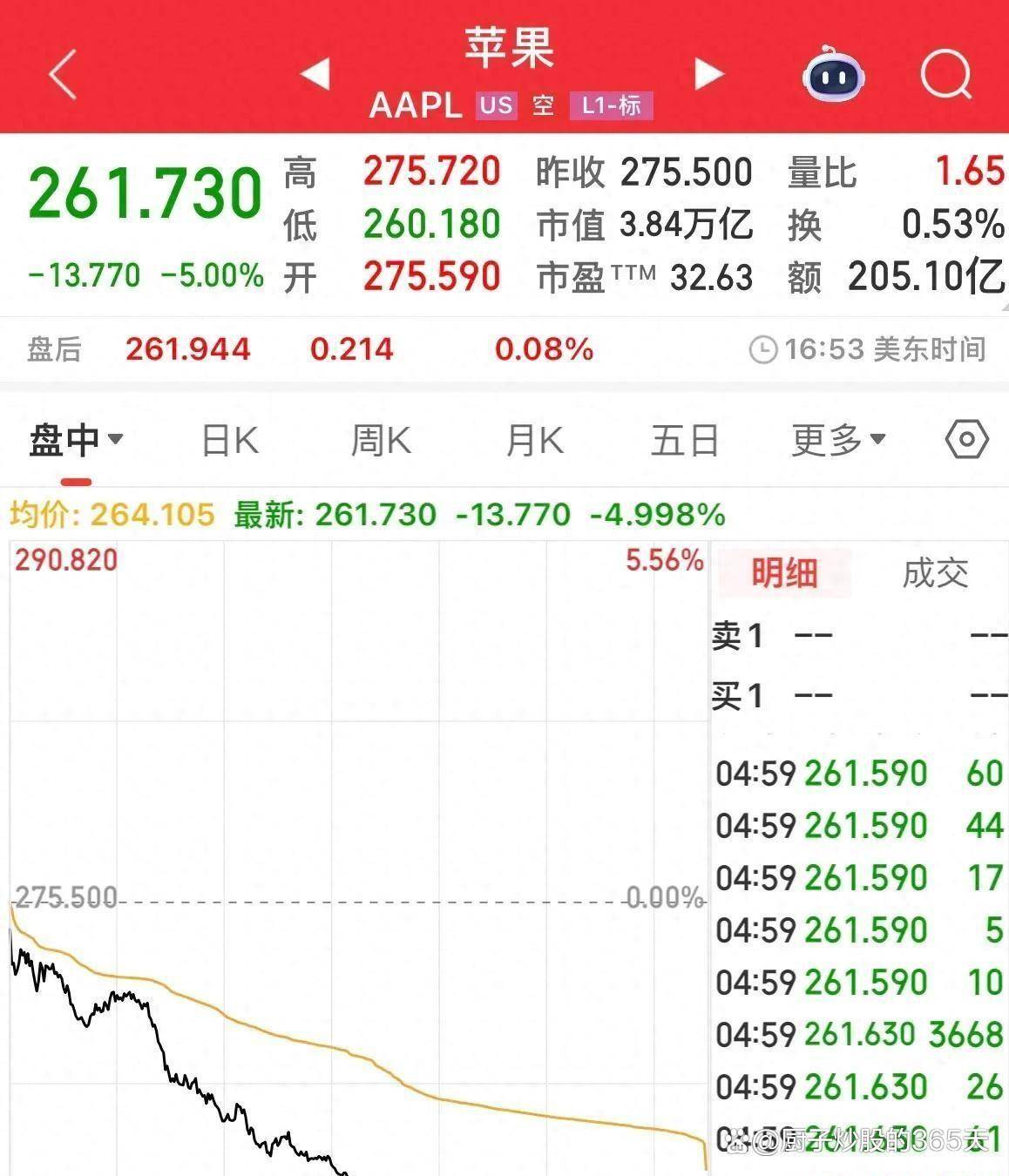
Market Overview - The US stock market experienced a significant decline, with the Dow Jones Industrial Average dropping 669.42 points (1.34%) to close at 49,451.98 points, the Nasdaq Composite falling 469.32 points (2.03%) to 22,597.15 points, and the S&P 500 decreasing by 108.71 points (1.57%) to 6,832.76 points [1][2][3] Market Sentiment - Over 4,100 stocks declined, indicating widespread market panic as investors rushed to sell assets, particularly in the tech and growth sectors. The VIX index surged, reflecting heightened risk aversion [2][3] Sector Performance - The sell-off affected nearly all sectors, with notable declines in precious metals and semiconductor stocks. The precious metals sector saw significant drops, with gold futures down 3.08% and silver futures plummeting 10.62% [4][5][6][8] - The Philadelphia Semiconductor Index fell by 2.5%, with individual stocks like AEHR Test Systems down 17.58% and Intel down over 3% [8][10] Major Companies - Apple Inc. experienced a substantial drop of 5.00%, resulting in a market cap loss of over $120 billion, attributed partly to regulatory concerns [12] - Other major tech companies also faced declines, with Tesla down 1.62%, Amazon down 2.20%, and Meta Platforms down nearly 3% [12] Financial Sector - Bank stocks fell across the board, with JPMorgan Chase down over 2%, Goldman Sachs down over 4%, and Citigroup down over 5%, driven by concerns over AI disrupting traditional wealth management [13][14] Economic Indicators - Recent economic data, including a drop in initial jobless claims and lower-than-expected existing home sales, contributed to market anxiety about potential economic overheating and prolonged high interest rates [24][25][26] Global Market Impact - The sell-off in the US markets had a ripple effect on global markets, with European indices also closing lower after initially opening higher, indicating a widespread sentiment of fear [18][19][20] AI Concerns - The market's decline was exacerbated by fears regarding the disruptive impact of AI technologies on various industries, leading to significant stock price drops in sectors perceived to be at risk [21][22][30] Storage Chip Sector - In contrast to the overall market trend, storage chip stocks saw gains, with companies like SanDisk and Seagate Technology rising significantly, reflecting a belief that AI's growth will increase demand for data storage [29]


晚间暴雷!黄金、白银、原油、美股全线崩盘,42只中概集体下跌
Sou Hu Cai Jing· 2026-02-14 04:22
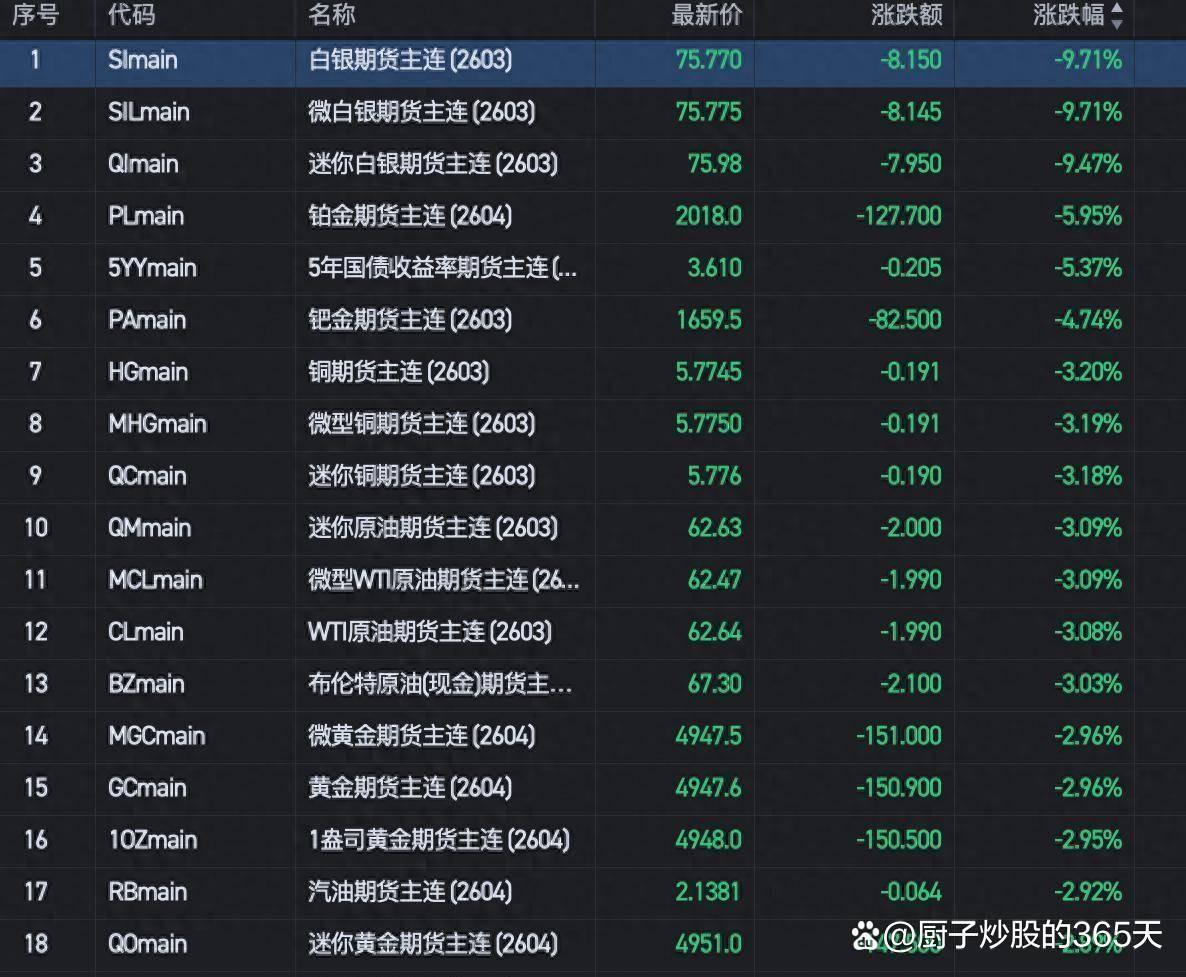
Market Overview - On February 13, 2026, a significant asset sell-off occurred in global financial markets, particularly impacting U.S. stock indices. The Dow Jones Industrial Average fell by 669.42 points (1.34%) to close at 49,451.98, while the Nasdaq Composite Index dropped 469.32 points (2.03%) to 22,597.15. The S&P 500 Index also declined by 108.71 points (1.57%) to 6,832.76 [1]. Commodity Market Impact - The sell-off extended to the commodity markets, with gold and silver experiencing substantial declines. COMEX gold futures fell by 3.08% to $4,941.4 per ounce, while COMEX silver futures plummeted by 10.62% to $75.01 per ounce [2][3]. Technology Sector Reaction - Major technology companies were severely affected, with Apple’s stock price dropping by 5%, resulting in a market value loss of over $120 billion (approximately 800 billion RMB). Other tech giants like Microsoft, Amazon, Tesla, Meta, and Nvidia also saw significant declines [3][4]. Chinese Concept Stocks - The Nasdaq Golden Dragon China Index, which includes many Chinese concept stocks, fell by 3% on the same day, indicating a collective sell-off in this sector. Over 40 Chinese concept stocks experienced substantial declines, with Tencent Music down 10.57% and Alibaba down 3.40% [3][4][6]. Employment Data Influence - The catalyst for this market turmoil was a strong U.S. employment report released on February 11, showing a non-farm payroll increase of 130,000 in January, significantly above the expected 70,000. This led to a shift in market expectations regarding Federal Reserve interest rate cuts, with the probability of a March rate cut dropping from 19.6% to 6% [5][6]. Capital Expenditure Concerns - Major tech companies announced aggressive capital expenditure plans for 2026, with Alphabet projecting $175 billion to $185 billion and Amazon estimating $200 billion, both nearly doubling their 2025 expenditures. This raised investor concerns about the return on such investments, especially as many companies reported record profits but saw stock price declines [10][11]. Market Sentiment and Volatility - The market's fear and volatility increased sharply, with the VIX index rising significantly. The sell-off was exacerbated by algorithm-driven trading, which triggered stop-loss orders and led to extreme price movements [15][16][17]. Global Market Impact - The financial turmoil that began in Wall Street quickly spread to global markets, with Asian and European stock markets opening lower in response to the U.S. declines [18].



美股三大指数周线齐跌
财联社· 2026-02-14 00:39
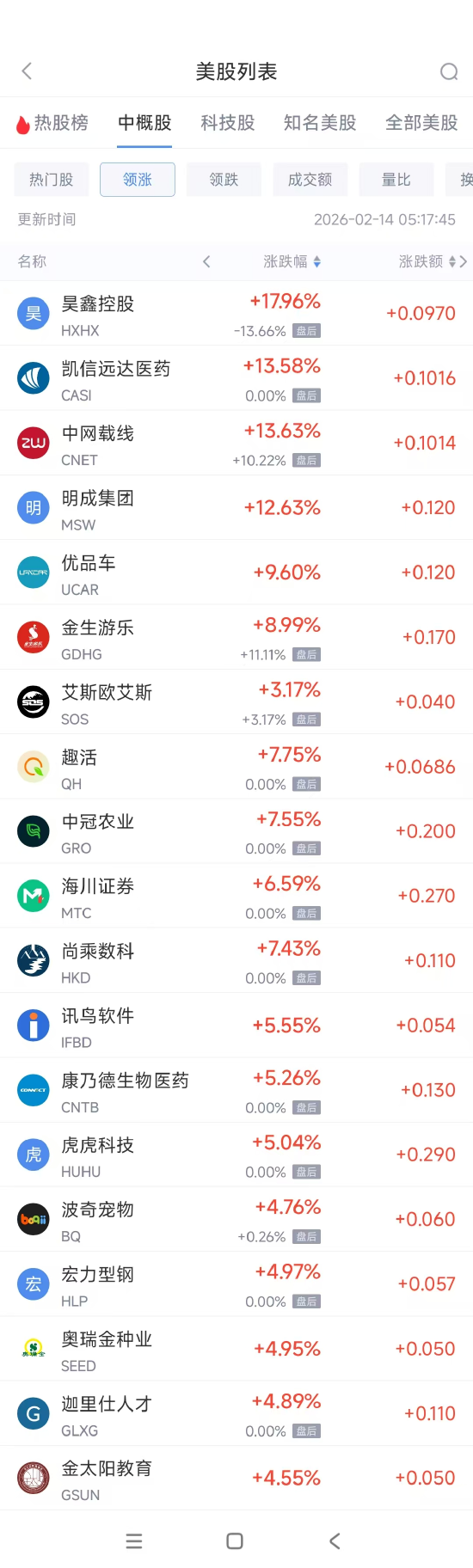
Market Overview - The three major indices showed mixed performance, with the Dow Jones up 0.10% to 49,500.93 points, the S&P 500 up 0.05% to 6,836.17 points, and the Nasdaq down 0.22% to 22,546.67 points [3] - All three indices recorded weekly declines, with the S&P 500 down 1.4%, the Dow down 1.2%, and the Nasdaq down 2.1% [3] Economic Indicators - The U.S. Bureau of Labor Statistics reported that the January CPI rose 2.4% year-over-year and 0.2% month-over-month, both below market expectations [3] - The core CPI, excluding volatile food and energy prices, increased by 2.5% year-over-year and 0.3% month-over-month, aligning with market expectations [3] - Phil Blancato, Chief Market Strategist at Osaic, indicated that this data could pave the way for interest rate cuts and inflation control if the trend continues [3] Sector Performance - Concerns over AI disruption led to market sell-offs, affecting various sectors including software, real estate, trucking, and financial services [6] - Financial stocks such as Charles Schwab and Morgan Stanley fell by 10.8% and 4.9%, respectively, while software company Workday dropped 11% and commercial real estate firm CBRE fell 16% [6] - The media sector was also impacted, with Disney down approximately 3% and Netflix down 6% [7] Technology Stocks - Major tech stocks mostly declined, with Nvidia down 2.21%, Apple down 2.27%, Microsoft down 0.13%, Google down 1.06%, and Amazon down 0.41% [7] - Tesla saw a slight increase of 0.09%, while Oracle rose by 2.34% and Netflix increased by 1.33% [7] Chinese Stocks - The Nasdaq Golden Dragon China Index fell by 0.10%, with Alibaba down 1.89%, JD.com down 1.38%, and Pinduoduo up 0.06% [7] - NIO remained flat, while Xpeng rose by 1.36% and Li Auto fell by 1.81% [7]



拼多多股价创60日新低,春节活动与监管新规并行
Jing Ji Guan Cha Wang· 2026-02-13 22:45
Group 1 - Pinduoduo's stock price closed at $101.03 on February 13, 2026, with a daily increase of 0.81%, but a cumulative decline of 3.99% over the past five days, indicating significant volatility [1] - The stock hit a near 60-day low of $100.22 on February 12, 2026, with a single-day drop of 4.16%, primarily due to slowing core business growth and intensified industry competition [1] - For Q3 2025, Pinduoduo reported a total revenue growth of 9% year-on-year, while online marketing service revenue growth decreased to 8%, reflecting weakened growth momentum in the domestic main site [1] Group 2 - Starting February 12, 2026, Pinduoduo launched the "Spring Festival Never Closes" campaign, increasing subsidies for essential goods like fresh food and daily necessities, while ensuring supply chain stability during the festival [2] - The platform is also enhancing food safety governance, including stricter merchant qualification reviews and live broadcast controls, in response to the "Live E-commerce Supervision Management Measures" implemented on February 1, 2026 [2] Group 3 - Some institutions hold a cautious outlook on Pinduoduo's short-term prospects, with Macquarie lowering the target price to $126 due to weak core business growth and profitability pressures from Temu [3] - Citigroup's report highlights that while Temu maintains high growth targets, it faces financial uncertainties due to regulatory scrutiny from the EU and China [3] -景林资产 increased its holdings in Pinduoduo by 611,300 shares in Q4 2025, indicating long-term confidence in the e-commerce sector [3]
2月14日热门中概股涨跌不一 阿里巴巴跌2.05%,腾讯音乐涨4.52%
Xin Lang Cai Jing· 2026-02-13 21:21
Core Viewpoint - The performance of Chinese concept stocks varied on February 14, with the Nasdaq China Golden Dragon Index (HXC) closing down by 0.1% [1][7]. Group 1: Stock Performance - Among the rising stocks, Pinduoduo increased by 0.06%, NetEase by 2.06%, and Tencent Music by 4.52% [1][7]. - Among the declining stocks, Alibaba fell by 2.05%, JD.com by 1.38%, and Ideal Auto by 1.81% [1][7]. - The US stock market closed mixed on Friday, with the Dow Jones gaining 48.95 points (0.10%) and the Nasdaq dropping 50.48 points (0.22%) [1][7]. Group 2: Market Trends - All three major US stock indices recorded declines for the week, with the Dow down 1.23%, Nasdaq down 2.1%, and S&P 500 down 1.39% [1][7]. - The market continues to assess the impact of artificial intelligence development on industries such as logistics, real estate, and software [1][7]. - The US core CPI for January reached a nearly five-year low [1][7].

买得安心,吃得放心:拼多多“春节不打烊”全面提升食品消费保障
Xin Lang Cai Jing· 2026-02-13 11:08
Core Viewpoint - Pinduoduo is enhancing its food safety measures and subsidies for essential goods during the Spring Festival to ensure consumer confidence and supply stability [1][4]. Group 1: Subsidy and Supply Measures - Pinduoduo launched the "Spring Festival Never Closes" initiative, increasing subsidies for essential items such as fresh fruits, grains, meats, snacks, and beverages to ensure normal delivery during the holiday [1]. - The platform aims to stabilize prices and supply for consumers' "vegetable baskets" and "New Year's Eve dinners" during the Spring Festival [1]. Group 2: Food Safety Governance - Pinduoduo is implementing multiple food safety governance measures, including compliance checks on merchant qualifications, food advertising regulation, and real-time monitoring of product compliance [1][2]. - The platform will enhance the scrutiny of merchants selling cold-processed pastries, requiring additional documentation to ensure compliance [2]. Group 3: Intellectual Property and Brand Protection - Pinduoduo is expanding its channels for intellectual property infringement complaints to protect food merchants' rights, having processed hundreds of thousands of complaints in 2025 [2]. - The platform will conduct random inspections of brand products and compensate consumers tenfold for any counterfeit goods identified [2]. Group 4: Live Streaming and Youth Protection - Starting February 1, 2026, Pinduoduo will intensify governance over live streaming merchants, focusing on food categories and content regulation [3]. - The platform has introduced a "minor mode" to prevent merchants from selling alcohol and other restricted items to minors [3]. Group 5: Future Commitments - Pinduoduo plans to continuously improve its governance measures and adhere to national laws and regulations to enhance its food safety assurance system [4].
PDD Holdings Inc (PDD) Under Pressure, Here’s What You Should Know
Yahoo Finance· 2026-02-13 10:19
PDD Holdings Inc. (NASDAQ:PDD) is one of the High Growth International Stocks to Buy Now. PDD Holdings Inc. (NASDAQ:PDD) has been under pressure from growing domestic competition, regulatory challenges, and higher expenses, threatening profitability. Recently, on January 28, Alicia Yap from Citi lowered the firm’s price target on the stock from $170 to $142 and maintained a Hold rating. Earlier, on January 15, Eddy Wang from Morgan Stanley reiterated a Buy rating on the stock with a $148 price target. ...
拼多多“春节不打烊”持续保供给,全面提升食品安全保障
经济观察报· 2026-02-13 09:17
Core Viewpoint - Pinduoduo has launched the "Spring Festival Never Closes" initiative to ensure the supply of essential goods during the Spring Festival, enhancing subsidies for various food categories and implementing multiple food safety measures to guarantee consumer confidence in purchasing [1][4]. Group 1: Food Safety Measures - The platform has intensified compliance checks on food merchants' qualifications, increasing the frequency of verification and using algorithmic models for real-time monitoring of product compliance [1][2]. - Specific measures for "cold processed pastries" include requiring merchants to provide detailed food production licenses and imposing penalties for non-compliance [2]. - Pinduoduo will conduct real-time inspections of advertisements and product information to intercept false claims and impose penalties based on the severity of violations [2]. Group 2: Governance and Compliance - Starting February 1, 2026, new regulations will enhance the governance of live-streaming merchants, focusing on food categories and content management [3]. - The platform is developing a comprehensive food database to improve oversight and has established a special governance team for food safety, increasing regular inspections in collaboration with accredited testing agencies [3]. - Pinduoduo has implemented a "minor mode" to prevent merchants from selling alcohol to minors, reinforcing its commitment to consumer protection [3]. Group 3: Future Commitments - The company aims to continuously improve its governance measures and comply with national laws and regulations, ensuring consumer rights are fully protected [4].

理解电商税:商家面临的规则与执行
晚点LatePost· 2026-02-13 08:13
Core Viewpoint - Pinduoduo was fined for failing to report tax-related information as required, highlighting the broader implications of tax compliance in the e-commerce sector [2][3] Group 1: Tax Compliance Issues - Pinduoduo was fined 100,000 yuan for not submitting tax information on time, which reflects a growing trend of stricter tax enforcement in the e-commerce industry [3] - E-commerce platforms have historically allowed self-reporting of business data, leading to potential tax evasion, but new regulations require quarterly reporting of seller information and business data [3][4] - The lack of strict enforcement previously allowed many small businesses to report significantly lower taxable incomes, resulting in substantial tax underpayment [5][6] Group 2: Tax Structure and Rates - The so-called "e-commerce tax" is not a new tax but rather the enforcement of existing taxes like VAT, corporate income tax, and personal income tax that were not strictly collected before [4] - Tax rates for small-scale taxpayers (annual sales ≤ 5 million yuan) are set at 3% of sales, while general taxpayers (annual sales > 5 million yuan) face a rate of 13% [7] - The tax burden has shifted, with larger, compliant businesses seeing a decrease in effective tax rates, while non-compliant small businesses face increased tax liabilities [8] Group 3: Market Dynamics and Business Strategies - The increase in tax compliance has led to concerns among e-commerce sellers about the impact on their profit margins, especially during peak sales periods like "Black Friday" [8][9] - Many small businesses are unaware of tax regulations and often rely on outsourcing for accounting, which complicates their compliance efforts [9][10] - The pressure to maintain competitive pricing while adhering to tax regulations may lead to increased prices for consumers as businesses adjust to cover new tax costs [10][12] Group 4: Fair Competition and Future Outlook - Stricter tax enforcement aims to level the playing field between e-commerce businesses and traditional brick-and-mortar companies, ensuring fair competition [11][12] - The long-term effects of these tax policies may lead to the elimination of less profitable products and businesses that cannot sustain the increased tax burden [10][12]

150亿!拼多多成立两家关联企业
Xin Lang Cai Jing· 2026-02-13 04:53
Core Insights - Pinduoduo has established two new companies in Shanghai with a combined registered capital of 15 billion yuan, indicating a strategic move towards supply chain upgrades and business expansion [2][3] Company Developments - The two new companies, Shanghai Xinpin Mupudong E-commerce Co., Ltd. and Shanghai Xinpin Hongqiao E-commerce Co., Ltd., are fully controlled by Pinduoduo's core affiliates and share a unified management structure [2][3] - Shanghai Xinpin Hongqiao was established on February 2 with a registered capital of 10 billion yuan, focusing on import and export, internet sales, and logistics services [2] - Shanghai Xinpin Mupudong was founded a day later with a registered capital of 5 billion yuan, sharing similar business focuses as Hongqiao [3] Strategic Context - The establishment of these companies aligns with Pinduoduo's recent strategic adjustments, including a governance restructuring announced at the annual shareholder meeting on December 19, 2025 [4] - Pinduoduo's co-founder Zhao Jiazhen emphasized the importance of supply chain upgrades and the goal of creating a "new Pinduoduo" within three years, focusing on quality and brand value rather than low prices [4] Business Implications - The new companies are seen as a means to optimize Pinduoduo's operational structure and reduce compliance risks, effectively separating operations and sales into distinct entities [5] - Future operations of Temu will concentrate on supply chain optimization, while the new companies will handle operational and sales functions, potentially including logistics investments [6] - The inclusion of logistics services in Hongqiao's business scope suggests plans for future expansion into local services and enhanced logistics infrastructure [6]