Regeneron(REGN)

Search documents
Should You Buy This Biotech Stock That Just Gained 5% in 1 Day?
The Motley Fool· 2025-12-01 04:15
Core Viewpoint - Regeneron Pharmaceuticals is experiencing a potential turnaround as it addresses challenges related to its key product Eylea, with recent developments positively impacting its share price and sales outlook [1][2]. Regeneron's Eylea Strategy - Eylea has faced competition from Roche's Vabysmo and Amgen's biosimilar Pavblu, leading to declining sales [2]. - In August 2023, Regeneron received approval for a higher-dose version of Eylea, which offers less frequent dosing and does not compete with a cheaper biosimilar [2][3]. - In Q3, Regeneron's revenue increased by 1% year over year to $3.75 billion, with Eylea HD sales in the U.S. growing by 10% to $431 million, while combined sales of the original version dropped by 28% to $1.11 billion [3]. Recent Developments - Eylea HD received a label expansion from the FDA for treating macular edema following retinal vein occlusion, allowing a dosing schedule of up to every eight weeks [4][5]. - This expansion is expected to enhance Eylea HD's market position and attract more patients, potentially boosting sales growth in the medium term [5]. Other Growth Drivers - Regeneron's eczema treatment Dupixent continues to perform well, with worldwide sales increasing by 27% year over year to $4.86 billion in Q3 [6][7]. - Dupixent has received additional approvals, including for chronic spontaneous urticaria in the EU, which should sustain its growth trajectory [7]. New Product Launches and Future Prospects - The company is launching new products and has received FDA approval for Lynozyfic, a treatment for multiple myeloma, and positive results for cemdisiran, a potential therapy for myasthenia gravis [8][9]. - Regeneron is also developing treatments to help patients on GLP-1 drugs maintain muscle mass while losing weight, with promising phase 2 study results [9]. - The company is expected to deliver strong financial results over the next five years, supported by a stock buyback program and a newly initiated dividend [10].



口服FXIa抑制剂asundexian预防脑卒中复发III期成功:创新药周报20251130-20251130
Huachuang Securities· 2025-11-30 14:27
Investment Rating - The report indicates a positive investment outlook for the oral FXIa inhibitor asundexian, particularly following its successful Phase III trial results for preventing recurrent strokes [21][25]. Core Insights - The oral FXIa inhibitor asundexian has shown significant efficacy in reducing the risk of ischemic stroke in patients with non-cardioembolic ischemic stroke or high-risk transient ischemic attack, achieving its primary efficacy and safety endpoints in the OCEANIC-STROKE study [21][25]. - The report highlights the potential of FXI inhibitors to provide safer anticoagulation options with lower bleeding risks compared to traditional anticoagulants [9][10]. - The report discusses the diverse potential indications for FXI/XIa inhibitors, including prevention of venous thromboembolism (VTE) in orthopedic surgeries, stroke prevention in atrial fibrillation patients, and treatment of cancer-associated VTE [13][10]. Summary by Sections Section 1: Focus on Innovative Drugs - The report reviews the recent advancements in innovative drugs, particularly in the anticoagulant space, emphasizing the role of FXI inhibitors [4][5]. Section 2: Mechanism of Action - FXIa plays a crucial role in pathological thrombus formation while having a limited role in hemostasis, making it an ideal target for developing safer anticoagulants [9][10]. Section 3: Clinical Development Progress - Asundexian has successfully completed Phase III trials, while other FXIa inhibitors like milvexian have faced challenges, including trial terminations due to efficacy concerns [30][33]. - The report details the ongoing clinical trials for various FXI inhibitors, including those by companies like Bayer, BMS, and Regeneron, highlighting their respective stages of development and potential applications [20][39][45]. Section 4: Market Potential - The report underscores the significant market potential for FXI inhibitors, given the high incidence of stroke and VTE, with approximately 12 million people affected by stroke annually worldwide [25][21].





Is Regeneron Pharmaceuticals Stock Underperforming the S&P 500?
Yahoo Finance· 2025-11-28 12:11
Core Insights - Regeneron Pharmaceuticals, Inc. (REGN) is a major player in the biotechnology industry, with a market cap of $82.5 billion and a portfolio of nine marketed drugs [1][2] Company Overview - REGN is classified as a large-cap stock, reflecting its significant size and influence in the biotechnology sector [2] - The company has a strong product lineup, including key products like Eylea and Dupixent, which contribute to its financial success [2] Stock Performance - REGN's stock has experienced a 33.5% increase over the past three months, outperforming the S&P 500 Index, which gained 5.4% in the same period [3] - Year-to-date, REGN shares have risen 10.2%, while over the past 52 weeks, they have climbed 4.2%, underperforming the S&P 500's YTD gains of 15.8% and 13.1% over the last year [4] Recent Developments - On October 28, REGN shares surged 11.8% following the release of Q3 results, with an adjusted EPS of $11.83 surpassing Wall Street's expectations of $9.44 [5] - The company's revenue for the quarter was reported at $3.8 billion, exceeding the forecast of $3.6 billion [5] Competitive Landscape - Incyte Corporation (INCY) has shown stronger performance compared to REGN, with a 53% gain year-to-date and a 41.2% increase over the past 52 weeks [6] Challenges - REGN faces challenges such as increased scrutiny on drug pricing, regulatory uncertainties, and competition from larger pharmaceutical companies, which may impact its growth prospects [5]
Regeneron (REGN) Up 20.2% Since Last Earnings Report: Can It Continue?
ZACKS· 2025-11-27 17:36
Core Insights - Regeneron reported Q3 2025 adjusted EPS of $11.83, exceeding the Zacks Consensus Estimate of $9.44, but down 5% from $12.46 in the previous year due to higher expenses [2] - Total revenues increased by 1% year over year to $3.7 billion, driven by higher sales of Eylea HD and Dupixent profits, surpassing the Zacks Consensus Estimate of $3.6 billion [2] Revenue Breakdown - Eylea HD generated $431 million in the U.S., up 10% year over year, exceeding the Zacks Consensus Estimate of $414 million [6] - Eylea sales in the U.S. fell 41% year over year to $681 million, missing the Zacks Consensus Estimate of $686 million, primarily due to increased competition and market share loss [4] - Total collaboration revenues reached $2 billion, an increase of 18.6% from the previous year, beating the Zacks Consensus Estimate of $1.8 billion [7] Collaboration and Product Sales - Sanofi's collaboration revenues rose 28% to $1.6 billion, driven by higher Dupixent sales, surpassing the Zacks Consensus Estimate of $1.5 billion [8] - Dupixent sales increased 27% year over year to $4.86 billion [8] - Bayer's collaboration revenues totaled $345 million, down 12% year over year [9] Cost and Margin Analysis - Gross margin on net product sales decreased to 86% from 89% due to ongoing investments in manufacturing [11] - Adjusted R&D expenses increased 18% year over year to $1.3 billion, while adjusted SG&A expenses decreased 12% to $541 million [11] Pipeline and Regulatory Updates - The FDA approved Eylea HD for various ophthalmology indications, and Regeneron plans to submit a new application for a pre-filled syringe by January 2026 [6][14] - The EMA recommended approval of Dupixent for chronic spontaneous urticaria, with a decision expected soon [13] - A phase III study of cemdisiran met its primary and secondary endpoints, with a regulatory submission planned for Q1 2026 [16] Market Performance and Outlook - Regeneron shares have increased by approximately 20.2% since the last earnings report, outperforming the S&P 500 [1] - The consensus estimate for Regeneron has shifted upward by 12.49% since the earnings release, indicating positive investor sentiment [17] - Regeneron holds a Zacks Rank 3 (Hold), suggesting an expectation of in-line returns in the coming months [20]

“AI泡沫论”肆虐市场之际 医疗保健领衔价值股破空崛起
智通财经网· 2025-11-26 13:22
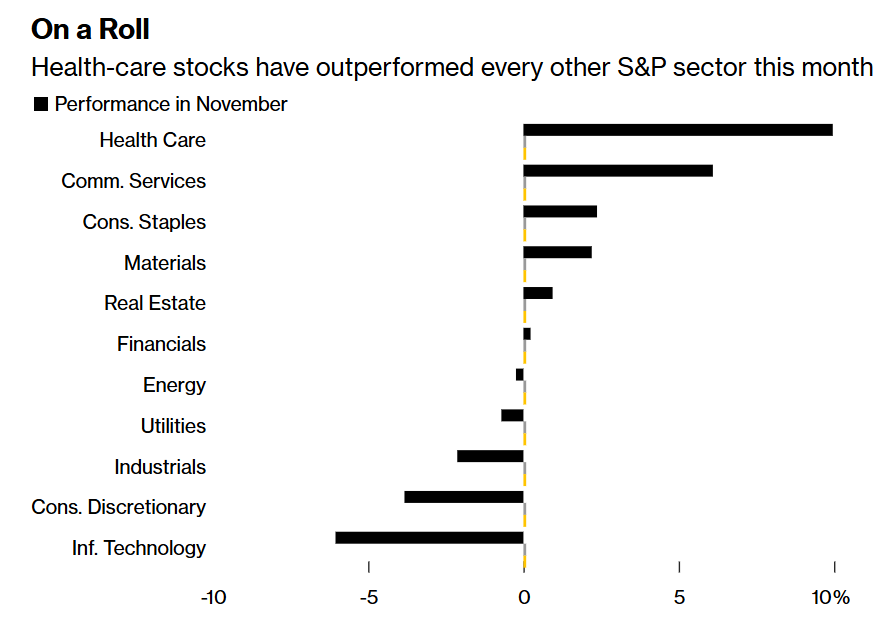
Core Viewpoint - The global financial market is witnessing a shift as investors reassess their positions in technology stocks closely tied to AI, particularly in light of concerns over an "AI bubble" and are increasingly favoring value stocks with stable cash flows and lower valuations compared to high-profile AI stocks like Nvidia and AMD [1][18]. Group 1: Value Stocks and Market Trends - Value stocks are characterized by low price-to-earnings (P/E) and price-to-book (P/B) ratios, stable earnings, and high dividend yields, often belonging to established companies [2]. - The healthcare sector has emerged as a significant beneficiary in the current market rotation towards value stocks, outperforming other sectors with a 10% increase in the S&P 500 Healthcare Index [2][3]. - The S&P 500 index has seen a decline of 1.1% during the same period, while companies like Eli Lilly have experienced substantial gains, highlighting the contrasting performance between value and growth stocks [3][15]. Group 2: Fund Flows and Investor Behavior - Hedge funds have been aggressively buying into the healthcare sector, marking it as the largest net buying segment among value stocks for four consecutive weeks, with the most significant inflow in over five years [6][7]. - Mutual funds have also increased their allocation to healthcare stocks, reflecting a broader trend of investors seeking undervalued opportunities amid fears of an AI bubble [7]. - The healthcare sector's strong performance is attributed to positive clinical trial results, accelerated AI-driven research, and a resurgence in merger and acquisition activities [10][12]. Group 3: Performance Metrics and Valuation - The healthcare sector's earnings have exceeded expectations, making it the best-performing sector in over four years, with a current P/E ratio of approximately 18.7, compared to the S&P 500's 22.1 [15][12]. - Notable individual stock performances include Merck, which rose 23% in November, and Regeneron, which increased by 21% following positive regulatory news [11][12]. - The shift towards healthcare stocks is seen as a response to the overvaluation of tech stocks and the search for more stable investment opportunities [18][17].


Sanofi Faces Surprise HQ Search As French Authorities Expand Tax Probe
Benzinga· 2025-11-25 18:30
Group 1: Legal Investigation - Sanofi SA's Paris headquarters was visited by tax investigators amid a financial probe into alleged "money laundering of tax fraud" [1] - The preliminary investigation, launched in January 2024, may involve organized groups and possible criminal conspiracy [1] - Sanofi claims compliance with all applicable laws and intends to cooperate with authorities [2] Group 2: Product Approval - The European Commission approved Dupixent for moderate-to-severe chronic spontaneous urticaria in patients aged 12 and above [3] - Approval is based on data from two Phase 3 clinical trials in the LIBERTY-CUPID program, showing significant reduction in urticaria activity compared to placebo [4] - Dupixent also increased the percentage of patients with well-controlled disease and complete response at 24 weeks compared to placebo [5]

SNY & REGN's Dupixent Gets EU Nod for Chronic Spontaneous Urticaria
ZACKS· 2025-11-25 16:46
Core Insights - The European Commission has approved Dupixent (dupilumab) for the treatment of moderate-to-severe chronic spontaneous urticaria (CSU) in adults and adolescents aged 12 and above, who have an inadequate response to antihistamines and are naive to anti-IgE therapy [1][2][9] - Dupixent is the first targeted medicine approved for CSU in the EU in over a decade and is now approved for seven types of chronic inflammatory diseases in the EU [2][4] - Dupixent generated global product sales of €11.47 billion in the first nine months of 2025, reflecting a growth of 22.7% at a constant exchange rate, with expectations to reach around €22 billion in sales by 2030 [13] Company Performance - Sanofi's shares have gained 1.9% year to date, while the industry has seen a growth of 16% [3] - Regeneron recorded collaboration revenues of $4.24 billion from Sanofi during the first nine months of 2025, marking a year-over-year increase of 27.8% [13] Drug Approval and Studies - Dupixent was previously approved in the U.S. for CSU in April 2025, marking its seventh indication, and is also approved in Japan [4][5] - The approval in the EU is based on data from two late-stage studies (Study A and Study C) that demonstrated significant reductions in itch and hives compared to placebo at 24 weeks [9][10] - Safety data from the studies were consistent with Dupixent's known safety profile [11] Future Prospects - A supplemental biologics license application for Dupixent to treat allergic fungal rhinosinusitis (AFRS) is under priority review in the U.S., with a decision expected by February 28, 2026 [14]

汇丰:首予再生元制药(REGN.US)“买入”评级 看好Eylea HD放量及肿瘤管线多点催化
智通财经网· 2025-11-25 07:40
Core Viewpoint - HSBC initiates coverage on Regeneron Pharmaceuticals (REGN.US) with a "Buy" rating and a target price of $890, highlighting the growth potential of its drug Eylea HD and several promising cancer therapies in its pipeline [1][2] Group 1: Drug Sales and Market Penetration - The sales growth potential of Eylea HD (aflibercept) is a core reason for the positive outlook, despite its current market penetration being below expectations [1] - Regulatory risks associated with Eylea HD are expected to be resolved in the short term, paving the way for accelerated adoption and increased market penetration by 2026 [1] Group 2: Cancer Therapy Pipeline - The analyst emphasizes the upcoming clinical data for the dual immunotherapy LAG-3 antibody fianlimab combined with PD-1 inhibitor Libtayo (cemiplimab), set to be released in the first half of 2026, with Keytruda as a comparator [1] - Phase III clinical data for the combination therapy in melanoma adjuvant treatment is anticipated to be announced next year, while a Phase III trial for first-line metastatic melanoma is expected to complete by 2027, using Opdualag (nivolumab and relatlimab) as a comparator [1] Group 3: Financial Forecast - HSBC forecasts Regeneron's adjusted diluted earnings per share (EPS) to be $43.48 in 2026, surpassing the market consensus of $42.98 [2]
Press Release: Sanofi and Regeneron's Dupixent approved as the first targeted medicine in the EU in over a decade for chronic spontaneous urticaria
Globenewswire· 2025-11-25 06:00
Core Insights - The European Commission has approved Dupixent (dupilumab) as the first targeted treatment for moderate-to-severe chronic spontaneous urticaria (CSU) in over a decade, providing a new option for patients aged 12 and older who have not responded adequately to antihistamines [1][4][5] Group 1: Approval and Clinical Data - Dupixent is approved for adult and adolescent patients with CSU who have inadequate response to histamine-1 antihistamines and are naive to anti-immunoglobulin-E therapy [1][4] - The approval is based on two phase 3 clinical studies (LIBERTY-CUPID program) demonstrating significant reductions in urticaria activity, itch, and hive severity compared to placebo at 24 weeks [2][7][8] - In the EU, approximately 270,000 individuals aged 12 and older suffer from CSU that remains symptomatic despite standard antihistamine treatment [5][6] Group 2: Efficacy and Safety - Dupixent significantly reduced symptoms of CSU, leading to more patients achieving well-controlled disease or complete response compared to placebo in the studies [2][3] - The most common adverse reactions associated with Dupixent include injection site reactions, conjunctivitis, and arthralgia, with safety results consistent with its known profile [3][10] Group 3: Mechanism and Broader Impact - Dupixent works by inhibiting interleukin-4 (IL4) and interleukin-13 (IL13), which are key drivers of type 2 inflammation, offering a new approach for treating CSU [4][10] - Beyond the EU, Dupixent is also approved for CSU in several countries, including the US and Japan, and is indicated for multiple chronic inflammatory diseases [4][11]

Dupixent® (dupilumab) Approved as the First Targeted Medicine in the European Union (EU) in Over a Decade for Chronic Spontaneous Urticaria (CSU)
Globenewswire· 2025-11-25 06:00
Core Insights - The European Commission has approved Dupixent (dupilumab) for the treatment of moderate-to-severe chronic spontaneous urticaria (CSU) in patients aged 12 years and older who do not respond adequately to standard antihistamine treatment [1][4][11] - Dupixent is the first innovative treatment for CSU in over a decade, targeting IL-4 and IL-13, which are key drivers of type 2 inflammation [2][4] - The approval is based on data from two Phase 3 clinical trials showing significant reductions in itch and hives compared to placebo at 24 weeks [1][2][7] Group 1: Approval and Indications - Dupixent is now approved for use in patients with CSU who are naïve to anti-immunoglobulin E (IgE) therapy and have inadequate responses to histamine-1 antihistamines [1][4] - Approximately 270,000 adults and adolescents in the EU suffer from CSU that remains symptomatic despite standard treatment [1][6] Group 2: Clinical Trials and Efficacy - The LIBERTY-CUPID Phase 3 program included three studies assessing Dupixent as an add-on therapy to antihistamines, demonstrating significant efficacy in reducing urticaria activity and improving patient outcomes [2][7][8] - Study A and Study C involved 284 patients aged 12 years and older, while Study B included 108 patients, providing additional safety data [2][7] Group 3: Safety Profile - Safety results from the trials were consistent with Dupixent's known safety profile, with common adverse reactions including injection site reactions, conjunctivitis, and arthralgia [3][4] - Adverse events observed more frequently with Dupixent compared to placebo included injection site reactions, COVID-19, and hypertension [3][4] Group 4: Broader Context and Future Potential - Beyond the EU, Dupixent is also approved for CSU in the United States and Japan, indicating a growing acceptance of the treatment in various markets [4][11] - The Dupixent development program has been extensive, with over 60 clinical trials involving more than 10,000 patients across various chronic diseases driven by type 2 inflammation [15][16]