
Shopify(SHOP)

Search documents
Shopify upgraded, Coinbase downgraded: Wall Street's top analyst calls
Yahoo Finance· 2026-02-12 14:44
Upgrades - Fastly (FSLY) upgraded to Outperform from Market Perform due to a "stellar" quarter driven by rising contribution from agentic AI traffic [2] - MercadoLibre (MELI) upgraded to Overweight from Neutral with a price target increase to $2,800 from $2,650, citing valuation after recent underperformance [2] - Analog Devices (ADI) upgraded to Overweight from Equal Weight with a price target increase to $375 from $315, highlighting strong correlation between sales growth and the Purchasing Managers' Index [3] - BorgWarner (BWA) upgraded to Buy from Hold with a price target increase to $82 from $46, noting a pivotal shift with the company's entrance into the AI data center market [3] - Shopify (SHOP) upgraded to Buy from Hold with an unchanged price target of $159, citing valuation and strong quarter performance [3] - Shopify also upgraded to Outperform from Neutral with an unchanged price target of $150 [3] Downgrades - Coinbase (COIN) downgraded to Sell from Buy with a price target of $120, as estimates are cut ahead of the Q4 report, modeling softness through the first half of 2026 [4] - Kraft Heinz (KHC) downgraded to Underweight from Neutral with a price target decrease to $22 from $24, despite a Q4 beat, due to below consensus growth and earnings outlooks for 2026 [4] - Icon (ICLR) downgraded to Underperform from Neutral with a price target decrease to $75 from $195, following an internal board investigation into accounting practices [4] - Inspire Medical (INSP) downgraded to Equal Weight from Overweight with a price target decrease to $70 from $145, citing uncertainty about physician reimbursement [4] - Humana (HUM) downgraded to Sector Perform from Outperform with a price target decrease to $189 from $322, indicating a balanced risk/reward setup in an uncertain reimbursement backdrop [4]

Shopify Q4 财报解读:股价大跌 40%,是机会还是风险?
美股研究社· 2026-02-12 12:25
Core Viewpoint - Shopify has consistently outperformed the S&P 500 index over the past three years, and the recent decline of nearly 40% from its peak may present a buying opportunity [2]. Financial Performance - In Q4 2025, Shopify reported a Gross Merchandise Volume (GMV) of $123.84 billion, a year-over-year increase of 31.1%, exceeding market expectations of $119.96 billion by $3.88 billion [7]. - Revenue for the quarter reached $3.67 billion, up 30.6% year-over-year, surpassing market expectations of $3.59 billion by $0.82 billion [8]. - Monthly Recurring Revenue (MRR) was $205 million, reflecting a 15.2% year-over-year growth, also exceeding expectations of $199.05 million by $0.0595 million [8]. - Operating income was $631 million, a 35.7% increase year-over-year [9]. - Free cash flow amounted to $715 million, up 17.0% year-over-year, although the profit margin declined [10]. Yearly Financial Overview - For the year ended December 31, 2025, key financial metrics included: - GMV: $378.44 billion, up from $292.28 billion in 2024 [11]. - Revenue: $11.56 billion, compared to $8.88 billion in 2024 [11]. - Gross profit: $5.56 billion, up from $4.47 billion in 2024 [11]. - Operating income: $1.47 billion, compared to $1.08 billion in 2024 [11]. - Free cash flow: $2.01 billion, up from $1.60 billion in 2024 [11]. - The year-over-year revenue growth rate was 30% for 2025, compared to 26% for 2024 [11]. Margin Trends - The gross margin decreased from 48% to 46%, and the free cash flow margin fell from 22% to 19% [12]. - The decline in gross margin has been a structural trend since 2016, with a compound annual growth rate decline of -1.2% [12]. - The company attributes this trend to the growth of merchant solutions, which typically have lower margins than subscription solutions [13]. Operating Expenses - Over the past two years, the proportion of sales and marketing, research and development, and general and administrative expenses relative to revenue has decreased, indicating strong operating leverage [14]. - Transaction and loan loss provisions have increased, primarily due to financing-related merchant solutions, but are expected to normalize without significant value erosion [14]. 2026 Performance Guidance - Shopify expects revenue growth in Q1 2026 to remain above 30%, similar to Q4 2025 levels [18]. - Gross profit growth is anticipated to be in the high 20% range [19]. - Operating expenses as a percentage of revenue are projected to be between 37% and 38% [20]. - Free cash flow margin is expected to be in the range of 10% to 15%, slightly lower than Q1 2025 [21]. Valuation - Shopify's current valuation appears to be below the historical median, which is high at 31 times gross profit [22]. - Using a five-year discounted cash flow model, assuming a 25% annual growth rate for free cash flow, the implied value is approximately $77 billion, indicating the current stock price may be overvalued by nearly 100% [22]. - In a highly optimistic scenario with a 25% growth rate over ten years, the reasonable equity value could be around $155.6 billion, suggesting a slight undervaluation at the current market cap of $149 billion [22]. Conclusion - Analysts view Shopify as a high-quality company with a strong market position and recurring revenue model, justifying a valuation premium [27]. - Despite a 40% decline, market growth expectations remain high, and pressures on profit margins and economic downturn risks have not been fully priced into the stock, potentially creating a buying opportunity [27].


市场恐慌情绪蔓延,Shopify、Unity股价惨遭重挫
Xin Lang Cai Jing· 2026-02-12 10:03
Core Viewpoint - The market experienced a significant sell-off on Wednesday, affecting companies like Unity Software and Shopify despite their strong quarterly earnings reports for December. Group 1: Shopify - Shopify forecasted a year-over-year revenue growth of just over 30% for Q1, maintaining a similar growth rate to Q4, yet its stock price dropped by 12% immediately after the announcement [3][11]. - Analysts from William Blair noted the strong performance and steady growth of Shopify, questioning the rationale behind the stock's decline [3][11]. - Shopify is aggressively integrating AI into its operations, collaborating with OpenAI for instant checkout features and developing AI shopping products with Google [3][11]. - New Street Research highlighted that while Shopify's AI narrative is compelling, panic in the SaaS sector overshadowed these developments, leading to a final stock drop of 6.7% [3][11]. Group 2: Unity Software - Unity's stock plummeted by 26% despite reporting a 10% year-over-year revenue growth, marking its strongest quarter of the year, with a slight expected increase in growth for Q1 2026 [4][12]. - The market's reaction is attributed to concerns over AI impacts, particularly following Google's release of the Genie AI tool, which caused Unity's stock to fall by 27% shortly thereafter [4][12]. - Unity's primary business involves mobile in-app advertising technology, which has seen market share erosion to competitors like AppLovin, although Unity claims progress with its new AI advertising products [4][12]. - The overall sentiment in the market is characterized by a "sell first, think later" mentality, leading to significant stock declines without substantial new negative information [4][12]. Group 3: Lyft - Lyft's stock fell by 17% after its Q4 earnings report, which showed a revenue growth of only 3%, impacted by regulatory adjustments; however, adjusted growth was 13.5% [5][14]. - MoffettNathanson's report indicated that Lyft's U.S. ride-sharing business growth is expected to halve to 7% by 2025, primarily due to Lyft's price increases outpacing those of Uber [5][14]. - The report suggests that Lyft must take aggressive measures to regain market share from Uber, which could negatively affect its profit margins [5][14].


Why I'm Not Buying the Dip in Shopify Stock
The Motley Fool· 2026-02-12 04:31
Core Viewpoint - Shopify's stock experienced a decline following its latest earnings report, despite revenue growth exceeding analysts' expectations, indicating potential overvaluation concerns in the market [1][2]. Financial Performance - Shopify's fourth-quarter revenue grew by 31% year over year, showcasing strong business performance [4]. - Net income, excluding equity investments, increased by approximately 30% year over year during the same period [4]. - Free cash flow rose by 17% year over year to $715 million, resulting in a free cash flow margin of 19% [5]. - For the full year, Shopify's free cash flow increased by 26% year over year, surpassing $2 billion [5]. Share Repurchase Program - Shopify announced a share repurchase program, authorizing up to $2 billion to buy back its own stock, reflecting financial strength [6]. AI Integration - The company reported a 15-fold increase in orders from AI search since January 2025, indicating significant growth in AI-driven commerce [7]. - Shopify is leveraging AI to automate workflows for merchants, promoting a new concept termed "agentic commerce" [7]. Valuation Concerns - Shopify's forward price-to-earnings ratio is currently in the sixties, raising questions about whether such a high valuation is justified [9]. - To support its current valuation, Shopify would need to achieve an average compound annual growth rate in earnings per share of twenty percent or higher over the next decade [10]. - The deceleration in top-line growth from 32% in Q3 to 31% in Q4 raises concerns about the sustainability of growth, particularly in the context of AI's impact on traditional e-commerce [11].

X @BSCN
BSCN· 2026-02-12 00:45
🚨 BREAKING: TRUIST SECURITIES CUTS SHOPIFY PRICE TARGET FROM $155 TO $110@Truist lowered its $SHOP target citing "material valuation compression across coverage" while maintaining a Hold rating.However, the analyst noted Shopify's Q4 results were strong, 31% GMV growth, accelerating payments penetration and called the post-earnings selloff "disconnected" from fundamentals.Shopify actually beat Q4 estimates today: $0.57 EPS vs $0.51 expected, $3.67B revenue vs $3.59B expected, and announced a $2B share buyba ...
Stock Market Today, Feb. 11: Shopify Falls After Investors React to Guidance Despite Strong Revenue Growth
Yahoo Finance· 2026-02-11 22:42
Group 1: Company Performance - Shopify's stock closed at $118.71, down 6.70%, after an initial spike due to strong Q4 results and positive revenue guidance [1] - The company reported a 30% growth in sales and a 26% increase in free cash flow (FCF) for 2026, surpassing Wall Street's Q4 estimates [3] - Trading volume reached 52.3 million shares, approximately 450% above its three-month average of 9.5 million shares [1] Group 2: AI Initiatives - Shopify's AI-driven commerce initiatives are expected to support future growth and margins, with orders from AI search increasing 15 times compared to January 2025 levels [4] - The AI-powered assistant, Sidekick, has generated nearly 4,000 custom apps and created over 29,000 automations with Shopify Flow [4] Group 3: Market Context - The S&P 500 slipped 0.03% to 6,940, while the Nasdaq Composite fell 0.16% to 23,066, indicating a broader market trend affecting e-commerce platforms [2] - Wix.com, another e-commerce platform, closed at $72.10, down 4.31%, as investors consider AI competition and digital commerce growth expectations [2] Group 4: Investment Considerations - Shopify's shares are trading at 82 times FCF, indicating that the stock is priced for near-perfect results, and guidance for approximately 32% sales growth in Q1 is not seen as optimistic enough [3] - The Motley Fool Stock Advisor analyst team has identified 10 stocks for investors to consider, and Shopify was not included in this list [5]
Shopify Shares Slide 12% Despite Strong Earnings and Revenue Growth
Financial Modeling Prep· 2026-02-11 21:58
Core Viewpoint - Shopify Inc. reported strong fourth-quarter earnings and issued positive guidance for the first quarter, yet its shares fell over 12% intra-day, indicating market concerns despite the positive financial results [1]. Financial Performance - For the fourth quarter ended December 31, 2025, Shopify achieved adjusted earnings per share of $0.57, surpassing analyst expectations of $0.51 [2]. - Revenue for the quarter increased by 31% year over year to $3.67 billion, exceeding the consensus forecast of $3.59 billion [2]. - The company marked its eleventh consecutive quarter of revenue growth of 25% or higher, excluding logistics [2]. - Free cash flow reached $715 million during the quarter, resulting in a free cash flow margin of 19% [2]. - Gross merchandise volume (GMV) grew by 31% to $123.84 billion [2]. Future Guidance - For the first quarter of 2026, Shopify expects revenue growth in the low-thirties percentage range year over year, consistent with the fourth quarter and above analyst expectations of 25.2% growth [4]. - The company anticipates a free cash flow margin in the low-to-mid teens, slightly below the level recorded in the same period of 2025 [4].

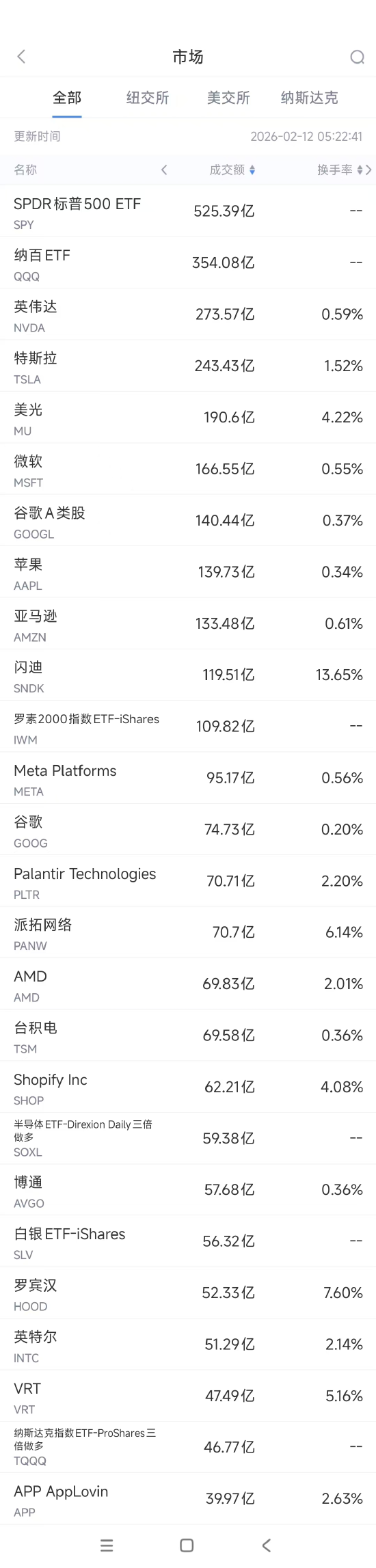
2月12日美股成交额前20:比尔盖茨称“从未接触过任何受害者”
Xin Lang Cai Jing· 2026-02-11 21:50
Group 1: Nvidia - Nvidia's stock rose by 0.78% with a trading volume of $27.357 billion, and UBS raised its target price from $235 to $245 [1] - Goldman Sachs increased its earnings forecast for Nvidia's Q4 FY2026 and maintained a target price of $250, emphasizing the visibility of revenue for 2027 as a key catalyst [1] - Over 90% of analysts rated Nvidia as "Buy" or "Hold," with an average target price of $260.26, reflecting optimistic expectations for AI computing demand [1] Group 2: Tesla - Tesla's stock increased by 0.80% with a trading volume of $24.343 billion, amid reports of the departure of Vice President Raj Jaganathan after 13 years with the company [10] - This departure is part of a recent trend of executive exits from Tesla and xAI [10] Group 3: Micron - Micron's stock surged by 9.94% with a trading volume of $19.06 billion, as Morgan Stanley raised its target price from $350 to $450 while maintaining an "Overweight" rating [10] - The new target price exceeds Micron's closing price of $410.34, aligning with a generally positive outlook from analysts [10] Group 4: Microsoft - Microsoft's stock fell by 2.15% with a trading volume of $16.655 billion, coinciding with Bill Gates' unexpected visit to Shanghai for an event [2][11] Group 5: Google - Google's Class A shares (GOOGL) declined by 2.39% with a trading volume of $14.044 billion, as the company introduced a new feature allowing consumers to purchase products directly through its AI-driven search engine and Gemini chatbot [11] - This initiative is part of Google's broader strategy to monetize user interactions with AI [11] Group 6: SanDisk and Palantir - SanDisk's stock rose by 10.65% with a trading volume of $11.951 billion, contributing to a general increase in storage sector stocks [12] - Palantir's stock fell by 2.75% with a trading volume of $7.071 billion, although Daiwa Capital Markets upgraded its rating from Neutral to Buy, while lowering the target price from $200 to $180 [12] Group 7: Shopify - Shopify's stock decreased by 6.70% with a trading volume of $6.221 billion, as the company positions "agent commerce" as an expansion channel rather than a product feature [12] - The company's president noted that orders from AI-driven searches are approximately 15 times higher than the same period last year, indicating significant growth potential [12]




Shopify Still Looks Like A Great Business, Just Not A Great Price
Seeking Alpha· 2026-02-11 20:35
Core Insights - Shopify Inc. has outperformed the S&P 500 index over the past three years, indicating strong market performance and investor confidence [1] Group 1: Company Performance - Shopify's share price has historically shown significant dips, yet it has managed to maintain a net outperforming status compared to the S&P 500 index [1]

Why Shopify Popped And Then Dropped Today
Yahoo Finance· 2026-02-11 18:52
Core Insights - Shopify reported strong revenue growth, with revenue rising 31% to $3.67 billion, surpassing the consensus estimate of $3.59 billion [3] - Despite the positive earnings report, the stock experienced a significant decline due to broader fears about AI disruption in the software sector [4] Financial Performance - Revenue increased by 31% to $3.67 billion, and gross merchandise volume (GMV) also rose by 31% to $123.8 billion, marking the fastest GMV growth since 2021 [3] - Adjusted earnings per share were reported at $0.48, slightly below the consensus estimate of $0.51 [3] Market Reaction - Initially, Shopify's stock gained in pre-market trading but fell by 12.1% during regular trading hours due to market sentiment regarding the software sector [1][4] - The stock's reversal from gains to losses is noted as a rare occurrence, with little in the earnings numbers justifying the decline [4] Strategic Outlook - Shopify's President emphasized the company's AI strategy, highlighting partnerships with OpenAI and Google Gemini to enhance AI capabilities for merchants [5] - The company anticipates continued strong growth, targeting low-thirties revenue growth for the first quarter [5] Competitive Position - Shopify is viewed as well-positioned within the e-commerce sector, potentially more insulated from AI disruption compared to other software stocks [6] - Despite the stock's recent decline, the business fundamentals remain strong, and the company is actively pursuing growth through AI initiatives [6]