
Toyota(TM)

Search documents
国产vs丰田:燃料电池合金催化剂的对比分析与追赶路径
势银能链· 2026-01-13 03:00
"宁波膜智信息科技有限公司"为势银(TrendBank)唯一工商注册实体及收款账户 添加文末微信,加 绿氢 群 在 2025势银 氢能与燃料电池产业年会上, 苏州擎动动力科技有限公司总经理朱威博士 ,以 《 国产合金催化剂距离丰田还有多远 》 为题 ,系 统阐述了在燃料电池核心材料领域,国内产业与国际先进水平之间的对比与追赶路径。报告基于详实的数据与实验对比,从行业挑战、技术剖 析、国产进展及未来展望等多个维度,进行了深入解读。 在全球加速能源转型与 "双碳"目标的双重驱动下,燃料电池作为高效清洁的能源转换技术,其商业化进程备受关注。然而,产业链面临一个突出 瓶颈:对贵金属铂的高度依赖。自2025年以来,铂金价格大幅攀升,导致催化剂成本在电堆总成本中的占比显著提高,降本压力空前。 铂合金催 化剂因其高活性、低铂载量的特点,被视为破局的关键方向。但其在实际应用中的耐久性问题,尤其是非贵金属元素在酸性环境中的刻蚀溶出, 成为了规模化应用的"卡脖子"难题。 在这一领域,日本丰田汽车通过两代技术 更迭 ,为行业提供了成功范本。丰田将铂钴合金催化剂成功应用于 Mirai系列燃料电池乘用车,其第二 代产品实现了15万公里 ...



日经225暴涨1800点创历史新高,半导体大涨,软银涨近6%
21世纪经济报道· 2026-01-13 01:10
Group 1 - The Nikkei 225 index surged over 3%, reaching a historical high, driven by gains in automotive, financial, and machinery stocks, with Toyota up 5.0%, Nomura Holdings up 5.2%, and Kawasaki Heavy Industries up 6.0% [1] - AI and semiconductor stocks in Japan also saw significant increases, with Advantest rising over 9%, Tokyo Electron up 7.8%, and SoftBank Group increasing by 5.9% [1] Group 2 - The Japanese yen appreciated against the US dollar, reaching 157.90, while the 20-year Japanese government bond yield rose by 8 basis points to 3.135%, marking a record high [3] - The 10-year Japanese government bond yield surged to 2.13%, the highest level since February 1999, attributed to Japan's fiscal expansion and tightening monetary policy [3] - Prime Minister Fumio Kishida's proposed budget for fiscal year 2026 amounts to 122.3 trillion yen, with significant allocations for debt repayment and new bond issuance [3] Group 3 - There are discussions regarding the potential dissolution of the House of Representatives by Prime Minister Kishida, which could delay the approval of the 2026 budget [4] - The South Korean stock market opened higher, with significant gains in major stocks such as Hyundai Motor, which rose by 3.81% [4] Group 4 - The US stock market experienced a V-shaped rebound, with Google's market capitalization surpassing 4 trillion, and notable increases in Chinese assets, including a 21% rise in Kingsoft Cloud and over 10% in Alibaba [5] - Storage chip prices are expected to rise by 50%, prompting smartphone manufacturers to urgently reduce production of budget models [5]



丰田汽车股价涨幅扩大至4.9%
Mei Ri Jing Ji Xin Wen· 2026-01-13 00:27
每经AI快讯,1月13日,丰田汽车股价涨幅扩大至4.9%。 (文章来源:每日经济新闻) ...
合资车企的生死500天
3 6 Ke· 2026-01-12 11:25
Core Viewpoint - The automotive landscape in China has dramatically changed, with joint venture car manufacturers facing significant challenges and competition from domestic brands and new energy vehicles [2][3][4]. Group 1: Challenges Faced by Joint Venture Car Manufacturers - 2023 and 2024 are considered the most difficult years for joint venture car manufacturers in China, with several brands like Changan Suzuki and Dongfeng Renault exiting the market [3]. - Joint venture brands that once thrived in China are now losing market share to domestic brands and Tesla, with their product competitiveness being heavily criticized [4]. - The perception of joint venture brands has shifted, with consumers questioning their value compared to domestic electric vehicle brands [4]. Group 2: Signs of Recovery - In 2023, some joint venture brands began to show signs of recovery, such as GAC Toyota's Platinum 3X, which received 10,000 orders within an hour of its launch [5]. - Dongfeng Nissan's N7 model also performed well, achieving over 40,000 deliveries in six months despite later production issues [6]. - The emergence of new models from joint ventures indicates a potential turnaround, with some industry observers suggesting a "comeback" for these brands [7][8]. Group 3: The 2023 Shanghai Auto Show - The 2023 Shanghai Auto Show marked a turning point, showcasing the strength of domestic brands and the challenges faced by joint ventures [9][17]. - Executives from major global automotive companies were reportedly shocked by the advancements of domestic brands, which now offer competitive products [12][13]. - The event highlighted a shift in market dynamics, with domestic brands beginning to lead industry trends while joint ventures are seen as followers [18]. Group 4: Internal Changes and Strategy Shifts - Joint venture manufacturers are now allowing their Chinese teams more autonomy in product development, moving away from a global model to a more localized approach [31][32]. - This shift includes empowering local teams to design and develop products tailored to the Chinese market, as seen with Nissan's N7 and GAC Toyota's Platinum 3X [34][39]. - The focus on local development is part of a broader strategy to enhance competitiveness in the rapidly evolving automotive landscape [44][50]. Group 5: The Concept of Reverse Joint Ventures - The trend of "reverse joint ventures" is emerging, where foreign companies collaborate with Chinese brands to leverage local technology and market knowledge [54][57]. - This shift indicates a significant change in the dynamics of the automotive industry, with Chinese companies now taking the lead in technology and product development [62][63]. - The evolving landscape suggests that foreign manufacturers are increasingly reliant on Chinese innovation to remain competitive in the global market [64][68].




年终盘点2025汽车市场的“龙门一跃”:油退电进,全球登顶
3 6 Ke· 2026-01-12 10:37
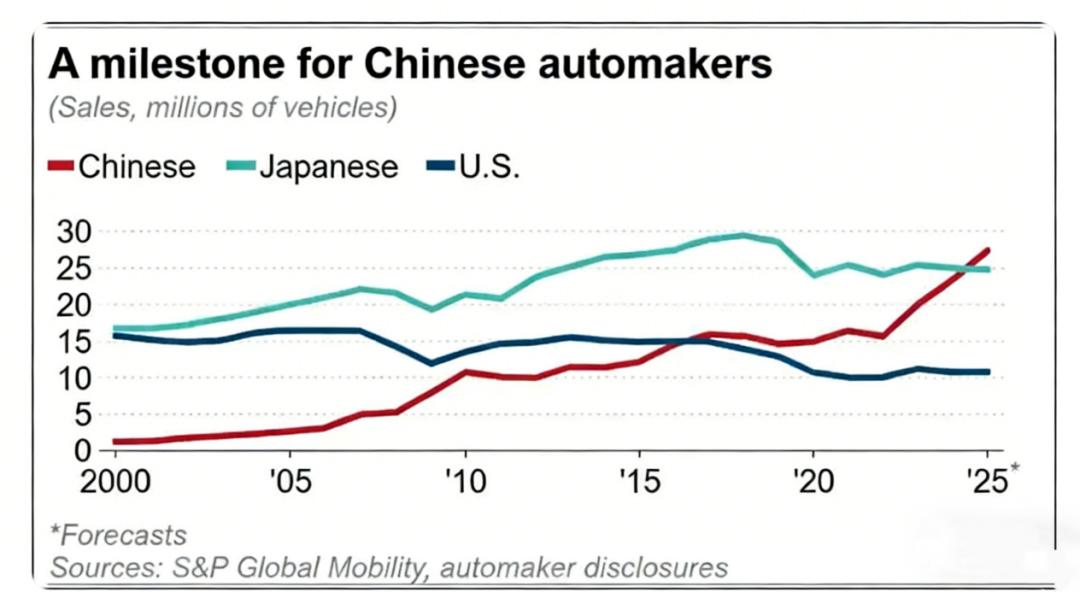
Core Insights - The penetration rate of new energy vehicles (NEVs) in China has surpassed 50%, marking a significant shift in the automotive market dynamics, transitioning from a "policy-driven" to a "product-driven" model [1][10] - The year 2025 is seen as a pivotal moment for the Chinese automotive industry, with the market experiencing a fundamental transformation akin to a "Nokia moment" [1] - The competition is evolving from price wars to value wars, emphasizing technology and product quality over mere volume [11] Industry Overview - In 2025, China's automotive manufacturers are projected to achieve global sales of 27 million vehicles, securing the top position in the global new car sales rankings for the first time [2] - China has overtaken Japan to become the world's largest automobile exporter, with NEVs accounting for a significant portion of this growth [4] - The domestic market's NEV sales are nearing 60%, reflecting a structural change in consumer preferences [4] Sales and Market Penetration - By November 2025, the retail penetration rate of NEVs reached 53.6%, with projections for the full year estimating a rate of 54.0% [6] - The rapid increase in NEV penetration is attributed to a combination of policy support, technological advancements, infrastructure development, and market demand [7] Policy and Technological Developments - The exit of purchase subsidies in 2023 has been offset by continued tax exemptions and various local incentives, which have helped maintain consumer interest in NEVs [7] - 2025 is expected to be a year of technological breakthroughs in NEVs, with advancements in high-voltage platforms, solid-state batteries, and smart driving technologies [8] Infrastructure and Consumer Experience - The expansion of charging infrastructure is crucial for alleviating consumer concerns about range anxiety, with projections of 20 million charging stations by the end of 2025 [9] - The cost advantages of NEVs are becoming increasingly apparent, with electric vehicles offering significantly lower operating costs compared to traditional fuel vehicles [9] Competitive Landscape - The shift from price competition to value competition is reshaping the industry, with companies focusing on technological innovation and profitability [11] - Some companies, like Leap Motor, have emerged as strong competitors, achieving significant sales growth and profitability [13] Global Expansion - In 2025, China's automotive exports are expected to exceed 7 million units, with NEV exports alone projected to reach 2.315 million units, marking a 102.9% increase [21] - Chinese automakers are transitioning to a "global + local" model, emphasizing localized production and R&D to better penetrate international markets [22] Challenges and Future Outlook - Despite rapid growth, challenges such as trade protectionism and compliance costs remain significant hurdles for Chinese automakers in global markets [24] - The automotive industry is expected to continue evolving, with a focus on sustainable growth and value creation as it navigates the transition from a subsidy-driven to a market-driven environment [25]


2025年丰田在华新车销量增加,本田、日产减少
日经中文网· 2026-01-12 08:00
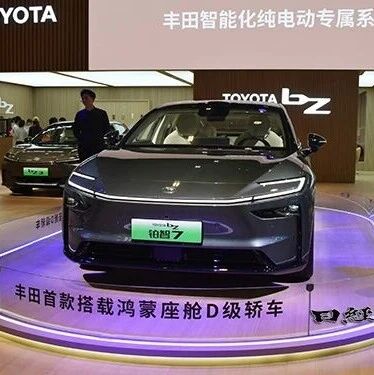
Core Viewpoint - Japanese automakers are experiencing a decline in sales in China, but the expansion of electric vehicle (EV) product lines is stabilizing the downward trend for some companies, particularly Toyota, which is showing signs of recovery in new car sales [4][5]. Group 1: Sales Performance - Toyota's new car sales in China for 2025 are projected to be 1,780,400 units, representing a year-on-year increase of 0.2%. The luxury brand Lexus is expected to sell 182,000 units, up 0.7% year-on-year [4]. - Nissan's sales are forecasted at 653,024 units, down 6% year-on-year, marking the seventh consecutive year of decline, although the decrease is less severe than the 12% drop in 2024 [4]. - Honda's sales are expected to be 645,345 units, reflecting a 24% year-on-year decline, continuing a five-year downward trend [4]. Group 2: Market Dynamics - The demand for new energy vehicles (NEVs) in China is robust, with local giants like BYD continuing to see sales growth. Japanese automakers, which have primarily focused on fuel vehicles, are lagging in the NEV sector [4]. - The market share of Chinese brands in the passenger car segment has increased from 38% in 2020 to 70% in the first 11 months of 2025, while Japanese brands' share has decreased from 23% to 10% [4]. Group 3: Product Line Expansion - Starting in 2025, three Japanese automakers are significantly expanding their NEV product lines, with signs of sales recovery emerging. Toyota plans to launch the pure electric SUV "bZ3X" through its local joint venture GAC Toyota in March 2025 [5]. - Toyota's EV sales are expected to surge by 86% year-on-year, reaching 109,300 units in 2025, with the sedan "bZ7" set to launch in spring 2026 [5].
全球大公司要闻 | 台积电下一代1.4纳米工艺研发顺利,计划2027年启动风险试产
Wind万得· 2026-01-11 22:42
Group 1 - TSMC is progressing well with the development of its next-generation 1.4nm process, planning to start risk production in 2027 and gradually ramp up production in 2028. The company expects sales to reach NT$335 billion in December 2025, a year-on-year increase of 20.4%, slightly exceeding market expectations. Cumulative sales for 2025 are projected at NT$3.81 trillion, reflecting a year-on-year growth of 31.6% [2] - OpenAI is advancing audio AI technology and plans to release a more natural real-time voice model in 2026, aiming to replace screen interactions with voice. The company is also investing $1 billion with SoftBank Group in SB Energy to support its growth as a data center developer and operator [2] - Meta has reached agreements with nuclear power suppliers Oklo, Vistra, and TerraPower to potentially acquire up to 6.6 GW of nuclear power capacity by 2035, positioning itself as the largest nuclear energy buyer among tech giants to support its data center operations [2] - Merck is reportedly in talks to acquire cancer drug developer Revolution Medicines for between $28 billion and $32 billion, which would mark a significant transaction in the recent biotech merger wave and enhance its oncology product line [2] Group 2 - Geely Holding is likely to announce an expansion plan in the U.S. within the next 24 to 36 months, with brands like Zeekr and Lynk & Co potentially suitable for the U.S. market, aiming to accelerate its global layout and expand into high-end overseas markets [5] - BAIC New Energy has launched a pilot operation for the Arcfox Alpha S (L3 version) in collaboration with Beijing Mobility, with the first batch of vehicles expected to enter designated areas by Q2 2026, promoting the commercialization of autonomous driving technology [5] - China Resources Microelectronics has signed a strategic cooperation agreement with TCL Industries and Zhonghuan Lianxing, focusing on power devices, smart power modules, and MCUs to enhance competitiveness in the semiconductor supply chain [5] - Tencent's Chief AI Scientist stated that the company has a strong 2C gene and faces challenges in the 2B market in China, indicating a future exploration of differentiated development paths for 2B business [5] - Stone Technology has received approval from the CSRC for its Hong Kong IPO, planning to issue no more than 33.108 million shares, which will further expand its financing channels [6] Group 3 - Samsung Electronics' Galaxy S26 Ultra model will support eSIM and is expected to be released next month, while major tech companies like Google, Microsoft, and Meta are seeking memory supply support from Samsung and SK Hynix due to global memory shortages [11] - Toyota remains the top-selling car brand in Indonesia for 2025, while Tesla has surpassed Toyota in global market capitalization, reflecting ongoing market optimism for the electric vehicle sector and increasing pressure on traditional automakers [11] - Sumitomo Metal Mining is investing in a nickel wet processing plant in Indonesia to build a stable resource supply network, with Japan's nickel metal production expected to reach 106,000 tons by 2025 [11] - BMW Group expects global sales of 2.464 million units in 2025, a slight increase of 0.5% year-on-year, with a 12.5% decline in the Chinese market, while European and U.S. markets show growth of 7.3% and 5.0%, respectively [13] - LVMH is reportedly collaborating with Chinese beauty brand Mao Geping, although specific details of the partnership have not been disclosed, indicating its expansion in the beauty sector [13]




全球车企市值重排座次,特斯拉领先丰田,小米超越比亚迪
Jin Rong Jie· 2026-01-11 10:17
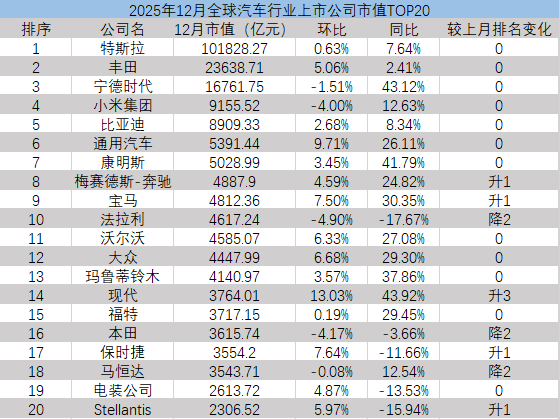
Core Insights - The global automotive industry saw significant changes in market capitalization rankings by December 2025, with most companies experiencing growth, particularly Chinese automakers [1] Group 1: Global Automotive Market Capitalization - Tesla remains the highest valued company with a market capitalization of 101,828.27 billion yuan, showing a month-on-month increase of 0.63% and a year-on-year increase of 7.64% [2][4] - Toyota ranks second with a market capitalization of 23,638.71 billion yuan, reflecting a month-on-month growth of 5.06% and a year-on-year growth of 2.41% [2][4] - CATL (Contemporary Amperex Technology Co., Limited) ranks third with a market capitalization of 16,761.75 billion yuan, experiencing a month-on-month decline of 1.51% but a year-on-year increase of 43.12% [2][4] - BYD ranks fifth with a market capitalization of 8,909.33 billion yuan, with a month-on-month increase of 2.68% and a year-on-year increase of 8.34% [2][4] Group 2: Domestic Automotive Market Capitalization - BYD leads the domestic market with a market capitalization of 8,990.33 billion yuan, significantly higher than the combined market caps of the next four companies [5] - The second-ranked company, Seres, has a market capitalization of 2,080.25 billion yuan, showing a month-on-month decline of 4.31% but a year-on-year growth of 3.29% [5] - Great Wall Motors ranks third with a market capitalization of 1,936.65 billion yuan, with a month-on-month increase of 3.33% but a year-on-year decline of 13.97% [5] - SAIC Motor ranks fourth with a market capitalization of 1,749.58 billion yuan, reflecting a month-on-month increase of 1.67% and a year-on-year decline of 27.19% [5] - Geely ranks fifth with a market capitalization of 1,725.89 billion yuan, showing a month-on-month increase of 10.69% and a year-on-year increase of 22.97% [5] Group 3: Future Outlook - The commercialization of L3 autonomous driving is expected to become a focal point for industry development in 2026, with projections indicating that the domestic L3 autonomous driving market could exceed 1.2 trillion yuan by 2030 [8] - The first conditional L3 autonomous driving vehicle approvals have been granted to BAIC Arcfox and Changan Deep Blue, allowing for conditional autonomous driving on designated roads [8] - The Chinese new energy passenger vehicle market is anticipated to achieve high-quality growth in 2026, supported by favorable policies, potentially leading to increased sales and market share for Chinese automakers [8]

中国出手反制日本“再军事化”意图
Xin Lang Cai Jing· 2026-01-11 06:51
Group 1 - China has announced stricter export controls on dual-use items to Japan to prevent its militarization and nuclear ambitions, emphasizing the legality and reasonableness of the measures [1][3] - The new regulations cover all dual-use items, prohibiting any that may enhance Japan's military capabilities, with China retaining the right to interpret these regulations [3][4] - Japan's imports of dual-use items from China are estimated to be around 10.7 trillion yen in 2024, accounting for 42% of its total imports from China, raising concerns in Japanese industries [4] Group 2 - The potential tightening of export controls on rare earth materials could significantly impact Japan's economy, particularly in the automotive and electronics sectors, where China supplies over 70% of its rare earth imports [4] - If the rare earth export controls persist for three months, Japan could face losses of up to 660 billion yen, equating to a 0.11% decline in economic output [4] - The relationship between technology, resources, and military capabilities indicates that economic ties cannot be entirely separated from security considerations, with China aiming to establish clear boundaries through these regulations [4]


Multi-tech pathway approach must for self reliance, achieve energy security goals: Toyota
The Economic Times· 2026-01-11 05:41
Core Viewpoint - The company emphasizes a multi-technology approach to achieve energy security and reduce fossil fuel dependence in India, highlighting the importance of various technologies including battery electric vehicles, hybrids, and alternative fuels like ethanol and hydrogen [1][10]. Group 1: Multi-Technology Approach - The automaker believes that a combination of technologies is essential due to India's geographical diversity and consumer acceptance challenges [1][10]. - Key initiatives from the government, such as the ethanol program and hydrogen mission, are aimed at increasing fossil fuel substitution and enhancing energy security [10]. - Multiple technologies, including compressed biogas (CBG) and hydrogen, are critical for addressing localized pollution issues [4][10]. Group 2: Hybrid Vehicles and Local Conditions - Hybrid vehicles are particularly suited for congested areas like Delhi, where their electric motors can effectively operate in slow-moving traffic [5][10]. - The company asserts that hybrids, alongside EVs, play a significant role in combating air pollution [6][10]. Group 3: Roadmap for Sustainable Mobility - The company is committed to developing a strong portfolio of green technologies, including a full range of EVs, strong hybrids, plug-in hybrids, and fuel cell vehicles [6][10]. - Expansion of charging infrastructure is identified as a key factor for enhancing EV adoption across the country [7][10]. - The goal is to transition away from petrol and diesel rapidly, aligning with global environmental challenges focused on carbon neutrality [7][10]. Group 4: Economic Viability and Manufacturing - The company emphasizes the need for a reduction in manufacturing costs to ensure the viability of the EV segment, moving away from reliance on subsidies [9][10]. - Viability is expected to be achieved through scale, which will be facilitated by introducing more electrified technology products [9][10].
