
富世华集团

Search documents
快讯|美国公司推出Yogi硅胶人形机器人;TetherIA打造欠驱动开源机械手;2025中国机器人大赛暨RoboCup落幕等
机器人大讲堂· 2025-10-20 04:06
Group 1 - The 2025 China Robot Competition and RoboCup World Cup China Division successfully concluded, attracting over 1,700 teams from more than 300 universities, with a focus on practical applications in intelligent manufacturing and public services [3][4]. - A total of 58 teams won championships, showcasing strong engineering skills, innovative thinking, and teamwork, with many technical solutions demonstrating high practical potential and promotional value [3]. Group 2 - Doosan Robotics has signed a memorandum of understanding with agricultural machinery company Datong to jointly develop AI technology for agricultural robots, aiming to optimize field robots for smart farms and outdoor agricultural environments [7]. - The collaboration will focus on developing AI-equipped devices for unstructured agricultural environments and expanding the global market for field robots [7]. Group 3 - TetherIA has launched the Aero Hand Open, an open-source underactuated robotic hand designed for dexterous manipulation, capable of performing tasks like grasping screws and opening cans, with a price of $314 for a complete kit [10]. - The hand's underactuated design allows for greater compliance and adaptability, making it effective for everyday grasping tasks [10]. Group 4 - Husqvarna Group has introduced seven AI-powered robotic lawn mowers equipped with night vision cameras, enhancing lawn care capabilities with features like wireless installation and intelligent obstacle avoidance [13]. - The new models cater to various lawn sizes, with the Automower 540 EPOS designed for professional users and compatible with upcoming AI Vision accessories [13]. Group 5 - Cartwheel Robotics is developing a humanoid robot named "Yogi," made from medical-grade silicone for safe interaction, featuring modular batteries for reliable operation and high-torque actuators [15]. - The robot aims to serve as a household assistant rather than an industrial robot, with significant interest from universities for potential research applications [15].


市场看好石头科技割草机器人“后来居上”的密钥:藏在半年报和产品力中
Xin Lang Cai Jing· 2025-09-11 02:52
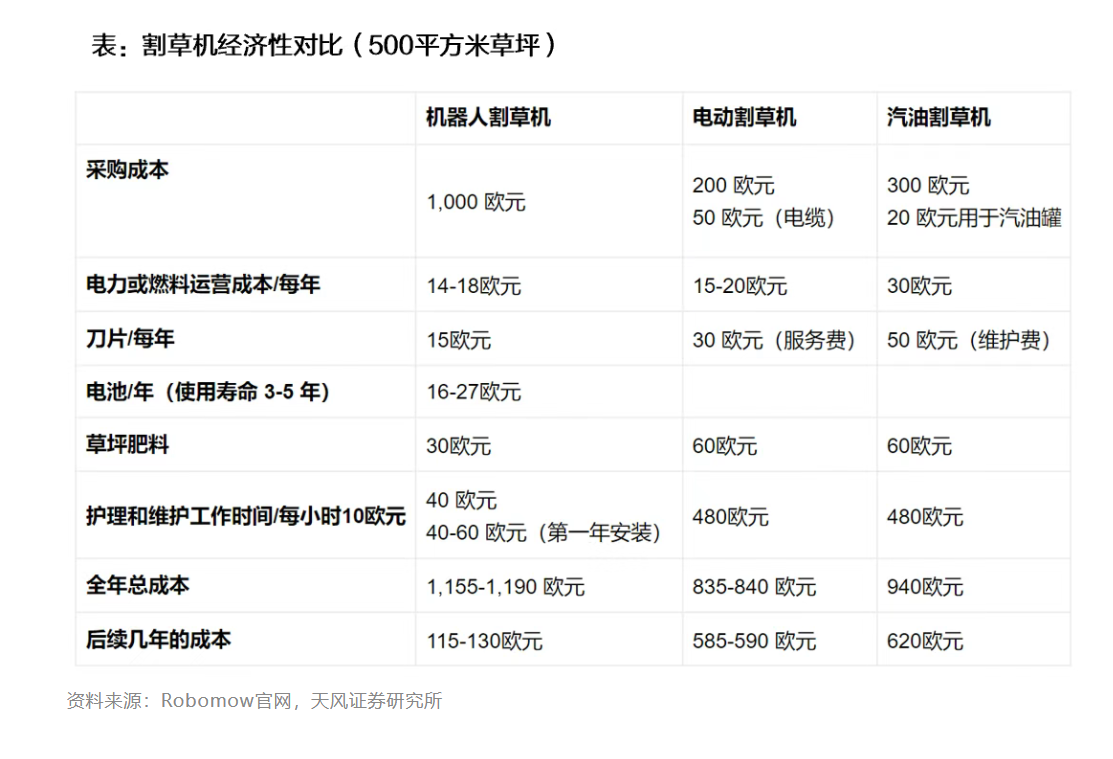
Core Viewpoint - The lawn mower robot market is experiencing rapid growth with a low penetration rate, presenting significant investment opportunities compared to the more mature vacuum cleaner robot market [1][2]. Market Growth and Demand - The global smart home cleaning robot market is projected to ship 15.352 million units in the first half of 2025, a year-on-year increase of 33%, with lawn mower robots shipping 2.343 million units, up 327.2% [1]. - The surge in demand for lawn mower robots is driven by overseas markets, particularly in Europe and North America, where high-end consumers are increasingly accepting and willing to pay for automated devices [1][2]. Market Penetration and Competition - The lawn mower robot market is still in its early stages, with a global sales volume of only 1.1 million units in 2022 compared to 25 million traditional lawn mowers sold in 2021 [2]. - The penetration rate in regions like the UK and the US remains below 5%, indicating substantial room for growth [2]. Cost Efficiency - Although the initial purchase cost of lawn mower robots is higher than traditional electric and gasoline mowers, their long-term operational costs are more competitive [4][5]. - For a 500 square meter lawn, the total cost of ownership for a lawn mower robot over two years is lower than that of electric and gasoline mowers, with first-year costs of €1,155-€1,190 for the robot compared to €835-€840 for electric and €940 for gasoline mowers [4][5]. Product Innovation - The market is shifting towards boundary-less lawn mowers, which are gaining a significant market share, increasing from approximately 35% in 2024 to around 65% [1][11]. - Companies like Stone Technology are leveraging advanced features such as all-wheel drive and active steering systems to enhance user experience and address common industry pain points [12][11]. Strategic Positioning - Stone Technology is positioned to capitalize on the market's growth with its strong product innovation, effective channel strategies, and high advertising efficiency [13][15]. - The company is adopting a cash flow model that supports expansion by increasing accounts receivable and inventory while reducing contract liabilities, indicating a focus on market penetration and channel support [18][20]. Financial Projections - Analysts predict that Stone Technology could capture 5%-10% of the lawn mower market by 2026, potentially contributing between ¥450 million and ¥1.35 billion in direct profits [21]. - The valuation of Stone Technology is expected to increase significantly as it expands into the outdoor robot market, with a projected P/E ratio of 30 reflecting its growth potential [21][22].

天风证券:割草机器人企业差距拉开 自研RTK芯片有成本优势或胜出
智通财经网· 2025-04-28 03:25
Industry Overview - The lawn mower market is primarily concentrated in North America and Europe, with traditional lawn mower shipments reaching approximately 25 million units in 2021, while global robotic lawn mower sales were 1.1 million units in 2022. Assuming a growth rate of 28% for 2023 and 2024, global robotic lawn mower sales could approach 1.8 million units, with a penetration rate of less than 10% [1] - The average lawn area in Europe is 300-400 square meters, while in the U.S. it is 600-1000 square meters. The penetration rate of robotic mowers in Europe, excluding the UK, remained above 15% in 2021, with the Northwest region reaching 50-60%. In contrast, the UK and U.S. penetration rates are still below 5%, indicating the industry is in its early stages [2] Competitive Landscape - Major players in the global smart robotic lawn mower market include Sweden's Husqvarna Group (including Husqvarna and Gardena) and China's Worx, which together account for approximately 90% of global robotic lawn mower shipments. The sales of Ninebot's robotic lawn mowers have rapidly increased, with 37,000 units sold in 2023 and revenue of 595 million yuan in the first three quarters of 2024, representing a year-over-year growth of 379% [2] Economic Viability - Although the purchase cost of robotic lawn mowers is higher than that of electric and gasoline mowers, their subsequent costs are competitive. For a 500 square meter lawn, the purchase price of a robotic mower is about 1,000 euros, compared to 200 euros plus 50 euros for an electric mower and 300 euros plus 20 euros for a gasoline mower. After two years of use, the overall cost of robotic mowers becomes lower than that of electric and gasoline mowers [3] Technological Advancements - The integration of RTK and VSLAM technologies enhances the efficiency of robotic lawn mowers by improving navigation, positioning, and obstacle avoidance. VSLAM addresses signal interference from obstacles, while RTK compensates for environmental disturbances such as rain and dust. Ninebot's EFLS combines satellite positioning with signals from multiple sensors for real-time navigation, addressing low mowing efficiency and complex setup issues [4] Product Comparison - Robotic lawn mowers in the European market offer a cost-performance advantage, with Ninebot's models starting at 999 euros, compared to Husqvarna's boundary-free models starting at 2,148 euros. In the U.S., Segway's Navimow X3 series will be released in spring 2025, featuring innovative designs and faster mowing speeds for areas up to 10,000 square meters [6]

割草机器人:园林行业“自动驾驶”,AI赋能下的新兴赛道
Tianfeng Securities· 2025-04-27 14:12
Industry Rating - The report maintains an "Outperform" rating for the electric equipment industry, specifically for robotic lawn mowers [1]. Core Insights - The robotic lawn mower market is experiencing significant growth, with a projected sales increase of 28% in 2023 and 2024, leading to an estimated global sales volume of approximately 180 million units by 2024, with a penetration rate of less than 10% [2][11]. - The economic advantages of robotic lawn mowers are notable, as their total cost of ownership becomes lower than that of electric and gasoline mowers after two years of use [3][31]. - The competitive landscape is evolving, with major players like Husqvarna and Worx holding about 90% of the market share, but new entrants like Ninebot are rapidly increasing their sales [2][18]. Summary by Sections Industry Space & Competitive Landscape - North America and Europe are the primary markets for lawn mowers, with traditional mower shipments around 25 million units in 2021 and robotic mower sales of 1.1 million units in 2022 [2][11]. - The average lawn area in Europe is 300-400 square meters, while in the U.S. it is 600-1000 square meters, affecting the suitability of robotic mowers in these regions [2][17]. - The market is currently dominated by Husqvarna, Gardena, and Worx, which collectively hold a 90% market share [18]. Economic Viability - The initial purchase cost of robotic mowers is higher than that of electric and gasoline mowers, but their operational costs are lower over time [3][29]. - For a 500 square meter lawn, the purchase price of a robotic mower is approximately 1,000 euros, while electric and gasoline mowers cost 200 euros plus 50 euros for cables and 300 euros plus 20 euros for fuel, respectively [29][31]. - The total cost in the first year for robotic mowers ranges from 1,155 to 1,190 euros, compared to 835-840 euros for electric mowers and 940 euros for gasoline mowers [31]. Technological Advancements - The integration of lithium battery technology and AI is driving innovation in robotic mowers, enhancing their efficiency and functionality [3][33]. - The report highlights the importance of advanced positioning technologies like RTK and VSLAM for improving navigation and obstacle avoidance in robotic mowers [4][39][46]. - Ninebot's EFLS system combines satellite positioning with multiple sensor signals for precise navigation, addressing key challenges in lawn care [5][51]. Product Comparison - Ninebot's robotic mowers are competitively priced starting at 999 euros in Europe, offering a cost advantage over Husqvarna's products, which start at 2,148 euros [6][60]. - The report notes that Ninebot's products are designed for boundary-less mowing, which enhances user experience compared to traditional wired models [78]. Winning Companies - Companies that successfully integrate hardware and software, understand the lawn care industry, and have cost advantages in their technology are likely to succeed [7]. - The report recommends focusing on companies that lead in AI chip development and those with strong brand and distribution channels [7].