
平安人寿

Search documents
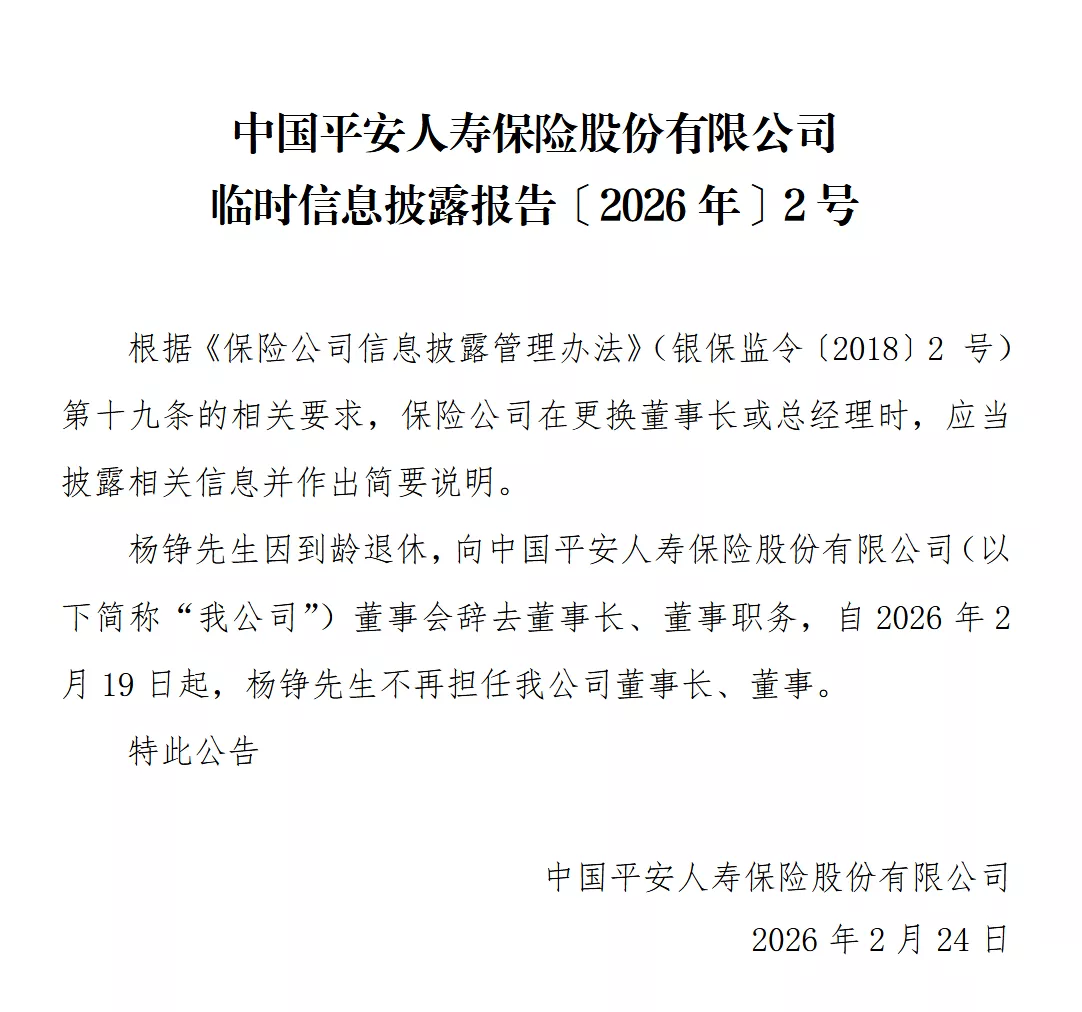
平安人寿:董事长杨铮因到龄退休辞任
Cai Jing Wang· 2026-02-26 09:28
近日,平安人寿发布公告称,杨铮因到龄退休,向该公司董事会辞去董事长、董事职务,自2026年2月19日起,杨铮不再担任公司董事长、董事。 (平安人寿) ...

保险行业周报(20260209-20260213):25Q4险资运用:权益配置维持历史高位-20260225
Huachuang Securities· 2026-02-25 03:42
Investment Rating - The industry investment rating is "Recommended," indicating an expected increase in the industry index exceeding the benchmark index by more than 5% in the next 3-6 months [21]. Core Insights - The insurance sector's total asset allocation reached approximately 38.5 trillion yuan by the end of Q4 2025, reflecting a year-to-date growth of 15.7%, with a net increase of over 5 trillion yuan throughout the year [2][4]. - The average comprehensive solvency adequacy ratio for insurance companies stands at 181.1%, with life insurance companies at 169.3% and property insurance companies at 243.5% [2]. - The industry is experiencing a shift in dividend insurance products, with a notable decrease in the preset interest rate to 1.25%, down from the previous cap of 1.75% [2]. - The overall premium income for the industry in 2025 is projected to be 6.12 trillion yuan, with a high fund conversion rate of 85% [4]. Summary by Sections Market Performance - The insurance index decreased by 2.52%, underperforming the market by 2.88 percentage points, with significant variations in individual stock performances [1]. Asset Allocation - The allocation of equity and fund assets in the insurance sector reached 5.70 trillion yuan, accounting for approximately 15.4% of total assets, maintaining a historical high [5]. - The stock assets alone amounted to 3.73 trillion yuan, representing 10.1% of total assets, with a year-on-year increase of 2.5% [5]. Company Performance and Valuation - The estimated PEV (Price to Embedded Value) for major life insurance companies is as follows: China Life at 0.89x, New China Life at 0.85x, Ping An at 0.78x, and China Pacific at 0.69x [6]. - The recommended order for investment in major companies is China Pacific, Ping An, China Life H, and China Property Insurance [6]. Future Outlook - The report anticipates that dividend insurance will attract household savings during the interest rate decline cycle, supporting growth in new premium income and net profit value (NBV) for life insurance [5]. - The long-term interest rates are expected to stabilize and rise, which may positively influence the PEV towards 1x [5].




中国平安临时股东会通过章程修订,取消监事会设置
Jing Ji Guan Cha Wang· 2026-02-20 07:44
Group 1 - The core point of the article is that Ping An Insurance is undergoing significant corporate governance changes, including the cancellation of the supervisory board and the appointment of a new chairman following the retirement of the current chairman [1] - As of February 14, 2026, Ping An Life has increased its stake in China Life's H-shares to over 10%, triggering a mandatory bid, indicating a strategic focus on high-dividend asset allocation [1] - On February 13, 2026, Ping An's A-share price closed at 65.29 yuan, down 1.88%, with a trading volume of approximately 5.51 billion yuan, while the insurance sector index fell by 1.74% and the Shanghai Composite Index decreased by 1.26% [1] Group 2 - According to Western Securities, the insurance sector index fell by 2.48% in the week of February 15, 2026, underperforming the broader market, but the insurance industry has long-term growth potential amid structural transformation [2] - The comprehensive target price set by the institution is 86.18 yuan, indicating a potential upside of 32% from the current stock price, with a profit forecast showing a 12.84% year-on-year increase in net profit for 2025 [2]

白银飙升近4%,金饰克价跌破1500元,老铺黄金又要涨价
21世纪经济报道· 2026-02-18 10:50
Core Viewpoint - The article discusses the recent fluctuations in gold and silver prices, highlighting a significant increase in both commodities on February 18, with gold reaching a peak of $4940 per ounce and silver surpassing $76 per ounce [1][2]. Group 1: Gold and Silver Price Movements - On February 18, gold prices rose over 1.3%, reaching a peak of $4940 per ounce before settling at $4920 per ounce [1]. - Silver prices increased by more than 3.8%, with a daily high of $76 per ounce [1]. - The closing price for silver was reported at $76.010, reflecting a 3.42% increase from the previous day [2]. Group 2: Domestic Jewelry Pricing - Several gold jewelry brands reported a decrease in domestic gold jewelry prices, with prices falling below 1500 yuan per gram [2]. - Notable prices included Chow Tai Fook at 1499 yuan per gram, Lao Miao Gold at 1499 yuan per gram, and Liufu Jewelry at 1497 yuan per gram [2]. - Other brands like Chow Sang Sang and Lao Feng Xiang maintained prices around 1500 yuan per gram, reported at 1500 yuan and 1510 yuan respectively [2]. Group 3: Market Sentiment and Federal Reserve Commentary - A survey by Bank of America indicated that buying gold has become the most crowded trade for the second consecutive month, with 50% of fund managers favoring gold in February, slightly down from 51% in January [6]. - Recent comments from Federal Reserve officials suggested that there is still room for interest rate cuts, with estimates indicating about 75 basis points of potential cuts before reaching a neutral rate [6].

年内近30家村镇银行注销解散
21世纪经济报道· 2026-02-18 07:53
Core Viewpoint - The article highlights the accelerated pace of integration and exit of village banks by joint-stock banks, marking a shift from rapid expansion to a focus on high-quality development in the industry [1][6]. Group 1: Recent Developments in Village Bank Exits - As of the end of January 2026, Everbright Bank has completed the exit of its three village banks, achieving a total "zero" status for its village banking operations [1][3]. - Shanghai Pudong Development Bank (SPDB) is also actively pursuing the "village to branch" model, with two of its village banks exiting in early February 2026, making it one of the most active banks in this regard [1][5]. - Nearly 30 village banks have been deregistered since the beginning of 2026, significantly higher than the same period last year [1][6]. Group 2: Integration and Exit Strategies - The exit actions by Everbright Bank are characterized as a "proactive application + compliance approval" model, with the bank inheriting all rights and obligations of the exited banks [3][4]. - The trend indicates a shift towards a more specialized and high-quality development phase for village banks, as the government emphasizes risk management and transformation of local financial institutions [6][10]. - The restructuring of over 230 village banks in 2025 through mergers, acquisitions, and exits reflects a deep reshaping of the industry, driven by both state-owned and joint-stock banks [6][9]. Group 3: Differentiated Approaches Among Joint-Stock Banks - SPDB has notably accelerated its exit process, reducing its village banks from 28 to approximately 13, with significant exits occurring between July 2025 and February 2026 [8][9]. - In contrast, Minsheng Bank has retained a broader network of village banks, exiting only two out of 28, indicating a different strategic focus [9]. - Other banks like Huaxia Bank and several others have completed their exits, while some banks have not engaged in village banking at all, highlighting varied strategies across the sector [7][9]. Group 4: Implications for Industry Personnel - The integration and exit of village banks signal a transition for employees, potentially moving from subsidiary roles to formal positions within parent banks, which may offer better resources and processes [9][10]. - However, this transformation also poses challenges, including changes in job roles and assessment systems, as well as potential impacts on existing business structures and client relationships [9][10].


5.85万亿平安人寿核心高层调整:董事长杨铮到龄退休,85后蔡霆代行职责,开年大手笔举牌中国人寿H股
Xin Lang Cai Jing· 2026-02-14 11:34
Group 1: Leadership Changes - Yang Zheng plans to resign from the position of Chairman due to retirement, with Vice Chairman Cai Ting taking over the responsibilities [3][9] - Cai Ting has been with Ping An Life for 10 years, holding various positions across Ping An Group, Ping An Bank, and Ping An Life [3][10] - Yang Zheng has been a long-time member of Ping An, joining in 1994 and holding multiple leadership roles before becoming Chairman in December 2020 [4][10] Group 2: Market Activities - Since the beginning of 2026, Ping An Life has been active in the secondary market, increasing its stake in China Life H shares [5][11] - On January 22, 2026, Ping An Life purchased 11.891 million shares at an average price of HKD 32.0553, raising its stake from 8.98% to 9.14% [5][11] - On February 2, 2026, the company further increased its holdings by acquiring 10.895 million shares at an average price of HKD 33.2588, bringing its total stake to 10.12% [6][11] Group 3: Financial Performance - In 2025, Ping An Life reported a 11.67% year-on-year increase in insurance business revenue, totaling CNY 470.932 billion [6][12] - The net profit for the same period grew by 23%, reaching CNY 105.566 billion [6][12] - As of the end of the third quarter of 2025, total assets amounted to CNY 5.85 trillion, a 12.71% increase from the beginning of the year [12]
债市信用挖掘系列之一:2026年票息策略的几条底线思维
GF SECURITIES· 2026-02-14 01:32
Core Insights - The report emphasizes that the current market is likely to experience a divergence in expectations, moving from a long-term bullish sentiment to a more uncertain and volatile environment, making interest rate strategies more favorable [1] - The primary risk associated with interest rate strategies is default risk, which has evolved over time, particularly in the context of credit bonds [1] Group 1: Credit Bond Default Risk Reassessment - Historical default rates show that private enterprises have a higher proportion of defaults, particularly in the real estate sector, while state-owned enterprises and banks have experienced occasional unexpected risks [11] - The current landscape of industrial bonds is dominated by state-owned enterprises, with a low probability of events similar to "Yong Coal," indicating that risk industries have reached a bottom [12] - The preference for holdings in public bond funds is shifting towards state-owned enterprises, counter-cyclical industries, quality regions, and leading institutions, reflecting a low exposure to risk [12] Group 2: Market Volatility and Interest Rate Strategies - The report outlines two main strategies for navigating the anticipated market volatility in 2026: - Strategy One focuses on credit downshifting and long-duration bonds with yields above 2.5%, targeting stable liabilities and absolute returns, particularly in city investment bonds and state-owned enterprise bonds [2] - Strategy Two emphasizes high liquidity and low volatility bonds with yields above 2.0%, aimed at defensive allocations in strong regions and leading enterprises [2] Group 3: Market Dynamics and Economic Indicators - The report notes that the lack of sufficient negative factors, combined with a weak economic recovery and unchanged monetary policy, suggests that the market will likely remain in a state of fluctuation [2] - The report highlights that while there is some room for interest rate cuts, the timing will depend on the verification of increasing economic recovery pressures [2] - The bond market is currently constrained within a range, leading to a higher probability of volatility [2]
平安人寿大幅增资至360亿元
Zhong Guo Jing Ying Bao· 2026-02-13 12:54
工商资料显示,2026年2月11日,平安人寿发生注册资本变更,其注册资本由338亿元人民币增至360亿 元人民币。 截至2025年9月末,平安人寿核心偿付能力充足率和综合偿付能力充足率分别为134.52%和185.68%,处 于充足水平。 《中国经营报》记者注意到,早在2025年4月,平安人寿发布公告称,该公司全体股东拟向平安人寿增 资约199.99亿元。据公告,平安人寿各股东按照现有持股比例(以现金方式同比例)认购新增股份,如 果有股东放弃认购新增股份,则对其放弃认购的股份,统一由股东中国平安(601318.SH,02318.HK) 以现金方式认购。增资扩股完成后,平安人寿的注册资本从338亿元增加至约360亿元。 偿付能力方面,截至2025年9月末,得益于增资扩股、利润留存、持有至到期核算的债券重新分类、无 固定期限资本债券发行共同影响,平安人寿核心资本增速较快,实际资本较2024年年末亦有所增长;同 期最低资本受境外权益类资产价格风险影响亦有所上升。 (文章来源:中国经营报) ...
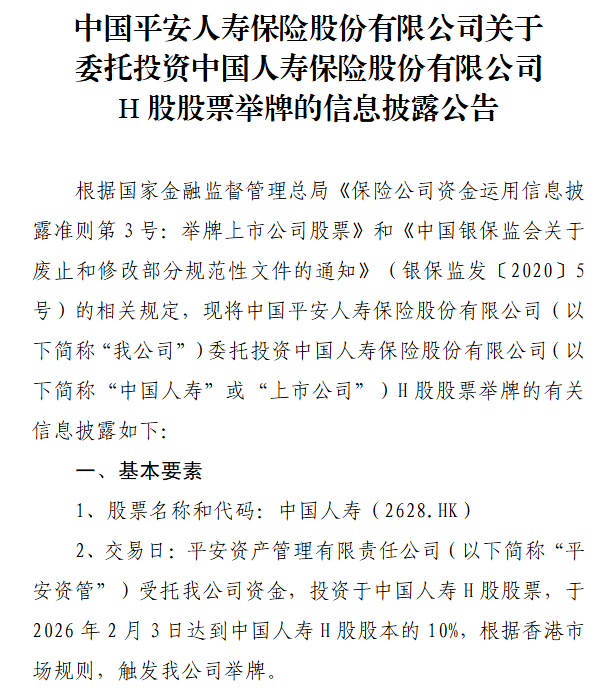
平安人寿再度举牌中国人寿H股,持股比例达10%
Guo Ji Jin Rong Bao· 2026-02-12 16:52
Core Viewpoint - The insurance capital is actively increasing its stakes in undervalued insurance stocks, indicating a strategic shift towards long-term stable returns and improved investment yields [1][4][5]. Group 1: Investment Activities - On February 10, Ping An Life announced that it had acquired 10% of China Life's H-shares, triggering a mandatory disclosure under Hong Kong regulations [1]. - Ping An Life previously reached a 5% stake in China Life's H-shares on August 12, 2025, and has since continued to increase its holdings, including significant purchases of 12.68 million shares and 44.09 million shares in late August 2025 [4]. - In addition to China Life, Ping An Life has also increased its stake in China Pacific Insurance, raising its ownership from 4.98% to 5.04% through a purchase of 174.14 million shares at an average price of HKD 32.0655 per share [4]. Group 2: Market Trends and Insights - Analysts suggest that the trend of insurance capital acquiring undervalued stocks is driven by the need for stable dividend yields and the desire to match assets with liabilities effectively [5][6]. - The investment strategy of Ping An emphasizes a "three criteria" principle: reliable operations, expected growth, and sustainable dividends, which guides their long-term investment decisions [5]. - The demand for insurance capital to acquire stocks is expected to continue into 2026, with a focus on both high dividend yield and high return on equity (ROE) targets [6][7].
险资开年加码港股:1个月扫货15.6亿
Xin Lang Cai Jing· 2026-02-12 12:12
Core Viewpoint - The Hong Kong IPO market has become increasingly active in 2026, with insurance capital accelerating its investments in this market, highlighting a trend towards global asset allocation and the pursuit of undervalued quality assets [1][2][6]. Group 1: Insurance Capital Participation - Since January 2026, insurance capital has participated in cornerstone subscriptions for 10 Hong Kong IPOs, with a total subscription amount of HKD 1.558 billion [1][6]. - In 2025, insurance capital participated in cornerstone subscriptions for 12 Hong Kong IPOs, amounting to HKD 2.620 billion [1][6]. - Key cornerstone investors in recent IPOs include Ping An Life and Taikang Life, with significant allocations in companies like Muyuan Foods and Dongpeng Beverage [2][6]. Group 2: Market Dynamics and Investment Preferences - The low interest rate environment has made the Hong Kong market a primary avenue for insurance capital's global asset allocation, with many undervalued quality assets available [2][6]. - Companies listed in both A-shares and H-shares often have H-shares priced at a discount compared to A-shares, making them attractive for insurance capital seeking better valuations and higher dividend yields [2][6]. - Insurance capital is increasingly focusing on "hard technology" and new consumption sectors, with some projects experiencing competitive bidding [3][7]. Group 3: Performance and Tax Advantages - The Hong Kong capital market regained the top position globally for IPO fundraising in 2025, raising USD 37.4 billion, surpassing the total of the previous three years [3][7]. - Newly listed stocks have performed well, with an average first-day increase of 23.8% and a cumulative first-month increase of 30.7%, particularly in the biotech and healthcare sectors [3][7]. - Insurance companies benefit from tax advantages in Hong Kong, as they can avoid corporate income tax on dividends from H-shares held for over 12 months, enhancing their net returns compared to individual investors [8].
