幻方

Search documents
2025年超八成百亿私募收益跑赢沪指
2 1 Shi Ji Jing Ji Bao Dao· 2026-02-02 06:45
Core Insights - The private equity funds in 2025 have shown strong performance, with an average return of 34.86% among 57 billion-yuan private equity funds, significantly outperforming the Shanghai Composite Index, which rose by 18.41% [1] - Quantitative strategies have emerged as the dominant approach among leading private equity firms, with 17 out of the top 20 funds utilizing this strategy [5] Performance of Private Equity Funds - Lingjun Investment achieved the highest average return of 73.51% in 2025, leading the market [2] - Yuanxin Investment and Fusheng Asset followed closely with returns exceeding 70%, ranking second and third respectively [3] - Lin Yuan Investment was the only fund with a negative average return in 2025, attributed to its heavy investment in "old stocks" [3] Quantitative Strategies - The success of quantitative strategies in 2025 is not solely due to a bull market; rather, it is linked to improvements in trading volume, volatility, and liquidity [6] - Quantitative strategies are predominantly employed by larger private equity funds, with less than 10% of funds below 50 million yuan utilizing this approach [7] Regional Distribution of Private Equity Funds - The majority of billion-yuan private equity managers are concentrated in first-tier and strong second-tier cities, with Shanghai, Guangdong, and Beijing leading in numbers [9] - Guangdong's private equity funds benefit from a complete industrial chain and high information flow efficiency, particularly in emerging industries [10] Talent and Investment Preferences - Talent availability significantly influences the performance of private equity funds, with the Yangtze River Delta and Pearl River Delta regions each having their unique advantages [10][11] - The investment mindset in the Jiangsu-Zhejiang-Shanghai region is more progressive, showing a higher acceptance of new strategies and innovative products [11]
中证1000指增如何把握Beta与Alpha? | 资产配置启示录
私募排排网· 2026-01-20 03:41
Group 1 - The core viewpoint of the article emphasizes the growing interest in the CSI 1000 Index Enhanced products, which aim to share Beta returns while striving for excess Alpha, particularly in a recovering market since 2025 [3] - The CSI 1000 Index features a small and mid-cap style, covering companies ranked approximately 801 to 1800 in A-share market capitalization, with a significant representation from high-growth sectors such as electronics, electrical equipment, pharmaceuticals, and computers [4] - The CSI 1000 Index typically exhibits higher elasticity and greater volatility compared to broader indices like the CSI 300 and CSI 500, making it more suitable for investors with a certain risk tolerance seeking potential excess returns through accepting short-term fluctuations [4] Group 2 - Since 2021, the Chinese government has introduced various policies to support the high-quality development of "specialized, refined, and innovative" small and medium-sized enterprises, with cumulative fiscal subsidies exceeding 10 billion by 2025 [7] - The combination of industrial upgrades and policy dividends provides a clear growth logic for the CSI 1000 Index in the medium to long term, particularly as high-tech enterprises constitute a significant portion of its constituent stocks [7] - The performance of private equity CSI 1000 Index Enhanced strategies has shown a clear "Beta + Alpha" advantage, with a strategy index return exceeding 36% over the past year, compared to less than 16% for the CSI 1000 Index [7] Group 3 - When selecting CSI 1000 Index Enhanced products, traditional metrics like return rate and volatility are important, but two new indicators are introduced: non-regular investment annualized return and regular investment annualized return [10] - Non-regular annualized return reflects the product's ability to generate returns from a single entry point, while regular annualized return measures the stability of performance over time with fixed frequency investments [12][13] - Products that perform well on both metrics are rare and indicate a more sustainable and evenly distributed source of Alpha, making them suitable for both one-time allocations and long-term regular investments [14] Group 4 - The article highlights the compounding effect of index enhancement, noting that in volatile market conditions, consistent outperformance against a benchmark can lead to significant excess returns over time [18] - The strategy of index enhancement focuses on closely tracking the benchmark while allocating more to quality stocks and less to underperforming ones, aiming to accumulate excess returns [19] - Long-term holding is suggested as the optimal approach for index enhancement, as short-term evaluations may not accurately reflect the strategy's true capabilities [19]


Barra风控+限制个股权重+高成分股占比!敦和量化,打造“攻守兼备”的指增利器!
私募排排网· 2026-01-19 12:00
Core Viewpoint - The article emphasizes the increasing structural differentiation in the market, highlighting the phenomenon where "indices rise but profits do not." It presents Dunhe Asset Management's investment philosophy of "asset rotation based on safety margins" as a solution to enhance excess returns in a challenging investment environment [1]. Group 1: Company Overview - Dunhe Asset Management, established in 2011, has consistently adhered to its investment philosophy and has received multiple industry awards, including the Golden Bull Award and the Golden Yangtze Award [1]. - In 2022, Dunhe Asset Management proactively entered the quantitative investment sector by establishing the Dunhe Quantitative Anxin Division, which comprises seven specialized teams and nearly 30 professionals with extensive quantitative experience [1]. Group 2: Performance Metrics - As of December 2025, the Dunhe Year Wheel Quantitative Index Enhancement Series products have shown impressive performance, with the "Dunhe Year Wheel CSI 1000 Index Enhancement No. 1 A-Class" achieving a full-year return of ***% and excess geometric returns exceeding ***%, with a maximum drawdown of ***%, significantly lower than the CSI 1000 index drawdown [2]. - The "Dunhe Year Wheel CSI 2000 Index Enhancement No. 1 A-Class" also reported a full-year return of ***% since its inception on April 16, 2025, with similar metrics of excess returns and drawdown [3][4]. Group 3: Investment Strategy - The Dunhe Year Wheel Quantitative Index Enhancement Strategy is designed as a balanced enhancement tool covering various indices, aiming to provide both offensive and defensive capabilities [8]. - The strategy employs a three-pronged framework of "factor-model-risk control," integrating human and machine-driven factor discovery, traditional machine learning, and advanced deep learning models to enhance predictive capabilities while mitigating strategy crowding [8][9][10]. Group 4: Team Composition - The investment research team for the Year Wheel series consists of seven core members with backgrounds in mathematics, physics, computer science, and artificial intelligence, combining strong academic foundations with practical experience [7]. - The investment manager, Yao Yifan, has over ten years of quantitative research experience across various prestigious institutions, contributing to the strategy's robust professional foundation [7]. Group 5: Future Outlook - As market structural opportunities become increasingly difficult to capture and competition in quantitative strategies intensifies, the article suggests that building a truly balanced and stable investment portfolio will be crucial for future success [11].

时隔十年,融资保证金再收紧,释放出哪些信号?
私募排排网· 2026-01-19 03:20
Core Viewpoint - The adjustment of financing margin from 100% to 80% by the three major exchanges in August 2023 laid the foundation for a liquidity bull market a year later, with significant market participation observed in early 2026 [2]. Market Reaction - On January 14, 2026, the financing margin was raised back to 100%, leading to a sharp market adjustment, with the Shanghai and Shenzhen 300 index erasing early gains and closing down by 0.40% [2]. - The market's "V-shaped" fluctuation indicates a struggle between exuberant sentiment and rational regulation, with the regulatory intent being to conduct necessary "counter-cyclical adjustments" in response to signs of overheating [2]. Financing Margin Adjustment History - The last increase in financing margin occurred on November 14, 2015, during a period of market rebound after a leveraged bull market bubble burst, with significant increases in financing balance and trading activity [5]. - In October 2015, the financing balance increased by 126.1 billion, with daily financing buy amounts rising by 76% compared to September, prompting regulatory concerns about excessive leverage [5]. Impact on Market Liquidity - The increase in financing margin is expected to suppress market trading volume, as seen in late 2015 when trading volumes returned to previous average levels despite slight index gains [8]. - The theoretical reduction in financing purchasing power by 20% will lead to a decrease in new leveraged funds, resulting in a structural optimization of market volume rather than a simple decline in trading activity [8]. Investment Logic - The policy aims to shift market focus from speculative trading to fundamental-based investments, emphasizing the importance of earnings certainty, valuation safety margins, and sustainable dividend capabilities [10]. - Large-cap stocks are expected to outperform as the reliance on leveraged trading diminishes, with blue-chip and dividend assets likely to rise quickly to compensate for previous underperformance [10]. Differences from Previous Adjustments - The current margin adjustment is considered more moderate compared to 2015, focusing on preemptive risk management rather than reacting to a market crisis [14]. - Despite the increase in margin, the current market is characterized by a recovery in earnings structure and confidence, with the financing balance relative to market capitalization remaining lower than in 2015 [15].

黄金、白银走牛,CTA策略又火了!一文详解CTA策略!
私募排排网· 2026-01-17 00:00
Core Viewpoint - Since 2025, commodities like gold and silver have surged to historical highs, with industrial metals such as copper and aluminum also showing strong trends due to macroeconomic expectations and supply-demand changes. The CTA (Commodity Trading Advisor) strategy has gained popularity among private equity firms, capitalizing on these opportunities to achieve significant net value increases in their products [2]. Group 1: CTA Strategy Overview - CTA, or Commodity Trading Advisor, originated in the U.S. during the 1970s and 1980s, initially focusing on commodity futures but later expanding to various derivatives including stock index futures, treasury futures, and forex futures. Its core feature is investing in derivatives rather than directly in stocks or bonds, aiming for absolute returns regardless of market conditions [3]. - CTA strategies can be categorized into subjective and quantitative types. Subjective CTAs rely on the fund manager's experience and fundamental analysis, while quantitative CTAs utilize computer models to quickly capture price trends and arbitrage opportunities [3]. Group 2: Types of CTA Strategies - Trend-following strategies are the most common, relying on price momentum to capture trends. They open positions in the direction of a clear price trend and hold until the trend ends or a stop-loss is triggered. Common tools include moving averages and momentum indicators [4]. - Arbitrage and statistical strategies do not depend on single-direction trends but instead exploit price mismatches or statistical deviations. This includes inter-month arbitrage, inter-commodity arbitrage, inter-market arbitrage, and statistical arbitrage based on historical price relationships [7][8]. - Many managers combine both types of strategies to create a "trend + arbitrage" mixed configuration, balancing returns and volatility across different market conditions [10]. Group 3: Profit Logic and Advantages of CTA Strategies - The dual-direction mechanism of the futures market allows CTAs to profit from both rising and falling prices, making them capable of generating positive returns even during stock market downturns [11]. - Empirical data shows that CTA strategies have low correlation with stocks and bonds, particularly during extreme market events, providing diversification benefits and reducing overall portfolio volatility [11]. - Futures trading inherently involves leverage, and CTAs can quickly respond to market changes through stop-loss orders, position control, and diversification [11]. Group 4: Risks and Limitations of CTA Strategies - Trend-following CTAs may face challenges in unclear or frequently fluctuating markets, leading to false signals and potential drawdowns [12]. - The inherent leverage in futures trading can amplify losses if position management and risk control are inadequate, especially during extreme market events [12]. - Strategy homogeneity risk arises when many CTAs use similar trend models, potentially leading to collective liquidation at trend reversals, exacerbating short-term market volatility [12]. - Some niche products or distant contracts may have limited liquidity, affecting execution efficiency for large capital movements [12]. Group 5: Investor Suitability for CTA Strategies - CTA strategies are suitable for high-net-worth individuals or institutions seeking diversified asset allocation, investors sensitive to market volatility, and those with a certain risk tolerance who can accept periodic drawdowns [14]. - They are not recommended for short-term speculative investors or for holding a disproportionately high share in a portfolio [14]. Group 6: Future Outlook for CTA Strategies - The macro environment suggests that high volatility in commodities may become a medium to long-term norm due to global supply chain restructuring, green energy investments, and geopolitical conflicts. The expansion of domestic financial derivatives offers broader opportunities for CTAs [15]. - However, investors should be cautious of potential volatility in the "post-bull market" phase, as commodities like gold and silver may have already priced in optimistic expectations [15]. - CTA should be viewed as a long-term asset allocation tool rather than a short-term profit vehicle, with a focus on understanding its profit logic and risk boundaries for appropriate allocation [15].

排排网基金销售公司总经理林丽:2025的里程碑之年,私募行业活力迸发
私募排排网· 2026-01-08 12:19
Core Viewpoint - The 20th Private Fund Development Forum, hosted by 排排网 Group, aims to explore new paths for high-quality development in China's private fund industry, focusing on AI empowerment, investment opportunities in equity markets, and the value of CTA strategy allocation [2]. Group 1: Industry Overview - In 2025, the private securities industry reached a milestone with a management scale exceeding 7 trillion yuan, marking it as a core growth engine for the sector [5]. - The number of private funds with over 10 billion yuan increased by 22, totaling 113, showcasing a robust expansion of the top-tier segment [5]. - The overall return for private funds exceeded 25% in 2025, with over 90% of products achieving positive returns, reflecting strong investor trust [5]. - The number of registered private securities products surpassed 10,000, representing a growth of over 50% compared to the previous year, indicating heightened investor enthusiasm [5]. Group 2: Future Outlook - The private fund industry is expected to evolve into a more diversified and mature landscape, driven by continuous market optimization and internal upgrades [6]. - There will be an upgrade in strategy diversification, with stock strategies remaining dominant while multi-asset and derivative strategies serve as stabilizers for risk management [6]. - The influx of institutional funds into the equity market is anticipated to create significant opportunities for Fund of Funds (FOF) [6]. - The industry structure is expected to become clearer, with leading private funds consolidating resources while smaller funds differentiate themselves [6]. - The internationalization of private funds is accelerating, particularly among leading firms, with a stronger willingness for global expansion [6]. Group 3: Company Initiatives - 排排网 has leveraged a large database to simplify fund investments and has built an integrated service platform for public and private funds [7]. - The company achieved significant progress in the public fund sector, gaining high recognition from clients for its professional fund selection and portfolio configuration capabilities [7]. - In 2026, 排排网 aims to continue its mission of serving the real economy, focusing on data-driven strategies and technological innovation to foster high-quality industry development [7].

五年潮变,量化私募走到了舞台中央
2 1 Shi Ji Jing Ji Bao Dao· 2026-01-06 13:09
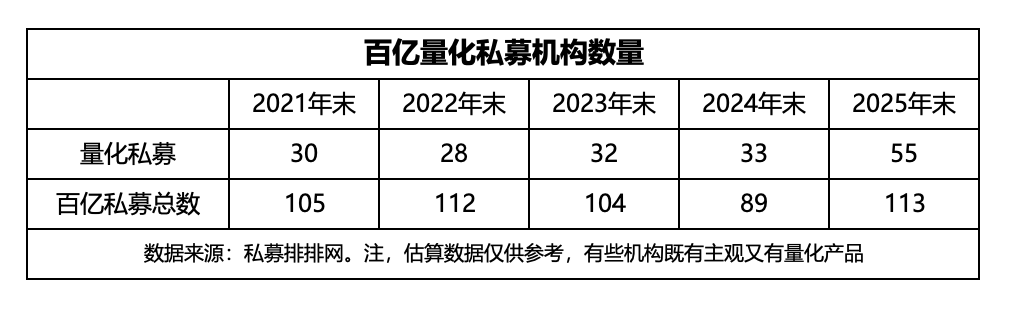
21世纪经济报道记者 杨娜娜 头部阵营的内部格局持续剧烈洗牌。2025年,幻方、九坤、明汯、衍复依旧稳坐"四大天王"之位,合计管理规模约3000亿元左右。世纪前沿在一年内规模净 增超300亿元,跃入600亿俱乐部;诚奇资产则新进500亿阵营;顽岩资产更是上演"两级跳",直接跨入400亿梯队。 与此同时,包括平方和投资、稳博投资、思勰投资、锐天投资等在内的20多家机构还挤在100亿-200亿的腰部区间,竞争呈白热化态势。行业格局也已今非 昔比,2022年二季度,500亿规模曾是行业顶峰,仅有九坤等极少数机构触及;而至2025年末,700亿-800亿已成为顶级玩家新的入场券。 这一结构性变化的背后,是量化机构凭借其业绩表现、风控能力及产品标准化优势,赢得了机构与高净值投资者的持续青睐。 从私募排排网统计的数据来看,截至2025年年末,近五年来百亿私募收益率前十的机构中,量化私募占据六席。其规模扩张并非单纯依赖市场贝塔,而是在 成熟的多策略与风控框架支撑下,将业绩的稳定性转化为强大的资金吸纳能力。 这五年,是头部机构巩固优势、规模极致膨胀的五年,也是新锐力量凭借技术迭代与策略创新实现"规模跃迁"的五年。 2025年 ...
2025收官盛宴!超百家私募管理人的“财富共鸣”,不容错过!
私募排排网· 2026-01-04 03:33
Core Insights - The private equity industry is experiencing significant growth, with over 100 private equity firms surpassing 10 billion yuan in assets by October 2025, marking a return to the "double hundred era" [2] - By the end of November, over 600 firms among the 7,000 existing securities private equity firms achieved annual growth, with nearly 100 firms elevating their scale by two levels or more, indicating strong momentum in the industry [2] - The total management scale of domestic private equity funds exceeded 22 trillion yuan by the end of October, further rising to 22.09 trillion yuan by the end of November, reflecting a robust increase in both industry scale and product issuance [2] - The average return for 5,116 private equity products with performance data was notable, with quantitative long and subjective long strategies showing strong performance, achieving average returns of ***% and ***% respectively [2] Industry Trends - The private equity sector is characterized by a diverse range of products, with over 12,000 new products registered in 2025, indicating a growing variety and sustained high issuance enthusiasm [2] - The industry is at a critical juncture, facing opportunities and uncertainties, particularly regarding the continuation of the easing cycle in 2026 and the potential for quantitative strategies to maintain their success from 2025 [2] - A VIP roadshow event titled "Hearing Wealth" is set to commence on January 5, 2026, featuring leading private equity managers focusing on annual reviews and future outlooks, particularly in quantitative and subjective strategies [2]

量化宏观为什么突然爆火?
私募排排网· 2026-01-03 10:00
Core Viewpoint - The rise of quantitative macro strategies in the private equity industry has become a focal point, with these strategies gaining significant traction compared to traditional subjective macro strategies [2][3]. Group 1: Growth of Quantitative Macro Strategies - Since 2020, hedge funds employing quantitative macro strategies have seen an average annual growth rate of over 15%, significantly outpacing traditional subjective macro strategies [2]. - As of November, the average return for 195 macro strategy products was 25.50%, with subjective macro strategies yielding 26.42% and quantitative macro strategies at 21.42% [2]. - The Sharpe ratio for quantitative macro strategies reached 2.11, compared to 1.57 for subjective macro strategies, indicating better risk-adjusted performance [2]. Group 2: Reasons for Popularity - The global macro environment has become increasingly complex, with challenges such as the COVID-19 pandemic, high inflation, and geopolitical conflicts, making traditional decision-making methods less effective [3]. - Quantitative macro strategies have successfully avoided severe losses by utilizing real-time market liquidity monitoring and stress testing models, prompting a reevaluation of investment methodologies [3]. Group 3: Characteristics of Quantitative Macro Strategies - Quantitative macro strategies utilize systematic, data-driven models to analyze relationships between macroeconomic variables and financial asset prices, enabling automated or semi-automated asset allocation and trading [7]. - Key features include data-driven decision-making, systematic investment processes, multi-dimensional analysis, and a strong focus on risk management [8]. Group 4: Types of Quantitative Macro Strategies - Strategies can be categorized into five types: 1. Fundamental Quantitative Strategies: Based on economic indicators like GDP and inflation [10]. 2. Systematic Trend Following: Identifying momentum factors through price trends [11]. 3. Cross-Asset Relative Value: Arbitraging pricing discrepancies across different markets [12]. 4. Machine Learning Macro Forecasting: Using advanced algorithms to predict economic cycles [13]. 5. Macro Factor Investing: Capturing risk premiums based on growth, inflation, and liquidity factors [10]. Group 5: Differences Between Quantitative and Subjective Macro Strategies - Subjective macro strategies rely on the personal insights and intuition of fund managers, while quantitative macro strategies are based on data, models, and statistical patterns [14]. - Quantitative macro strategies offer greater scalability and consistency in performance, while subjective strategies are more prone to volatility and depend heavily on individual managers [15][16]. Group 6: Future Outlook - The evolution of quantitative macro strategies represents a necessary advancement in macro investment methodologies in the data era, emphasizing the importance of integrating human judgment with machine capabilities [17][18].

市场预期升波,2026年指增如何演绎?
私募排排网· 2025-12-22 03:36
Core Viewpoint - The A-share market in 2025 continues the long-term trend of declining volatility, characterized by "low trend, low amplitude" due to increased institutionalization and regulatory emphasis on high-quality development [2] Group 1: Market Volatility Analysis - The annualized daily volatility of major broad-based indices is below the five-year average, with the CSI 300's volatility dropping below 15% and the CSI 1000 index showing a significant decline from its 2024 peak [9][10] - The number of trading days with an absolute price change greater than 2% for the CSI 1000 index is only 21 days as of December 10, significantly lower than 60 days in 2024, indicating a convergence of daily price fluctuations [10] Group 2: Causes of Volatility Decline - The decline in volatility is attributed to multiple structural factors, including accounting standard adjustments that reduced the impact of equity volatility on insurance profits, allowing long-term funds to increase allocations to low-turnover, low-beta assets [13] - A decrease in tail risk events throughout the year has led to a continuous downward adjustment in the market's pricing of systemic risks, contributing to the low volatility environment [13] - Regulatory changes in public fund assessments have led to a trend towards passive management, resulting in smoother rebalancing and reduced industry divergence [13] Group 3: Impact on Investment Strategies - Low volatility environments compress the price differences of stocks, making it difficult for high-frequency and momentum strategies to perform well, while some trend-following strategies struggle to generate positive feedback [16] - Despite the compression of alpha in certain enhanced strategies due to low volatility, new structural opportunities arise, particularly in stable cash flow and low-volatility sectors, which are expected to sustain their value [17] - Small-cap and micro-cap assets, which remain under-covered by institutions, present significant alpha sources due to their lower pricing efficiency and higher volatility, making them attractive for enhanced strategies [17]