
西测测试

Search documents
计算机行业周报:太空光伏“破晓”:商业航天的能源革命与万亿机遇
HUAXI Securities· 2026-03-01 02:45
Investment Rating - Industry Rating: Recommended [3] Core Insights - The commercial space industry is accelerating, and space photovoltaics are opening up growth opportunities. The demand for space photovoltaics is surging due to the commercialization of space, with the U.S. and China leading global commercial launches. Space photovoltaics offer significant advantages over ground-based solar, including unobstructed sunlight, 24-hour power generation, and high energy density, making them essential for AI data centers and satellite constellations [1][14]. - Countries are rapidly positioning themselves in the space photovoltaic sector, with China holding key advantages. The Chinese photovoltaic industry dominates global production, accounting for 92% of silicon wafer capacity and over 80% of battery and module production. This positions China to meet the substantial equipment procurement needs arising from Elon Musk's 200GW production plan [2][15]. - China is entering a dense phase of reusable rocket launches, marking 2026 as a breakthrough year for commercial space. Both state-owned and private companies are making significant advancements in reusable rocket technology, which will reshape the economic model of commercial space and reduce launch costs [5][16]. Summary by Sections Section 1: Commercial Space Acceleration - The commercial space sector is entering a new era, with the U.S. and China as the main players. In 2025, the U.S. is expected to conduct 167 launches, while China will have 92, both showing year-on-year growth. Low Earth orbit satellites are becoming central to development, driven by the need for satellite internet and resource allocation [19][25]. Section 2: Global Positioning in Space Photovoltaics - Major global tech giants are competing in the space photovoltaic arena through differentiated strategies. The U.S. has a "three giants" competition, while China employs a "state-owned + private enterprise" collaborative model. Chinese companies are increasingly entering the supply chain of SpaceX, with significant procurement opportunities anticipated [2][28]. Section 3: Reusable Rocket Launches in China - 2026 is set to be a pivotal year for China's commercial space sector, with multiple core rockets entering key validation stages. The advancements in reusable rocket technology are expected to significantly lower launch costs and create new opportunities in satellite networking and space infrastructure [5][34]. Section 4: Investment Recommendations - Beneficiary companies in space photovoltaics include JunDa Co., Maiwei Co., Liancheng CNC, Laplace, Dongfang Risheng, Yujing Co., Jiejia Weichuang, Gaoce Co., Aotewei, and Jingsheng Mechanical [6][17]. - In the SpaceX and North America sector, recommended companies include Western Materials, Xinwei Communication, and Tongyu Communication [6][18]. - For rockets, key companies include Aerospace Power, Chaojie Co., Zaiseng Technology, Aerospace Machinery, Aerospace Hongtu, GaoHua Technology, Aerospace Electronics, and Tianli Composite [6][18]. - In the space computing sector, recommended companies are Shunhao Co., Zhenlei Technology, Putian Technology, Zhongke Xingtou, Jiayuan Technology, Qianzhao Optoelectronics, and Shanghai Port [6][18]. - Satellite-related companies include Xicet Testing, Tianyin Machinery, Xinwei Communication, Tongyu Communication, and China Satellite [6][18]. - For communication payloads and laser communication, recommended companies are Aerospace Electronics, Fenghuo Communication, New Light Optoelectronics, Shanghai Hanhua, and Zhenlei Technology [6][18]. - Ground stations and user terminals include Haige Communication, Beidou Xingtong, Shuo Beid, Huace Navigation, and Mengsheng Electronics [6][18]. Section 5: Industry Trends and Future Outlook - The space photovoltaic industry is transitioning from "engineering productization" to "scale industrialization." Future efforts should focus on technology, engineering, manufacturing, and system collaboration to seize the vast market opportunities presented by commercial space [33].

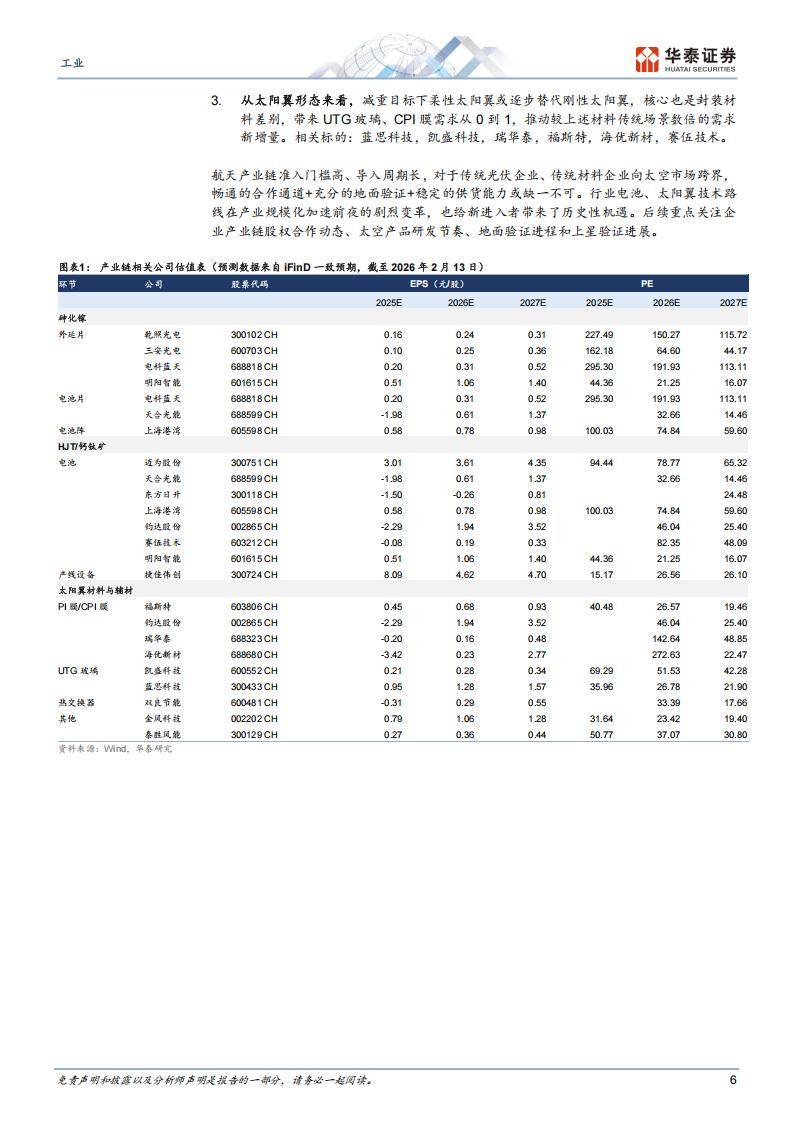
太空光伏,未来最具确定性的25家公司
Sou Hu Cai Jing· 2026-02-27 13:45
关于报告的所有内容,请于公众『市场分析报告』阅读原文 《太空光伏,未来最具确定性的25家公司》 近日,中国一次性向国际通信联盟提交了超20万颗卫星的部署计划,同时,SpaceX也向美国联邦通信委员会申请 发射100万颗卫星。这一轮卫星互联网的密集部署,背后不仅是频轨资源的排他性争夺,更预示着太空基础设施 建设正从单纯的通信功能向算力上天演进。在大国科技竞争的背景下,低轨卫星市场的规模正从数十兆瓦级向百 兆瓦、甚至吉瓦级迈进,能源补给成为了限制太空资产扩张的核心瓶颈。 本次梳理重点聚焦太空光伏这一前沿领域,通过对太空算力趋势、太空光伏市场前景以及中国相关产业链企业发 展机遇的系统性分析,展现能源转型在星辰大海中的新路径。太空光伏主要包含太空对太空供电(S2S)以及太 空对地面供电(S2E)两大主流场景,前者决定了当前卫星与空间站的生命线,后者则承载着人类实现24小时全 天候清洁能源补给的终极梦想。 一、轨道资源与太空算力驱动能源变革 短期内,太空卫星基础设施的频轨资源具有显著的先到先得特征。由于地球轨道空间有限,且电磁频谱属于不可 再生资源,谁先占领轨道并投入运行,谁就拥有了这一区域的话语权。随着人工智能应用呈 ...

2026年中国电磁兼容性(EMC)测试行业市场政策、产业链图谱、市场规模、竞争格局及发展趋势分析:市场竞争较为激烈[图]
Chan Ye Xin Xi Wang· 2026-02-27 01:26
Core Viewpoint - The electromagnetic compatibility (EMC) testing industry in China is experiencing steady growth driven by regulatory improvements, expanding market demand across various sectors, and increasing compliance requirements from both domestic and international markets [1][4][5]. Market Overview - The regulatory framework for EMC testing in China has expanded from traditional consumer electronics to include diverse sectors such as automotive, new energy, medical, rail transportation, and aerospace [1][4]. - The market size of the EMC testing industry in China is projected to reach 6.928 billion yuan by 2025, with a year-on-year growth of 11.7%. EMC testing services account for approximately 76.13% of the market, while EMC testing equipment represents about 23.87% [1][8]. Policy Environment - Recent policies emphasize the importance of product quality and safety, mandating EMC testing for various industries, including automotive, consumer electronics, and aerospace, thereby creating a favorable environment for the EMC testing industry [4][5]. Industry Chain - The upstream of the EMC testing industry includes suppliers of electromagnetic materials and testing equipment, while the downstream encompasses demand markets across multiple sectors such as automotive, consumer electronics, and medical devices [6][7]. Demand Structure - The automotive sector is the largest demand market for EMC testing in China, expected to account for nearly 30% of the market by 2025. The rapid growth of the automotive market, particularly in new energy vehicles, provides significant growth opportunities for the EMC testing industry [7][8]. Competitive Landscape - The EMC testing market in China is characterized by a competitive landscape with a mix of state-owned, foreign, and domestic private testing institutions. The market concentration remains low, indicating intense competition [10]. - Key players in the industry include companies like 广电计量 (Guangdian Measurement), 西安西测 (Xi'an Xice), and others, which are leveraging their technical capabilities and service advantages to capture market share [10][11]. Development Trends - The EMC testing industry is expected to see a continuous improvement in standards and compliance requirements driven by government policies, leading to a more regulated and high-quality market [12]. - Technological advancements will focus on smart and high-end solutions, with AI and automation playing a significant role in enhancing testing efficiency and accuracy [13]. - The service model is shifting towards integrated solutions that encompass testing, rectification, certification, and consulting, aiming to meet the comprehensive needs of enterprises throughout their product lifecycle [14].



我国可回收火箭将密集发射,加快产业发展
Xuan Gu Bao· 2026-02-26 15:03
据上证报报道,据中科宇航透露,该公司可回收液体运载火箭力箭二号计划于今年3月下旬首飞,将搭 载我国轻舟一号货运飞船初样实施发射。中科宇航已向主管部门申报2026年发射计划,全年计划执行13 次发射,并力争追加1一2次任务,发射频次与任务密度再创新高。 蓝箭航天近日宣布,我国重复使用火箭朱雀三号计划今年第二季度再次开展回收试验。据介绍,朱雀三 号研制团队目前正在对火箭着陆流程进行优化,计划于2026年第二季度再次开展回收试验,并根据回收 试验情况争取于今年第四季度尝试首次回收复用飞行。 公司方面,据上证报表示, 西测测试:积极布局商业航天检测业务。 西部材料:主营钛合金产品,广泛应用于航空航天领域。 *免责声明:文章内容仅供参考,不构成投资建议 *风险提示:股市有风险,入市需谨慎 中泰证券认为,今年是中国商业火箭首飞+回收验证密集期,产业从"技术攻关"向规模化,可复用,低 成本落地迈进,太空算力,卫星互联网,太空旅游,深空探测等应用爆发直接拉动火箭需求。 ...
2026年度策略:强者恒强的千亿赛道,关注商业航天等新兴产业带来的发展机遇
Soochow Securities· 2026-02-14 11:41
Core Insights - The report emphasizes the strong growth potential in the testing services industry, particularly driven by emerging sectors such as commercial aerospace and new technologies [4][6] - The testing services sector is closely linked to macroeconomic growth, with a projected global market size of approximately 2.3 trillion RMB by 2024, reflecting a CAGR of about 6% from 2021 to 2024 [4][24] - In China, the testing services market is expected to reach around 487.6 billion RMB by 2024, with a CAGR of approximately 10.5% from 2015 to 2024, indicating a robust growth trajectory [5][24] Industry Overview - The testing, inspection, and certification (TIC) industry serves various sectors including consumer goods, industrial products, and pharmaceuticals, covering all stages from R&D to production and distribution [16][24] - The industry is characterized by a large market space and stable growth, with demand closely tied to macroeconomic trends and government regulations [20][24] - Emerging technologies such as AI, electric vehicles, and commercial aerospace are expected to create new testing demands, raising the entry barriers for new players [6][20] Company Performance - The report analyzes 19 listed companies in the testing services sector, highlighting their revenue and profit performance, with notable companies including Huace Testing, Guangdian Measurement, and Su Testing [2][11] - In the first three quarters of 2025, the testing services sector in China reported a revenue of 30.4 billion RMB, a decline of 7% year-on-year, but a growth of 3% when excluding companies heavily involved in medical testing [5][57] - Leading companies such as Huace Testing, Guangdian Measurement, and Su Testing demonstrated superior performance, with revenue growth rates of 7%, 12%, and 9% respectively, significantly outpacing the industry average [5][62] Market Dynamics - The testing services market is experiencing a structural shift, with a trend towards consolidation as larger firms gain market share and smaller firms face challenges [44][50] - The report notes that the majority of testing institutions in China are small and micro-sized, which limits their ability to withstand economic pressures [50][51] - Government policies are increasingly supporting the marketization and consolidation of testing institutions, aiming to enhance the overall quality and efficiency of the industry [51][53] Financial Metrics - The report indicates that the average gross margin for the testing services sector has improved, reaching 26.2% in the first three quarters of 2025, reflecting a recovery in profitability [63] - The accounts receivable turnover days have increased from 90 days in 2019 to 176 days in 2025, indicating a slowdown in cash flow and potential credit risks within the industry [67][68] - The report highlights that the proportion of accounts receivable in relation to revenue has risen to 50%, suggesting increasing challenges in managing receivables [71]



SPACEX申请至多100万轨位,轨道数据中心时代有望开启
Tebon Securities· 2026-02-12 09:23
Investment Rating - The report maintains an "Outperform" rating for the telecommunications industry [1] Core Insights - The satellite internet sector is transitioning from a communication hub to a computing intermediary, with a significant increase in the number of satellites reported globally by the end of 2025 [3] - SpaceX's application to deploy up to 1 million satellites aims to create a dual barrier of "physical space + spectrum resources," forcing global space powers to reassess the strategic value of orbital assets [3] - The shift to orbital computing could alleviate the energy crisis faced by ground-based AI data centers, utilizing near-infinite solar energy and natural cooling in a vacuum environment [3] - The aggressive satellite deployment plan by SpaceX is expected to catalyze the domestic industry, enhancing China's position in the satellite internet market and accelerating the transition from policy-driven to market-driven growth [3] Summary by Sections Market Performance - The telecommunications sector has shown a performance range from -34% to +103% compared to the CSI 300 index over the specified periods [2] Related Research - The report references several studies that highlight the competitive landscape and technological advancements in the satellite internet and AI sectors, indicating a growing interest and investment potential in these areas [3] Suggested Companies to Watch - The report recommends monitoring several companies, including Xinke Mobile, Aerospace Huanyu, Aerospace Electronics, and others, which are positioned to benefit from the developments in the satellite internet industry [3]
北摩高科:公司子公司京瀚禹在航空航天领域的市场竞争力较强
Zheng Quan Ri Bao Wang· 2026-02-06 08:47
证券日报网讯2月6日,北摩高科(002985)在互动平台回答投资者提问时表示,作为军用元器件第三方 检测领域的领军企业之一,公司子公司京瀚禹在航空航天领域的市场竞争力较强,公司拥有相对成熟和 全面的电子元器件检测工作体系。与西测测试(301306)相比,京瀚禹在技术竞争力方面具有自身的优 势,除了拥有数十年沉淀积累的软件著作权及专利技术外,还拥有与北航合作的联合实验室,在技术研 发和创新方面有更多的资源支持。同时,京瀚禹从元器件采购、检测到SMT贴装、软件研发、数据分 析,可提供一站式解决方案,也在多地设分支,响应速度快,便于全国性客户的集中管理。京瀚禹高端 设备数量多,测试程序库和配套板卡规模大,可支持多品种、大批量的检测需求。 ...

SpaceX:从“变革”中崛起的“星际先行者”
Soochow Securities· 2026-02-02 11:53
证券研究报告 SpaceX:从"变革"中崛起的"星际先行者" 东吴证券研究所所长助理、计算机首席分析师 王紫敬 执业证书编号:S0600521080005 联系邮箱:wangzj@dwzq.com.cn 2026年2月2日 核心观点 ◆ 1. 传统主业:由"星链"与"火箭发射"构筑的万亿航天基本盘 ◆ SpaceX已通过技术代差重塑了航天经济学,其核心收入来源由星链(Starlink)和火箭发射业务组成 。星链已从早期的空间互联网集群进化为全球维度的数字资 产,截至2026年1月,在轨卫星已超9500颗,全球活跃用户达900万,Payload Space预计2025年星链将贡献公司约70%的收入 。特别是通过收购频谱许可证和部署 DTC(手机直连)技术,星链正转型为全球移动运营商,消除通信盲区 。火箭发射则是其物理支撑,猎鹰9号作为世界上最成功的商业复用火箭,已将发射成本 压低至传统火箭的十分之一 。这种强大的发射能力不仅支撑了星链的快速组网,更确立了SpaceX在全球商业发射市场近乎垄断的地位 。 ◆ 2. 太空算力:从地球代偿到构建"在轨智能"的生态闭环 ◆ 随着星舰带来的发射成本大幅下行,每一枚卫星正在 ...
西测测试2025年业绩预亏 积极布局商业航天新赛道蓄力未来
Zheng Quan Ri Bao Wang· 2026-01-29 11:15
西测测试始终坚持以技术为根基,以资质为台阶。旗下子公司成功取得NADCAP认证、ASP证书及 SPCAP证书,NADCAP、ASP和SPCAP认证不仅是国际航空航天领域的黄金准入标准,更是西测测试 跻身全球高可靠性供应链核心层的有力证明。这些资质为西测测试在商业航天高可靠性业务领域的拓展 奠定了坚实基础,开启了服务更高层级客户、参与更关键项目的大门。 面对商业航天"低成本、高可靠、快迭代"的行业核心需求,西测测试创新性地提出并实践"商业航天超 级代工厂"模式。该模式深度融合"检测+制造"双轮驱动战略,构建了从设计验证、元器件筛选、核心部 件智能制造到整星/整舱环境与可靠性试验的一站式全链条服务体系。以卫星载荷为例,西测测试可以 为商业卫星制造商提供从"设计验证——核心部件智能制造——整星/整舱环境与可靠性试验"的"一站 式"服务,能够显著缩短客户研制周期、降低综合管理成本、保障全过程质量一致性,已获得国内多家 主流商业卫星平台及载荷研制企业的认可与积极评价。公开信息显示,西测测试已成功承接并交付了涵 盖核心部件制造与全系统测试验证的示范性订单,为客户提供了从"蓝图"到"上天"全链条的关键环节支 持。同样的模式 ...
东吴证券:商业航天迎多重共振 聚焦火箭端卫星端等四大赛道
Zhi Tong Cai Jing· 2026-01-29 02:44
智通财经APP获悉,东吴证券发布研报称,长期以来,我国商业航天的核心痛点在于"星多箭少"——海 量卫星组网需求受制于极度稀缺的投送能力。2025年12月3日,朱雀三号遥一成功入轨,标志着国产商 业火箭成熟的大规模入轨能力。建议关注SpaceX相关标的、火箭端卫星端、以及太空算力/太空光伏四 大赛道。 东吴证券主要观点如下: 太空算力与太空光伏(前瞻赛道):太空算力:顺灏股份;太空光伏设备:晶盛机电、高测股份、捷佳 伟创、连城数控、宇晶股份、双良节能、拉普拉斯;太空光伏产品:云南锗业、中来股份、乾照光电、 东方日升、钧达股份、明阳智能、上海港湾、琏升科技、天合光能、晶科能源、蓝思科技、凯盛科技。 风险提示:技术验证不及预期、订单兑现不及预期、地缘政治波动风险、市场波动风险等。 战略重要性:发星保轨、防御升维与地外矿权 当前商业航天的竞争本质上是一场关于空间主权与资源份额的"圈地运动"。(1)发星保轨:受限于 ITU"先到先得"的分配准则,近地轨道相位与频谱资源正被星链等超大规模星座迅速挤占,加速提升发 射通量已成为捍卫中国空间生存权的底线。(2)军事维度:商业航天已演变为地月态势感知与天基防 御体系的核心底座, ...
