
JIANGXI BANK(01916)

Search documents
江西银行因贷款管理不到位收罚单 27日收报0.7港元
Sou Hu Cai Jing· 2026-02-27 10:29
根据其官网显示,江西银行于2015年12月成立,2018年6月在香港上市。该行正式在职员工总数5700余人,全行共有22家一级分支机 构,27个职能部门,225个营业网点,营业机构已覆盖江西省全部设区市,在广州、苏州设立两家省外分行,发起设立了江西省首家金 融租赁公司和4家村镇银行。 | 序号 | 当事人名称 | 主要违法违规行为 | 行政处罚内容 | 作出决定机关 | | --- | --- | --- | --- | --- | | 1 | 江西银行股 份有限公司 | | 对江西银行股份 有限公司罚款30 | | | | | 贷款管理不到位 | 万元;对欧阳品 | | | | 及相关责任 | | 华、陈勇分别给 | | | | 人 | | 予警告 | | | | | | | 国家金融监督 | | | | | | 管理总局江西 | | | | | 对江西银行股份 | 监管局 | | | 江西银行股 | | 有限公司南昌迎 | | | | 份有限公司 | 未严格审查银行承 | 宾大道支行罚款 | | | 2 | 南昌迎宾大 | 兑汇票业务贸易背 | 40万元;对万俊 | | | | 道支行及相 | 景真实性 ...

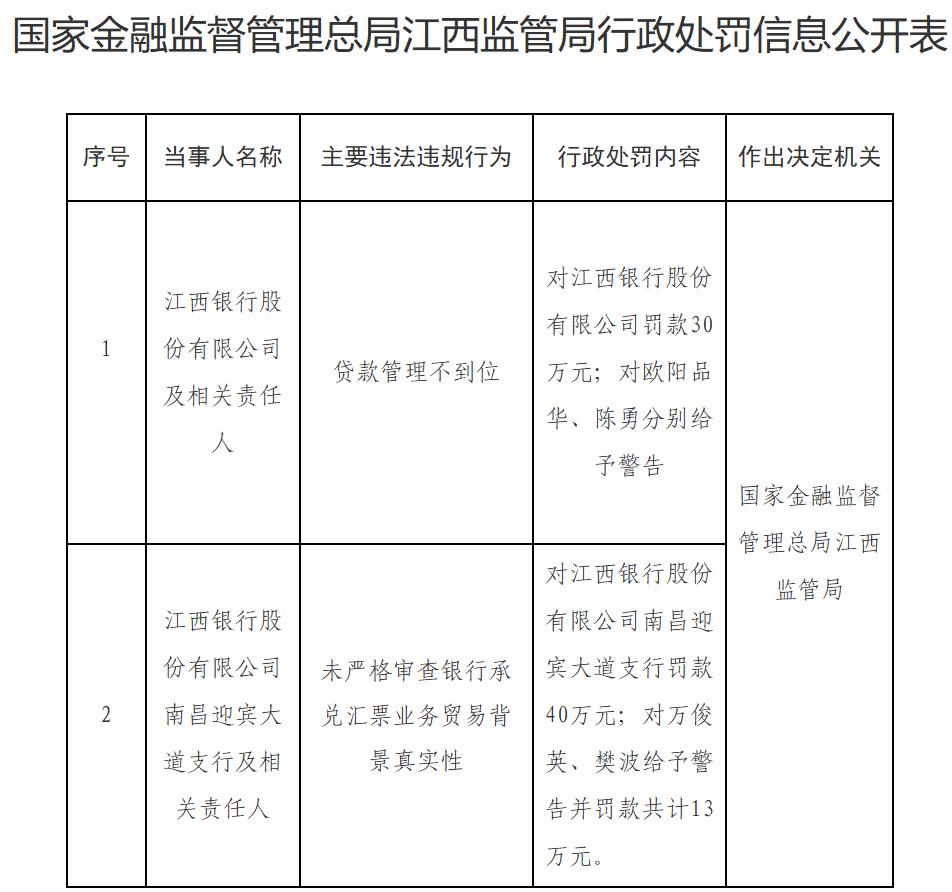
江西银行及某支行合计被罚70万 涉贷款管理不到位等
Zhong Guo Jing Ji Wang· 2026-02-27 06:57
| 序号 | 当事人名称 | 主要违法违规行为 | 行政处罚内容 | 作出决定机关 | | --- | --- | --- | --- | --- | | 1 | 江西银行股 份有限公司 | 贷款管理不到位 | 对江西银行股份 有限公司罚款 30万元;对欧 | | | | 及相关责任 | | | | | | 人 | | 阳品华、陈勇分 | | | | | | 别给予警告 | 国家金融监督 | | | | | 对江西银行股份 | 管理总局江西 | | | 江西银行股 | | 有限公司南昌迎 | 监管局 | | | 份有限公司 | 未严格审查银行承 | 宾大道支行罚款 | | | 2 | 南昌迎宾大 | 兑汇票业务贸易背 | 40万元;对万 | | | | 道支行及相 | 昌真实性 | 俊英、樊波给予 | | | | 关责任人 | | 警告并罚款共计 | | | | | | 13万元。 | | 江西银行股份有限公司南昌迎宾大道支行及相关责任人未严格审查银行承兑汇票业务贸易背景真实性。 国家金融监督管理总局江西监管局对江西银行股份有限公司南昌迎宾大道支行罚款40万元;对万俊英、 樊波给予警告并罚款共计13万元。 以 ...
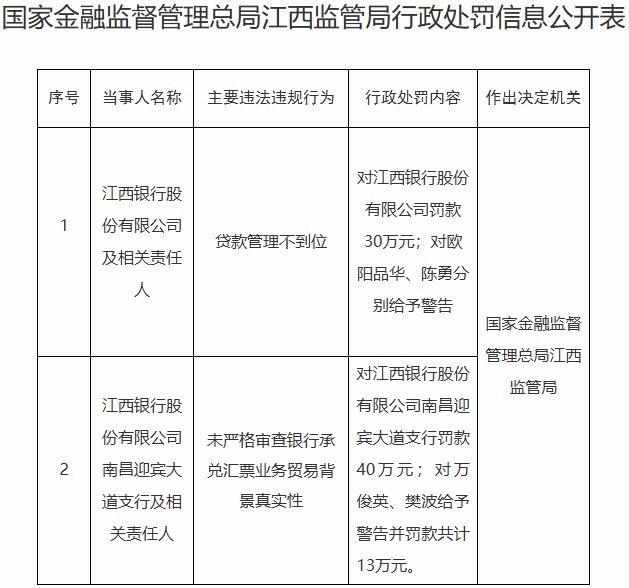
江西银行,再被罚!
Zhong Guo Ji Jin Bao· 2026-02-26 16:25
【导读】江西银行再被罚!去年罚款总额同比已增超四成 中国基金报记者 嘉合 2月25日,国家金融监督管理总局江西监管局再次剑指江西银行:因存在多项业务违法违规行为,江西银行及旗下南昌迎宾大道支行被合计罚款70万元, 相关责任人同步被罚。 国家金融监督管理总局江西监管局披露信息显示,因存在贷款管理不到位问题,对江西银行处以罚款30万元,对涉事责任人欧阳某华和陈某分别处以警 告。 同时,因存在未严格审查银行承兑汇票业务贸易背景真实性问题,对江西银行南昌迎宾大道支行处以罚款40万元,对该行涉事责任人万某英和樊某分别处 以警告并罚款共计13万元。 | 序号 | 当事人名称 | 主要违法违规行为 | 行政处罚内容 | 作出决定机关 | | --- | --- | --- | --- | --- | | 1 | 江西银行股 份有限公司 | | 对江西银行股份 有限公司罚款 | | | | 及相关责任 | 贷款管理不到位 | 30万元;对欧 | | | | 人 | | 阳晶华、陈勇分 | | | | | | 别给予警告 | 国家金融监督 | | | | | | 管理总局江西 | | | 江西银行股 | | 对江西银行股份 有 ...

江西银行 再被罚!
Zhong Guo Ji Jin Bao· 2026-02-26 16:23
【导读】江西银行再被罚!去年罚款总额同比已增超四成 2月25日,国家金融监督管理总局江西监管局再次剑指江西银行:因存在多项业务违法违规行为,江西银行及旗下南昌迎宾大道支行被合计罚款 70万元,相关责任人同步被罚。 国家金融监督管理总局江西监管局披露信息显示,因存在贷款管理不到位问题,对江西银行处以罚款30万元,对涉事责任人欧阳某华和陈某分别 处以警告。 同时,因存在未严格审查银行承兑汇票业务贸易背景真实性问题,对江西银行南昌迎宾大道支行处以罚款40万元,对该行涉事责任人万某英和樊 某分别处以警告并罚款共计13万元。 | 序号 | 当事人名称 | 主要违法违规行为 | 行政处罚内容 | 作出决定机关 | | --- | --- | --- | --- | --- | | 1 | 江西银行股 | | 对江西银行股份 有限公司罚款 | | | | 份有限公司 | 贷款管理不到位 | 30万元;对欧 | | | | 及相关责任 | | 阳品华、陈勇分 | | | | く | | 别给予警告 | | | | | | | 国家金融监督 | | | | | 对江西银行股份 | 管理总局江西 | | | 江西银行股 | | ...
江西银行2025年财报将披露,资产质量与盈利能力受关注
Jing Ji Guan Cha Wang· 2026-02-19 02:44
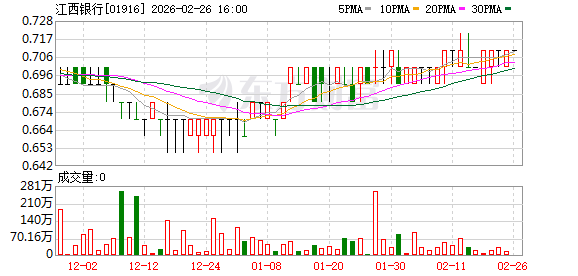
Core Viewpoint - Jiangxi Bank (01916.HK) is expected to face scrutiny regarding its asset quality, profitability, and compliance management as it approaches the release of its 2025 annual performance report in March 2026 [1][2]. Performance and Operational Situation - Asset Quality: As of the first half of 2025, Jiangxi Bank reported a non-performing loan (NPL) ratio of 2.36%, significantly higher than the industry average of 1.49%, with the real estate sector's NPL ratio reaching 19.07%. The ability to improve these figures by year-end is critical [1]. - Profitability: The bank experienced a year-on-year decline in operating income of 19.91% and a net profit decrease of 10.53% in the first half of 2025, raising concerns about reversing this downward trend by year-end [1]. - Compliance and Internal Control: In 2025, Jiangxi Bank and its branches received seven fines totaling approximately 4.45 million yuan, indicating ongoing challenges in compliance management [1]. Business Development Situation - Village and Town Bank Integration: Jiangxi Bank continued its strategy of integrating village and town banks in 2025, including acquiring the remaining equity of Jinxian Ruifeng Village Bank and planning to convert it into a branch, as well as increasing its stake in Nanchang Dafeng Village Bank to 40.68% through judicial auction. The impact of these integrations on business performance is noteworthy [2]. - Regional Policy Environment: In 2025, Jiangxi Province led the central region in the growth rate of technology loans, prompting market interest in whether such regional policies could create potential opportunities for Jiangxi Bank's business development [2]. Recent Stock Performance - Recent stock performance of Jiangxi Bank has diverged from its fundamentals. As of February 12, 2026, the stock price was 0.71 HKD, with a 5.97% increase over the past 60 trading days, reaching a recent high. This performance is attributed to low valuation (price-to-book ratio of approximately 0.10), low liquidity, and expectations surrounding regional policies. Future market performance and potential market value management actions remain points of interest for some investors [3].
江西银行2025年累计收7罚单总罚445万元 3年皆"仙股"
Zhong Guo Jing Ji Wang· 2026-02-13 07:56
Core Viewpoint - Jiangxi Bank has faced multiple penalties in 2025 due to compliance issues, yet its stock price has shown an upward trend despite these challenges [1] Group 1: Penalties and Compliance Issues - In 2025, Jiangxi Bank received a total of 7 fines, amounting to approximately 4.45 million yuan [1] - The Nanchang Bayi Branch was fined 300,000 yuan in December 2025 for "inadequate loan management," resulting in a lifetime ban for one responsible individual [1] Group 2: Stock Performance - Jiangxi Bank was listed on the Hong Kong Stock Exchange on June 26, 2018, with an initial offering price of 6.39 HKD [1] - As of May 18, 2022, the stock price was reported at 0.91 HKD, and it continues to be classified as a "penny stock" [1]
江西银行罚单频发资产质量承压,股价却逆势上涨
Jing Ji Guan Cha Wang· 2026-02-12 07:58
Group 1 - The core viewpoint of the articles highlights the compliance issues faced by Jiangxi Bank, which resulted in multiple penalties and a deteriorating asset quality, particularly in the real estate sector [1][2] Group 2 - In 2025, Jiangxi Bank received a total of 7 penalties, amounting to approximately 4.45 million yuan, with a significant fine of 300,000 yuan imposed on the Nanchang Bayi branch for inadequate loan management [1] - The non-performing loan (NPL) ratio for Jiangxi Bank rose to 2.36% in the first half of 2025, significantly exceeding the average level for city commercial banks, with the real estate sector's NPL rate reaching 19.07% [1] Group 3 - Despite the negative events, Jiangxi Bank's stock price on the Hong Kong market closed at 0.71 HKD on February 12, 2026, with a trading range of 2.82% for the day and a 5.97% increase over the past 60 trading days [2] - The market performance appears to diverge from the fundamentals, potentially influenced by extreme undervaluation, with a current price-to-book ratio of only 0.10 times and a dividend yield of approximately 5.86% [2] - Regional policy expectations may also play a role, as Jiangxi Province's technology loan growth rate was the highest in central China in 2025, possibly leading to improved perceptions of the local financial environment [2]
债市迷影!吉林银行2亿索赔浙商银行为何落空?江西银行旧案揭开真相!
Sou Hu Cai Jing· 2026-02-10 16:13
Core Viewpoint - The recent court ruling involving Jilin Bank's 200 million yuan claim against Zheshang Bank highlights the challenges and risks in the private bond market, particularly regarding the delineation of responsibilities among banks and investors [2][9]. Group 1: Case Background - The dispute centers around the "17 Kangde Investment PPN001" private bond issued by Kangde Investment Group in 2017, with an initial issuance size of 200 million yuan and a coupon rate of 7% [3][4]. - Jilin Bank's investment of 201.51 million yuan was characterized by non-market practices, as the decision was made prior to the bond's issuance and without reliance on disclosure documents [5]. Group 2: Legal Proceedings - Jilin Bank's claim of over 220 million yuan against Zheshang Bank and other intermediaries resulted in consecutive losses in both first and second trials [6][9]. - The court's final ruling emphasized that Jilin Bank's investment decision lacked a causal relationship with any false statements, and Zheshang Bank had conducted thorough due diligence [7]. Group 3: Industry Implications - The outcomes of both Jilin Bank and Jiangxi Bank's cases, which involved similar claims and resulted in identical rulings, signal a clear judicial stance on the responsibilities within the private bond market [9]. - Industry experts suggest that these rulings serve as a warning for financial institutions, emphasizing the importance of pre-investment risk management over post-investment claims [9].



双重缓冲机制,滞胀阴影下的组合解药?从汇添富中证细分有色金属产业主题ETF联接C(019165)再看资产配置底层逻辑
Sou Hu Cai Jing· 2026-02-06 07:38
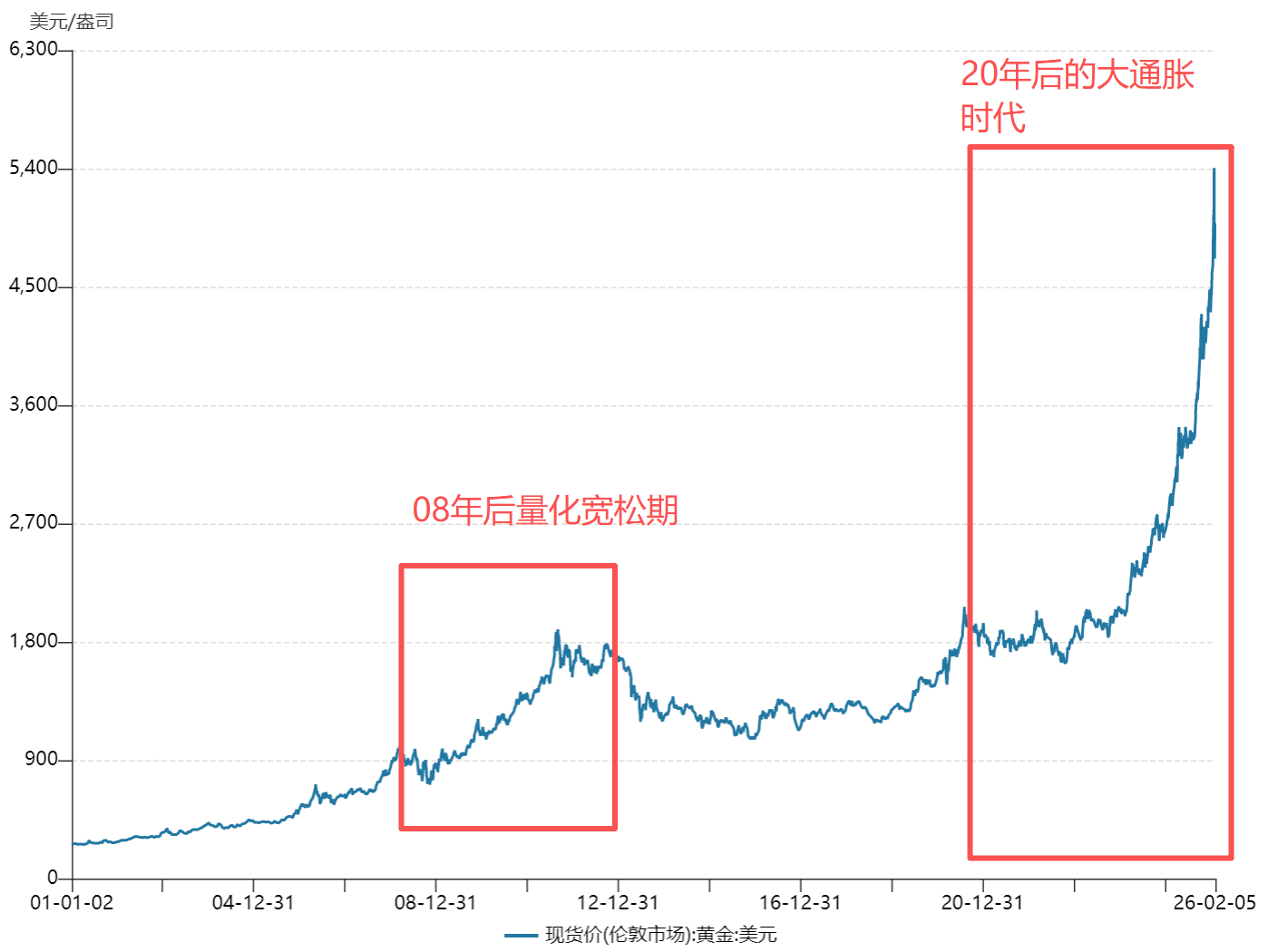
Core Insights - The article emphasizes the need for a reassessment of asset allocation strategies in light of increasing global macroeconomic uncertainties and rising correlations between traditional equity and bond assets [1] - It highlights the unique role of precious metals ETFs as risk diversifiers in investment portfolios, particularly during periods of economic stagnation and high inflation [1] Group 1: Market Dynamics - Precious metals such as copper, aluminum, and gold exhibit a non-linear relationship with stock and bond yields, making them valuable during economic downturns [1] - The demand for copper is being reshaped by long-term factors such as new energy installations and AI data center construction, while supply constraints persist due to reduced capital expenditures from 2018 to 2022 [1] - Historical data shows that during the quantitative easing period post-2008, gold prices surged from approximately $750/oz to $1,900/oz, reflecting a 150% increase over three years [1] Group 2: Inflation and Asset Performance - During the inflation surge from 2020 to 2022, gold prices rose from below $1,450 to over $3,400/oz by 2025, while copper prices increased from $4,400/ton to over $10,700/ton, marking a 140% rise within 15 months [2][4] - Gold serves as a hedge against currency devaluation, while copper captures demand expansion during industrial recovery phases [4] Group 3: Investment Strategies - The investment strategy employed by David Swensen at Yale involved increasing the allocation to physical assets like commodities and energy to about 15%, leveraging their low correlation with financial assets [5] - Precious metals ETFs provide a practical avenue for ordinary investors to engage in this strategy, offering essential cyclical hedging capabilities [6] Group 4: ETF Performance and Structure - The ETF in focus, Huatai-PineBridge's index, covers a broad range of metals including gold, copper, aluminum, lithium, and rare earths, positioning it to benefit from a "super cycle" in the metals market [6] - As of February 5, 2026, the index's top three sectors are copper (34.2%), aluminum (14.6%), and gold (14.4%), indicating a balanced exposure to both industrial and precious metals [7][9] - The fund has achieved a remarkable return of 173.08% over the past two years, significantly outperforming major indices like the CSI 300, with a lower maximum drawdown, showcasing a favorable risk-return profile [9]
汇添富中证细分有色金属产业主题ETF发起式联接C(019165)低成本布局有色行业向上机遇,2025年我国有色金属企业工业增加值增长6.9%
Xin Lang Cai Jing· 2026-02-06 07:26
Group 1 - The core viewpoint of the news highlights the growth and performance of the non-ferrous metal industry in China, with significant increases in production, investment, and trade [2] - As of February 6, 2026, the non-ferrous metal industry theme index (000811) rose by 0.25%, with notable increases in constituent stocks such as Hunan Gold (9.94%) and Guocheng Mining (5.67%) [1] - The non-ferrous ETF Huatai-PineBridge increased by 0.32%, with a remarkable annual growth of 109.34% as of February 5, 2026 [1] Group 2 - In 2025, China's non-ferrous metal enterprises saw an industrial added value growth of 6.9%, with total production exceeding 8 million tons, reaching 8,175 million tons, a 3.9% increase year-on-year [2] - Fixed asset investment in the non-ferrous metal industry grew by 4.9%, surpassing the national industrial investment growth rate by 2.3 percentage points, with mining sector investments soaring by 41.0% [2] - The total import and export trade of non-ferrous metals reached $412.24 billion, marking a 12.4% increase from the previous year [2] Group 3 - The Huatai-PineBridge non-ferrous metal industry theme ETF (019165) has shown a maximum monthly return of 20.81% since its inception, with a one-year Sharpe ratio of 3.44 [3] - The fund has a maximum drawdown of 15.91% over the past year, ranking 2 out of 5 in its category, indicating relatively low risk [3] - The fund manager, Dong Jin, has 15.6 years of experience and has achieved a return of 82.96% since taking office on March 21, 2025 [3] Group 4 - The Huatai-PineBridge non-ferrous metal industry theme ETF (019165) offers a flexible mechanism with no subscription fees, which is particularly beneficial in the volatile non-ferrous metal sector [4] - This mechanism significantly reduces transaction costs for investors, allowing them to capture segment profits without being eroded by subscription and redemption fees [4]