ZZEPC(600023)

Search documents
浙能电力(600023) - 关于董事离任的公告
2026-02-11 08:45
证券代码:600023 证券简称:浙能电力 公告编号:2026-004 浙江浙能电力股份有限公司 关于董事离任的公告 本公司董事会及全体董事保证本公告内容不存在任何虚假记载、误导性陈述或者重大遗 漏,并对其内容的真实性、准确性和完整性承担法律责任。 浙江浙能电力股份有限公司(以下简称"公司")近日收到公司董事胡敏的 书面辞职报告,胡敏因工作调动原因申请辞去公司董事职务。 | 姓名 | 离任职务 | 离任时间 | 原定任期到期日 | 离任原因 | 是否继续在公 司及其控股子 | 具体 | 是否存在 未履行完 | | --- | --- | --- | --- | --- | --- | --- | --- | | | | | | | 公司任职 | 职务 | 毕的公开 | | | | | | | | | 承诺 | | 胡敏 | 董事 | 2026 年 2 月 10 日 | 2027 年 8 月 19 日 | 工作调动 | 否 | / | 否 | 二、离任对公司的影响 根据《公司法》和《公司章程》的相关规定,胡敏辞去董事职务不会导致董 事会成员低于法定人数,不会影响公司董事会的正常运行,辞职报告自送达董事 会之日起 ...

浙能电力:辅助服务对电力收入的贡献较低
Zheng Quan Ri Bao Wang· 2026-02-09 13:17
Core Viewpoint - Zhejiang Energy Power (600023) indicated that auxiliary services are essential for maintaining the safe and stable operation of the power system, ensuring power quality, and are provided by adjustable resources, although their contribution to electricity revenue is relatively low [1] Group 1 - Auxiliary services include peak regulation, frequency regulation, backup, and ramping, which are necessary beyond normal electricity production, transmission, and usage [1] - The revenue generated from auxiliary services is significantly lower compared to that from electricity production [1]
公用事业行业2025年报业绩前瞻:成本端缓和电价压力,燃气毛差弥补销量影响
Shenwan Hongyuan Securities· 2026-02-09 08:23
Investment Rating - The report rates the public utility industry as "Overweight" for 2025, indicating a positive outlook compared to the overall market performance [1]. Core Insights - The report highlights that the cost pressures from coal and natural gas prices are easing, which is expected to improve the profit margins for power generation companies. The implementation of capacity pricing is stabilizing revenues, allowing for a diversified income model for thermal power companies [3]. - Hydropower is projected to benefit from improved water conditions in the second half of 2025, leading to stable growth in electricity generation. The reduction in financial costs due to interest rate cuts is also expected to enhance profitability [3]. - Nuclear power utilization hours are expected to remain high, but the decline in market electricity prices may negatively impact earnings. The approval of new nuclear projects is anticipated to support long-term growth [3]. - Renewable energy, particularly wind and solar, is expected to continue its high growth trajectory, supported by favorable investment mechanisms and stable returns from existing projects [3]. - The natural gas sector is poised for profitability improvements due to declining costs and a recovery in demand from commercial users [3]. Summary by Sections Thermal Power - Coal prices are expected to decline initially and then rebound, with an average price of 697 RMB/ton for 2025, down 18.47% year-on-year. The average price in Q2 2025 is projected to be 632 RMB/ton, a 12.36% decrease quarter-on-quarter and a 25.5% decrease year-on-year. The implementation of capacity pricing is expected to stabilize revenues for thermal power companies [3]. Hydropower - The utilization hours for hydropower are projected to be 3367 hours in 2025, an increase of 12 hours year-on-year. The first half of the year is expected to see lower water levels, while the second half will benefit from improved conditions, particularly in Q4 [3]. Nuclear Power - The utilization hours for nuclear power are expected to reach 7809 hours in 2025, an increase of 126 hours year-on-year. However, the decline in market electricity prices may negatively impact earnings [3]. Renewable Energy - By the end of September 2025, the total installed capacity for wind and solar energy is expected to reach 1.7 billion kW, with annual additions of 15-18.9 million kW needed to meet the 2035 target of 3.6 billion kW [3]. Natural Gas - The report anticipates a recovery in sales volume for natural gas companies in Q4 2025, driven by lower costs and improved demand from commercial sectors [3]. Company Performance Forecast - The report provides a detailed forecast for key companies in the public utility sector, indicating varying growth rates across different segments, with some companies expected to see significant profit growth while others may experience declines [4][5]. Investment Recommendations - The report recommends several companies across different segments, including thermal power, hydropower, nuclear power, renewable energy, and natural gas, highlighting those with strong growth potential and stable earnings [3].




中电联预计26年用电增速5%-6%,2月代理购电价整体下行
GOLDEN SUN SECURITIES· 2026-02-08 11:35
Investment Rating - The report maintains an "Accumulate" rating for the industry [2] Core Insights - The China Electricity Council forecasts a 5%-6% growth in electricity consumption for 2026, with a significant decline in proxy electricity prices in February [5][12] - Over 80% of provinces and cities reported a year-on-year decrease in proxy electricity prices in February, with Jiangsu, Inner Mongolia, and Liaoning experiencing the largest declines of 29.3%, 25.6%, and 23.1% respectively [5][14] - The report anticipates that by the end of 2026, the installed capacity of solar power will exceed that of coal power for the first time, with renewable energy sources accounting for half of the total installed capacity [5][14] Summary by Sections Industry Outlook - The report predicts that by 2026, the total installed capacity of renewable energy will reach half of the total installed capacity, with solar power surpassing coal power for the first time [5][14] - The total electricity consumption in China is expected to be between 10.9 and 11 trillion kilowatt-hours, reflecting a year-on-year growth of 5%-6% [5][14] Investment Trends - In January 2026, the State Grid completed fixed asset investments of 30.8 billion yuan, a year-on-year increase of 35.1% [6][14] - The Southern Power Grid plans to invest over 24 billion yuan in the first quarter of 2026, marking a year-on-year increase of over 20% [7][14] Proxy Electricity Prices - The report highlights that proxy electricity prices have generally decreased, with significant drops in various regions, indicating a more favorable supply-side environment [5][14] Key Companies and Recommendations - The report suggests focusing on high-dividend coal-fired power leaders and companies with stable electricity prices and integrated coal power operations, such as Huaneng International and Huadian International [8][14] - It also recommends monitoring companies in the wind and solar sectors, including Xintian Green Energy and Longyuan Power [8][14]




2025年中国火力发电量产量为62945.5亿千瓦时 累计下降1%
Chan Ye Xin Xi Wang· 2026-02-03 03:07
Core Viewpoint - The report highlights a decline in China's thermal power generation, with a projected decrease in output for 2025 compared to previous years, indicating potential challenges for the industry [1]. Industry Summary - According to the National Bureau of Statistics, the thermal power generation output in December 2025 is expected to be 581.2 billion kilowatt-hours, representing a year-on-year decrease of 3.2% [1]. - The cumulative thermal power generation output for the entire year of 2025 is projected to be 6,294.55 billion kilowatt-hours, reflecting a cumulative decline of 1% [1]. - The report is part of a comprehensive market survey and investment potential research for the thermal power industry in China from 2026 to 2032, published by Zhiyan Consulting [1].





浙能电力1月30日获融资买入2655.35万元,融资余额4.71亿元
Xin Lang Zheng Quan· 2026-02-02 01:23
Group 1 - The core viewpoint of the news is that Zhejiang Energy Power Co., Ltd. has experienced a decline in stock price and financial performance, with significant changes in financing and shareholder structure [1][2][3] Group 2 - On January 30, Zhejiang Energy Power's stock price fell by 0.80%, with a trading volume of 482 million yuan. The financing buy-in amount was 26.55 million yuan, while the financing repayment was 34.84 million yuan, resulting in a net financing buy of -8.29 million yuan [1] - As of January 30, the total balance of margin trading for Zhejiang Energy Power was 472 million yuan, with a financing balance of 471 million yuan, accounting for 0.71% of the circulating market value, which is above the 90th percentile of the past year [1] - The company reported a total revenue of 58.814 billion yuan for the period from January to September 2025, a year-on-year decrease of 11.28%, and a net profit attributable to shareholders of 6.230 billion yuan, a year-on-year decrease of 7.02% [2] - Since its A-share listing, Zhejiang Energy Power has distributed a total of 30.473 billion yuan in dividends, with 7.911 billion yuan distributed in the last three years [3] - As of September 30, 2025, the number of shareholders of Zhejiang Energy Power increased to 155,000, a rise of 10.58%, while the average circulating shares per person decreased by 9.56% to 86,495 shares [2][3]
容量电价,因何而来?向何处去?
Changjiang Securities· 2026-02-02 00:42
Investment Rating - The report suggests a positive outlook for the utility sector, particularly for coal-fired power operators, with a recommendation to focus on quality transformation operators such as Huaneng International, Datang Power, Guodian Power, Huadian International, China Power, China Resources Power, and Funiu Co., Ltd. [7] Core Insights - The report highlights the importance of the capacity compensation mechanism in addressing the long-standing issue of fixed cost recovery in the coal-fired power sector. The implementation of a reliable capacity compensation mechanism is expected to resolve the dual pricing system between long-term contracts and spot market prices, leading to a more balanced electricity market. [2][5][7] - The report anticipates that by 2026, the national capacity supply-demand ratio will reach 84%-96%, with capacity prices ranging from 276 to 316 RMB/year·kW. This is expected to alleviate the downward pressure on long-term contract prices significantly. [7] - The report emphasizes that the introduction of the capacity compensation mechanism will decouple the fixed cost recovery from long-term contract pricing, thus allowing coal-fired power to return to being a public utility. [7] Summary by Sections Introduction - The report discusses the recent announcement by the National Development and Reform Commission regarding the improvement of the capacity price mechanism, which aims to unify various types of regulatory power sources under a new reform initiative. [18] Importance of Capacity Compensation Mechanism - The capacity price is designed to compensate for fixed costs associated with power plants, which include capital costs, fixed operating and maintenance costs, and taxes. This mechanism is crucial for ensuring that power companies can recover their fixed costs effectively. [21][22] International Examples and Domestic Innovations - The report references the PJM capacity market mechanism in the U.S. and the innovative capacity compensation mechanism trialed in Gansu Province, which aims to achieve near-full recovery of fixed costs. [6] Breaking the Profitability Dilemma - The report concludes that if the reliable capacity compensation mechanism is implemented nationwide, it will significantly reduce the profitability challenges faced by coal-fired power plants under the current dual pricing system. [7]
2025年中国发电量产量为97158.8亿千瓦时 累计增长2.2%
Chan Ye Xin Xi Wang· 2026-01-29 03:49
Core Viewpoint - The report highlights the growth and trends in China's electricity generation industry, with specific data on production and year-on-year changes [1]. Group 1: Industry Overview - As of December 2025, China's electricity generation volume reached 8,586 billion kilowatt-hours, reflecting a year-on-year growth of 0.1% [1]. - Cumulatively, China's electricity generation for the year 2025 is projected to be 97,158.8 billion kilowatt-hours, indicating a cumulative growth of 2.2% [1]. Group 2: Companies Involved - The report mentions several listed companies in the electricity sector, including Huaneng International (600011), Datang Power (601991), Guodian Power (600795), Huadian International (600027), and others [1]. Group 3: Research and Consulting - The insights are derived from a report by Zhiyan Consulting, which specializes in industry research and provides comprehensive consulting services for investment decisions [1].



2025 年我国规上工业发电量同比增长 2.2%,寒潮下美国气价周环比大涨
Xinda Securities· 2026-01-25 09:01
1. Report Industry Investment Rating - The investment rating for the utilities industry is "Bullish" [2] 2. Core Viewpoints of the Report - The power sector is expected to see improved profitability and value re - evaluation after multiple rounds of power supply - demand contradictions. Coal - fired power's peak - shaving value is prominent, electricity prices may rise slightly, and the cost of coal - fired power enterprises is controllable. The performance of power operators is likely to improve significantly. For the natural gas sector, with the decline in upstream gas prices and the recovery of domestic consumption, the urban gas business can achieve stable gross margins and high growth in sales volume. Traders with low - cost long - term contract gas sources and receiving terminal assets may increase profits [5][98] 3. Summary by Relevant Catalogs 3.1 This Week's Market Performance - As of January 23rd, the utilities sector rose 2.3%, outperforming the market (CSI 300 fell 0.6% to 4,702.50). The top three industries in terms of gains and losses were building materials (9.2%), petroleum and petrochemicals (7.7%), and steel (7.3%), while the bottom three were banks (-2.7%), communications (-2.1%), and non - bank finance (-1.5%) [12] - The power sector rose 1.72%, and the gas sector rose 7.21%. Among sub - industries, thermal power generation rose 2.71%, hydropower generation fell 0.89%, nuclear power generation rose 0.33%, thermal services rose 2.09%, comprehensive power services rose 4.56%, photovoltaic power generation rose 7.21%, and wind power generation rose 2.82% [14] - In the power sector, the top three gainers were Nanwang Energy (16.26%), Shanghai Electric Power (11.95%), and Zhongmin Energy (7.76%); the bottom three were Yangtze Power (-1.96%), Huaneng Power International (-1.47%), and Huaneng Hydropower (-0.87%). In the gas sector, the top three gainers were Zhongtai Co., Ltd. (23.02%), Jiufeng Energy (14.70%), and Furan Energy (13.15%); the bottom three were Shuifa Gas (0.00%), ENN Energy (1.45%), and Dazhong Public Utilities (2.26%) [17] 3.2 Power Industry Data Tracking 3.2.1 Thermal Coal Prices - In January, the annual long - term contract price of Qinhuangdao Port thermal coal (Q5500) was 684 yuan/ton, a month - on - month decrease of 10 yuan/ton. As of January 23rd, the market price of Shanxi - produced thermal coal (Q5500) at Qinhuangdao Port was 686 yuan/ton, a week - on - week decrease of 11 yuan/ton [23] - As of January 23rd, the pit - mouth price of Shaanxi Yulin thermal lump coal (Q6000) was 770 yuan/ton, a week - on - week decrease of 15 yuan/ton; the pit - mouth price (tax - included) of Datong南郊 coking coal (Q5500) was 626.08 yuan/ton, a week - on - week decrease of 1.82 yuan/ton; the wagon - loading price of Inner Mongolia Dongsheng large - sized clean coal (Q5500) was 564 yuan/ton, a week - on - week decrease of 5 yuan/ton [23] - As of January 22nd, the FOB spot price of Newcastle NEWC 5500 kcal thermal coal was 73.55 US dollars/ton, a week - on - week increase of 0.05 US dollars/ton; the ARA 6000 kcal thermal coal spot price was 101.5 US dollars/ton, a week - on - week increase of 4.80 US dollars/ton; the Richards Bay thermal coal FOB spot price was 80 US dollars/ton, a week - on - week increase of 3.95 US dollars/ton. As of January 23rd, the Newcastle NEWC index price was 108.4 US dollars/ton, a week - on - week increase of 1.2 US dollars/ton. The ex - warehouse price of Indonesian coal (Q5500) at Guangzhou Port was 731.9 yuan/ton, a week - on - week decrease of 3.81 yuan/ton; the ex - warehouse price of Australian coal (Q5500) at Guangzhou Port was 737.15 yuan/ton, a week - on - week decrease of 3.36 yuan/ton [26] 3.2.2 Thermal Coal Inventory and Power Plant Daily Consumption - As of January 23rd, the coal inventory at Qinhuangdao Port was 582 tons, a week - on - week increase of 32 tons [30] - As of January 22nd, the coal inventory of 17 inland provinces was 9,010.4 tons, a week - on - week decrease of 290.3 tons (3.12%); the daily consumption of power plants in 17 inland provinces was 445.9 tons, a week - on - week increase of 33.7 tons/day (8.18%); the available days were 20.2 days, a decrease of 2.4 days compared to last week [32] - As of January 22nd, the coal inventory of 8 coastal provinces was 3,299.4 tons, a week - on - week decrease of 49.5 tons (1.48%); the daily consumption of power plants in 8 coastal provinces was 241.7 tons, a week - on - week increase of 23.9 tons/day (10.97%); the available days were 13.7 days, a decrease of 1.7 days compared to last week [32] 3.2.3 Hydropower Inflow Situation - As of January 23rd, the Three Gorges outbound flow was 9,180 cubic meters per second, a year - on - year increase of 13.05%, and flat week - on - week [45] 3.2.4 Key Power Market Transaction Electricity Prices - In the Guangdong day - ahead spot market, as of January 16th, the weekly average price was 349.15 yuan/MWh, a week - on - week increase of 10.85% and a year - on - year decrease of 6.2%. In the real - time spot market, the weekly average price was 291.58 yuan/MWh, a week - on - week decrease of 0.83% and a year - on - year decrease of 22.2% [52] - In the Shanxi day - ahead spot market, as of January 22nd, the weekly average price was 377.70 yuan/MWh, a week - on - week increase of 253.77% and a year - on - year increase of 15.9%. In the real - time spot market, the weekly average price was 385.26 yuan/MWh, a week - on - week increase of 194.3% and a year - on - year increase of 7.5% [59] - In the Shandong day - ahead spot market, as of January 18th, the weekly average price was 221.85 yuan/MWh, a week - on - week increase of 9.59% and a year - on - year decrease of 15.4%. In the real - time spot market, the weekly average price was 275.45 yuan/MWh, a week - on - week increase of 50.11% and a year - on - year increase of 11.9% [60] 3.3 Natural Gas Industry Data Tracking 3.3.1 Domestic and International Natural Gas Prices - As of January 23rd, the national index of LNG ex - factory prices at the Shanghai Oil and Gas Trading Center was 3,992 yuan/ton (about 2.85 yuan/cubic meter), a year - on - year decrease of 7.44% and a month - on - month increase of 3.72%. In November 2025, the average import price of domestic LNG was 490.97 US dollars/ton (about 2.48 yuan/cubic meter), a year - on - year decrease of 17.25% and a month - on - month increase of 2.80%. As of January 23rd, the CIF price of imported LNG in China was 11.32 US dollars/million British thermal units (about 2.93 yuan/cubic meter), a year - on - year decrease of 19.80% and a month - on - month increase of 9.58% [58] - As of January 21st, the European TTF spot price was 13.79 US dollars/million British thermal units, a year - on - year decrease of 10.3% and a week - on - week increase of 21.0%; the US HH spot price was 4.98 US dollars/million British thermal units, a year - on - year increase of 12.9% and a week - on - week increase of 68.8%; the Chinese DES spot price was 10.6 US dollars/million British thermal units, a year - on - year decrease of 22.6% and a week - on - week increase of 6.5% [61] 3.3.2 EU Natural Gas Supply, Demand, and Inventory - In the third week of 2026, the EU's natural gas supply was 6.34 billion cubic meters, a year - on - year increase of 14.8% and a week - on - week increase of 4.6%. Among them, LNG supply was 3.21 billion cubic meters, a week - on - week increase of 12.6%, accounting for 50.6% of the natural gas supply; imported pipeline gas was 3.13 billion cubic meters, a year - on - year increase of 4.2% and a week - on - week decrease of 2.6%. From January to March 2026, the EU's cumulative natural gas supply was 18.28 billion cubic meters, a year - on - year increase of 11.2% [65] - In the fourth week of 2026, the EU's natural gas inventory was 54.489 billion cubic meters, a year - on - year decrease of 14.60% and a week - on - week decrease of 4.45%. As of January 21st, 2026, the EU's natural gas inventory level was 47.6% [73] - In the third week of 2026, the EU's estimated natural gas consumption was 11.82 billion cubic meters, a week - on - week increase of 0.8% and a year - on - year increase of 6.2%. From January to March 2026, the EU's estimated cumulative natural gas consumption was 33.49 billion cubic meters, a year - on - year increase of 13.4% [75] 3.3.3 Domestic Natural Gas Supply and Demand - In November 2025, the apparent domestic natural gas consumption was 36.28 billion cubic meters, a year - on - year increase of 4.1%. From January to November 2025, the cumulative apparent domestic natural gas consumption was 388 billion cubic meters, a cumulative year - on - year decrease of 0.1% [78] - In December 2025, the domestic natural gas production was 22.98 billion cubic meters, a year - on - year increase of 5.4%. The LNG import volume was 8.48 million tons, a year - on - year increase of 18.8% and a month - on - month increase of 22.2%. The PNG import volume was 4.97 million tons, a year - on - year increase of 12.7% and a month - on - month decrease of 0.8%. From January to December 2025, the cumulative domestic natural gas production was 261.89 billion cubic meters, a cumulative year - on - year increase of 6.3%. The cumulative LNG import volume was 68.43 million tons, a cumulative year - on - year decrease of 10.7%. The cumulative PNG import volume was 59.43 million tons, a cumulative year - on - year increase of 8.0% [79] 3.4 This Week's Industry News 3.4.1 Power Industry - Related News - In December 2025, the power generation of above - scale industrial enterprises was 858.6 billion kWh, a year - on - year increase of 0.1%. From January to December 2025, it was 9,715.9 billion kWh, a year - on - year increase of 2.2%. In December 2025, the decline of thermal power narrowed, and the growth rates of hydropower, nuclear power, wind power, and solar power generation slowed down [87] - Facing the severe test of winter power supply, the national energy system took multiple measures to ensure stable supply. After winter 2026, the national electricity load increased rapidly, exceeding 1.4 billion kilowatts for the first time on January 20th, reaching 1.417 billion kilowatts and setting three consecutive winter records. The daily electricity consumption also exceeded 30 billion kWh for the first time in winter, reaching 30.47 billion kWh on January 19th [87] 3.4.2 Natural Gas Industry - Related News - From January to December 2025, the natural gas production of above - scale industrial enterprises was 261.9 billion cubic meters, a year - on - year increase of 6.2%. In December, the production was 23 billion cubic meters, a year - on - year increase of 5.1% [88] 3.5 This Week's Important Announcements - Shenergy Co., Ltd.: In 2025, the power generation of its controlled power plants was 57.654 billion kWh, a year - on - year decrease of 1.7%. The on - grid electricity was 55.376 billion kWh, with an average on - grid electricity price of 0.494 yuan/kWh (tax - included). In the fourth quarter of 2025, it added 2.0672 million kilowatts of controlled installed capacity. As of the end of 2025, its controlled installed capacity was 20.6611 million kilowatts, a year - on - year increase of 15.1% [89] - Shanghai Electric Power Co., Ltd.: From January to December 2025, its combined power generation was 78.232 billion kWh, a year - on - year increase of 1.41%. The on - grid electricity was 74.979 billion kWh, a year - on - year increase of 1.49%. The average on - grid electricity price was 0.58 yuan/kWh. As of the end of December 2025, its controlled installed capacity was 26.3213 million kilowatts, and clean energy accounted for 62.59% of the installed capacity [90] - Hubei Energy Group Co., Ltd.: As of the end of 2025, its total assets were 100.081 billion yuan, a year - on - year increase of 1.83%. The attributable net profit was 1.896 billion yuan, a year - on - year increase of 4.51% [91] - SDIC Power Holdings Co., Ltd.: From October to December 2025, the power generation of its controlled enterprises was 33.142 billion kWh, and the on - grid electricity was 32.229 billion kWh, a year - on - year decrease of 14.22% and 14.43% respectively. From January to December 2025, the power generation was 158.093 billion kWh, and the on - grid electricity was 154.209 billion kWh, a year - on - year decrease of 8.12% and 8.06% respectively. In the fourth quarter, it added 2.1471 million kilowatts of controlled installed capacity. As of the end of the fourth quarter, its installed controlled capacity was 46.8956 million kilowatts [92] - Guanghui Energy Co., Ltd.: It is estimated that the attributable net profit in 2025 will be between 1.32 billion yuan and 1.47 billion yuan, a year - on - year decrease of 50.03% - 55.13% [93] - Furan Energy Group Co., Ltd.: In 2025, its natural gas supply was 4.931 billion cubic meters, and its operating revenue was 33.754 billion yuan, a year - on -


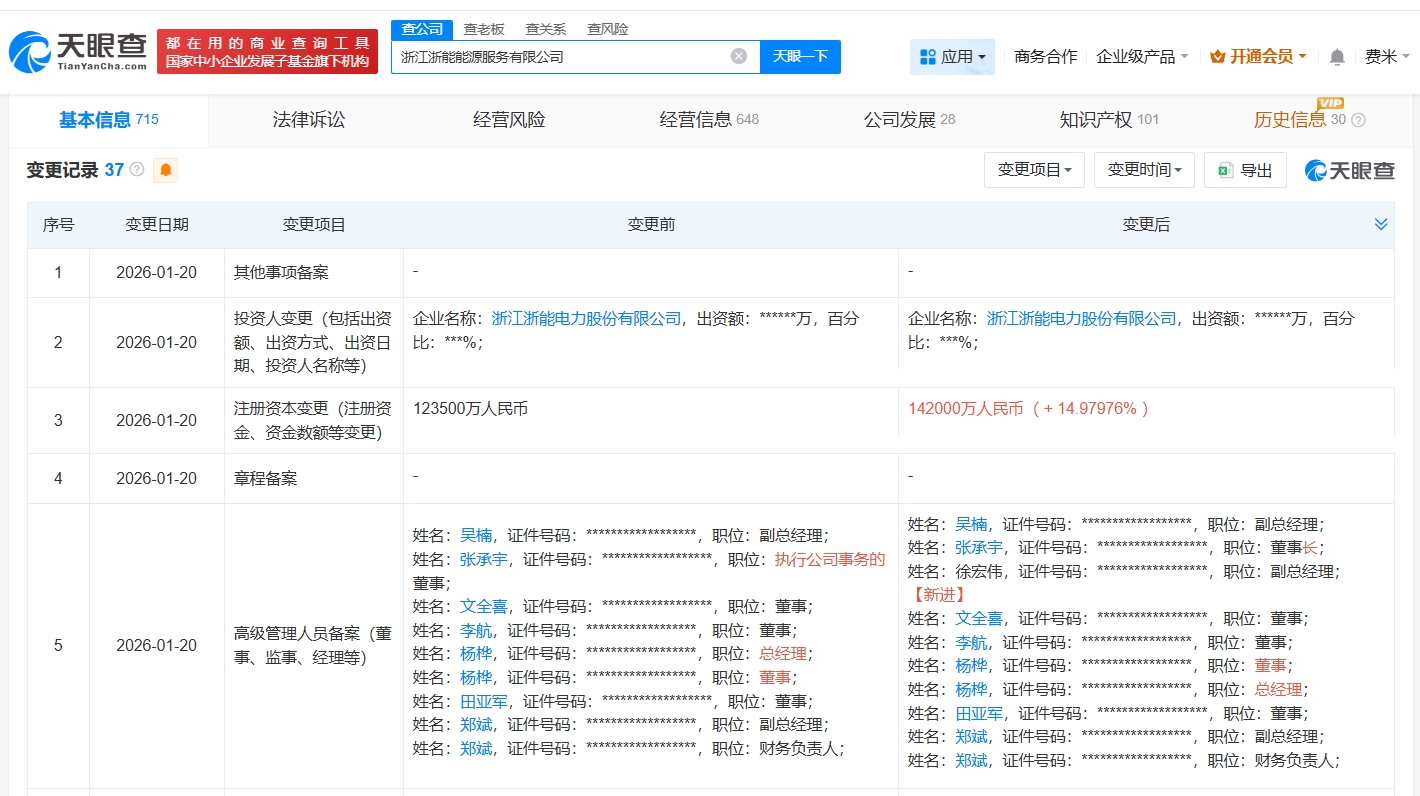
浙能电力旗下能源服务公司增资至14.2亿
2 1 Shi Ji Jing Ji Bao Dao· 2026-01-22 08:56
Core Viewpoint - Zhejiang Zheneng Energy Service Co., Ltd. has increased its registered capital from 1.235 billion RMB to 1.42 billion RMB, representing an approximate 15% increase, along with changes in key personnel [1][2]. Company Information - Zhejiang Zheneng Energy Service Co., Ltd. was established in February 2017 and is wholly owned by Zheneng Electric Power Co., Ltd. (stock code: 600023) [1][2]. - The company operates in various sectors including power supply, power generation, transmission, and distribution [1][2]. Capital Changes - The registered capital change reflects an increase from 1,235 million RMB to 1,420 million RMB, which is a growth of approximately 14.97% [2]. - The change in registered capital was officially recorded on January 20, 2026 [2]. Personnel Changes - Recent changes in key personnel include the appointment of new executives, although specific names and positions were not detailed in the summary [2].