
GYLS(600059)

Search documents
白酒股今日情绪爆发午后17股涨停 茅台大涨8.6%
Di Yi Cai Jing· 2026-01-29 08:29
Group 1 - The core viewpoint of the news is that the recent surge in liquor stocks, particularly in the white liquor sector, is attributed to a combination of capital seeking safety and changes in market sentiment [1][2] - On January 29, 17 white liquor stocks collectively hit the daily limit, with Kweichow Moutai rising by 8.61%. Other notable stocks like Wuliangye, Luzhou Laojiao, and Yanghe also reached their daily limits [1] - The performance of white liquor stocks has been poor since the third quarter of 2025, with many companies reporting significant declines in earnings growth. For instance, Jinzhongzi Liquor expects a net profit loss of 150 to 190 million yuan for 2025 [1] Group 2 - The collective rise in white liquor stocks is not closely related to the fundamentals of individual companies, as observed by Shen Meng from Xiangsong Capital. The strong performance of white liquor, resource, and banking stocks contrasts with the noticeable pullback in the technology and small-cap sectors [2] - The current bullish sentiment in the stock market is favorable for liquor consumption during the upcoming Spring Festival, contributing to optimistic investor sentiment [2] - Real estate stocks also experienced a collective surge due to news influences, highlighting the strong correlation between the liquor and real estate sectors [2]






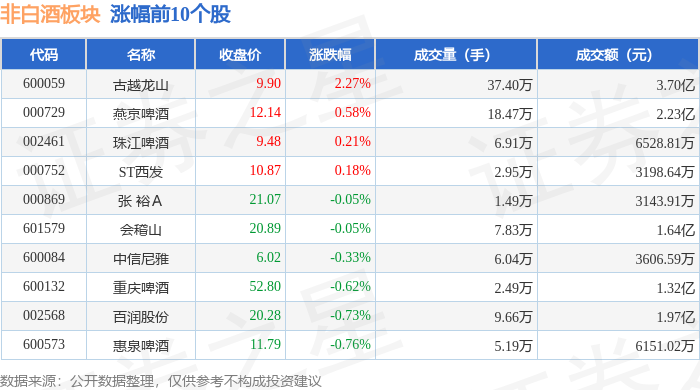
非白酒板块1月28日跌0.4%,*ST椰岛领跌,主力资金净流出3164.16万元
Zheng Xing Xing Ye Ri Bao· 2026-01-28 08:58
Market Overview - The non-white liquor sector experienced a decline of 0.4% compared to the previous trading day, with *ST Yedao leading the drop [1] - The Shanghai Composite Index closed at 4151.24, up 0.27%, while the Shenzhen Component Index closed at 14342.9, up 0.09% [1] Stock Performance - Notable gainers in the non-white liquor sector included: - Guyue Longshan (600059) with a closing price of 9.90, up 2.27% and a trading volume of 374,000 shares, totaling 370 million yuan [1] - Xianjing Beer (000729) closed at 12.14, up 0.58% with a trading volume of 184,700 shares, totaling 223 million yuan [1] - Conversely, *ST Yedao (600238) closed at 6.19, down 3.28% with a trading volume of 113,100 shares, totaling 70.73 million yuan [2] Capital Flow - The non-white liquor sector saw a net outflow of 31.64 million yuan from main funds, while retail funds experienced a net inflow of 63.59 million yuan [2] - The detailed capital flow for selected stocks showed: - Guyue Longshan had a main fund net outflow of 25.35 million yuan, with retail net outflow of 45.19 million yuan [3] - *ST Lanhua (000929) had a main fund net inflow of 5.45 million yuan, while retail funds saw a net inflow of 121.62 million yuan [3]


黄仁勋餐桌“出圈”背后 古越龙山多维度撬动黄酒高端市场
Zhong Zheng Wang· 2026-01-28 08:06
品牌传播方面,公司聚焦高端定位,强化"中国消费名品"等核心标签传播,深入挖掘并推广国家级非遗 酿造技艺,巩固"正宗黄酒标杆"的品牌认知。营销层面,以"百城共品古越龙山"为全年主线,联合中国 企业家俱乐部开展"名酒进名企""名酒进商会"等高端圈层品鉴活动,同时加大短视频等新媒体平台投放 力度,实现"品效合一"。值得关注的是,此次产品进入科技精英私宴场景,是公司产品在布局高端消费 场景过程中的一次重要突破,印证了其品牌在高净值人群中的认可度,就行业发展现状而言尤为难得。 中证报中证网讯(记者罗京)近期,英伟达创始人黄仁勋在沪私宴时饮用古越龙山(600059)黄酒的相关 照片经社交平台传播后,引发市场广泛关注,带动公司品牌及产品热度显著攀升。 黄酒承载着中国千年酿酒文化,但长期以来,行业面临消费场景固化、价格带偏低、"有品类无品牌"等 发展瓶颈,品牌价值未能充分释放。在此背景下,古越龙山近年推进的高端化、年轻化、全球化、数字 化"四化战略",成为其突破行业局限的核心路径,而此次事件的市场反响,也被视为其长期布局的阶段 性体现。 在产品端,古越龙山以年份酒为核心强化高端产品线布局,重点打造国酿、青花醉等系列产品。其核 ...
黄酒行业调研反馈报告:三问三答,黄酒复兴行至何方?
Huachuang Securities· 2026-01-26 06:26
Investment Rating - The report maintains a "Recommendation" rating for the yellow wine industry, expecting the industry index to rise more than 5% over the next 3-6 months compared to the benchmark index [17]. Core Insights - The yellow wine industry is entering a strategic opportunity period for revival, with companies like Kuaijishan achieving significant product innovation and market expansion, resulting in a stock price increase of over 85% in the year [5]. - The report highlights three key questions regarding the revival of yellow wine: 1. **High-end Product Development**: There has been a successful upgrade in product structure and pricing, with Kuaijishan and Guyuelongshan implementing price increases in April 2025, leading to improved dealer payment prices and expected growth rates exceeding 50% for key products [5]. 2. **Youth Market Engagement**: New product launches aimed at younger consumers have generated interest, but the repurchase rate remains low, indicating a need for further product optimization [5]. 3. **National Expansion**: The report notes that while regional expansion efforts are underway, particularly in Zhejiang and Jiangsu, the overall market penetration outside traditional areas remains slow [5]. - For 2026, both Kuaijishan and Guyuelongshan are expected to lead the industry with clear growth strategies, targeting double-digit growth and focusing on marketing and product optimization [5]. Summary by Sections Industry Basic Data - The yellow wine industry consists of 10 listed companies with a total market value of 752.55 billion and a circulating market value of 678.81 billion [2]. Relative Index Performance - The absolute performance over the last 12 months shows an increase of 11.2%, while the relative performance indicates a decline of 12.5% compared to the benchmark [3]. Research Reports - The report references a previous in-depth study on the yellow wine industry, emphasizing the strategic opportunities for revival and the positive feedback from market channels [5].

黄仁勋2026年首度来华,逛菜市场后聚会品“绍兴黄酒”
Xin Lang Cai Jing· 2026-01-25 12:23
Core Insights - Jensen Huang, the founder of NVIDIA, will visit China for the first time in 2026, with planned stops in Shanghai, Shenzhen, and Beijing [1][3] - Huang was seen enjoying a meal at a Michelin restaurant in Shanghai after visiting the Lujiazui Jinde Market, where he sampled a 20-year-old Shaoxing rice wine from Guyue Longshan [1][3] Company and Industry Summary - Huang's visit signifies NVIDIA's potential interest in expanding its presence in the Chinese market, which could lead to new partnerships or business opportunities [1][3] - The choice of a high-end Shaoxing wine during a formal dining experience reflects a cultural appreciation that may resonate with Chinese consumers and business partners, highlighting the importance of local customs in international business relations [1][3]


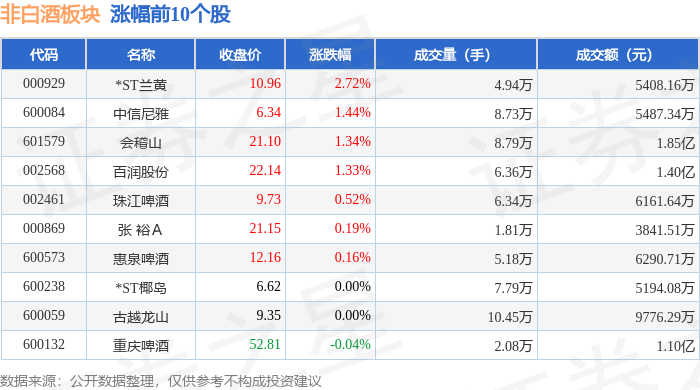
非白酒板块1月23日涨0.18%,*ST兰黄领涨,主力资金净流出2353.25万元
Zheng Xing Xing Ye Ri Bao· 2026-01-23 09:04
Core Viewpoint - The non-liquor sector experienced a slight increase of 0.18% on January 23, with *ST Lanhuang leading the gains, while the overall market indices also showed positive movement [1]. Group 1: Market Performance - The Shanghai Composite Index closed at 4136.16, up by 0.33% [1]. - The Shenzhen Component Index closed at 14439.66, up by 0.79% [1]. - The non-liquor sector stocks showed varied performance, with *ST Lanhuang rising by 2.72% to a closing price of 10.96 [1]. Group 2: Stock Performance - The top performers in the non-liquor sector included: - *ST Lanhuang: 10.96, +2.72%, trading volume of 49,400 shares, turnover of 54.08 million [1]. - Zhongxin Niya: 6.34, +1.44%, trading volume of 87,300 shares, turnover of 54.87 million [1]. - Huijuan Beer: 12.16, +0.16%, trading volume of 51,800 shares, turnover of 62.91 million [1]. - Conversely, stocks like Weilang Co. and ST Xifa saw declines of 2.12% and 1.88%, respectively [2]. Group 3: Capital Flow - The non-liquor sector experienced a net outflow of 23.53 million from institutional funds and 36.39 million from speculative funds, while retail investors contributed a net inflow of 59.92 million [2]. - Notable capital flows included: - Qingdao Beer: -35.13 million from institutional funds, with a retail outflow of -49.91 million [3]. - *ST Yedao: +5.45 million from institutional funds, with a retail inflow of +1.50 million [3].




古越龙山今日大宗交易平价成交74.9万股,成交额700.32万元
Xin Lang Cai Jing· 2026-01-22 09:40
| 交易日期 证券简称 | | 壬券代码 | 成交价(元) 成交盒额(万元) 成交量(*) 买入营业部 | | | 美出营业部 | 是否为专场 | | --- | --- | --- | --- | --- | --- | --- | --- | | 026-01-22 | 古越龙山 | 600059 | 9.35 700.32 | 74.9 74.9 | 用膏渣膏反蓋酸份 | 哥喬想讀愛愛臉的 | Ka | 1月22日,古越龙山大宗交易成交74.9万股,成交额700.32万元,占当日总成交额的6.54%,成交价9.35 元,较市场收盘价9.35元持平。 ...

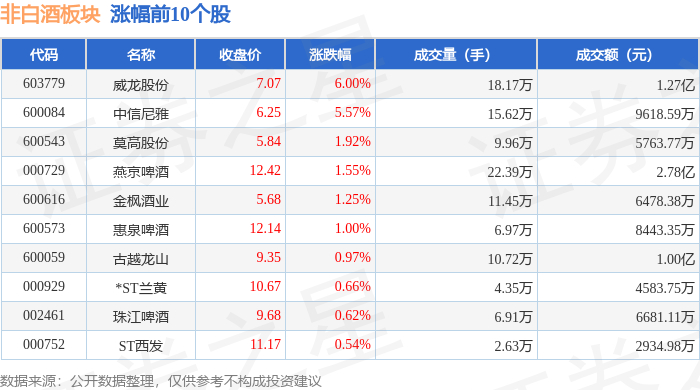
非白酒板块1月22日涨0.72%,威龙股份领涨,主力资金净流出1821.8万元
Zheng Xing Xing Ye Ri Bao· 2026-01-22 09:02
Core Viewpoint - The non-baijiu sector experienced a 0.72% increase on January 22, with Weilong Co., Ltd. leading the gains, while the Shanghai Composite Index rose by 0.14% and the Shenzhen Component Index increased by 0.5% [1] Group 1: Market Performance - The closing price of Weilong Co., Ltd. was 7.07, with a rise of 6.00% and a trading volume of 181,700 shares, amounting to a transaction value of 127 million yuan [1] - Other notable performers included CITIC Neya with a closing price of 6.25, up 5.57%, and Mogaoguan Co. at 5.84, up 1.92% [1] - The overall trading volume in the non-baijiu sector showed varied performance, with some stocks like Feike Beer and Jinfeng Wine also recording positive gains [1] Group 2: Capital Flow - The non-baijiu sector saw a net outflow of 18.218 million yuan from institutional investors and 35.8685 million yuan from retail investors, while there was a net inflow of 54.0864 million yuan from individual investors [2] - The capital flow data indicates that while institutional and speculative funds withdrew, retail investors were actively buying into the sector [2] Group 3: Individual Stock Analysis - Chongqing Beer experienced a net outflow of 16.9419 million yuan from institutional investors, while retail investors contributed a net inflow of 1.2597 million yuan [3] - Weilong Co., Ltd. had a net inflow of 14.4287 million yuan from institutional investors, but faced a net outflow of 1.19562 million yuan from retail investors [3] - Qingdao Beer saw a net inflow of 11.5279 million yuan from institutional investors, indicating strong institutional interest despite retail outflows [3]


黄酒从“江浙特产”到“全国潮饮”的进阶之路
Zheng Zhou Ri Bao· 2026-01-20 23:37
Core Insights - The yellow wine industry in China is experiencing a significant revival, with a notable increase in popularity among younger consumers and innovative product offerings [1][3][5] Industry Overview - The yellow wine sector is projected to achieve impressive results by 2025, with companies like Kuaijishan seeing a stock price increase of 90.15% in one year, making it a leader among liquor companies [1] - In 2024, there are nearly 800 yellow wine production enterprises in China, generating revenues of 20 billion yuan, a year-on-year growth of 5.26%, with a production volume of approximately 4 million tons, up 3.5% [2] Cultural and Consumer Trends - The resurgence of yellow wine is attributed to three key trends: the return of cultural value, the evolution of consumer demographics, and the explosion of the new beverage market [3][4] - The primary consumer base for yellow wine has shifted to younger generations, particularly those aged 25-30 and above, with a growing interest from the 18-24 age group [3] Product Innovation - Innovative products such as "one day one smoked sparkling yellow wine" and collaborations like "Yue Xiao Pi" between Guyue Longshan and China Resources Beer are redefining the market [5] - The introduction of low-alcohol, lightly sweet, and easy-to-drink products is aimed at attracting a broader audience, including younger consumers [5][6] Strategic Recommendations - To appeal to younger consumers, the industry must focus on brand expression, product form, and channel accessibility, utilizing modern marketing strategies and platforms [6][7] - The goal is to shift the perception of yellow wine from an "elderly drink" to a trendy beverage for all ages [6] Regional Development - The revival of yellow wine is not limited to traditional regions like Jiangsu and Zhejiang; new production hubs are emerging in Shanxi and Hubei, supported by local government policies [7] - In Shanxi, the establishment of a "yellow wine professional town" has led to a significant increase in production capacity and enterprise growth [7] Market Valuation and Future Outlook - The yellow wine industry is undergoing a value reassessment, with companies like Kuaijishan and Guyue Longshan trading at price-to-earnings ratios exceeding 35 times expected profits for 2026 [8] - The industry is expected to maintain sustainable growth if companies continue to invest in branding and focus on high-end and youthful market segments [8]
资本重新“酿”酒:黄酒能否讲出千亿故事
Jing Ji Guan Cha Bao· 2026-01-19 03:17
Core Viewpoint - The yellow wine sector is experiencing significant growth, with companies like Kuaijishan (601579) achieving remarkable stock price increases, while traditional liquor stocks are facing declines. The potential for the yellow wine industry to reach a market size of 100 billion is highlighted, driven by high-end, youthful, and nationwide strategies [1][2][12]. Group 1: Market Performance - Kuaijishan's stock surged by 90.15% in 2025, making it the top-performing liquor company, while major white liquor brands like Moutai and Wuliangye saw declines of -6.47% and -19.57% respectively [1][2]. - The yellow wine index recorded a 51.67% increase in the first five months of 2025, outperforming other liquor segments and popular concepts like humanoid robots and pet economy [1][2]. Group 2: Industry Dynamics - The market capitalization of Kuaijishan reached 9.86 billion, while Guyue Longshan (600059) was at 8.32 billion, still significantly lower than Moutai and Wuliangye [2]. - The yellow wine industry accounted for less than 2% of the total liquor market, with a production volume of approximately 4 million tons and sales of around 20 billion in 2024 [2][12]. Group 3: Strategic Changes - Kuaijishan and Guyue Longshan implemented significant price adjustments in April 2025, marking Kuaijishan's first major price increase since 2016, aimed at enhancing the industry's pricing structure [3][5]. - The sales revenue from mid-to-high-end products for Kuaijishan reached 1.065 billion in 2024, constituting 67.26% of its total revenue, while Guyue Longshan's mid-to-high-end sales were 1.398 billion, making up 73.36% [3][4]. Group 4: Consumer Trends - The consumer base for yellow wine is becoming increasingly younger, with 70% of users under 35 years old, indicating a shift in consumption patterns [4][5]. - The introduction of innovative products, such as sparkling yellow wine, has shown potential for breaking into new consumer markets, with significant sales growth during promotional events [4][6]. Group 5: Future Outlook - Analysts suggest that the yellow wine industry could realistically aim for a market size of 300 billion by 2025, with the potential for further growth if high-end products are successfully promoted [2][12]. - Despite the optimistic outlook, some analysts express caution, noting that achieving a 100 billion market size will require sustained innovation and the establishment of strong consumer scenarios [12][13].