
YTCO(600066)

Search documents
2026年汽车投资策略
2026-01-28 03:01
Summary of the Conference Call Industry Overview - The conference focused on the automotive industry, specifically strategies and forecasts for 2026, with a review of the automotive market from 2005 to 2025 [1][2]. Key Insights and Arguments 1. **Sales Growth and Valuation**: - Sales growth is a sufficient but not necessary condition for the valuation of the automotive sector to increase. Historical data shows that years with sales growth corresponded with rising valuations, but there were exceptions in years like 2012 and post-2020 [3]. - The automotive sector's valuation tends to respond approximately three months ahead of sales growth before 2020, and this response time has shortened to about one month post-2020 [3]. 2. **Comparison with 2018**: - The year 2026 is expected to mirror 2018, which also faced declining sales due to policy changes. In 2018, the automotive sector began to decline three months before sales dropped significantly [4][5]. 3. **Impact of Policy Changes**: - The introduction of a 5% purchase tax on new energy vehicles in 2026 and changes in subsidy structures are expected to impact demand negatively [1][2]. 4. **Investment Opportunities**: - The focus for 2026 is on new growth areas, particularly in smart driving technologies. Companies in this sector are seen as undervalued, with many trading below 30x P/E ratios while maintaining decent growth rates [7][8]. 5. **Low Valuation and High Growth Stocks**: - Several companies were highlighted as having strong growth potential while being undervalued, including: - **Mastec**: Estimated 20% growth in 2026 with a P/E of 15-16x [10]. - **Yatong**: Expected 30% growth with a P/E of around 20x [10]. - **Fuyou Glass**: Anticipated 15% growth with a P/E of about 15x [11]. - **Weichai Power**: Projected 15% growth with a similar P/E [11]. 6. **Sector-Specific Insights**: - Companies like **Desay SV** and **Kobota** are expected to see significant revenue growth due to their involvement with major clients like Li Auto and NIO, with projected revenues of 90 billion and 21 billion respectively for Q4 [17][21]. - **Huayang Group** is expected to maintain a growth rate of over 20% in 2026, driven by high-margin products [24]. Other Important but Overlooked Content - The conference also discussed the potential risks associated with rising raw material costs, particularly for companies in the forging sector, which could impact earnings realization [13]. - The importance of technological cycles, including the shift towards electric and smart vehicles, was emphasized as a key driver for future growth in the automotive sector [6][7]. - The discussion included a focus on the competitive landscape, with companies like Fuyou Glass expected to benefit from a more favorable market position as competitors exit [30][31]. Conclusion - The automotive industry is facing challenges due to policy changes and market dynamics, but there are significant investment opportunities in undervalued companies with strong growth potential, particularly in the smart driving and electric vehicle segments. The insights from the conference provide a comprehensive overview of the current state and future outlook of the automotive sector.


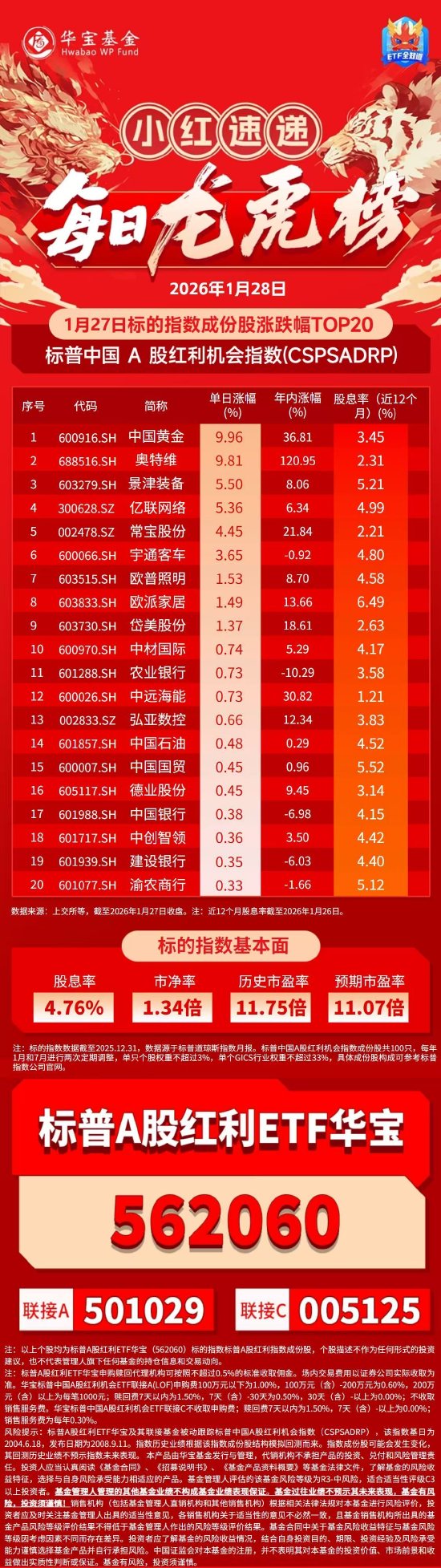
小红日报|止步场内六连阳,标普A股红利ETF华宝(562060)标的指数微跌收盘
Xin Lang Cai Jing· 2026-01-28 01:24
Group 1 - The article highlights the top 20 stocks in the S&P China A-Share Dividend Opportunity Index (CSPSADRP) based on their daily and year-to-date performance as of January 27, 2026 [1][5] - China Gold (600916.SH) leads with a daily increase of 9.96% and a year-to-date increase of 36.81%, with a dividend yield of 3.45% [1][5] - Aotewei (688516.SH) shows a remarkable year-to-date increase of 120.95%, with a daily increase of 9.81% and a dividend yield of 2.31% [1][5] Group 2 - The index's historical price-to-earnings ratio is reported at 4.76%, with an expected price-to-earnings ratio of 11.07 [2] - The dividend yield for the index over the past 12 months is noted as 1.34 times, indicating a strong return for investors [2] - The article mentions the formation of a MACD golden cross signal, suggesting positive momentum for the stocks listed [4][8]






汽车周洞察:汽车行业2025Q4基金持仓分析
Changjiang Securities· 2026-01-27 09:15
Investment Rating - The investment rating for the automotive industry is "Positive" and is maintained [9] Core Insights - In Q4 2025, the fund holding ratio in the automotive industry slightly increased to 4.35%, up by 0.02 percentage points from the previous quarter, indicating an overall overweight of 0.14% compared to the market capitalization of automotive stocks in A-shares [2][5] - The configuration ratio for automotive manufacturing decreased to 1.04%, down by 0.12 percentage points, while the configuration ratio for automotive parts increased to 3.31%, up by 0.14 percentage points [5] - The wholesale sales of passenger vehicles in Q4 2025 reached 8.846 million units, showing a year-on-year decrease of 0.3% but a quarter-on-quarter increase of 15.1% [5] Summary by Sections Market Performance - The A-share automotive sector increased by 2.15%, outperforming the CSI 300 index which decreased by 0.62% [28] - Among sub-sectors, commercial vehicle parts rose by 7.36%, while automotive sales and services fell by 5.74% [28] Fund Holdings - The top fifteen fund holdings in the automotive sector for Q4 2025 include Fuyao Glass, Slin Intelligent Drive, and Sailun Tire, with significant inflows into Slin Intelligent Drive and outflows from Jianghuai Automobile [6][17] Investment Recommendations - The report emphasizes three main investment themes: 1. Overseas expansion with recommendations for companies like Minth Group and BYD 2. High-end passenger vehicles and parts with a focus on companies like Geely and Ideal Automotive 3. Embracing AI technology with recommendations for companies like Top Group and Xpeng Motors [7][22][23]




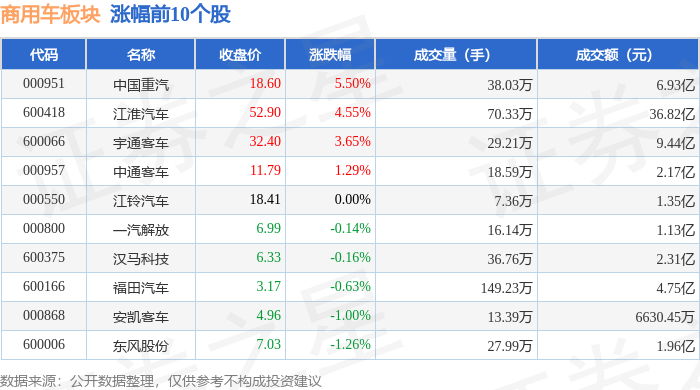
商用车板块1月27日涨2.28%,中国重汽领涨,主力资金净流入5319.84万元
Zheng Xing Xing Ye Ri Bao· 2026-01-27 08:49
Core Viewpoint - The commercial vehicle sector experienced a rise of 2.28% on January 27, with China National Heavy Duty Truck leading the gains, while the Shanghai Composite Index increased by 0.18% and the Shenzhen Component Index rose by 0.09% [1]. Group 1: Market Performance - The commercial vehicle sector's stocks showed varied performance, with China National Heavy Duty Truck closing at 18.60, up by 5.50%, and Jianghuai Automobile at 52.90, up by 4.55% [1]. - The trading volume for Jianghuai Automobile was 703,300 shares, resulting in a transaction value of 3.682 billion yuan [1]. - Other notable performers included Yutong Bus, which rose by 3.65% to close at 32.40, and Zhongtong Bus, which increased by 1.29% to 11.79 [1]. Group 2: Capital Flow - The commercial vehicle sector saw a net inflow of 53.1984 million yuan from institutional investors, while retail investors contributed a net inflow of 78.1087 million yuan [2]. - Conversely, speculative funds experienced a net outflow of 131 million yuan [2]. - The capital flow data indicates that Jianghuai Automobile had a significant net inflow of 91.0266 million yuan from institutional investors, while Foton Motor faced a net outflow of 155.29 million yuan from speculative funds [3].



东风超2500辆夺冠!重汽暴涨33倍 广汽追陕汽!2025氢能重卡榜单来了| 头条
第一商用车网· 2026-01-27 01:42
Core Viewpoint - In December 2025, China's new energy heavy truck sales reached a record high, totaling 231,100 units for the year, representing a year-on-year growth of 182% [1] Group 1: Overall Market Performance - In December 2025, domestic new energy heavy trucks sold 45,300 units, a year-on-year increase of 198%, with pure electric, fuel cell, and hybrid models selling 40,800 units, 4,202 units, and 284 units respectively [2] - The sales growth for fuel cell and hybrid heavy trucks significantly outpaced the overall market, with fuel cell trucks experiencing a year-on-year growth of 623% and hybrid trucks 209% [2][4] - The market for fuel cell and hybrid heavy trucks showed a notable increase in December, with fuel cell trucks accounting for 9.28% of the market share, while hybrid trucks remained low at 0.63% [5] Group 2: Fuel Cell Heavy Truck Performance - In December 2025, fuel cell heavy trucks sold 4,202 units, with a month-on-month growth of 610% and a year-on-year growth of 623%, marking a significant surge in both sales and growth rate [8] - Dongfeng led the sales with 1,592 units, capturing a market share of 37.9%, followed by Yutong and Sinotruk with 625 and 463 units respectively [10] - The competition for monthly sales champions in the fuel cell heavy truck market was intense, with Dongfeng securing the year-end sales champion after consistently leading since September [12] Group 3: Yearly Performance and Market Share - In 2025, the fuel cell heavy truck market saw a total sales volume of 7,282 units, a year-on-year increase of 64%, with significant growth from companies like Sinotruk and GAC, which saw increases of 3,294% and 16,650% respectively [14][17] - Dongfeng achieved the highest annual sales with 2,563 units, capturing a market share of 35.2%, an increase of 19.7 percentage points from 2024 [17] - The market dynamics showed a pattern of fluctuations throughout the year, with a total of five monthly champions emerging, indicating a highly competitive environment [17]




中国商用车天空中,弥漫着说不出来的紧张感
汽车商业评论· 2026-01-26 23:27
Core Viewpoint - The commercial vehicle industry in China is experiencing a paradox of increasing sales but declining profits, driven by intense competition and a shift towards new energy vehicles [8][10][29]. Group 1: Market Overview - In 2025, the commercial vehicle market in China achieved a total sales volume of 4.296 million units, representing a year-on-year growth of 10.9% [8]. - The heavy truck market, often seen as a barometer of economic activity, sold 1.145 million units, up 27% year-on-year, indicating a recovery in demand [13]. - Despite the growth in sales, the profitability of leading companies has declined, with a total net profit of only 25.74 billion yuan for seven major manufacturers, down 40% year-on-year [13][14]. Group 2: Profitability Challenges - The industry faces a "sell more, earn less" scenario, where increased sales do not translate into higher profits due to price wars and compressed margins [9][24]. - The logistics sector is experiencing a supply-demand imbalance, with the average freight rate index at a historical low of 105.1 points, leading to significant drops in transport fees [17][19]. - The cost of traditional fuel vehicles remains high compared to new energy vehicles, which are driving down market prices and squeezing profit margins for traditional operators [20][22]. Group 3: Transition to New Energy - The penetration rate of new energy commercial vehicles exceeded 25% in 2025, with a total of 95.4 million units sold, marking a 63.7% increase year-on-year [42]. - Companies like Foton Motor have successfully adapted to the new energy landscape, achieving a revenue increase of 27.1% and a net profit surge of 157.4% [41]. - The transition to new energy and smart technologies is seen as essential for future profitability, although the initial costs remain high [25][27]. Group 4: Competitive Landscape - The market is increasingly dominated by a few leading companies, with over 70% market share held by top players like Beiqi Foton and China National Heavy Duty Truck [31]. - Successful companies are leveraging strategic positioning, policy alignment, and market responsiveness to navigate the competitive landscape [34][36]. - The focus is shifting from volume growth to refined competition, emphasizing the importance of understanding market dynamics and customer needs [54]. Group 5: Future Outlook - The commercial vehicle industry must transition from a reliance on one-time sales to a focus on long-term value creation through lifecycle services [56][70]. - Companies are setting ambitious sales targets for 2026, with major players like FAW Jiefang and China National Heavy Duty Truck aiming for significant increases in sales volume [56][59]. - The key to success in 2026 will be the ability to harness policy support, technological advancements, and a focus on customer-centric service models [60][73].





宇通1.7万辆霸榜 金龙/海格大涨 安凯杀疯!2025客车出口超7.8万辆 | 头条
第一商用车网· 2026-01-26 06:59
Core Viewpoint - In December 2025, China's bus exports reached a record high, with total exports exceeding 10,000 units for the first time, marking a significant year-end surge in the industry [1][4]. Export Performance - In 2025, a total of 78,313 buses were exported, a 26.68% increase from 61,820 units in 2024 [1][11]. - December 2025 saw exports of 11,975 buses, a year-on-year increase of 63.73% and a month-on-month increase of 112.51% [1][4]. Market Segmentation - All segments (large, medium, and light buses) experienced significant growth in December 2025, with large buses exporting 5,070 units (up 35.89%), medium buses 4,028 units (up 214.44%), and light buses 2,877 units (up 24.98%) [3][4]. - The overall export volume in December was nearly double that of November, indicating a strong recovery after two months of decline [4][8]. Company Rankings - Yutong Bus led the export rankings with 17,149 units, a 22.49% increase from 14,000 units in 2024 [10][11]. - Xiamen Jinlong followed with 12,255 units, a remarkable 64.90% increase, while Ankai Bus saw a dramatic rise of 152.84% to 5,034 units [10][12]. Segment Leaders - In the seating bus category, Xiamen Jinlong topped the list with 9,953 units exported, a 57.63% increase, while Yutong followed with 8,392 units [17][18]. - For public buses, Yutong also led with 8,460 units, a 37.61% increase, followed by BYD with 4,173 units [26][27]. Future Outlook - The bus export market is expected to remain strong in 2026, with potential for further growth as the industry recovers from previous declines [8][29].
汽车行业周报:政策托底静待反弹,关注海外电动化
Guoyuan Securities· 2026-01-26 06:24
Investment Rating - The report maintains a "Recommended" investment rating for the automotive industry [6] Core Insights - The automotive market is experiencing significant negative growth, with retail sales of passenger vehicles dropping by 28% year-on-year in the first half of January 2026, and wholesale sales declining by 35% [1][19] - The report emphasizes the need for supportive policies to stimulate market recovery and highlights the potential for growth in the overseas electric vehicle market due to favorable policies in countries like Canada and Germany [3][4] - The report suggests that the domestic market may rebound following the implementation of supportive policies, which could positively impact leading brands [4] Summary by Sections Market Overview - As of January 1-18, 2026, retail sales of passenger vehicles in China reached 679,000 units, a decrease of 28% compared to the same period last year, while wholesale sales totaled 740,000 units, down 35% year-on-year [1][19] - In the same period, retail sales of new energy vehicles were 312,000 units, reflecting a 16% decline year-on-year, and wholesale sales were 348,000 units, down 23% [1][19] Policy Developments - Canada announced plans to import 49,000 electric vehicles from China, significantly reducing tariffs from 100% to 6.1% [3] - Germany introduced a new subsidy program for electric vehicles, offering up to 6,000 euros to families purchasing new electric cars, effective from January 1, 2026 [3][44] - The UK government has launched a substantial subsidy program for electric trucks, with a total budget of 318 million pounds [48] Investment Opportunities - The report highlights the potential for Chinese new energy vehicles to expand into overseas markets, driven by favorable international policies [4] - It suggests that the recovery of the domestic automotive market could benefit leading brands significantly [4]




当200余种车型被机器人接管后 记者直呼“找不到人”
Xin Lang Cai Jing· 2026-01-25 09:58
【当200余种车型被机器人接管后 记者直呼"找不到人"】#河南宇通200余种车型被机器人接管#近日, 河南。一进到这个工厂里(宇通型材下料智能加工车间),@大象新闻 记者发现根本就看不到工人, 全是机器在干活!22.5米跨度智能天车,每分钟跑140米,10万余种物料全自动化加工。400多台焊接机 器人,30秒完成一个焊缝焊接,承担200多种车型制造。宇通客车自动化工程师马明亮介绍:相比以 前,我们的加工速率提升了15%,库存交货时间缩短了20%。#新河南新高地##智创新未来# (来源:猛犸新闻) ...

汽车行业周报:补贴政策变化致25Q4翘尾现象消失,对26年需求透支有所减少-20260125
GF SECURITIES· 2026-01-25 09:48
Investment Rating - The report provides a "Buy" rating for several companies in the automotive sector, indicating an expected performance that will exceed the market by more than 10% over the next 12 months [5][22]. Core Insights - The change in subsidy policies has led to the disappearance of the tail effect in Q4 2025, resulting in a reduction of demand overdraw for 2026. In December 2025, the number of insured vehicles was 2.278 million, down 16.4% year-on-year but up 13.6% month-on-month. The total number of insured vehicles for the year reached 23.047 million, a slight increase of 0.6% year-on-year, with the penetration rate of new energy vehicles rising to 54.0%, an increase of 7.1 percentage points year-on-year [4][7][16]. Summary by Sections 1. Changes in Subsidy Policies - The report highlights that the changes in subsidy policies have caused consumers to adopt a wait-and-see approach, leading to a decrease in demand overdraw for 2026. The expectation is that as replacement subsidy application channels open, pent-up demand will materialize, and the domestic terminal market will trend towards "price increase and stable volume" [4][7]. 2. PHEV Market Share Tracking - The focus is on the performance of PHEV market shares, particularly for BYD and Geely, as the "mid-level assisted driving equity" leads to share differentiation. The report emphasizes the importance of monitoring configuration adjustments and terminal discount changes to understand further market share differentiation [9][16]. 3. Recent Report Insights - The report notes that the passenger vehicle inventory saw a slight reduction in December 2025, with an estimated 1.5 million vehicles in demand waiting to be fulfilled. The overall industry theme for 2025 was "emerging from deflation," with a judgment of "stable volume and slow price increase" being validated. The outlook for 2026 remains "price increase and stable volume," differing from market consensus due to regulatory changes and risk-return assessments [16][17]. 4. Investment Recommendations - The report suggests a "shelf-style" investment approach, recommending various companies across the passenger vehicle chain. Right-side targets include Geely, BYD, and others, while left-side targets include Great Wall Motors and Changan Automobile. In the commercial vehicle chain, recommended companies include China National Heavy Duty Truck Group and Weichai Power [17].


