
TBEA(600089)

Search documents
深化产融结合 多晶硅期货服务光伏产业链企稳升级
Zhong Guo Zheng Quan Bao· 2026-01-23 20:57
为确保期货市场与实体产业高效对接,广期所在多晶硅期货合约设计中采用注册品牌交割制度,并对交 割品质量标准设定进行了详尽调研,以满足上下游企业产销需求。 广发期货分析师纪元菲表示,多晶硅生产企业产能较为集中,行业内的贸易对品牌声誉、质量标准较为 重视,具备品牌管理基础。同时,品牌交割制度有利于保障产业客户的需求,进一步确保入库商品质量 的可追溯性与一致性。 ● 本报记者王超 作为服务实体经济的重要金融工具,多晶硅期货上市已满一周年,在稳定光伏产业链、优化行业生态方 面发挥了不容忽视的作用。作为光伏产业链的核心原材料,当前多晶硅仍面临供需阶段性错配、价格大 幅波动的风险。期货工具的引入,为产业企业提供了重要的价格"晴雨表"和风险"防护垫",为整个光伏 行业平滑周期波动、管理风险、转型升级持续注入力量。 服务国家战略契合产业迫切需求 在"硅料-硅片-电池片-组件"组成的光伏产业链中,多晶硅位于上游,是决定光伏产品性能与成本的核心 环节。中国作为多晶硅全球最大的生产国和消费国,已建立起全球领先的产业优势。然而,近年来其价 格受产业周期、技术迭代等多重因素影响波动显著,给上下游企业的稳定经营带来挑战。数据显示, 202 ...



83股特大单净流入超2亿元
Xin Lang Cai Jing· 2026-01-23 13:11
Group 1 - The core point of the article highlights significant net inflows and outflows of capital in specific stocks, indicating investor interest and market trends [1] Group 2 - Longi Green Energy leads with a net inflow of 2.654 billion, the highest among stocks [1] - Aerospace Electronics follows with a net inflow of 2.423 billion, ranking second [1] - Other notable stocks with high net inflows include Goldwind Technology, Lens Technology, and China Satellite [1] Group 3 - On the outflow side, TBEA shows the largest net outflow of 3.335 billion [1] - NewEase and Zhongji Xuchuang have net outflows of 2.913 billion and 2.625 billion, ranking second and third respectively [1]




——煤炭行业2025年年报业绩前瞻:下半年煤价及行业利润边际改善,煤价筑底、盈利回升可期
Shenwan Hongyuan Securities· 2026-01-23 11:54
Investment Rating - The report maintains a positive outlook on the coal industry, suggesting an "Overweight" rating, indicating that the industry is expected to outperform the overall market [22]. Core Insights - The coal industry is anticipated to see a recovery in prices and profits in the second half of 2025, driven by seasonal demand and improved market conditions [1]. - Domestic raw coal production is projected to grow slightly by 1.2% year-on-year in 2025, while coal imports are expected to decline by 9.6% [2][11]. - The fourth quarter of 2025 is expected to witness a significant rebound in both thermal coal and coking coal prices, with thermal coal prices rising approximately 13.9% quarter-on-quarter [2][15]. Summary by Sections Supply and Demand Dynamics - Domestic raw coal production for 2025 is estimated at 4.832 billion tons, reflecting a year-on-year increase of 1.2%. Monthly production figures for October, November, and December are projected at 407 million, 427 million, and 437 million tons, respectively, with slight declines in growth rates [5]. - Coal imports for 2025 are expected to total 490 million tons, a decrease of 9.6% compared to the previous year, with notable monthly fluctuations in the last quarter [11]. Price Trends - In Q4 2025, the average spot price for thermal coal at Qinhuangdao port is projected to be around 767 RMB/ton, down 6.99% year-on-year but up 13.9% from Q3 2025 [14][15]. - Coking coal prices are also expected to rise, with the average price for Shanxi's main coking coal reaching 1,727 RMB/ton, marking a 0.8% increase year-on-year and a 10.44% increase from Q3 2025 [15]. Company Performance Forecasts - Key companies in the coal sector are expected to report varying performance in Q4 2025. China Shenhua is projected to achieve a net profit of 14.129 billion RMB, a year-on-year increase of 12.16% [16]. - Other companies such as TBEA and Erdos are also expected to show significant profit growth, while companies like Shaanxi Coal and Energy may see declines due to price pressures [16]. Valuation Metrics - The report includes a valuation table for key coal companies, indicating their expected earnings per share (EPS) and price-to-earnings (PE) ratios for 2025 and beyond, providing insights into their market positioning [17].



煤炭行业2025年年报业绩前瞻:下半年煤价及行业利润边际改善,煤价筑底、盈利回升可期
Shenwan Hongyuan Securities· 2026-01-23 10:41
Investment Rating - The report maintains a positive outlook on the coal industry, indicating a "Look Forward" investment rating for 2025 [2]. Core Insights - The report highlights a slight increase in domestic raw coal production in 2025, with a year-on-year growth of 1.2%, reaching 4.832 billion tons. However, coal imports are expected to decline by 9.6% to 490 million tons [3][8]. - In Q4 2025, both thermal coal and coking coal prices are projected to rebound significantly, with thermal coal prices increasing by approximately 13.9% from Q3 2025 [3][20]. - Key companies in the coal sector are expected to show varied performance in Q4 2025, with some exceeding expectations, while others may fall short [3][21]. Summary by Sections Supply and Demand Dynamics - Domestic raw coal production growth is slowing, with a total output of 4.832 billion tons in 2025, reflecting a 1.2% increase from 2024. Monthly production figures for October, November, and December show slight declines [3][8]. - Coal imports are projected to decrease to 490 million tons in 2025, a 9.6% drop compared to the previous year, with significant monthly fluctuations noted in Q4 [15][16]. Price Trends - Q4 2025 sees a notable increase in both thermal and coking coal prices, with the average price of Qinhuangdao port's 5500 kcal thermal coal at approximately 767 CNY/ton, a 13.9% increase from Q3 2025 [3][20]. - Coking coal prices are also on the rise, with the average price for Shanxi's main coking coal reaching 1727 CNY/ton, marking a 10.44% increase from Q3 2025 [20]. Company Performance Forecasts - Six companies are expected to exceed profit expectations in Q4 2025, including China Shenhua, TBEA, and others, with projected profits showing significant year-on-year growth [3][21]. - Ten companies are anticipated to meet expectations, while one company, Shaanxi Black Cat, is expected to underperform [3][21]. Investment Recommendations - The report suggests focusing on growth-oriented thermal coal companies such as TBEA and Jinkong Coal, as well as stable dividend-paying companies like China Shenhua and Shaanxi Coal [3][21].



主力动向:1月23日特大单净流入86.65亿元
Zheng Quan Shi Bao Wang· 2026-01-23 10:24
Market Overview - The net inflow of large orders in the two markets reached 8.665 billion yuan, with 83 stocks seeing net inflows exceeding 200 million yuan, led by Longi Green Energy with a net inflow of 2.654 billion yuan [1][2] - The Shanghai Composite Index closed up 0.33%, with a total of 2,408 stocks experiencing net inflows and 2,576 stocks seeing net outflows [1] Industry Performance - Among the 13 industries with net inflows, the power equipment sector had the highest net inflow of 13.781 billion yuan, with an index increase of 3.50% [1] - The defense and military industry followed with a net inflow of 4.370 billion yuan and a rise of 2.65% [1] - Other notable sectors with significant inflows included non-ferrous metals and media [1] Individual Stock Performance - Longi Green Energy led the net inflow rankings with 2.654 billion yuan, followed by Aerospace Electronics with 2.423 billion yuan [2] - Other top stocks with significant inflows included Goldwind Technology, Lens Technology, and China Satellite [2] - Stocks with net outflows were led by TBEA with a net outflow of 3.335 billion yuan, followed by NewEase and Zhongji Xuchuang with outflows of 2.913 billion yuan and 2.625 billion yuan, respectively [2][4] Stock Price Movements - Stocks with net inflows exceeding 200 million yuan saw an average increase of 9.90%, outperforming the Shanghai Composite Index [2] - Notable stocks that closed at their daily limit included Meichang Co. and Qianzhao Optoelectronics [2] Detailed Stock Data - Top stocks with net inflows: - Longi Green Energy: 19.35 yuan, +10.01%, 2.654 billion yuan, Power Equipment [2] - Aerospace Electronics: 31.46 yuan, +10.00%, 2.423 billion yuan, Defense and Military [2] - Goldwind Technology: 29.58 yuan, +10.00%, 2.097 billion yuan, Power Equipment [2] - Top stocks with net outflows: - TBEA: 28.55 yuan, -1.21%, -3.335 billion yuan, Power Equipment [4] - NewEase: 383.02 yuan, -6.51%, -2.913 billion yuan, Communication [4] - Zhongji Xuchuang: 585.00 yuan, -5.80%, -2.625 billion yuan, Communication [4]


数据复盘丨钙钛矿电池、商业航天等概念走强 191股获主力资金净流入超1亿元




Zheng Quan Shi Bao Wang· 2026-01-23 09:56
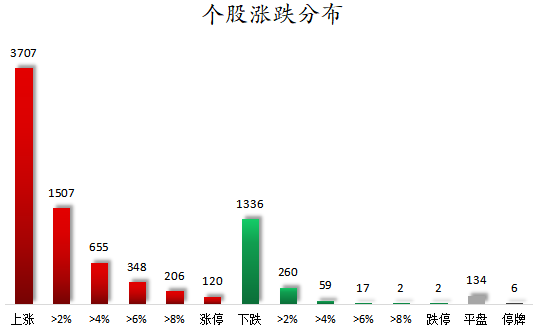
Market Overview - The Shanghai Composite Index closed at 4136.16 points, up 0.33%, with a trading volume of 1.3369 trillion yuan. The Shenzhen Component Index rose 0.79% to 14439.66 points, with a trading volume of 1.7484 trillion yuan. The ChiNext Index increased by 0.63% to 3349.50 points, with a trading volume of 822.63 billion yuan. The STAR Market 50 Index closed at 1553.71 points, up 0.78%, with a trading volume of 110.8 billion yuan. The total trading volume of both markets was 3.0853 trillion yuan, an increase of 393.5 billion yuan compared to the previous trading day [1]. Sector Performance - The market saw more sectors gaining than losing, with notable increases in power equipment, non-ferrous metals, precious metals, defense and military, steel, media, computer, environmental protection, and textile and apparel sectors. Concepts such as perovskite batteries, commercial aerospace, satellite internet, sapphire, lithium mining, cultivated diamonds, small metals, gold, and interactive short dramas were particularly active. In contrast, sectors like communication, insurance, banking, coal, and home appliances experienced declines [1]. Individual Stock Performance - A total of 3707 stocks rose, while 1336 stocks fell, with 134 stocks remaining flat and 6 stocks suspended. Excluding newly listed stocks, there were 120 stocks hitting the daily limit up and 2 stocks hitting the limit down [2]. - Among the stocks that hit the daily limit up, 23 stocks had consecutive limit-up days of 2 or more, with Fenglong Co., Ltd. leading with 18 consecutive limit-ups [3]. Capital Flow - The net capital outflow from the two markets was 4.167 billion yuan, with the ChiNext seeing a net inflow of 1.515 billion yuan. The CSI 300 index experienced a net outflow of 1.005 billion yuan, while the STAR Market saw a net outflow of 3.171 billion yuan. Out of 31 sectors, 13 sectors had net capital inflows, with the power equipment sector leading with a net inflow of 8.977 billion yuan [4][6]. - The top sectors with net inflows included non-ferrous metals (4.552 billion yuan), media (2.173 billion yuan), and defense and military (2.157 billion yuan). Conversely, the communication sector had the highest net outflow of 7.992 billion yuan, followed by electronics (6.350 billion yuan) and machinery (5.077 billion yuan) [4][6]. Notable Stocks - 191 stocks had net capital inflows exceeding 1 billion yuan, with Jin Feng Technology receiving the highest net inflow of 1.861 billion yuan. Other notable stocks included Lens Technology (1.594 billion yuan), Qian Zhao Optoelectronics (1.267 billion yuan), and Xian Dao Intelligent (1.217 billion yuan) [7][8]. - Conversely, 116 stocks experienced net capital outflows exceeding 1 billion yuan, with Xin Yi Sheng leading with a net outflow of 3.471 billion yuan, followed by Zhong Ji Xu Chuang (3.103 billion yuan) and Li Ou Shares (2.604 billion yuan) [10][11]. Institutional Activity - Institutional investors had a net selling of approximately 1.02 billion yuan, with 22 stocks seeing net purchases and 14 stocks net sales. Jin Feng Technology was the most purchased stock by institutions, with a net purchase amount of approximately 266 million yuan [13][14].

123.23亿元主力资金今日抢筹电力设备板块
Zheng Quan Shi Bao Wang· 2026-01-23 09:36
资金面上看,两市主力资金全天净流出85.76亿元,今日有12个行业主力资金净流入,电力设备行业主 力资金净流入规模居首,该行业今日上涨3.50%,全天净流入资金123.23亿元,其次是有色金属行业, 日涨幅为2.73%,净流入资金为54.32亿元。 沪指1月23日上涨0.33%,申万所属行业中,今日上涨的有23个,涨幅居前的行业为电力设备、有色金 属,涨幅分别为3.50%、2.73%。电力设备行业位居今日涨幅榜首位。跌幅居前的行业为通信、银行, 跌幅分别为1.52%、0.90%。 主力资金净流出的行业有19个,电子行业主力资金净流出规模居首,全天净流出资金130.25亿元,其次 是通信行业,净流出资金为69.11亿元,净流出资金较多的还有机械设备、公用事业、建筑装饰等行 业。 电力设备行业今日上涨3.50%,全天主力资金净流入123.23亿元,该行业所属的个股共365只,今日上涨 的有313只,涨停的有28只;下跌的有51只。以资金流向数据进行统计,该行业资金净流入的个股有201 只,其中,净流入资金超亿元的有51只,净流入资金居首的是隆基绿能,今日净流入资金27.62亿元, 紧随其后的是金风科技、先导智能, ...



两市主力资金净流出85.76亿元,创业板资金净流入
Zheng Quan Shi Bao Wang· 2026-01-23 09:31
资金面上,今日主力资金全天净流出85.76亿元。其中,创业板主力资金净流入25.34亿元;科创板主力 资金净流出29.26亿元;沪深300成份股主力资金净流出219.64亿元。 1月23日,沪指上涨0.33%,深成指上涨0.79%,创业板指上涨0.63%,沪深300指数下跌0.45%。可交易 A股中,上涨的有3941只,占比72.09%,下跌的1390只。 行业资金流向方面,今日有12个行业主力资金净流入,电力设备行业主力资金净流入规模居首,该行业 今日上涨3.50%,全天净流入资金123.23亿元,其次是有色金属行业,日涨幅为2.73%,净流入资金为 54.32亿元。 (文章来源:证券时报网) 主力资金净流出的行业有19个,电子行业主力资金净流出规模居首,今日上涨0.31%,全天净流出资金 130.25亿元,其次是通信行业,今日跌幅为1.52%,净流出资金为69.11亿元,净流出资金较多的还有机 械设备、公用事业、建筑装饰等行业。 今日各行业资金流向 | 行业 | 日涨跌幅(%) | 资金流向(亿元) | 行业 | 日涨跌幅(%) | 资金流向(亿元) | | --- | --- | --- | --- | ...

新能源ETF(516160)强势拉升涨超3%,政策+资本双轮驱动,新能源全产业链迎发展新机遇
Xin Lang Cai Jing· 2026-01-23 02:03
Core Viewpoint - The renewable energy sector is experiencing positive momentum driven by supportive government policies and increasing demand in electric vehicles and energy storage [1][2][3] Group 1: Market Performance - The New Energy ETF (516160) rose by 3.02%, with a trading volume of 906.94 million yuan [1] - Key stocks in the index, such as Maiwei Co., Ltd. and Laplace, saw significant gains of 20.00% and 19.62% respectively [1] Group 2: Government Policies - On January 20, the Ministry of Finance released five documents outlining a package of favorable policies to support small and medium enterprises, private investment, and equipment upgrades [1] - Key focus areas for support include energy power, new energy vehicles, energy conservation, and small hydropower [1] Group 3: Industry Trends - The electric vehicle and energy storage sectors are entering a new growth cycle, with several automakers announcing ambitious sales targets for 2026 [2] - Global lithium battery production is projected to reach 2,297 GWh by 2025, marking a 48.5% year-on-year increase, with power batteries being the main growth driver [2] - CATL and Changan Automobile signed a five-year strategic cooperation memorandum focusing on advanced fields such as battery swapping and smart vehicles [2] Group 4: Supply Chain Dynamics - The supply and demand for lithium carbonate are expected to remain favorable, with China's production projected to reach 976,300 tons by 2025, a 49% increase [2] - A recent investment of 3.688 billion yuan by a major mining company aims to produce approximately 80,000 tons of lithium carbonate annually [2] Group 5: Technological Advancements - The solid-state battery sector is entering a critical phase of engineering and industrialization, with recent tests being conducted in extreme cold conditions [2] - The State Grid announced a fixed asset investment of 4 trillion yuan for the 14th Five-Year Plan period (2026-2030), a 40% increase from the previous period, aimed at achieving carbon peak by 2030 [3] - The integration of AI in manufacturing is being promoted to enhance productivity and support new industrialization [3] Group 6: Index Composition - The New Energy Index includes companies involved in renewable energy production, application, storage, and interaction devices, with the top ten weighted stocks accounting for 43.23% of the index [3]





电力设备行业资金流出榜:宁德时代等25股净流出资金超亿元
Zheng Quan Shi Bao Wang· 2026-01-22 09:25
Market Overview - The Shanghai Composite Index rose by 0.14% on January 22, with 22 out of the 28 sectors experiencing gains. The top-performing sectors were building materials and defense, with increases of 4.09% and 3.23% respectively. Conversely, the beauty care and banking sectors saw declines of 0.76% and 0.43% respectively [1] Capital Flow Analysis - The main capital flow showed a net outflow of 21.612 billion yuan across the two markets. However, 12 sectors experienced net inflows, with the telecommunications sector leading at a net inflow of 8.019 billion yuan and a daily increase of 2.83%. The defense sector also performed well, with a net inflow of 5.713 billion yuan and a daily increase of 3.23% [1] Electric Power Equipment Sector Performance - The electric power equipment sector declined by 0.11%, with a net outflow of 7.206 billion yuan. Out of 365 stocks in this sector, 188 rose, 172 fell, and 4 hit the daily limit up while 1 hit the limit down. Notably, 128 stocks had net inflows, with 12 stocks receiving over 100 million yuan in net inflows, led by KOTAI Power with 431 million yuan [2] Top Gainers in Electric Power Equipment - The top gainers in the electric power equipment sector included: - KOTAI Power: +11.20%, 21.69% turnover, 431.07 million yuan inflow - LONGi Green Energy: +2.15%, 2.53% turnover, 353.53 million yuan inflow - Zhongchao Holdings: +10.04%, 4.61% turnover, 353.51 million yuan inflow [2] Top Losers in Electric Power Equipment - The top losers in the electric power equipment sector included: - CATL: -1.15%, 1.08% turnover, -1.444 billion yuan outflow - TBEA: -2.36%, 8.66% turnover, -991 million yuan outflow - Sungrow Power: -1.05%, 3.64% turnover, -909 million yuan outflow [3]
