
ZTT(600522)

Search documents
中天科技20260122
2026-01-23 15:35
Summary of Zhongtian Technology Conference Call Industry Overview - **Fiber Optic Demand**: Global demand for fiber optics is rising, driven by AI data centers and drones in overseas markets, particularly North America. Domestic demand is stable with accelerated construction of AI data center infrastructure, indicating an overall upward trend in demand [2][5]. - **Supply Constraints**: The fiber optic industry has faced supply limitations due to a prolonged downturn, leading to reduced production capacity and the exit of smaller players. This has improved the supply-demand balance, with fiber optic prices rising significantly since last year [2][6]. Company Insights - **Product Portfolio**: Zhongtian Technology's communication division includes a wide range of products such as fiber preform, fiber optic cables, optical composite cables, RF cables, optical modules, and wireless devices, with an overall business scale of approximately 9 to 10 billion yuan [3]. - **Production Capacity**: The company has an annual production capacity of around 90 million core kilometers for single-mode fiber and 7 million core kilometers for fiber optic cables. It also has a flexible capacity of 10% to 20% [3]. - **Smart Grid Advantage**: Zhongtian Technology holds a strong market position in the smart grid sector with products like OPGW, OPGC, and ADSS, benefiting from the national investment plan of 4 trillion yuan during the "15th Five-Year Plan" [7][28]. Price Trends - **Fiber Prices**: The price of G652D fiber has increased from 18 yuan to 35-40 yuan, while A2000 fiber has risen to 50-70 yuan, indicating a significant price surge that translates directly into profit for the company [2][10][11]. - **Future Price Predictions**: It is expected that G652D fiber prices will stabilize between 30-40 yuan in 2026, with potential gradual declines in 2027 as new production capacity comes online [4][12]. Market Dynamics - **North American Market**: The North American market is experiencing robust demand, with fiber optic demand from data centers expected to reach 100 million core kilometers by 2026, up from 20-30 million core kilometers previously [15]. - **Challenges for Domestic Firms**: Domestic companies face challenges entering the North American market due to tariffs and intellectual property risks, although opportunities exist for growth [17][22]. Profitability and Financial Outlook - **Profit Elasticity**: The significant increase in fiber prices is expected to enhance profit margins, with estimates suggesting that a 15 yuan increase per core kilometer could lead to substantial profit growth for Zhongtian Technology [11][14]. - **Revenue Structure**: In 2025, the company anticipates revenues of 4 to 5 billion yuan, with exports accounting for about 40% and domestic sales for 60%. This structure is expected to shift towards a greater emphasis on overseas markets in the future [23][27]. Future Developments - **Space Fiber Technology**: Zhongtian Technology has made breakthroughs in space fiber technology, achieving low attenuation levels and planning for mass production by 2026-2027. This technology has applications in data center interconnects and long-distance communication [18][19]. - **800G Optical Modules**: The company plans to supply 800G optical modules in 2026, targeting major internet companies and telecom operators, with a current gross margin of 20%-30% expected to improve as products move to higher-end markets [30][31]. Conclusion Zhongtian Technology is well-positioned to capitalize on the growing demand for fiber optics, particularly in the smart grid and data center sectors. The company’s strategic focus on expanding its overseas market presence and advancing its product offerings, such as space fiber and high-capacity optical modules, will likely enhance its profitability and market share in the coming years.

扩频技术再突破 中天射频4.9GHz新型漏缆首测成功
Zheng Quan Shi Bao Wang· 2026-01-23 12:40
Core Viewpoint - The launch of the 4.9GHz spread spectrum leakage cable product by Zhongtian RF Cable Co., Ltd. in collaboration with China Tower (Zhengzhou) Technology Innovation Center marks a significant breakthrough in high-frequency leakage cable technology and its application in complex environments like subway tunnels [1] Group 1: Product Development - Zhongtian RF has successfully expanded the application frequency of subway leakage cables from 3.7GHz to 4.9GHz, addressing the transmission bottleneck of high-frequency signals in complex scenarios [1] - The new product has undergone successful testing on Zhengzhou Metro Line 1, demonstrating excellent performance across all core indicators [1] Group 2: Industry Impact - The 4.9GHz frequency band presents higher challenges for coverage systems due to its high frequency and rapid signal attenuation, especially in environments with multiple obstructions and metal reflections [1] - The successful development and testing of this product signify a key advancement in the research and application of high-frequency leakage cable technology in China [1]
石墨烯概念持续走强,中超控股等多股涨停
Xin Lang Cai Jing· 2026-01-23 03:03
Group 1 - The graphene concept continues to strengthen, with companies such as Yuzhong Sanxia A, Zhongchao Holdings, and ST Xinhua Jin hitting the daily limit up [1] - Other companies like Zhongtian Technology, Mannesmann, Dao's Technology, Water Holdings, Maigemit, and Greenmei also experienced gains [1]


80.19亿元资金今日流入通信股
Zheng Quan Shi Bao Wang· 2026-01-22 14:23
Core Viewpoint - The communication industry experienced a significant increase of 2.83% on January 22, with a net inflow of 8.019 billion yuan in capital, indicating strong investor interest in this sector [1][2]. Market Performance - The Shanghai Composite Index rose by 0.14% on January 22, with 22 out of 28 sectors showing gains. The top-performing sectors included building materials and defense industries, which increased by 4.09% and 3.23%, respectively [1]. - The communication industry led the gains with a 2.83% increase, while the beauty care and banking sectors faced declines of 0.76% and 0.43% [1]. Capital Flow Analysis - Throughout the day, the main capital outflow from the two markets totaled 21.612 billion yuan, with 12 sectors experiencing net inflows. The communication sector had the highest net inflow of 8.019 billion yuan [1]. - The electronic industry saw the largest net outflow, totaling 13.206 billion yuan, followed by the power equipment sector with a net outflow of 7.206 billion yuan [1]. Communication Industry Details - Within the communication sector, 124 stocks were tracked, with 94 stocks rising and 3 hitting the daily limit. The top three stocks by net inflow were Zhongji Xuchuang (21.50 billion yuan), Xinyi Sheng (21.38 billion yuan), and Tianfu Communication (12.88 billion yuan) [2]. - The stocks with the highest capital outflow included Hengtong Optic-Electric (-3.50%), China Telecom (0.52%), and Zhongtian Technology (-1.67%) [5]. Top Gainers in Communication Sector - The top gainers in the communication industry included: - Zhongji Xuchuang: +6.72% with a capital flow of 2.1499251 billion yuan - Xinyi Sheng: +3.77% with a capital flow of 2.1376988 billion yuan - Tianfu Communication: +5.96% with a capital flow of 1.2876867 billion yuan [3]. Top Losers in Communication Sector - The top losers in the communication industry included: - Hengtong Optic-Electric: -3.50% with a capital outflow of -339.5335 million yuan - China Telecom: +0.52% with a capital outflow of -200.1121 million yuan - Zhongtian Technology: -1.67% with a capital outflow of -173.9190 million yuan [5].



2025年中国深海科技行业原材料现状 深海材料决定着科技能力的边界【组图】
Xin Lang Cai Jing· 2026-01-21 08:13
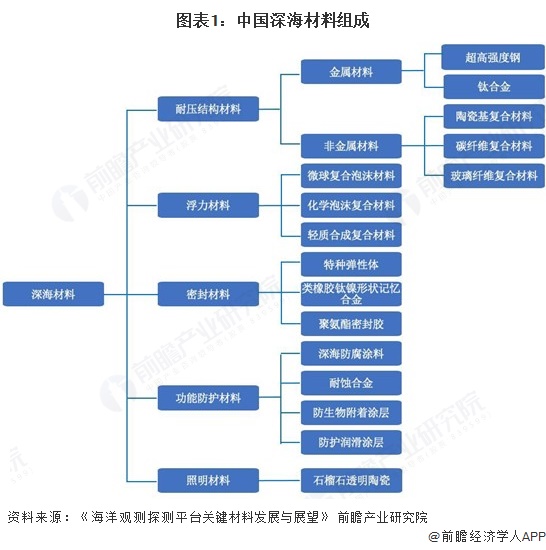
Core Viewpoint - The development of deep-sea materials is crucial for advancing deep-sea technology and unlocking the potential of the trillion-dollar deep-sea mineral resources market, supporting the entire industry chain from equipment manufacturing to resource utilization [1][3]. Group 1: Deep-Sea Materials Overview - Deep-sea materials are essential for operations in extreme environments characterized by high pressure, low temperature, and strong corrosion, directly influencing development capabilities [1]. - These materials can be categorized by function into pressure-resistant structural materials, buoyancy materials, sealing materials, protective materials, and lighting materials, and by properties into high-strength metal materials, polymer composites, and ceramic-based composites [1][3]. Group 2: Pressure-Resistant Structural Materials - Pressure-resistant structural materials are divided into metal and non-metal categories, with metal systems being more mature, including high-strength alloy steel, titanium alloys, and aluminum alloys [3]. - Non-metal materials are also making progress, with composite materials showing significant potential due to their lightweight and corrosion-resistant properties [3][4]. Group 3: Titanium Alloys - Titanium alloys, known as "marine metals," are favored for their high strength, excellent corrosion resistance, and low density (60% of steel), making them ideal for marine engineering and deep-sea pressure vessels [5]. - Companies like BaoTi Co., Ltd. and Western Materials are leading in titanium alloy production, with BaoTi being the largest global producer and achieving mass production of deep-sea titanium alloy components [7]. Group 4: Sealing Materials - Deep-sea sealing materials include rubber sealing materials, metal sealing materials, and special engineering plastics, with rubber materials currently dominating the market [9]. - Metal seals, particularly titanium and nickel-based alloys, are gaining attention for their superior durability and temperature adaptability in deep-sea applications [9]. Group 5: Corrosion-Resistant Materials - Corrosion-resistant materials are critical in deep-sea environments, with methods to reduce corrosion including the development of new materials and the application of protective coatings [11]. - Common anti-corrosion coatings used in marine applications include rubber-based, epoxy-based, fluorocarbon, and organic silicone coatings, each with specific advantages and limitations [11].





2025年中国光模块细分产品分析 800G光模块在2025年成为主流【组图】
Qian Zhan Wang· 2026-01-19 09:10
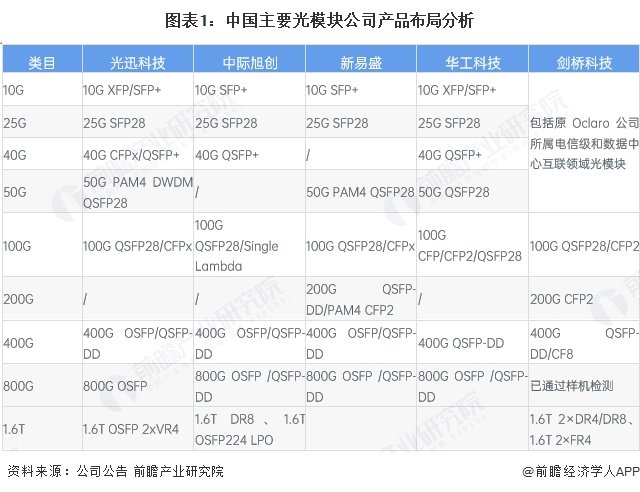
Core Insights - The report provides an analysis of the global and Chinese optical module industry, highlighting the product layout of representative companies and a comparative analysis of segmented products. Group 1: Product Layout of Representative Companies - Major Chinese optical module companies have product lines covering transmission rates up to 800G and below, including 10G, 25G, 40G, 50G, 100G, 200G, 400G, and 800G modules [1]. - The table outlines the specific products offered by companies such as Guangxun Technology, Zhongji Xuchuang, and others across various transmission rates, indicating a comprehensive coverage in the optical module market [1]. Group 2: 10G Optical Module Market - The 10G optical module market is mature, primarily featuring XFP and SFP+ modules, with SFP+ being favored for its lower cost, smaller size, and strong compatibility [3]. - 10G data center solutions typically involve 10G switches paired with SFP+ modules and LC fiber jumpers, emphasizing the importance of matching switch rates with corresponding optical modules [3]. Group 3: 40G Optical Module Demand - The 40G optical module, particularly the QSFP+ type, is widely used due to its compact design and ability to meet high-density, high-speed market demands [6]. - Transitioning from 10G to 40G is driven by the need for increased bandwidth and throughput in data centers, with 40G solutions often involving 40G switches and QSFP+ modules [6]. Group 4: 100G Optical Module Applications - The 100G optical module is primarily utilized in cloud data centers and high-speed networks, with QSFP28 emerging as the mainstream packaging method [7]. - Significant technological advancements in 100G modules include digital coherent receiver technology and advanced error correction coding, catering to evolving user demands [7]. Group 5: 400G Optical Module Commercialization - The 400G optical module is set to become commercially viable in 2023, driven by the increasing demand from AI model training and 5G network construction [10]. - Major Chinese telecom operators are expected to deploy 400G modules extensively, with significant market share anticipated by 2024-2025 [10]. Group 6: 800G Optical Module Projections - The 800G optical module is projected to become mainstream by 2025, primarily driven by the needs of AI data centers for large-scale GPU cluster interconnections [13]. - Different types of 800G modules are categorized based on transmission distance, catering to various applications from data center interconnections to long-distance transmission [15]. Group 7: 1.6T Optical Module Development - The 1.6T optical module is expected to see commercial rollout in 2025, with gradual scaling from initial small batch shipments to larger production volumes by year-end [16]. - Key players like Nvidia and Zhongji Xuchuang are leading the early adoption and certification processes for 1.6T modules [18].


电网概念股早盘走强,电网设备ETF、电网ETF涨超5%
Mei Ri Jing Ji Xin Wen· 2026-01-19 02:10
Core Viewpoint - The power grid concept stocks have shown strong performance in early trading, with significant gains in several companies, indicating a positive market sentiment towards the power equipment sector [1]. Group 1: Stock Performance - Xuji Electric has risen over 8%, while Guodian NARI and Hengtong Optic-Electric have increased by more than 7%. Other companies like Tebian Electric, Siyuan Electric, and Zhongtian Technology have also seen gains exceeding 4% [1]. - The power equipment ETF and the grid ETF have both increased by over 5% [1]. Group 2: Industry Outlook - According to brokerages, the new energy sector is expected to maintain a positive trend through 2026, supported by the National Energy Administration's commitment to enhance offshore wind power development during the 14th Five-Year Plan [2]. - The anticipated increase in overseas high-value orders is expected to expand China's wind power export potential, alongside domestic grid investment growth, which is likely to drive demand for power equipment [2]. - The power equipment sector is projected to sustain high prosperity levels due to these factors [2].



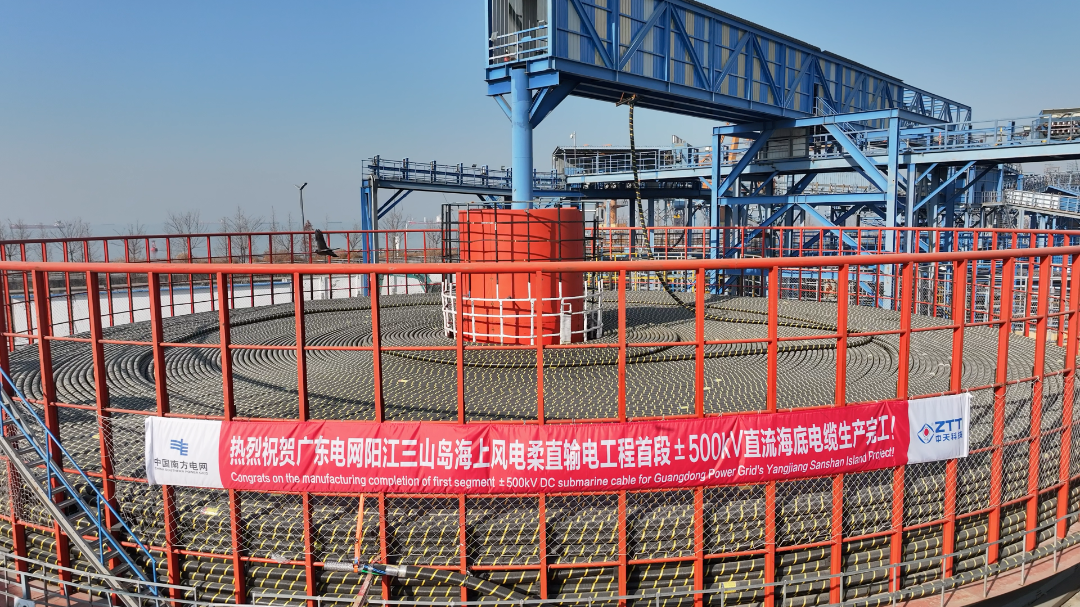
全球首个超大规模海陆一体±500kV柔直输电工程首段海缆在中天科技完成生产
Zhong Guo Neng Yuan Wang· 2026-01-19 01:04
Group 1 - The Guangdong Electric Power Grid Yangjiang Sanshan Island offshore wind power flexible direct current transmission project is the world's first ultra-large-scale integrated offshore and onshore ultra-high voltage flexible direct current transmission project, with a planned total installed capacity of 2GW and a total length of 116.5 kilometers for the submarine cable [3] - The project is located in the South China Sea, an area prone to typhoons and complex sea conditions, which poses extreme challenges to the electrical performance, mechanical strength, and environmental resistance of the submarine cable [3] - Zhongtian Technology has made significant advancements in key technologies for ±500kV direct current submarine cables, overcoming global challenges related to space charge accumulation and electric field distribution control under high direct current voltage [3] Group 2 - Zhongtian Technology has successfully developed key technologies for various voltage levels of direct current submarine cables, including ±160kV, ±200kV, ±320kV, and ±400kV, and has supplied the first ±400kV flexible direct current offshore wind project in Asia in 2021 [3] - The company plans to focus on high-capacity, long-distance, and highly reliable offshore transmission technology needs during the 14th Five-Year Plan, continuing to invest in research and development in core areas such as insulation materials, system design, and intelligent operation and maintenance [5] - Zhongtian Technology aims to build a comprehensive solution capability for direct current submarine cables, covering survey design, product manufacturing, offshore construction, and intelligent operation and maintenance [5]
国家电网“十五五”投资4万亿元,固态电池近期催化密集落地




GOLDEN SUN SECURITIES· 2026-01-18 06:32
Investment Rating - The report indicates a positive outlook for the power equipment industry, particularly in the renewable energy sector, with significant investments and technological advancements expected to drive growth [1][2][4]. Core Insights - The report highlights that the State Grid's investment during the "14th Five-Year Plan" period is projected to reach 4 trillion yuan, marking a 40% increase compared to the previous plan [2]. - The report emphasizes the stability in polysilicon prices and the continuous rise in battery component prices, with N-type battery prices increasing to 0.40 yuan per watt [15][16]. - The report identifies three key areas of focus: supply-side reform leading to price increases in the industry chain, long-term growth opportunities from new technologies, and industrialization opportunities from perovskite GW-level layouts [16]. Summary by Sections 1. New Energy Generation 1.1 Photovoltaics - Polysilicon prices remain stable, while battery component prices are on the rise, with N-type battery prices reaching an average of 0.40 yuan per watt [15]. - The report notes that leading component companies are responding to industry self-discipline by raising component prices, with distributed sales prices reaching 0.72 yuan per watt [15][16]. - Key companies to watch include Tongwei Co., GCL-Poly, LONGi Green Energy, JA Solar, and Trina Solar [16]. 1.2 Wind Power & Grid - The UK AR7 offshore wind auction results exceeded expectations, with a total scale of approximately 8.4GW, validating the upward trend in European offshore wind [17]. - The State Grid's investment is expected to enhance transmission capacity significantly, addressing bottlenecks in renewable energy delivery [18]. - Companies to focus on include Goldwind, Yunda Wind Power, Mingyang Smart Energy, and Sany Heavy Energy [18]. 1.3 Hydrogen & Energy Storage - By 2025, the production and sales of fuel cell vehicles in China are projected to reach 7,797 units, reflecting a 44% year-on-year increase [20]. - The report anticipates that new energy storage installations will reach 58.6GW/175.3GWh by 2025, with significant growth expected in the energy storage sector [21]. - Key players in the hydrogen sector include Shuangliang Energy, Huadian Heavy Industries, and Shenghui Technology [20]. 2. New Energy Vehicles - Solid-state batteries are gaining traction, with several automakers making progress towards mass production by 2026 [29]. - Companies such as BYD, Changan Automobile, and Chery are expected to achieve significant milestones in solid-state battery technology [29]. - The report suggests monitoring companies like Xiamen Tungsten, Hailiang Co., and Nanjing Advanced Lithium Battery [29]. 3. Industry Trends - The report notes a 0.4% increase in the new energy equipment sector from January 12 to January 16, 2026, with a cumulative increase of 5.3% since the beginning of the year [12]. - The photovoltaic equipment sector saw a 3.52% increase, while the wind power equipment sector experienced a decline of 1.28% during the same period [13].
阳江海上风电首段±500千伏直流海缆下线
Zhong Guo Dian Li Bao· 2026-01-16 03:09
Core Viewpoint - The successful completion of the first segment of the ±500 kV DC submarine cable for the Yangjiang Sanshan Island offshore wind power flexible direct current transmission project marks a significant milestone in China's offshore wind energy development and manufacturing capabilities [1] Group 1: Project Overview - The ±500 kV DC submarine cable, with a total length of 54.52 kilometers, addresses multiple technical challenges, showcasing China's manufacturing and innovation strength [1] - The entire cable route for the Yangjiang Sanshan Island project is approximately 114.8 kilometers, with 114.2 kilometers offshore and a maximum water depth of 52 meters [1] - The project is a core initiative for Guangdong's "New Offshore Guangdong" construction, aiming to establish a million-kilowatt-level offshore wind power base [1] Group 2: Project Timeline and Impact - The submarine cable is scheduled to begin offshore laying in April, with all cable construction expected to be completed by the end of June, and land-sea joint debugging to start in July [1] - The project is set to be operational by the end of October, facilitating efficient transmission of deep-sea wind power to the Guangdong-Hong Kong-Macao Greater Bay Area [1] - The project is anticipated to stimulate the upstream and downstream industrial chain, providing strong momentum for Guangdong's economic development [1]