
FYG,FUYAO GLASS(600660)

Search documents
福建“豪门”,打响继承之战
创业邦· 2026-02-01 10:09
Core Viewpoint - The article discusses the generational transition in family businesses, particularly among Fujian entrepreneurs, highlighting the challenges faced by the second generation as they take over leadership roles amidst changing market conditions and societal expectations [5][16]. Group 1: Succession in Fujian Enterprises - Xu Shihui, founder of Dali Food Group, has retired, passing leadership to his daughter Xu Yangyang, who has been groomed for this role for years [7][14]. - Cao Dewang, founder of Fuyao Group, has also stepped down, with his son Cao Hui taking over, marking a trend of succession among Fujian entrepreneurs [7][11]. - The transition of leadership is becoming a reality in Fujian's private enterprises, with several second-generation leaders stepping into their roles [7][8]. Group 2: Challenges Faced by Successors - The new generation faces a more challenging business environment and intense competition, along with the pressure of living up to their predecessors' legacies [16][18]. - Many successors, despite having better resources and education, struggle with the dual identity of being both children and inheritors, leading to potential conflicts [8][16]. - The decision to take over family businesses can lead to significant generational "wars," as seen in the case of Fuyao Group, where Cao Hui initially resisted taking over [11][12]. Group 3: Performance and Expectations - Dali Group's revenue peaked at 22.294 billion yuan in 2021 but has since declined, with 2023 revenue reported at 18.86 billion yuan, presenting a significant challenge for Xu Yangyang [20][21]. - Xu Yangyang aims to innovate beyond her father's established "imitator" strategy, which has become less effective in the current market [21][23]. - In contrast, Fuyao Group, under Cao Hui, is experiencing growth, with 2025 fiscal year revenue reaching 21.45 billion yuan, indicating a different set of challenges focused on maintaining market leadership [23][24]. Group 4: Strategies for Business Continuity - The article highlights the trend of inter-family marriages among Fujian entrepreneurs as a strategy to strengthen business alliances and ensure continuity [26][29]. - Establishing family offices has become a common practice among Fujian businesses to manage wealth and address succession issues proactively [27][30]. - The emphasis on collaboration and mutual support among family businesses reflects a cultural approach to navigating risks and uncertainties in the market [30][31].


福建「豪门」,打响继承之战
3 6 Ke· 2026-01-31 09:22
Core Insights - The article discusses the generational transition in family-owned businesses in Fujian, China, highlighting the challenges faced by the second generation as they take over leadership roles in a competitive and changing market environment [3][4][5]. Group 1: Leadership Transition - Xu Shihui, the founder of Dali Food Group, has retired, passing the presidency to his daughter Xu Yangyang, marking a significant leadership change in the company known for brands like "Dali Garden" and "Kebike" [3][4]. - Similarly, Cao Dewang, founder of Fuyao Group, has stepped down as chairman, with his son Cao Hui taking over, indicating a broader trend of leadership transitions among Fujian entrepreneurs [3][4]. - Other notable transitions include Xu Lianjie of Hengan Group handing over to his son Xu Qingliu, and Fu Guangming of Shennong Group passing control to his daughter Fu Fenfang [4]. Group 2: Challenges of Succession - The second generation faces intense pressure to meet the expectations set by their predecessors, often leading to comparisons in capability and performance [4][12]. - The decision to take over leadership roles is fraught with internal conflict, as many heirs express reluctance to step into their parents' shoes, preferring to pursue their own entrepreneurial paths [5][12]. - The article highlights the contrasting experiences of successors, with some like Cao Hui initially resisting the idea of taking over, while others like Xu Yangyang have been groomed for leadership from a young age [8][12]. Group 3: Market Dynamics and Performance - Dali Group's revenue peaked at 22.294 billion yuan in 2021 but has since declined, with 2023 revenue reported at 18.86 billion yuan, presenting a significant challenge for Xu Yangyang as she takes over [17][19]. - Hengan Group's Xu Qingliu aims to double the paper product business revenue target to 30 billion yuan, facing challenges such as raw material price fluctuations and industry competition [22]. - Fuyao Group, under Cao Hui's leadership, reported a revenue of 21.45 billion yuan in the first half of 2025, with a net profit exceeding 4.8 billion yuan, indicating a strong market position but also the need for continued innovation and growth [22]. Group 4: Cultural and Strategic Considerations - The article emphasizes the traditional approach of bloodline succession in Fujian businesses, where the eldest son is often seen as the most suitable successor [5][12]. - The concept of family alliances through marriage is highlighted as a strategy to strengthen business ties among Fujian entrepreneurs, reflecting a long-standing cultural practice [25][26]. - The establishment of family offices by Fujian businesses is noted as a modern approach to managing wealth and addressing succession issues, allowing for better risk management and strategic collaboration [26][28].


福建「豪门」,打响继承之战
36氪· 2026-01-31 09:08
Core Viewpoint - The article discusses the generational transition in family businesses among Fujian entrepreneurs, highlighting the challenges faced by the second generation as they take over leadership roles in a competitive and changing market environment [5][6][7]. Group 1: Leadership Transition - Xu Shihui, founder of Dali Food Group, has retired, passing the presidency to his daughter Xu Yangyang, who has been groomed for this role over the years [6][7]. - Similarly, Cao Dewang, founder of Fuyao Group, has stepped down as chairman, handing over the reins to his son Cao Hui, who has been prepared for leadership through international experience [6][10]. - The trend of generational handover is becoming more common among Fujian private enterprises, with several second-generation leaders taking charge of their family businesses [7][8]. Group 2: Challenges of Succession - The second generation faces intense pressure to meet the expectations set by their predecessors, often leading to a struggle between personal ambition and familial duty [5][16]. - The article notes that many second-generation entrepreneurs are hesitant to take over, with some preferring to pursue their own ventures instead of stepping into established family businesses [8][10]. - The transition is often marked by conflicts, as seen in the case of Cao Hui, who initially resisted taking over Fuyao but eventually agreed under his father's insistence [10][11]. Group 3: Business Performance and Strategy - Dali Food's revenue peaked at 22.294 billion yuan in 2021 but has since declined, with 2023 revenue reported at 18.86 billion yuan, indicating significant challenges for Xu Yangyang as she takes over [22][24]. - Fuyao Group, under Cao Hui's leadership, reported a revenue of 21.45 billion yuan in the first half of 2025, showing a double-digit growth, but maintaining this growth will be a key challenge [27]. - The article highlights the strategic shifts required by the new leaders, such as Xu Yangyang's attempts to innovate Dali's product lines in response to changing consumer preferences [24][22]. Group 4: Cultural and Structural Dynamics - The article emphasizes the traditional approach of family succession in Fujian, where leadership is typically passed down to the eldest son, reflecting deep-rooted cultural practices [8][10]. - The concept of family alliances through marriage is also discussed, showcasing how Fujian entrepreneurs are forming strategic partnerships to strengthen their business networks [30][31]. - The establishment of family offices among Fujian businesses is noted as a modern strategy to manage wealth and address succession issues, indicating a blend of traditional and contemporary approaches to business continuity [32][34].


2025年中国中空玻璃产量为1.3亿平方米 累计下降8.1%
Chan Ye Xin Xi Wang· 2026-01-31 02:37
Group 1 - The core viewpoint of the article highlights a decline in the production of hollow glass in China, with a reported decrease of 0.9% year-on-year in December 2025 and an overall cumulative decline of 8.1% for the year 2025 [1][1][1] Group 2 - The article cites that the production of hollow glass in China reached 0.1 million square meters in December 2025 [1] - Cumulative production for the entire year of 2025 was reported at 1.3 million square meters [1] - The data is sourced from the National Bureau of Statistics and compiled by Zhiyan Consulting, a leading industry consulting firm in China [1]





2025年中国平板玻璃产量为97591万重量箱 累计下降3%
Chan Ye Xin Xi Wang· 2026-01-30 03:45
Core Viewpoint - The report highlights the trends and forecasts in the Chinese flat glass industry from 2026 to 2032, indicating a slight growth in production despite a recent decline in cumulative output for 2025 [1] Industry Summary - According to the National Bureau of Statistics, the production of flat glass in China reached 88.29 million weight cases in December 2025, marking a year-on-year increase of 3.4% [1] - The cumulative production of flat glass for the entire year of 2025 was 975.91 million weight cases, reflecting a decrease of 3% compared to the previous year [1] - The report is published by Zhiyan Consulting, a leading industry consulting firm in China, which has been focusing on industry research for over a decade [1]


2025年中国夹层玻璃产量为16422.8万平方米 累计增长2.7%
Chan Ye Xin Xi Wang· 2026-01-30 03:45
Core Viewpoint - The Chinese laminated glass industry is experiencing a decline in production, with a notable decrease in output projected for December 2025 compared to the previous year [1] Industry Summary - According to the National Bureau of Statistics, the production of laminated glass in China is expected to reach 15.56 million square meters in December 2025, representing a year-on-year decrease of 7.1% [1] - For the entire year of 2025, the cumulative production of laminated glass is projected to be 164.228 million square meters, reflecting a cumulative growth of 2.7% [1] - The report by Zhiyan Consulting provides insights into the current market status and development trends of the laminated glass industry in China from 2026 to 2032 [1] Company Summary - Listed companies in the laminated glass sector include Qibin Group (601636), Nanfang A (000012), Fuyao Glass (600660), Jinjing Technology (600586), Kaisheng New Energy (600876), Yaopi Glass (600819), Shandong Pharmaceutical Glass (600529), and Yamaton (002623) [1]

汽车行业:25年四季度末公募基金超配汽车行业0.62pct
GF SECURITIES· 2026-01-29 11:52
[Table_Page] 深度分析|汽车 证券研究报告 [Table_Title] 汽车行业 25 年四季度末公募基金超配汽车行业 0.62pct [Table_Summary] 核心观点: [Table_Grade] 行业评级 买入 前次评级 买入 报告日期 2026-01-29 [分析师: Table_Author]张力月 SAC 执证号:S0260524040004 021-38003727 zhangliyue@gf.com.cn 分析师: 闫俊刚 SAC 执证号:S0260516010001 021-38003682 yanjungang@gf.com.cn 分析师: 陈飞彤 SAC 执证号:S0260524040002 SFC CE No. BWZ819 021-38003726 gfchenfeitong@gf.com.cn 分析师: 周伟 SAC 执证号:S0260522090001 021-38003684 gfzhwei@gf.com.cn 分析师: 罗英 SAC 执证号:S0260525110001 0755-82557403 shluoying@gf.com.cn -10% -2% 6 ...


福耀玻璃今日大宗交易折价成交35.58万股,成交额2099.46万元
Xin Lang Cai Jing· 2026-01-28 09:37
Group 1 - The core point of the news is that Fuyao Glass conducted a block trade on January 28, with a total of 355,800 shares traded, amounting to 20.9946 million yuan, which represents 1.47% of the total trading volume for that day [1] - The transaction price was 59 yuan per share, which is a discount of 5.01% compared to the market closing price of 62.11 yuan [1]

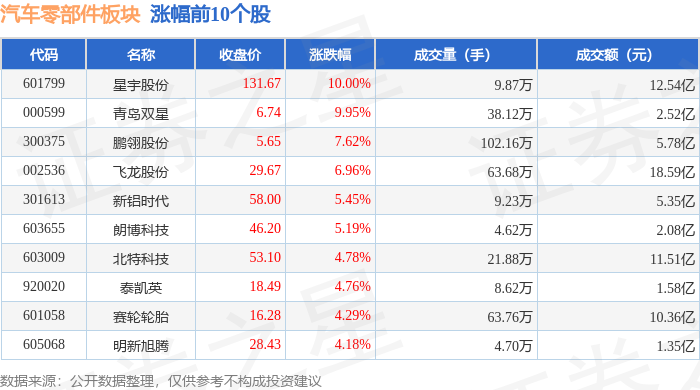
汽车零部件板块1月28日跌1.21%,威唐工业领跌,主力资金净流出35.74亿元
Zheng Xing Xing Ye Ri Bao· 2026-01-28 08:58
Group 1 - The automotive parts sector experienced a decline of 1.21% on January 28, with Weitang Industrial leading the drop [1] - The Shanghai Composite Index closed at 4151.24, up 0.27%, while the Shenzhen Component Index closed at 14342.9, up 0.09% [1] - Notable gainers in the automotive parts sector included Liangyu Co., which rose by 10.00% to a closing price of 131.67, and Qingdao Double Star, which increased by 9.95% to 6.74 [1] Group 2 - Weitang Industrial saw a significant drop of 13.00%, closing at 19.88, with a trading volume of 378,800 shares and a transaction value of 779 million [2] - The automotive parts sector experienced a net outflow of 3.574 billion in main funds, while retail investors saw a net inflow of 2.824 billion [2] - The top net inflows from retail investors included Qingdao Double Star with 92.09 million, while significant outflows were noted in companies like Feilong Co. with a net outflow of 158 million [3]



2026年汽车投资策略
2026-01-28 03:01
Summary of the Conference Call Industry Overview - The conference focused on the automotive industry, specifically strategies and forecasts for 2026, with a review of the automotive market from 2005 to 2025 [1][2]. Key Insights and Arguments 1. **Sales Growth and Valuation**: - Sales growth is a sufficient but not necessary condition for the valuation of the automotive sector to increase. Historical data shows that years with sales growth corresponded with rising valuations, but there were exceptions in years like 2012 and post-2020 [3]. - The automotive sector's valuation tends to respond approximately three months ahead of sales growth before 2020, and this response time has shortened to about one month post-2020 [3]. 2. **Comparison with 2018**: - The year 2026 is expected to mirror 2018, which also faced declining sales due to policy changes. In 2018, the automotive sector began to decline three months before sales dropped significantly [4][5]. 3. **Impact of Policy Changes**: - The introduction of a 5% purchase tax on new energy vehicles in 2026 and changes in subsidy structures are expected to impact demand negatively [1][2]. 4. **Investment Opportunities**: - The focus for 2026 is on new growth areas, particularly in smart driving technologies. Companies in this sector are seen as undervalued, with many trading below 30x P/E ratios while maintaining decent growth rates [7][8]. 5. **Low Valuation and High Growth Stocks**: - Several companies were highlighted as having strong growth potential while being undervalued, including: - **Mastec**: Estimated 20% growth in 2026 with a P/E of 15-16x [10]. - **Yatong**: Expected 30% growth with a P/E of around 20x [10]. - **Fuyou Glass**: Anticipated 15% growth with a P/E of about 15x [11]. - **Weichai Power**: Projected 15% growth with a similar P/E [11]. 6. **Sector-Specific Insights**: - Companies like **Desay SV** and **Kobota** are expected to see significant revenue growth due to their involvement with major clients like Li Auto and NIO, with projected revenues of 90 billion and 21 billion respectively for Q4 [17][21]. - **Huayang Group** is expected to maintain a growth rate of over 20% in 2026, driven by high-margin products [24]. Other Important but Overlooked Content - The conference also discussed the potential risks associated with rising raw material costs, particularly for companies in the forging sector, which could impact earnings realization [13]. - The importance of technological cycles, including the shift towards electric and smart vehicles, was emphasized as a key driver for future growth in the automotive sector [6][7]. - The discussion included a focus on the competitive landscape, with companies like Fuyou Glass expected to benefit from a more favorable market position as competitors exit [30][31]. Conclusion - The automotive industry is facing challenges due to policy changes and market dynamics, but there are significant investment opportunities in undervalued companies with strong growth potential, particularly in the smart driving and electric vehicle segments. The insights from the conference provide a comprehensive overview of the current state and future outlook of the automotive sector.


