BAIC BluePark(600733)

Search documents
获易方达重仓22亿,北汽蓝谷此次有何不同?
Ge Long Hui· 2026-01-29 11:38
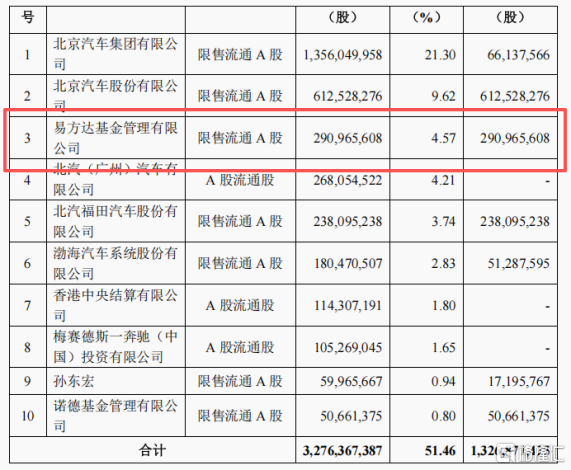
Core Viewpoint - The significant investment of 2.2 billion by E Fund in Beiqi Blue Valley, representing 36.67% of the total fundraising, indicates strong confidence in the company's potential for a turnaround in the competitive new energy vehicle market [1][19]. Group 1: Financial Performance and Growth - Beiqi Blue Valley is projected to incur a loss of 4.35 to 4.65 billion in 2025, with a reduction in losses by 33% to 37%, marking the best performance in six years [5]. - The company expects to sell 209,600 vehicles in 2025, a significant year-on-year increase of 84.06%, with revenue projected to reach approximately 28 billion, reflecting a 93% growth [5]. - The gross margin turned positive for the first time at 1.8% in Q3 2025, breaking the previous cycle of losses [6]. - Operating cash flow turned positive with a net amount of 754 million in the first three quarters of 2025, indicating improved financial health [7]. Group 2: Strategic Positioning and Market Dynamics - Beiqi Blue Valley is transitioning from a traditional automaker to a technology-driven company with dual brand strategies, supported by Huawei, focusing on both family vehicles and luxury segments [9][10]. - The "Extreme Fox" brand achieved a monthly sales record of over 24,000 units in December 2025, with an annual total of over 160,000 units, reflecting a 99% year-on-year growth [9]. - The "Enjoy" brand, developed in collaboration with Huawei, is gaining traction in the luxury car market, with significant sales milestones achieved [9]. Group 3: Investment Sentiment and Market Perception - The concentration of investment in Beiqi Blue Valley, with E Fund alone accounting for 36.67% of the total, suggests a strong commitment and thorough due diligence by institutional investors [15][16]. - The recent fundraising round saw 23 institutions competing, with a final issuance price of 7.56 yuan, reflecting a premium over the base price, indicating positive market sentiment [13][19]. - E Fund's investment strategy aligns with its historical approach of partnering with industry leaders, suggesting a long-term commitment to Beiqi Blue Valley's growth potential [11][19].


获易方达重仓22亿,北汽蓝谷(600733.SH)此次有何不同?
Ge Long Hui· 2026-01-29 11:36
Core Viewpoint - The significant investment of 2.2 billion by E Fund in Beiqi Blue Valley, representing 36.67% of the total fundraising, indicates strong confidence in the company's potential for a turnaround in the competitive new energy vehicle market [1][19]. Group 1: Financial Performance and Growth Potential - Beiqi Blue Valley's projected loss for 2025 is between 4.35 billion to 4.65 billion, with a reduction in loss margin of 33% to 37%, marking the best performance in six years [6]. - The company expects to sell 209,600 vehicles in 2025, a year-on-year increase of 84.06%, with revenue projected to reach approximately 28 billion, reflecting a 93% growth [6]. - The gross margin turned positive for the first time at 1.8% in Q3 2025, breaking the previous cycle of losses [8]. - Operating cash flow turned positive with a net amount of 754 million in the first three quarters of 2025, indicating improved financial health [9]. Group 2: Strategic Positioning and Brand Development - Beiqi Blue Valley is transitioning from a traditional automaker to a tech-driven company with dual brand strategies, focusing on the "Extreme Fox" and "Xiangjie" brands [11]. - The "Extreme Fox" brand targets the mid-to-high-end consumer market, achieving a monthly sales record of over 24,000 units in December 2025, a 103% year-on-year increase [11]. - The "Xiangjie" brand, developed in collaboration with Huawei, aims at the luxury car market, with significant sales growth and recognition [12]. Group 3: Governance and Investment Dynamics - The entry of E Fund is expected to optimize Beiqi Blue Valley's governance structure and enhance operational efficiency, opening up new capital operation possibilities [13]. - The concentration of shareholding in the recent fundraising round, with E Fund alone accounting for 36.67%, reflects a strong commitment and thorough due diligence [18][19]. - E Fund's investment strategy emphasizes long-term growth by aligning with industry leaders, suggesting confidence in Beiqi Blue Valley's future performance [13][19].
北汽蓝谷(600733) - 关于公司和控股股东部分董事、高级管理人员及骨干团队增持公司股份计划的进展公告
2026-01-29 11:17
证券代码:600733 证券简称:北汽蓝谷 公告编号:临 2026-008 北汽蓝谷新能源科技股份有限公司(以下简称"北汽蓝谷"或"公司")于 2026 年 1 月 14 日披露了《关于公司和控股股东部分董事、高级管理人员及骨干团队增持股份计划的公告》 (公告编号:临 2026-002),公司和控股股东北京汽车集团有限公司(以下简称"北汽集团") 部分董事、高级管理人员及骨干团队(以下简称"增持主体")基于对北汽蓝谷长期投资价值 的认可和对公司"三年跃升"及"十五五"发展战略的信心,计划自 2026 年 1 月 14 日(含本 日)起 6 个月内,通过上海证券交易所系统以集中竞价方式增持公司股份,合计拟增持金额不 低于人民币 1,450 万元,不超过人民币 1,640 万元。 增持计划的实施进展情况 截至公告披露日,增持主体以自有及自筹资金通过上海证券交易所交易系统集中竞价交易 方式累计增持公司股份 1,331,000 股,占公司总股本的 0.02%,增持金额为 1,103.10 万元。 增持金额已达到并超过本次增持计划拟增持最低金额的 50%,本次增持计划尚未实施完毕,增 持主体后续将按照增持计划继续增持公 ...
乘用车板块1月29日涨0.12%,上汽集团领涨,主力资金净流出7.09亿元
Zheng Xing Xing Ye Ri Bao· 2026-01-29 09:03
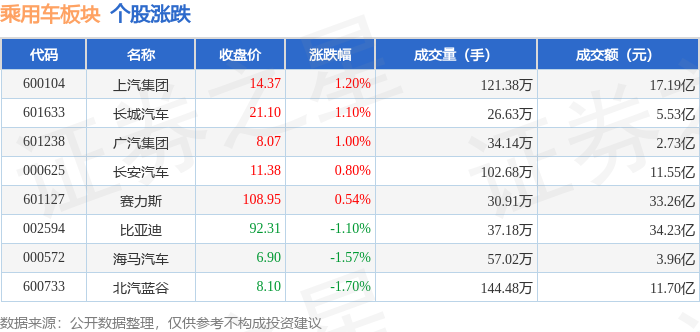
Group 1 - The passenger car sector increased by 0.12% on January 29, with SAIC Motor leading the gains [1] - The Shanghai Composite Index closed at 4157.98, up 0.16%, while the Shenzhen Component Index closed at 14300.08, down 0.3% [1] - Key stocks in the passenger car sector showed varied performance, with SAIC Motor closing at 14.37, up 1.20%, and BYD closing at 92.31, down 1.10% [1] Group 2 - The net outflow of main funds in the passenger car sector was 709 million yuan, while retail investors saw a net inflow of 501 million yuan [1] - Detailed fund flow data indicates that major stocks like GAC Group and Great Wall Motors experienced significant net outflows from main funds [2] - Retail investors showed positive net inflows in several stocks, including GAC Group and Haima Automobile, despite overall sector outflows [2]





A股定增一览:今日3家公司披露定增进展
Jin Rong Jie· 2026-01-29 00:04
Group 1 - On January 29, three companies in the A-share market announced plans related to private placements [1] - Two companies disclosed new private placement proposals, while one proposal was approved by the shareholders' meeting [1] - The highest proposed fundraising amounts were from Yunjigroup and Lixing Co., aiming to raise no more than 788 million yuan and 560 million yuan, respectively [1] Group 2 - Since the beginning of the year, 15 companies have announced completed private placement plans, with 7 companies raising over 1 billion yuan [1] - The companies with the highest fundraising amounts include Beiqi Blue Valley, Magmi Te, and Zhongbei Communication, raising 6 billion yuan, 2.663 billion yuan, and 1.92 billion yuan, respectively [1]


创近五年新低 2025年汽车行业销售利润率仅4.1%
经济观察报· 2026-01-28 12:24
Core Viewpoint - The automotive industry is experiencing a significant decline in profitability, with upstream components showing steady growth, while vehicle manufacturing and downstream dealerships face considerable pressure [1][2]. Group 1: Profitability Trends - In 2025, the automotive industry achieved a profit of 461 billion yuan, a year-on-year increase of 0.6%, but the sales profit margin dropped to 4.1%, lower than the average of 5.9% for downstream industrial enterprises [2]. - The profit margin for the automotive industry fell to 4.1% in 2025, marking a five-year low, with December profits plummeting to 20.7 billion yuan, a year-on-year decrease of 57.4% [2][3]. - The overall profit margin for the automotive industry in December 2025 was the lowest in five years, with a significant decline from 4.1% in December 2024 to 1.8% [2]. Group 2: Performance of Different Segments - Among 129 A-share automotive parts companies, 80 reported a year-on-year profit increase, indicating over 60% had both revenue and profit growth [3]. - In the vehicle manufacturing segment, 16 out of 22 A-share car manufacturers were profitable, but major players like BYD and GAC Group saw significant profit declines, with GAC Group's profit dropping by 3691.33% [3]. - The downstream dealership segment is under severe pressure, with only 28% meeting sales targets and a loss rate climbing to 55% [3]. Group 3: Cost Pressures - The overall unit cost for industrial enterprises has increased significantly, with lithium carbonate prices doubling and raw material costs rising for midstream and downstream sectors [3][4]. - The cost of a typical mid-sized smart electric vehicle has increased by 4,000 to 7,000 yuan due to rising prices of lithium, aluminum, and copper, which are difficult for manufacturers to pass on to consumers [4]. - Starting in 2026, a 5% purchase tax on new energy vehicles and changes to subsidy policies will further increase consumer costs, complicating demand and supply dynamics in the automotive market [4]. Group 4: Strategic Responses - Some automotive companies are accelerating collaboration with upstream suppliers to address challenges, as seen in the strategic discussions between China Aluminum Group and China FAW Group [5].


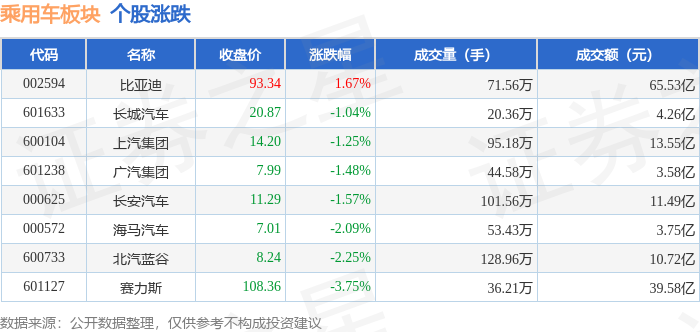
乘用车板块1月28日跌0.81%,赛力斯领跌,主力资金净流出10.29亿元
Zheng Xing Xing Ye Ri Bao· 2026-01-28 08:58
Group 1 - The passenger car sector experienced a decline of 0.81% on January 28, with Seres leading the drop [1] - The Shanghai Composite Index closed at 4151.24, up 0.27%, while the Shenzhen Component Index closed at 14342.9, up 0.09% [1] - BYD's stock price increased by 1.67% to 93.34, while several other major automakers like Great Wall Motors and SAIC Motor saw declines of 1.04% and 1.25% respectively [1] Group 2 - The passenger car sector saw a net outflow of 1.029 billion yuan from institutional investors, while retail investors contributed a net inflow of 762 million yuan [1] - Specific stocks like SAIC Motor and Great Wall Motors experienced significant net outflows from institutional investors, with amounts of -12.24 million yuan and -24.21 million yuan respectively [1] - In contrast, Haima Automobile and BYD saw net inflows from retail investors of 40.35 million yuan and 28.6 million yuan respectively [1]

创近五年新低 2025年汽车行业销售利润率仅4.1%
Jing Ji Guan Cha Wang· 2026-01-28 07:36
Core Viewpoint - The Chinese automotive industry is facing significant profit declines, with 2025 projected profits at 461 billion yuan, a mere 0.6% increase year-on-year, and a sales profit margin of 4.1%, which is below the average of 5.9% for downstream industrial enterprises [2] Group 1: Profit Trends - The automotive industry's profit margin is expected to drop to 4.1% in 2025, marking a five-year low, following a decline to 4.3% in 2024 [2] - In December 2025, the automotive industry reported profits of 20.7 billion yuan, a year-on-year decrease of 57.4%, with a profit margin of 1.8%, significantly lower than the 4.1% in December 2024 [2] - Excluding the pandemic-affected April 2022, December 2025's profit margin is the lowest in five years [2] Group 2: Industry Performance - The automotive supply chain shows a mixed performance, with upstream parts manufacturers experiencing stable growth, while vehicle manufacturing and downstream dealerships face significant challenges [3] - Among 22 A-share automotive companies, 16 reported profits, but major players like BYD and GAC Group saw substantial profit declines, with GAC Group's profit dropping by 3691.33% [3] - The dealership segment is under severe pressure, with only 28% meeting sales targets and a loss rate climbing to 55% [3] Group 3: Cost Pressures - The automotive industry is experiencing increased cost pressures, with lithium carbonate prices doubling and overall raw material costs rising, impacting profit margins [3][4] - The cost of a typical electric vehicle has increased by 4,000 to 7,000 yuan due to rising prices of lithium, aluminum, and copper, which manufacturers struggle to pass on to consumers [4] - Starting in 2026, a 5% tax on new energy vehicle purchases and changes to subsidy policies will further increase consumer costs, complicating demand and supply dynamics [4][5] Group 4: Future Outlook - The China Automotive Industry Association forecasts total vehicle sales to reach 34.75 million units in 2026, a 1% year-on-year increase, with new energy vehicles projected to grow by 15.2% to 19 million units [5] - Some automotive companies are accelerating collaborations with upstream suppliers to address these challenges, focusing on strategic partnerships and new material development [5]
北汽蓝谷新能源科技股份有限公司关于签订募集资金专户存储三方监管协议的公告
Xin Lang Cai Jing· 2026-01-27 19:59
Group 1 - The core point of the announcement is that Beijing Automotive Blue Valley New Energy Technology Co., Ltd. has signed a tripartite supervision agreement for the storage of raised funds to ensure proper management and usage of the funds, thereby protecting investor rights [3][4][6]. Group 2 - The company has received approval from the China Securities Regulatory Commission to issue 793,650,793 shares at a price of RMB 7.56 per share, raising a total of approximately RMB 5.99 billion, with a net amount of approximately RMB 5.94 billion after deducting issuance costs [2]. - The funds raised will be specifically allocated for projects related to new energy vehicle development, AI intelligent platforms, and smart driving electric systems [4][5]. - A special account for the raised funds has been established, which will only be used for the designated projects and cannot be used for other purposes [4][5]. Group 3 - The tripartite agreement involves the company, Huaxia Bank, and CITIC Securities, ensuring compliance with relevant laws and regulations regarding the management of raised funds [3][6]. - The agreement stipulates that the company must notify CITIC Securities of any withdrawals exceeding 20% of the net raised funds within a 12-month period [7]. - CITIC Securities is responsible for supervising the usage of the raised funds and must conduct at least biannual inspections of the fund's storage and usage [6][7]. Group 4 - The agreement will remain effective until all funds are fully utilized and the account is legally closed, or until mutually agreed upon termination [8]. - The tripartite agreement is documented in six copies, with each party retaining one copy and submitting others to regulatory bodies [8].
乘用车板块1月27日跌0.89%,赛力斯领跌,主力资金净流出8.12亿元
Zheng Xing Xing Ye Ri Bao· 2026-01-27 08:49
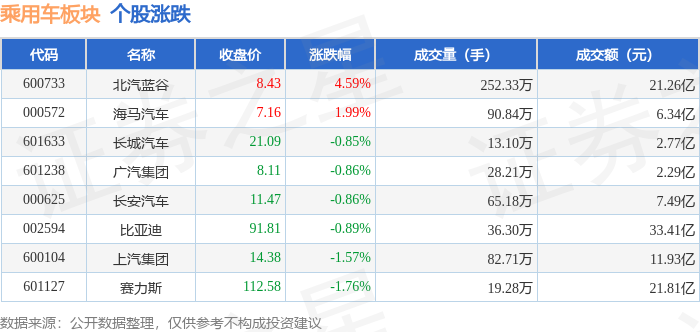
Group 1 - The passenger car sector experienced a decline of 0.89% on January 27, with Seres leading the drop [1] - The Shanghai Composite Index closed at 4139.9, up 0.18%, while the Shenzhen Component Index closed at 14329.91, up 0.09% [1] - Notable stock performances included Beiqi Blue Valley, which rose by 4.59% to a closing price of 8.43, while BYD fell by 0.89% to 91.81 [1] Group 2 - The passenger car sector saw a net outflow of 8.12 billion yuan from main funds, while retail investors contributed a net inflow of 6.36 billion yuan [1] - Beiqi Blue Valley had a main fund net inflow of 220 million yuan, while Great Wall Motors experienced a net outflow of 320.82 thousand yuan [2] - BYD faced a significant main fund net outflow of 5.937 billion yuan, with retail investors contributing a net inflow of 4.33 billion yuan [2]