Longi(601012)

Search documents
2025光伏大盘点:有人破产离场,有人国资“托底”
3 6 Ke· 2026-02-21 01:47
光伏行业洗牌加剧:跨界企业退市破产,国资"掐尖"接盘优质资产,格局重塑。 2025年4月,ST嘉寓和ST旭蓝发布了终止上市公告,成为A股当年首批面值退市的光伏企业 。与此同时,甘肃金刚光伏因逾8000万元借款逾期 被法院强制执行,四家下属公司申请重整 。但在另一个维度,曾折戟IPO的一道新能却迎来了新主人——衢州国资通过旗下公司取得不少于 34.05%的表决权,实现单独控股 。同样是光伏企业,有人倒在黎明前的血泊中,有人在国资"输血"后获得喘息。 2025光伏行业部分破产企业: | 时间 | 174 | 破产类型 | No | | --- | --- | --- | --- | | 1月3日 | 宿迁阳力能光伏有限公司 | 破产申请 | 江苏宿计 | | 1月7日 | 梓亦光伏(上海)有限公司 | 破产申请 | 上海 | | 1月9日 | 深圳市英威腾交通技术有限公司 | 破禁止鋁 | 广东深圳 | | 4月2日 | 太一光伏科技(常州)有限公司 | 破产申请 | 江苏常外 | | 4月8日 | 南阳德才光伏发电有限公司 | 破产申请 | 河南方城 | | 4月28日 | 华东光能科技(徐州)有限公司 | 破 ...





电力设备及新能源行业双周报(2026、1、30-2026、2、12):国务院办公厅发布《关于完善全国统一电力市场体系的实施意见-20260213
Dongguan Securities· 2026-02-13 07:33
Investment Rating - The report maintains an "Overweight" rating for the power equipment and new energy industry [2] Core Insights - The State Council issued the "Implementation Opinions on Improving the National Unified Electricity Market System," aiming to establish a unified electricity market by 2030, with market transactions accounting for about 70% of total electricity consumption [4][40] - The report highlights the performance of the power equipment sector, which has seen a year-to-date increase of 9.76%, outperforming the CSI 300 index by 7.82 percentage points [11][14] - The report emphasizes the importance of new operational entities like virtual power plants and smart microgrids in participating flexibly in the electricity market [45] Summary by Sections Market Review - As of February 12, 2026, the power equipment sector rose by 4.97% over the past two weeks, ranking third among 31 sectors [11] - The wind power equipment sector decreased by 3.07%, while the photovoltaic equipment sector increased by 3.93% [18][20] Valuation and Industry Data - As of February 12, 2026, the price-to-earnings (PE) ratio for the power equipment sector is 36.66 times, with sub-sectors like the battery sector at 33.19 times and the photovoltaic sector at 34.99 times [25] - The report provides detailed valuation metrics for various sub-sectors, indicating significant variations in PE ratios compared to their historical averages [25] Industry News - The report discusses the significant growth in renewable energy installations, with a total installed capacity of 2.34 billion kilowatts by the end of 2025, accounting for 60% of the national power generation capacity [40] - It also notes the government's focus on upgrading traditional industries and promoting new energy sectors, including hydrogen energy [40] Company Announcements - The report includes recent announcements from companies in the sector, such as government subsidies received by various firms, indicating ongoing support for the industry [43]


研判2026!中国太阳能扩散炉行业概述、产业链、市场规模、竞争格局、发展趋势分析:光伏产业推动,太阳能扩散炉市场规模持续增长[图]
Chan Ye Xin Xi Wang· 2026-02-13 03:30
Core Viewpoint - The solar diffusion furnace industry in China is experiencing significant growth, with the market size expected to reach 6.05 billion yuan by 2025, reflecting an 11% year-on-year increase, driven by the expansion of the photovoltaic industry and supportive government policies [1][6]. Industry Overview - Solar diffusion furnaces are essential for producing crystalline silicon solar cells, specifically for forming PN junctions, which are critical for enhancing cell efficiency [2]. - The main types of solar diffusion furnaces are vertical and horizontal, each offering distinct advantages in terms of production efficiency and space utilization [2]. Industry Chain - The upstream of the solar diffusion furnace industry includes quartz components, heating systems, temperature control systems, and gas control systems, with quartz components being crucial for stability and efficiency [3]. - The midstream involves the manufacturing of solar diffusion furnaces, while the downstream primarily serves the photovoltaic industry, specifically in solar cell and module production [3]. Current Development - The solar diffusion furnace market is benefiting from China's commitment to renewable energy, with solar power generation capacity increasing significantly from 204.2 GW in 2019 to an expected 1,161.2 GW by the end of 2025, marking a 41.90% year-on-year increase [4][5]. - The production of solar cells is projected to reach 83,274.3 MW by 2025, a 7.60% increase from the previous year, driven by government subsidies and technological advancements [5]. Competitive Landscape - The solar diffusion furnace industry has high entry barriers, making it difficult for new entrants to compete. Leading companies leverage technology, supply chains, and customer resources to maintain competitive advantages [7]. - Key players in the industry include North Huachuang, Jiejia Weichuang, and Jing Sheng Machinery, among others, with North Huachuang reporting a revenue increase of 32.97% year-on-year for the first nine months of 2025 [7][8]. Industry Trends - The rapid development of the solar diffusion furnace industry is leading to accelerated industry consolidation, with smaller companies lacking core technologies being phased out, while stronger companies invest in R&D and improve production processes [9]. - Domestic companies are increasingly focusing on international markets, expanding their presence through partnerships and participation in global trade shows, capitalizing on their competitive pricing and responsive service [10].





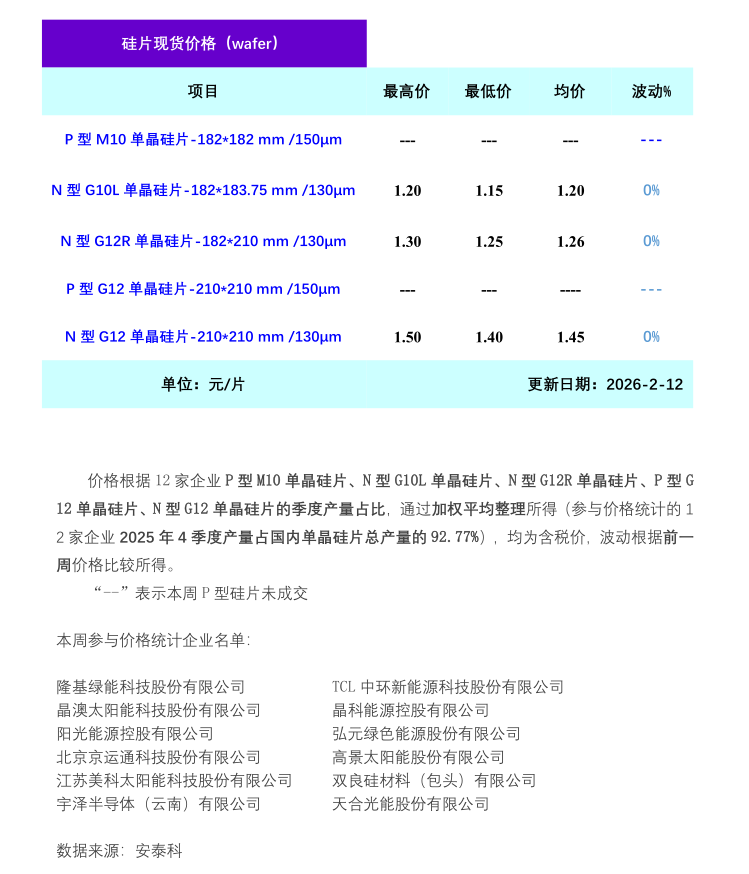
安泰科:本周市场观望为主 硅片价格持稳运行
智通财经网· 2026-02-13 01:55
Core Viewpoint - The silicon wafer prices remain stable this week, with no significant changes observed in the market due to weak demand and pre-holiday purchasing behavior [1][2]. Price Summary - N-type G10L silicon wafer (182*183.75mm/130μm) average transaction price is 1.20 CNY per piece, N-type G12R silicon wafer (182*210mm/130μm) is 1.26 CNY per piece, and N-type G12 silicon wafer (210*210mm/130μm) is 1.45 CNY per piece, all unchanged from last week [1][3]. - The mainstream price for battery cells is between 0.41-0.45 CNY/W, and for modules, it is between 0.71-0.75 CNY/W, also remaining stable compared to the previous week [1]. Market Activity - The silicon wafer market has seen general transaction activity, with companies halting purchasing orders ahead of the holiday, leading to minimal transactions [1]. - The overall operating rate in the industry has slightly decreased, with leading companies operating at 46% and 45%, while integrated companies are at 50%-60%, and other companies range from 50%-70% [1]. Future Outlook - In the short term, the silicon wafer market is expected to remain in a stalemate between upstream price support and downstream price pressure, with prices likely to stabilize [2]. - After the Spring Festival holiday, as terminal installation projects resume, there is potential for a slight market recovery driven by improved downstream demand for silicon wafers [2].



银价波动推高光伏产业成本 高功率组件涨价明显
Mei Ri Jing Ji Xin Wen· 2026-02-12 10:49
Core Viewpoint - The Chinese photovoltaic industry is facing a significant cost increase due to soaring silver prices, which have become a critical material for battery metallization, impacting profit margins and pricing strategies across the supply chain [1][2]. Group 1: Silver Price Impact - Silver prices have shown a sharp increase, with futures reaching 32,400 yuan/kg and spot prices hitting $121.64/oz by the end of January 2026, leading to a substantial rise in costs for photovoltaic components [2]. - The demand for silver in the photovoltaic sector has surged, consuming over 6,000 tons annually since 2020, accounting for nearly 20% of total silver demand [2]. - The cost of silver paste has increased, raising the complete cost of battery cells to over 0.5 yuan/W, with module costs exceeding 0.9 yuan/W [2][3]. Group 2: Cost Structure and Profit Margins - The proportion of silver in photovoltaic raw material costs has risen from approximately 9% in 2024 to over 30%, becoming the largest cost component outside of silicon [3]. - The rising raw material costs combined with low terminal product prices have created a "scissors gap," severely squeezing profit margins, contributing to widespread industry losses in 2025 [4]. - As of early February 2026, silver prices experienced volatility, with futures dropping to 20,600 yuan/kg, leading to a decrease in battery and module prices [4]. Group 3: Market Dynamics and Order Visibility - Domestic market orders are declining, with limited visibility on new contracts, while overseas markets are expected to dominate shipments in Q1 2026 due to export tax influences [5]. - The procurement attitude is cautious amid weak seasonal demand and recent price increases in components, resulting in insufficient order visibility for Q1 2026 [5]. Group 4: Cost Reduction Strategies - Companies are pursuing technological upgrades to reduce costs, with Longi Green Energy focusing on "cheap metalization" technology for mass production by Q2 2026 [6][8]. - Aiko Solar has implemented silver-free technology, significantly reducing costs and avoiding the impact of silver price fluctuations [8]. - The industry is exploring pathways for cost reduction through the substitution of cheaper metals and process optimizations, aiming for a silver consumption reduction of 10% to 20% [9]. Group 5: Future Outlook - The silver price is expected to remain high with fluctuations, driven by an expanding supply-demand gap and increased industrial demand, particularly from the photovoltaic sector [9]. - The impact of the "space photovoltaic" concept on silver demand is currently limited, with expectations for a 10% decrease in global silver usage in photovoltaics in 2026 compared to 2025 [9].

光伏行业"反内卷"成效进一步显现
Zheng Quan Ri Bao· 2026-02-12 09:29
Core Viewpoint - The photovoltaic industry is experiencing a significant cost gradient differentiation due to fluctuations in silver prices and technological upgrades, leading to a visible "anti-involution" effect within the industry [1]. Cost Pressure - The global silver investment demand is expected to remain strong through 2026, supported by geopolitical tensions and U.S. policy uncertainties, with silver prices having risen by 11% this year after surpassing $100 per ounce for the first time in January [2]. - Despite high prices leading to a projected 17% reduction in global jewelry and silverware demand, industrial demand remains resilient [2]. - A supply shortage of approximately 67 million ounces is anticipated in the global silver market by 2026, marking the sixth consecutive year of deficit, which is expected to keep silver prices strong [2]. - The photovoltaic sector, as a major consumer of silver, will continue to face cost pressures due to high silver prices, accelerating the development of silver paste substitution technologies among leading companies [2][3]. Technological Breakthroughs - Leading companies are rapidly advancing silver paste substitution technologies, with some planning large-scale production of alternative materials in the near future [4]. - Longi Green Energy has announced plans to start large-scale production of non-silver solutions, which could further reduce component costs [4]. - Other major players like JinkoSolar and Aiko are also actively pursuing silver paste alternatives, with significant collaborations aimed at industrializing low-silver technologies by 2026 [4][5]. Industry Restructuring - The shift towards high-efficiency and reliable components is expected to create a competitive landscape where companies with technological advantages can command price premiums, while less efficient capacities face dual pressures from price and demand declines [5][6]. - The Chinese photovoltaic industry is projected to see a significant change in 2026, with new installations expected to range between 180GW and 240GW, following a record high of 315GW in 2025 [5][6]. - The core theme of the industry's "anti-involution" in 2026 will be driven by upgraded end-user demand, pushing manufacturers towards high-quality development through technological iterations and improved market mechanisms [6].
银价波动推高光伏业成本,高功率组件涨价明显 头部企业: 通过贱金属替代和工艺优化实现降本
Mei Ri Jing Ji Xin Wen· 2026-02-12 07:25
Core Viewpoint - The Chinese photovoltaic industry is facing significant cost pressures due to soaring silver prices, which have become the primary driver of increased costs, surpassing traditional materials like silicon [1][2]. Group 1: Silver Price Impact - Silver prices have shown a rising trend, with futures reaching 32,400 yuan/kg and spot prices hitting $121.64/oz by the end of January [1]. - The demand for silver in the photovoltaic sector has surged, consuming over 6,000 tons annually since 2020, accounting for nearly 20% of total silver demand [1]. - The cost of silver paste has increased, raising the complete cost of battery cells to over 0.5 yuan/W and components to over 0.9 yuan/W [2]. Group 2: Cost Transmission - A 10% increase in silver prices results in an approximate 0.01 yuan/W rise in the unit cost of photovoltaic components, with silver's share of raw material costs rising from 9% in 2024 to over 30% [2][3]. - The disparity between rising raw material costs and stagnant product prices has created a "scissors gap," squeezing profit margins for manufacturers [3]. Group 3: Market Dynamics - The domestic market is experiencing a decline in project order execution, while overseas demand is expected to increase due to export tax incentives [4]. - The prices of copper and aluminum have also risen, further exacerbating cost pressures on photovoltaic components [4]. Group 4: Technological Responses - Companies are pursuing technological upgrades to reduce costs, with Longi Green Energy focusing on "cheap metalization" technology and JA Solar locking in suppliers to hedge against price fluctuations [5]. - Aiko Solar has successfully implemented a silver-free technology, significantly reducing costs and enhancing competitiveness [5]. Group 5: Future Outlook - Analysts predict that silver prices will remain high due to a widening supply-demand gap and increased industrial demand [6]. - The "space photovoltaic" concept discussed by Elon Musk is still in the ground verification stage and is not expected to significantly impact silver demand in the near term [6].
国内光伏组件报价大涨
2 1 Shi Ji Jing Ji Bao Dao· 2026-02-12 07:05
Group 1 - The core point of the article is the significant increase in solar module prices in China, with recent bidding results showing prices exceeding 1 yuan/W for the first time in years [1] - The bidding for Huadian Group's 8GW solar module procurement included two segments: 6GW of N-type high-efficiency modules at an average price of 0.8831 yuan/W and 2GW of N-type conventional modules at an average price of 0.8438 yuan/W [1] - Longi Green Energy reported that high-power (670W) module prices have surpassed 1 yuan/W, indicating a broader trend of rising component prices in the market [1][2] Group 2 - Aiko Solar indicated that their domestic module prices are nearing 0.9 yuan/W, while overseas prices exceed 1 yuan/W, reflecting the overall price increase in the industry [2] - Several companies noted that the recent rise in silver prices is a major factor driving the increase in module prices [3] - According to the China Photovoltaic Industry Association, the average all-in cost of mainstream photovoltaic products varies with silver prices, with costs at 0.783 yuan/W, 0.824 yuan/W, and 0.866 yuan/W at silver prices of 15,000 yuan/kg, 20,000 yuan/kg, and 25,000 yuan/kg respectively [3]
央企光伏组件集采再现1元/W报价 多家公司回应涨价
2 1 Shi Ji Jing Ji Bao Dao· 2026-02-12 06:36
Group 1 - The core point of the news is the significant increase in the prices of photovoltaic (PV) components in China, with recent bidding results showing prices exceeding 1 yuan/W for the first time in years [1][2] - China Huadian Group's recent tender for 8GW of PV components included two segments: 6GW of N-type high-efficiency components (645W) and 2GW of N-type conventional components (620W) [1] - The bidding results revealed that 25 companies participated in the first segment with prices ranging from 0.78 to 1.018 yuan/W, averaging 0.8831 yuan/W, while 31 companies participated in the second segment with prices from 0.76 to 0.923 yuan/W, averaging 0.8438 yuan/W [1] Group 2 - Longi Green Energy reported a noticeable increase in component prices, with high-power (670W) components now exceeding 1 yuan/W [1] - Trina Solar has raised its distributed PV component prices three times this year, with current prices for mid-size and large-size components ranging from 0.88 to 0.92+ yuan/W, and anti-glare components priced at 0.95 to 0.99+ yuan/W [1] - Aiko Solar indicated that domestic component prices are nearing 0.9 yuan/W, while overseas prices exceed 1 yuan/W [2] Group 3 - The increase in component prices is attributed to the rising silver prices, which have been identified as a key factor driving the current price surge [2] - The China Photovoltaic Industry Association's report on the cost analysis of mainstream PV products indicates that the average all-in cost for the TOPCon210R product varies significantly with silver prices, ranging from 0.783 yuan/W to 0.866 yuan/W depending on the silver price per kilogram [2]
电力设备新能源行业2026年投资策略报告:驭风逐光,破卷新章-20260212
Guoyuan Securities· 2026-02-12 02:46
Group 1: Photovoltaic Industry - The photovoltaic industry is experiencing a clear upward trend due to supply-side clearing and demand-side support, with expectations of profitability recovery in 2026 as inefficient companies exit the market and leading firms enhance efficiency through technological upgrades [1][14] - In 2025, China's photovoltaic industry saw a significant increase in installed capacity, reaching 315.07 GW, with a year-on-year growth rate of 13.67%, despite a slowdown in the second half of the year [14][16] - The introduction of policies aimed at preventing "involution" in the industry has led to a recovery in prices, with polysilicon prices rising over 50% from June to November 2025, indicating a shift towards a more rational pricing environment [22][29] Group 2: Wind Power Industry - The wind power industry is expected to benefit from a favorable supply-demand structure, with significant growth anticipated in offshore wind projects and exports, particularly in 2025 [1][3] - The domestic wind power market is projected to continue its growth trajectory, with offshore wind becoming a key focus area, supported by increasing demand for domestic and international markets [1][3] - Investment recommendations include focusing on leading manufacturers in the wind turbine sector and companies involved in high-barrier components such as submarine cables, which are expected to see increased demand [3][3] Group 3: New Energy Vehicles - The new energy vehicle sector in China is projected to achieve sales of 16.49 million units in 2025, reflecting a year-on-year growth of 28.2%, driven by stable market demand and improved product structures [2][3] - The industry is witnessing a recovery in profitability as supply-side chaos is effectively managed, with significant price increases in key materials like lithium hexafluorophosphate and vinyl carbonate [2][3] - The transition to a high-quality development phase is expected in 2026, supported by technological innovations and enhanced supply chain capabilities [2][3] Group 4: Lithium Battery Industry - The lithium battery industry is experiencing a recovery in profitability as inefficient production capacity is eliminated, with key materials seeing price increases and demand from new energy vehicles and energy storage continuing to rise [8][8] - Recommendations include focusing on leading companies in the battery and structural components sectors, which are expected to benefit from the industry's recovery [8][8] - The commercialization of solid-state batteries is accelerating, with several companies making significant progress in this area [8][8]