SAILUN GROUP(601058)

Search documents
半钢胎专题:拐点或至,乘势而飞
Changjiang Securities· 2026-01-13 09:19
Investment Rating - The report maintains a "Positive" investment rating for the industry [11] Core Viewpoints - The EU's anti-dumping measures against Chinese semi-steel tires are expected to be implemented by mid-2026, potentially leading to a demand shift of approximately 8.7 million units overseas. Current Chinese tire manufacturers have an overseas semi-steel tire capacity of only 17.6 million units per year, which is insufficient to meet the combined demand of approximately 25.1 million units from Europe and the US [3][10][76] - The semi-steel tire segment is characterized by strong consumer attributes, making it the most profitable category in the tire industry. The global demand for semi-steel tires is around 1.6 billion units annually, with an average price of $71 per tire, resulting in a market size of $114 billion [6][25] - Chinese semi-steel tire production capacity is projected to reach 82 million units per year by 2024, with an annual output of approximately 64 million units, accounting for about 40% of global supply. Exports constitute about 52% of China's semi-steel tire production [7][41] Summary by Sections EU Anti-Dumping Measures - The EU has initiated anti-dumping and countervailing investigations against Chinese semi-steel tires, with a final decision expected by June 2026. In 2024, the EU is projected to consume approximately 400 million semi-steel tires, with 90 million units imported from China, representing 60% of non-EU imports [8][59][60] Overseas Expansion of Chinese Tire Companies - Chinese tire manufacturers are increasingly establishing overseas production capacities, with approximately 22.2 million units per year already operational and an additional 28.7 million units planned. The EU's anti-dumping measures are expected to create a capacity gap that will take time to fill [9][68] - The US imports about 164 million semi-steel tires annually, with significant competition expected between the EU and the US for semi-steel tire capacity. The demand from the EU for 8.7 million units per year is likely to shift from China to overseas production [9][71] Investment Recommendations - The report suggests focusing on opportunities arising from both volume and price increases. Companies with greater marginal increases in overseas capacity and a higher proportion of total capacity in overseas production are expected to benefit more. Recommended companies include Senqilin, Sailun Tire, Zhongce Rubber, and Linglong Tire [10][76]


赛轮轮胎股价连续4天下跌累计跌幅7.8%,广发基金旗下1只基金持18.41万股,浮亏损失24.12万元
Xin Lang Cai Jing· 2026-01-13 07:20
Group 1 - The stock price of Sailun Tire has dropped by 3.18% to 15.53 CNY per share, with a total market capitalization of 51.064 billion CNY, and a cumulative decline of 7.8% over the last four days [1] - Sailun Group Co., Ltd. is based in Qingdao, Shandong Province, and was established on November 18, 2002. It was listed on June 30, 2011, with its main business involving the research, production, and sales of tire products, which account for 98.89% of its revenue [1] Group 2 - According to data from the top ten holdings of funds, one fund under GF Fund has a significant position in Sailun Tire. The GF Jubilee Mixed A Fund increased its holdings by 40,700 shares in the third quarter, bringing its total to 184,100 shares, which represents 1.46% of the fund's net value [2] - The GF Jubilee Mixed A Fund has a current scale of 87.9884 million CNY, with a year-to-date return of 0.1% and a one-year return of 8.18%, ranking 6,798 out of 8,091 in its category [2] - The fund manager, Liu Zhihui, has been in charge for 9 years and 60 days, with the fund's total assets amounting to 24.133 billion CNY. The best return during his tenure is 48.99%, while the worst is -0.65% [2]
化工2026年度策略:供需再平衡,化工新起点
Huafu Securities· 2026-01-12 11:03
Core Insights - The chemical industry is expected to experience a recovery in profitability in 2026, marking a new starting point for supply-demand rebalancing, driven by anti-involution policies and advancements in new productive forces such as AI and robotics [2][5]. Group 1: Industry Overview - The chemical industry faced a downturn in profitability and valuation in 2025, but signs of stabilization and recovery are anticipated in 2026 [2]. - The peak of capital expenditure in the chemical sector has passed, with fixed asset investment turning negative in the second half of 2025, indicating the end of the capacity expansion cycle [5][14]. - The Producer Price Index (PPI) for chemicals is expected to gradually turn positive in 2026 after a prolonged period of decline [14]. Group 2: Investment Themes - Capital expenditure is decreasing, and leading companies like Wanhua Chemical are expected to see a recovery in profitability as they reduce capital spending and increase their global market share in MDI [5]. - The anti-involution policy is reshaping supply dynamics, with a focus on quality development and the exit of outdated capacities, benefiting companies with innovative capabilities and export advantages [5]. - New materials are driving demand growth in traditional chemicals, with companies like Dinglong Technology and Anji Technology positioned to benefit from domestic substitution in high-end materials [5]. Group 3: Market Dynamics - Chemical prices have been under pressure, with the chemical product price index declining approximately 8.8% in 2025, but stock prices in the sector have rebounded by 33.3% [10][16]. - The operating rates of mainstream chemical products are showing signs of weakness, with inventory levels varying significantly across different products [17][18]. - The supply-demand balance for phosphate rock remains tight, with stable prices for high-grade phosphate rock, while the market for phosphate fertilizers is influenced by policy and demand fluctuations [46][43]. Group 4: Global Trends - The global chemical supply is shifting towards China, which has become the largest chemical producer, while European chemical production faces challenges due to high energy costs [31][33]. - The restructuring of supply chains due to tariff disturbances is prompting companies to adapt, with a focus on overseas expansion for leading chemical firms [26][22]. - The anti-involution policies are expected to enhance industry cash flow and promote sustainable development by curbing disorderly expansion and prioritizing profitability [40].



——基础化工行业周报:多晶硅、丁二烯价格上涨,关注反内卷和铬盐-20260111
Guohai Securities· 2026-01-11 13:03
Investment Rating - The report maintains a "Recommended" rating for the chemical industry [1] Core Insights - The chemical industry is expected to experience an upward cycle due to the implementation of "anti-involution" policies in China and the accelerated exit of some European facilities [29] - The report highlights the potential for domestic substitution of semiconductor materials from Japan due to rising geopolitical tensions, which could benefit various companies in the sector [5] - The chromium salt industry is undergoing a value reassessment driven by increased demand from AI data centers and commercial aircraft engines, with a projected supply-demand gap of 340,900 tons by 2028 [8] Summary by Sections Industry Performance - The chemical industry has shown strong relative performance with a 1-month increase of 10.7%, 3-month increase of 9.6%, and a 12-month increase of 45.1%, outperforming the CSI 300 index [3] Price Trends - Key products such as lithium carbonate and polysilicon have seen significant price increases, supported by policy guidance and industry self-discipline [12] - The price of chromium salts has remained stable, with metal chromium priced at 82,000 CNY/ton as of January 9, 2026 [15] Investment Opportunities - Focus on companies with low-cost expansion capabilities, such as Wanhu Chemical and Hualu Hengsheng, as well as those in sectors with improving market conditions like chromium salts and phosphates [6][9] - High dividend yield opportunities are identified in state-owned enterprises like China Petroleum and China National Chemical [10] Key Company Tracking - Companies such as Dongfang Shenghong and Huabei Yihua are highlighted for their earnings potential, with projected EPS growth for 2026 [30] - The report tracks specific price movements for various chemicals, including a notable increase in the price of ammonium phosphate and a stable price for urea [17][19]


基础化工行业周报:中国石化与中国航油实施重组,尿素市场迎开门红-20260111
Huafu Securities· 2026-01-11 08:51
Investment Rating - The report maintains a positive outlook on the basic chemical industry, highlighting strong performance in various sub-sectors and suggesting potential investment opportunities in specific companies [3][4][5]. Core Insights - The restructuring of China Petroleum & Chemical Corporation (Sinopec) and China Aviation Oil (China National Aviation Fuel) is a significant development, marking the first major state-owned enterprise restructuring in 2026, which is expected to enhance the production and application of sustainable aviation fuel (SAF) [3]. - The domestic urea market has shown signs of recovery, with prices rising to over 1700 RMB per ton, a 9% increase from the lowest point in October 2025, driven by steady demand and reduced supply [3][4]. - The report identifies several investment themes, including the competitiveness of domestic tire manufacturers, the potential recovery in consumer electronics, and the resilience of certain cyclical industries [4][5][7]. Summary by Sections Market Performance - The Shanghai Composite Index rose by 3.82%, the ChiNext Index by 3.89%, and the CSI 300 Index by 2.79%. The CITIC Basic Chemical Index increased by 5.39%, and the Shenwan Chemical Index by 5.03% [13][16]. - The top-performing sub-sectors included rubber additives (17.27%), electronic chemicals (15.08%), and modified plastics (9.87%) [16]. Key Industry Dynamics - Sinopec and China Aviation Oil's restructuring aims to streamline operations and enhance the production of SAF, positioning the companies for future growth in a low-carbon economy [3]. - The urea market is expected to continue its upward trend, with a forecast for moderate price increases in the near future due to favorable supply-demand dynamics [3][4]. Investment Themes - **Tire Industry**: Domestic tire manufacturers are becoming increasingly competitive, with recommended stocks including Sailun Tire, Senqcia, General Tire, and Linglong Tire [4]. - **Consumer Electronics**: A gradual recovery in consumer electronics is anticipated, with upstream material companies expected to benefit. Recommended stocks include Dongcai Technology, Stik, Lite-On Optoelectronics, and Ruian New Materials [4]. - **Cyclical Industries**: Focus on industries with strong resilience and inventory destocking, particularly in phosphate and fluorine chemicals, as well as polyester filament [5][7]. - **Vitamin Supply**: Attention is drawn to vitamin products due to supply disruptions from BASF, which may lead to market imbalances [7].


轮胎框架深度-替代加速拐点-高端配套突破-26戴维斯双击之年
2026-01-08 16:02
Summary of Tire Industry Conference Call Industry Overview - The tire industry is experiencing significant growth opportunities, particularly for domestic brands in the global market. Current market share for domestic brands in major markets like Europe and North America is around 15%, with substantial room for growth as they aim to replace foreign brands in the lower-tier segments [1][3][11]. Key Insights - **Market Share Growth**: Domestic tire brands are expected to increase their market share significantly by 2026, particularly in high-end segments, where they aim to capture over 50% of the market [2][3]. - **Global Expansion**: Leading domestic tire companies are accelerating their global expansion strategies, establishing production capacities in regions outside Southeast Asia to mitigate trade risks and enhance performance certainty [1][6][20]. - **Profitability**: Domestic tire companies exhibit strong profitability, with net profit margins around 10% and ROE exceeding 20%. Non-road tire products have gross margins as high as 40%-50% [1][23]. Market Dynamics - **Trade Policies**: Changes in trade policies in Europe and the U.S. are creating both challenges and opportunities for domestic tire manufacturers. The ability to adapt to these changes is crucial for maintaining competitiveness [6][17]. - **Cost Pressures**: Global automotive manufacturers are under significant cost-cutting pressures, which may benefit domestic tire companies due to their competitive pricing and cost structure [15][18]. Future Projections - **Valuation Potential**: The tire sector is currently valued at approximately 10 times earnings, with potential to rise to 15-20 times as growth prospects improve and trade disruptions lessen [24][25]. - **High-End Market Penetration**: By 2027, domestic brands are projected to achieve over 60% market share in the domestic semi-steel tire segment, driven by advancements in high-end model supply [21]. Company-Specific Insights - **ZC Rubber**: Anticipated to significantly increase production capacity by 2026, with a focus on high-end model supply [26]. - **Sailun**: Maintains a strong overseas presence, with plans to expand production in Indonesia and Mexico, while enhancing its high-end model offerings [27]. - **Sime Darby**: Focused on semi-steel tire production, with plans to enhance profitability through new capacity in Morocco [28]. - **Linglong Tire**: Aims to shift focus from low-end to high-end models to improve profitability [29]. - **Princeton**: Currently undervalued but expected to see valuation improvements with new production coming online in Malaysia [30]. Conclusion - The tire industry is poised for significant growth, driven by domestic brands' increasing market share, global expansion strategies, and strong profitability metrics. The evolving trade landscape and cost pressures on global manufacturers present both challenges and opportunities for domestic players. The overall outlook for the industry remains positive, with substantial potential for valuation increases in the coming years.
赛轮轮胎20260106
2026-01-07 03:05
Key Points Summary of Sailun Tire Conference Call Company Overview - **Company**: Sailun Tire - **Industry**: Tire Manufacturing Core Insights and Arguments - **Globalization Strategy**: Sailun Tire effectively manages exchange rate fluctuations through a global layout, with domestic factories importing natural rubber priced in USD and a high export ratio, making the overall impact of exchange rate fluctuations manageable [2][5] - **EU Anti-Dumping Investigation**: The preliminary results of the EU's anti-dumping investigation on Chinese semi-steel tires are expected in January 2025. Sailun has shifted its European exports to production bases in Vietnam, which has sufficient orders and high operating rates, minimizing the overall impact on the company [2][3][8] - **New Factory Developments**: The construction of new factories in Indonesia and Mexico is progressing steadily, expected to reach design capacity by March 2026. The new factory in He Ping has already produced its first unit, and the Dongjiakou semi-steel tire project is expected to commence production in Q4 2025 [2][4][5] - **Market Competition**: The domestic semi-steel tire market is becoming increasingly competitive. Sailun has set conservative targets for 2025, focusing on the OE (Original Equipment) market with a goal of 8 million units, while increasing the replacement market target by 100,000 units [2][10] - **Global Minimum Tax Impact**: The global minimum tax policy is expected to affect Sailun, particularly in Cambodia, where it must meet a 15% tax rate. This trend is anticipated to make it increasingly difficult to enjoy lower tax rates in the future [2][11][12] Additional Important Content - **Operational Challenges**: In Q4 2024, Sailun faces challenges such as tariffs imposed by the US on Chinese tires and intensified competition in the domestic market. Despite stable revenue and sales from January to September, profits have declined [3] - **Production Capacity and Strategy**: The company has a production capacity of 37 million tires in Vietnam and Cambodia, with plans to meet demand from the US and European markets. The expected production from the new Egyptian factory will also help meet market needs [10][15] - **Pricing and Profit Margins**: Pricing and profit margins are influenced by supply and demand dynamics. While some prices remain stable, adjustments are made based on long-term relationships with distributors and strategic customers [9][14] - **R&D and Testing Facilities**: The East China testing ground is expected to enhance product testing efficiency and reduce costs, aiding in the testing of new energy vehicles and brand marketing [4][24] - **Liquid Gold Tire Sales**: Sales of the Liquid Gold tire have increased by approximately 10% compared to 2024, although it has not met expectations. The high marketing costs have made it difficult to calculate specific profitability [25] - **Expansion Plans**: There are plans to potentially expand the capacity of the Egyptian factory, as the initial phase only occupies about one-third of the total land area [6] This summary encapsulates the key points discussed during the conference call, highlighting Sailun Tire's strategic responses to market challenges and opportunities within the tire manufacturing industry.
普利司通、赛轮、浪马、中化等重金砸向埃及!
Xin Lang Cai Jing· 2026-01-05 10:45
Core Insights - The approval of Prometeon Tyre Group's $300 million investment in Egypt marks a new phase in international cooperation within the Egyptian tire industry, contributing to the region's emergence as a strategic hub for global tire production [1][8] Investment Details - The project will initially focus on manufacturing tires for heavy-duty vehicles, construction equipment, and agricultural tractors, with plans to expand into passenger car tires later [2][10] - The products will leverage Egypt's logistical advantages via the Suez Canal and Red Sea ports, catering to domestic demand and exporting to the Middle East, Africa, and Europe [2][10] - This investment is one of the largest foreign investments in Egypt's tire manufacturing sector in recent years, filling a gap in high-end commercial vehicle tire production [2][10] Industry Trends - The investment by Prometeon is part of a broader trend, with major Chinese tire manufacturers also accelerating their capacity expansion in North Africa, indicating a clear "cluster effect" [3][12] - Other notable investments include: - Chaoyang Longma Tire's $190 million project in the Suez Canal Economic Zone, aiming for an annual production of 4.5 million passenger tires and 1 million heavy truck tires, expected to create around 1,400 jobs [5][12] - Sailun Group's $291 million project for 3.6 million radial tires annually, with groundbreaking in September 2025 [5][14] - China National Chemical Corporation's plan to invest $400 million to expand its Alexandria factory, adding 1.5 million tire capacity [5][14] Strategic Advantages - Egypt has become a strategic location for companies targeting European and African markets due to four key advantages: - Free trade agreements with the EU, EFTA, Turkey, and the African Continental Free Trade Area (AfCFTA) allow for zero or reduced tariffs on qualifying products, reducing costs for tire manufacturers [6][15] - The Suez Canal provides significant logistical advantages, enabling controlled logistics costs and rapid access to Middle Eastern, African, and Southern European markets [6][15] - A young and cost-effective labor force, with approximately 60% of the population under 30, offers a competitive edge for labor-intensive tire manufacturing [6][15] - A solid automotive industry foundation, with 23 assembly lines producing around 120,000 vehicles annually, creates substantial local demand for tires [6][15] Government Support - The Egyptian government is actively promoting policies to support foreign investment, including tariff reviews to protect local industries and the establishment of investor associations for streamlined administrative processes [8][17] - As projects like those from Prometeon, Longma, and Sailun materialize, Egypt is transitioning from merely a sales market to a comprehensive regional tire manufacturing center, reshaping its industrial landscape and impacting global tire supply chains [8][17]



2025山东轮胎富豪榜!
Xin Lang Cai Jing· 2026-01-04 11:30
Core Insights - The 2025 Shandong Wealth Creation List highlights the strong performance of the tire industry, with a total wealth creation amounting to 2.5 trillion yuan, showcasing the industry's significant contribution to the local economy [6][13]. Group 1: Leading Companies and Wealth Rankings - Huachin Rubber, led by the Niu Zhishun family, ranks first in the tire industry with a wealth value of 55.128 billion yuan, placing it in the top ten of the overall list [6][8]. - Linglong Tire and Haomai Group form a strong second tier, with the Wang Xicheng family of Linglong Tire at 33.596 billion yuan (ranked 18th) and Zhang Gongyun of Haomai Group at 33.581 billion yuan (ranked 19th), indicating their close financial standings [3][10]. - Other notable entrants in the top 100 include Shang Jiyong of Wanda Holdings, Liu Shengjun and Liu Xia of Haomai Group, Yuan Zhongxue of Sailun and Soft Control, and Qin Long of Senqilin, further solidifying the wealth landscape of Shandong's tire industry [3][10]. Group 2: Industry Strength and Transformation - The tire industry is recognized as a pillar industry in Shandong, demonstrating its robust capabilities and the successful transition from traditional manufacturing to high-end, intelligent production [4][11]. - Continuous focus on core business operations has led to synchronized growth in personal wealth and corporate value among Shandong tire entrepreneurs, contributing to the region's reputation as a stronghold in the tire sector [6][13].


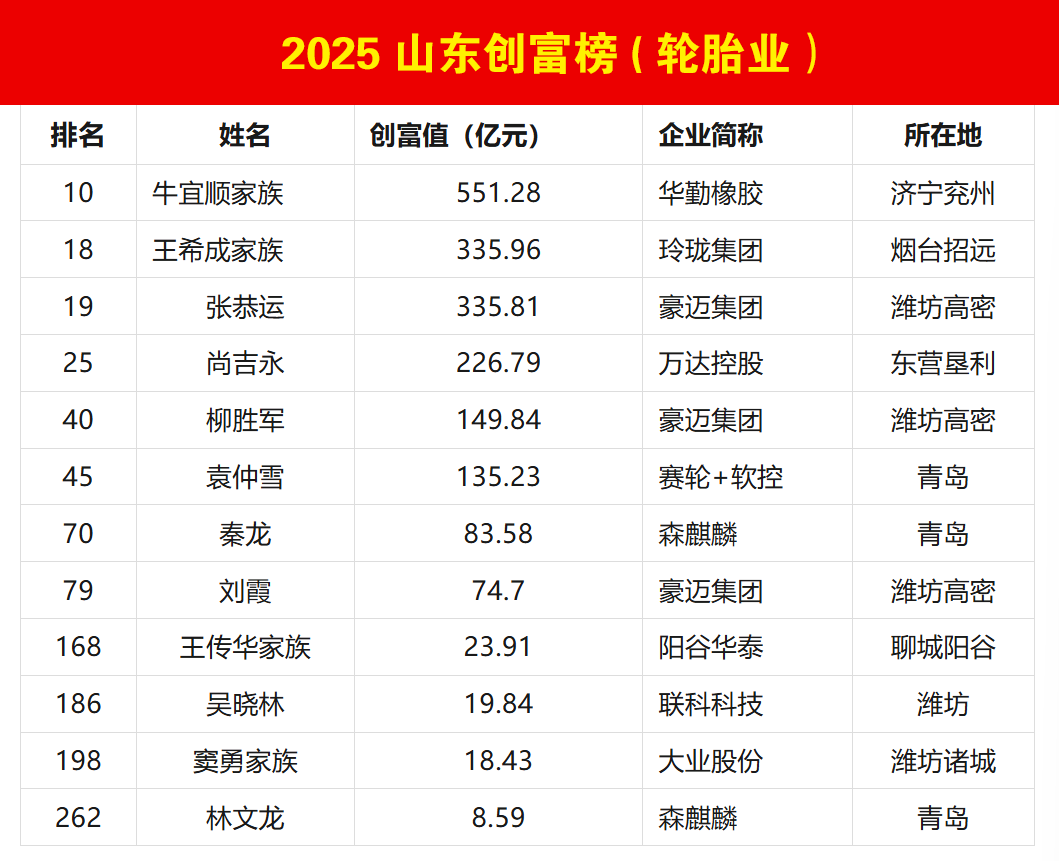
2025创富榜!多位轮胎大咖入选
Xin Lang Cai Jing· 2025-12-31 16:01
Core Insights - The "2025 Shandong Wealth Creation List" features 300 entrepreneurs from 165 companies, with a total wealth creation amounting to 2.5 trillion yuan, averaging 83.46 million yuan per person, and a minimum entry threshold of 5.3 million yuan [2][19][16]. Group 1: Tire Industry Entrepreneurs - Notable entrepreneurs in the tire industry include the Niu Yishun family, Wang Xicheng family, Zhang Gongyun, Shang Jiyong, and Yuan Zhongxue, with 8 individuals making it into the top 100 [2][18]. - The top tire industry entrepreneur is the Niu Yishun family, ranked 10th with a wealth creation value of 551.28 billion yuan from Huqin Rubber, located in Jining Yanzhou [2][18]. - Other prominent figures include Wang Xicheng family (18th, 335.96 billion yuan, Linglong Group, Yantai Zhaoyuan) and Zhang Gongyun (19th, 335.81 billion yuan, Haomai Group, Weifang Gaomi) [2][18]. Group 2: Overall Rankings and Wealth Distribution - The overall wealth creation list includes Zhang Gang at the top with 1,127.67 billion yuan from Xinfeng Group, followed by Zhang Bo (748.82 billion yuan, Weiqiao Group) and Yu Xiaoning family (738.25 billion yuan, Daon Group) [5][21]. - The list has seen an increase in female entrepreneurs, with 25 women represented, up by 5 from the previous year, contributing a total wealth of 237.7 billion yuan, averaging 95.08 million yuan per person [3][19]. - The list has been compiled by Shandong Business Daily for 16 consecutive years, highlighting the ongoing economic development in the region [3][19].