Seazen(601155)

Search documents
新城控股股价涨5.11%,安信基金旗下1只基金重仓,持有29.62万股浮盈赚取21.92万元
Xin Lang Cai Jing· 2025-11-20 05:28
Group 1 - The core point of the article highlights the recent performance of New城控股, which saw a 5.11% increase in stock price, reaching 15.23 yuan per share, with a trading volume of 270 million yuan and a turnover rate of 0.81%, resulting in a total market capitalization of 34.353 billion yuan [1] - New城控股, established on June 30, 1996, and listed on December 4, 2015, primarily engages in real estate development and sales, with revenue composition as follows: 68.63% from real estate development and sales, 29.06% from property leasing and management, and 2.31% from other supplementary activities [1] Group 2 - From the perspective of major fund holdings, data indicates that Anxin Fund has one fund heavily invested in New城控股. The Anxin New Value Mixed A Fund (003026) increased its holdings by 221,000 shares in the third quarter, totaling 296,200 shares, which represents 0.87% of the fund's net value, ranking as the sixth-largest holding [2] - The Anxin New Value Mixed A Fund (003026) was established on August 19, 2016, with a current size of 98.43 million yuan. Year-to-date returns stand at 9.53%, ranking 5803 out of 8136 in its category; over the past year, returns are at 12.33%, ranking 5137 out of 8055; and since inception, the fund has achieved a return of 104.2% [2] Group 3 - The fund managers of Anxin New Value Mixed A Fund (003026) are Wang Tao and Liang Bingzhe. As of the report, Wang Tao has a cumulative tenure of 10 years and 322 days, managing a total fund size of 9.625 billion yuan, with the best fund return during his tenure being 31.75% and the worst being -5.99% [3] - Liang Bingzhe has a cumulative tenure of 4 years and 84 days, managing a total fund size of 4.75 billion yuan, with the best fund return during his tenure being 27.73% and the worst being -3.81% [3]

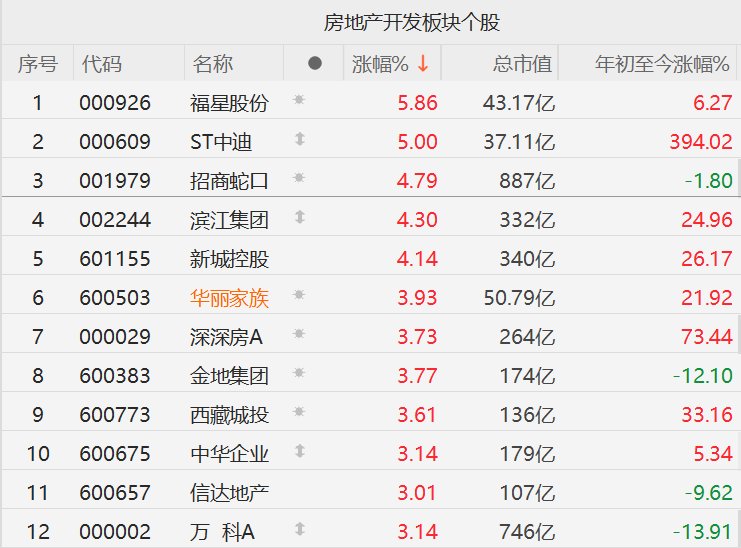
A股部分地产股拉升,招商蛇口涨超4%
Ge Long Hui A P P· 2025-11-20 03:32
Group 1 - A-share market saw a rise in certain real estate stocks influenced by related rumors, with notable increases in stocks such as China Merchants Shekou, Binjiang Group, and New Town Holdings, which rose over 4% [1] - Other companies like Huayi Family, Shenzhen Housing A, Jindi Group, Tibet City Investment, China Enterprises, Xinda Real Estate, and Vanke A experienced increases of over 3% [1] Group 2 - The real estate development sector showed significant stock performance, with 福星股份 (Fuxing Co.) leading with a rise of 5.86% and a total market value of 4.317 billion [2] - ST中油 (ST Zhongyou) followed with a 5.00% increase and a market value of 3.711 billion, while 招商蛇口 (China Merchants Shekou) rose by 4.79% with a market cap of 88.7 billion [2] - Other notable performers included 滨江集团 (Binjiang Group) with a 4.30% increase and a market value of 3.32 billion, and 新城控股 (New Town Holdings) with a 4.14% rise and a market cap of 3.4 billion [2]



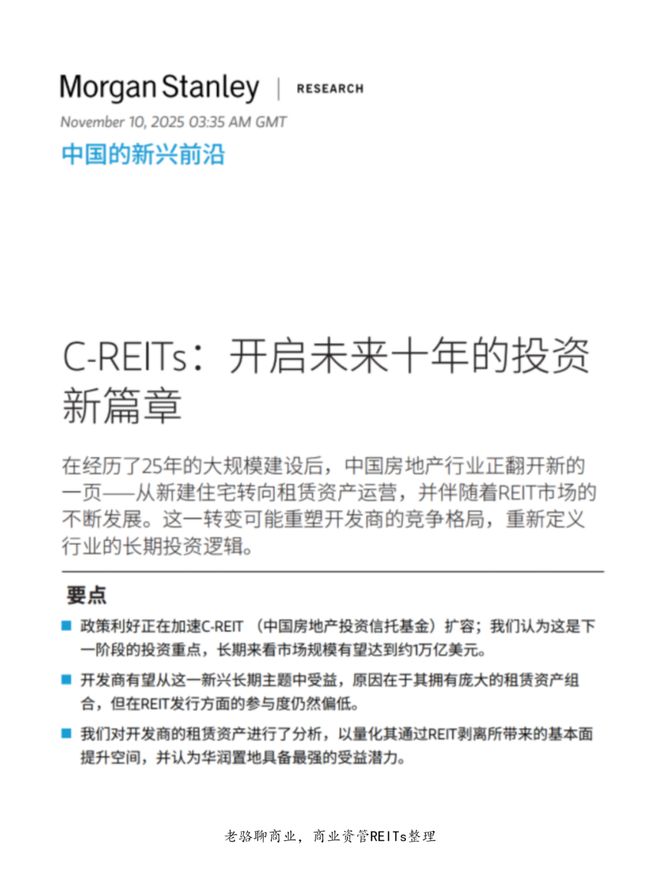
C-REITs:开启未来十年的投资新篇章
Xin Lang Cai Jing· 2025-11-19 04:31
Core Insights - The Chinese real estate industry is transitioning from new residential construction to rental asset operations, alongside the development of the REIT market, which may reshape the competitive landscape for developers and redefine long-term investment logic [1][3]. Group 1: C-REIT Expansion - Policy incentives are accelerating the expansion of C-REITs (China Real Estate Investment Trusts), with the market size expected to reach approximately $1 trillion in the long term [2][4]. - Developers are likely to benefit from this emerging long-term theme due to their large rental asset portfolios, although their participation in REIT issuance remains low [2][4]. - The analysis of developers' rental assets indicates that China Resources Land has the strongest potential for benefit from REIT spin-offs [2][4]. Group 2: Market Dynamics - Since Q3 2025, favorable policies have accelerated the issuance of domestic REITs, expanding the asset range and issuer backgrounds [6]. - C-REITs are expected to become an important asset class over the next 10 to 20 years due to their stable returns and low correlation with the stock market [6]. - The limited trading volume of C-REITs suggests that listed developers are a good entry point into this rapidly expanding theme [6]. Group 3: Key Beneficiaries - In-depth analysis shows that China Resources Land (1109.HK) has the highest short-term benefit potential, followed by New World Development (601155.SS) and Longfor Group (0960.HK) due to their large shopping center portfolios [7]. - Other companies with rich non-retail rental assets, such as China Overseas Land (0688.HK), China Merchants Shekou (001979.SZ), Vanke (2202.HK), and Poly Developments (600048.SS), may also benefit in the medium term as the REIT coverage expands [7]. Group 4: C-REIT Development History - The development of C-REITs over the past 25 years can be divided into four phases: initial preparation, gradual development, accelerated promotion, and full-speed phase [9]. - The regulatory framework for C-REITs was first proposed in the early 2000s, with significant progress made since the first public REIT was listed in mid-2021 [8][9]. Group 5: Current Market Status - As of September 2025, there are 75 publicly listed C-REITs with a cumulative issuance scale of approximately RMB 200 billion and a market value of about RMB 220 billion [10]. - Despite significant growth since the first public REITs were listed, C-REITs currently account for only 0.15% of the total market value of China's stock market [10]. Group 6: Future Potential - The potential market size for C-REITs is estimated to reach $1 trillion, which is 32 times the current market value of approximately $31 billion [15][16]. - The estimated value of commercial properties completed since 2000 is around $4.9 trillion, indicating a significant opportunity for C-REITs to capture a larger market share [14][15].

存量时代倒逼运营升级 商业地产迈入“精耕细作”阶段
Zhong Guo Jing Ying Bao· 2025-11-18 03:00
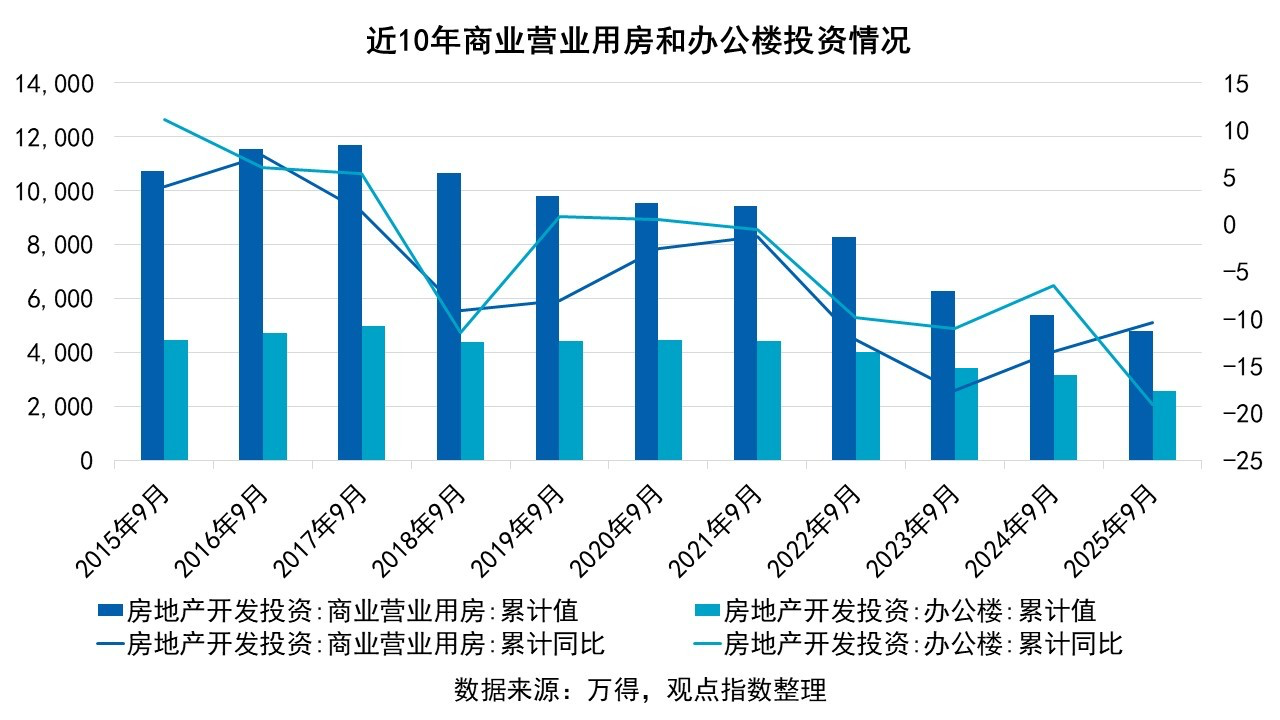
Core Insights - The "14th Five-Year Plan" emphasizes expanding domestic demand as a strategic foundation, focusing on improving people's livelihoods and promoting consumption, which presents new opportunities for retail real estate [2][3] - The commercial real estate sector is entering a phase of differentiation and revitalization, with some companies recovering investment activities despite facing revenue challenges [2][3] - The demand for experiential consumption is increasing, indicating a shift in consumer preferences that retail commercial real estate must adapt to [3][4] Group 1: Market Trends - The total retail sales of consumer goods reached 36.5877 trillion yuan from January to September 2025, with a growth rate of 4.46% [3] - During the recent 8-day National Day and Mid-Autumn Festival holiday, domestic travel reached 888 million people, an increase of 123 million compared to the previous year, with total spending of 809 billion yuan, up 108.2 billion yuan [3] - The commercial real estate development investment is still facing growth challenges, with large enterprises capturing market share but struggling for continuous revenue growth, while small and medium-sized enterprises face operational difficulties [3][5] Group 2: Consumer Behavior - The middle-aged and elderly population, along with young consumers, are identified as key demographics with significant spending potential [4] - The middle-class consumer group is experiencing structural shifts, leading to a complex consumption mindset characterized by a desire for diverse products and services [4] - Companies are adopting strategies that integrate social media and personalized services to enhance customer engagement and attract consumers [4][5] Group 3: Business Strategies - Companies are focusing on optimizing existing assets and exploring new business models, such as the "light asset" approach to expand their market presence [5] - The competition in the commercial sector is intensifying, requiring businesses to innovate in content creation, unique experiences, and refined operations [5][6] - The overall short-term policy effects on consumption are becoming evident, although the recovery of investment remains slow, indicating a gradual restoration of market confidence [6]


新城控股跌2.02%,成交额5837.76万元,主力资金净流入1243.77万元
Xin Lang Cai Jing· 2025-11-18 02:17
Core Viewpoint - New City Holdings has experienced a decline in stock price and revenue, indicating potential challenges in the real estate market [1][2]. Group 1: Stock Performance - On November 18, New City Holdings' stock price fell by 2.02%, reaching 14.58 CNY per share, with a total market capitalization of 32.887 billion CNY [1]. - The stock has increased by 21.91% year-to-date but has seen a decline of 2.61% over the last five trading days, 3.06% over the last twenty days, and 10.61% over the last sixty days [1]. Group 2: Financial Performance - For the period from January to September 2025, New City Holdings reported a revenue of 34.371 billion CNY, a year-on-year decrease of 33.34%, and a net profit attributable to shareholders of 0.974 billion CNY, also down by 33.05% [2]. - Cumulatively, the company has distributed 14.595 billion CNY in dividends since its A-share listing, with no dividends paid in the last three years [3]. Group 3: Shareholder Structure - As of September 30, 2025, the number of shareholders decreased by 12.34% to 43,200, while the average number of tradable shares per person increased by 14.07% to 52,155 shares [2]. - The top ten circulating shareholders include Hong Kong Central Clearing Limited, which reduced its holdings by 701,400 shares, and ICBC Value Selection Mixed A, which is a new shareholder with 15.7412 million shares [3].
新城控股投资研报:商业地产赋能下的估值修复机会
Xin Lang Cai Jing· 2025-11-17 07:53
Company Overview - The company, New Town Holdings, has been established for 20 years and operates with a dual business model of residential development and commercial operations, which enhances its stability [1] - As of Q3 2025, the company has total assets of 280.67 billion yuan and equity attributable to shareholders of 61.87 billion yuan, with a high shareholding concentration of 67.20% [1] - The major shareholders have pledged shares, but the pledge ratios are within safe limits, ensuring stable control [1] Core Competitiveness - The commercial real estate segment, centered around "Wuyue Plaza," has opened over 150 locations with a stable occupancy rate of 97.81% [2] - The total revenue from commercial operations reached 6.944 billion yuan, reflecting a year-on-year growth of 11.8%, with a gross profit margin of 71.20% [2] - The stable cash flow from commercial real estate mitigates the cyclical fluctuations of residential development, providing solid support for debt repayment [2] Industry Environment - Since 2025, the real estate industry has seen continuous policy easing, with central and local governments implementing measures to stabilize the market and improve financing conditions for private enterprises [4] - The market is experiencing a bifurcation, with core cities showing resilience while third and fourth-tier cities face pressure; sales in core cities saw a year-on-year decline of only 5.2% [5] - New Town Holdings has strategically acquired over 60% of its land reserves in core cities, positioning itself to capitalize on the industry's recovery [5] Financial Analysis - In Q3 2025, the company reported revenue of 12.271 billion yuan, a year-on-year decline of 30.51%, primarily due to reduced project deliveries [3] - The net profit attributable to shareholders was 79 million yuan, down 42.09% year-on-year, but the commercial operations continue to grow, contributing over 70% of gross profit [3] - The debt structure has improved, with a debt-to-asset ratio of 72.00% and a net debt ratio of 52.44%, indicating a strong liquidity position [3] Valuation and Stock Price Analysis - As of November 3, 2025, the company's stock price is 13.99 yuan, corresponding to a dynamic PE of 24.30 times and a PB of 0.40 times, significantly lower than the industry median [7] - The target price is set at 18.50 yuan, indicating a potential upside of 32.2% based on a 2026 PB of 0.68 times [7] - Analysts are optimistic about the stock's future performance, with 73.91% recommending a "strong buy" and a target price average of 18.49 yuan, suggesting a potential increase of 32.2% [8]

房地产行业2026年投资策略:潮平待风起,扬帆更远航
Shenwan Hongyuan Securities· 2025-11-17 04:13
Group 1 - The core viewpoint of the report indicates that the stabilization of the residential balance sheet suggests a potential bottoming out in the real estate market, but the speed of improvement will determine the duration of this bottoming process [3][4] - The report highlights that since 2021, China's housing prices have cumulatively declined by 37%, which is longer than the average decline of 34% over 6.1 years in 42 countries, indicating that while the price drop is significant, the adjustment period in China is still relatively short [22][7] - The report identifies five major opportunities in the industry, including the stabilization of the residential asset-liability ratio, a decrease in the housing price-to-income ratio, improving rental yields, a bullish stock market potentially boosting wealth effects, and a deep clearing of supply-side issues [3][4] Group 2 - The industry outlook predicts a structural bottoming out, with opportunities arising for quality housing and commercial real estate, driven by policies focusing on demand recovery and high-quality development [3][4] - The report anticipates that the core cities will stabilize sooner due to healthier supply-demand relationships, with a forecast for sales volume and price declines to narrow in 2025-2026 [3][4] - The report maintains a "positive" rating for the real estate sector, recommending specific companies in the quality housing and commercial real estate segments, as well as undervalued firms and property management companies [3][4]




地产及物管行业周报:国务院支持民间投资项目发行REITs,央行明确完善房地产金融基础性制度-20251116
Shenwan Hongyuan Securities· 2025-11-16 07:12
Investment Rating - The report maintains a "Positive" rating for the real estate and property management sectors [2][3]. Core Insights - The real estate market is expected to continue bottoming out, with core cities stabilizing sooner. Two major opportunities are highlighted: the rise of favorable policies for housing and the potential for commercial real estate assets to be revalued during a monetary easing cycle [2][3]. Industry Data - New home sales in 34 key cities totaled 201 million square meters last week, up 11.9% week-on-week, with first and second-tier cities increasing by 12.6% and third and fourth-tier cities by 3.2% [4][5]. - Year-on-year, new home sales in November are down 39%, with first and second-tier cities down 37.8% and third and fourth-tier cities down 49.2% [5][7]. - The inventory of unsold residential properties in 15 cities was 89.538 million square meters, with a slight increase of 0.03% week-on-week [22][23]. Policy and News Tracking - The State Council supports the issuance of REITs for private investment projects and the central bank aims to improve the foundational financial system for real estate [31][32]. - Local policies include the promotion of purchasing existing homes for affordable housing in Hangzhou and the launch of online applications for housing provident fund loans in Zhengzhou [31][34]. Company Dynamics - Several real estate companies reported their sales data for October 2025. China Jinmao achieved sales of 12 billion yuan, up 3%, while other companies like New Town Holdings and CIFI Holdings saw significant declines [38][39]. - China Resources Land announced a placement of 49.5 million shares, raising approximately 2.06 billion HKD, maintaining a 70.1% stake post-placement [38][39]. Sector Performance Review - The SW Real Estate Index rose by 2.7%, outperforming the CSI 300 Index, which fell by 1.08%, ranking 7th among 31 sectors [43][47]. - Notable stock performances included China Wuyi and Huaxia Happiness, which saw significant gains, while companies like Asia Pacific Real Estate and Shenzhen Real Estate A experienced declines [47].


房地产1-10月月报:投资低位进一步走弱,销售量价降幅均扩大-20251115
Shenwan Hongyuan Securities· 2025-11-15 11:14
Investment Rating - The report maintains a "Positive" rating for the real estate sector, indicating a cautious optimism despite current challenges [2][3]. Core Insights - The investment side of the real estate sector continues to weaken, with significant declines in new construction and completion rates. For the period from January to October 2025, total real estate investment decreased by 14.7% year-on-year, with new construction down by 19.8% and completions down by 16.9% [1][20]. - The sales side shows a broader decline in sales volume and price. From January to October 2025, the sales area decreased by 6.8% year-on-year, with a more pronounced drop of 18.8% in October alone. The sales amount also fell by 9.6% year-on-year, with a 24.3% decline in October [2][33]. - Funding sources for real estate development are tightening, with total funding down by 9.7% year-on-year. In October, funding sources saw a significant drop of 21.9% compared to the previous month [35]. Investment Analysis - The report suggests that the real estate sector is still in a bottoming phase, with core cities expected to stabilize sooner. Two major opportunities are highlighted: the potential shift of real estate companies towards manufacturing and the favorable conditions for quality commercial enterprises during a monetary easing cycle [2][3]. - Adjustments to the 2025 forecasts include a projected investment decline of 14.2% (previously 11.0%), new construction down by 18.0% (previously 15.1%), and completions down by 17.7% (previously 20.0%) [20][34].
行业点评报告:新房二手房价格环比降幅扩大,上海新房价格同环比持续领涨
KAIYUAN SECURITIES· 2025-11-14 14:57
Investment Rating - The investment rating for the real estate industry is "Positive" (maintained) [1] Core Insights - In October 2025, new home prices in 70 cities showed a month-on-month decline, while the year-on-year decline narrowed. First-tier cities maintained their price decline [6][10] - Second-hand home prices experienced both month-on-month and year-on-year declines, indicating a continued downward trend in the market [6][10] - The report highlights that the real estate market is moving towards stabilization due to various policies aimed at halting the decline, with expectations for further stabilization in the future [6][10] Summary by Sections New Home Prices - New home prices in first, second, and third-tier cities decreased by -0.3%, -0.4%, and -0.5% month-on-month respectively, with an overall decline of -0.5% across 70 cities, which is an increase in the decline rate by 0.1 percentage points compared to September [3][13] - Year-on-year, first, second, and third-tier cities saw declines of -0.8%, -2.0%, and -3.4% respectively, with the overall year-on-year decline for 70 cities narrowing by 0.1 percentage points to -2.6% [3][13] Second-Hand Home Prices - Second-hand home prices in 70 cities fell by -0.7% month-on-month, with the decline rate increasing by 0.1 percentage points. First, second, and third-tier cities saw declines of -0.9%, -0.6%, and -0.7% respectively [4][20] - Year-on-year, second-hand home prices across 70 cities decreased by -5.4%, with the decline rate expanding by 0.2 percentage points [4][20] Key City Performance - In a focus on 35 key cities, new home prices showed mixed results, with Shanghai leading with a month-on-month increase of +0.3% and a year-on-year increase of +5.7% [5][28] - Conversely, second-hand home prices in these cities uniformly declined, with Shanghai experiencing a year-on-year drop of -1.8% [5][28] Investment Recommendations - The report recommends focusing on strong credit real estate companies that can cater to improving customer demand, such as Greentown China, China Overseas Development, and others [6][10] - It also suggests companies benefiting from both residential and commercial real estate recovery, as well as high-quality property management firms under the "Good House, Good Service" policy [6][10]