
CPIC(601601)

Search documents
中国太保(601601):穿越周期、稳健前行,低估值保险龙头价值修复可期
Soochow Securities· 2026-02-13 05:41
Investment Rating - The report maintains a "Buy" rating for China Pacific Insurance (601601) [1] Core Views - The company is viewed as a leading insurance player with a low valuation, indicating potential for value recovery [1] - The report highlights the company's stable growth trajectory and its ability to provide consistent returns to shareholders through dividends [8] - The implementation of the "North Star Plan" is expected to enhance the company's competitive position and growth prospects in the insurance market [8] Summary by Sections 1. Company Overview - China Pacific Insurance is a leading comprehensive insurance group in China, focusing on life insurance as its main business while developing a balanced portfolio across various segments [14] - The company has a diversified ownership structure, with state-owned enterprises playing a significant role, which enhances operational efficiency [16] 2. Group Performance - The company has achieved stable growth in operating profits, with a return on equity (ROE) consistently above 10%, outperforming peers [8][21] - The internal value of the company is expected to grow steadily, with projections for 2025-2027 indicating increases of 8.1%, 8.3%, and 9.2% respectively [8] 3. Life Insurance Business - The life insurance segment has shown strong growth, with new business value (NBV) increasing significantly, leading the industry in growth rates [8][23] - The focus on bancassurance channels has resulted in a rapid increase in the proportion of new business from this segment, which is now a core growth driver [8][23] 4. Property Insurance Business - The property insurance segment has maintained profitability despite structural adjustments, with a stable growth rate in premiums [8][27] - The company has consistently achieved underwriting profitability, with a combined ratio (COR) that remains competitive within the industry [8][27] 5. Asset Management - The company has a robust investment strategy, with a high proportion of bond holdings and a stable investment return rate, placing it among the upper tier of listed insurance companies [8][31] - The net investment yield has averaged 4.3% from 2020 to 2024, indicating strong performance relative to peers [8][31] 6. Financial Projections - Revenue forecasts for 2023 to 2027 show a recovery trend, with expected revenues of 323.9 billion yuan in 2023 and projected growth to 439.7 billion yuan by 2027 [1] - The projected net profit for 2024 is 44.96 billion yuan, reflecting a significant year-on-year increase of 64.95% [1]

保险资金运用数据点评:2025年显著增配核心权益,债券增配节奏放缓
Soochow Securities· 2026-02-13 03:49
Investment Rating - The industry investment rating is maintained as "Increase" [1] Core Insights - The insurance industry is experiencing significant growth in asset allocation towards core equities, with a slowdown in bond allocation pace [5] - By the end of 2025, the total investment balance of the insurance industry reached 38.5 trillion yuan, marking a 15.7% increase from the beginning of the year, the highest growth rate since 2021 [9] - The allocation of "stocks + funds" increased by 1.6 trillion yuan in 2025, with a total balance of 5.7 trillion yuan by year-end [5] - The proportion of "stocks + funds" in total investment reached 15.4% by the end of 2025, an increase of 2.6 percentage points from the beginning of the year [5] - The demand in the market remains strong, and the optimization of liability costs is expected to alleviate pressure from interest rate spreads [5] Summary by Sections Investment Allocation - By the end of 2025, the investment scale of life insurance companies was 34.7 trillion yuan, accounting for 90.1% of the industry [5] - The allocation of bank deposits decreased to 7.6%, while the bond allocation increased to 51.1% [5] - The allocation of stocks and funds reached a high level, with stocks accounting for 10.1% and funds for 5.3% of total investments [5] Market Outlook - The recent decline in the yield of ten-year government bonds to approximately 1.81% is expected to ease the pressure on the investment income of insurance companies [5] - The insurance sector's valuation remains at historical lows, with estimated PEV ranging from 0.64 to 0.86 and PB from 1.15 to 2.24 [5]




黄石监管分局同意国华人寿黄石中心支公司营业场所变更
Jin Tou Wang· 2026-02-13 03:27
2026年2月12日,国家金融监督管理总局黄石监管分局发布批复称,《国华人寿保险股份有限公司湖北 分公司关于黄石中心支公司变更营业场所的请示》(国华寿鄂〔2026〕9号)收悉。经审核,现批复如 下: 二、国华人寿保险股份有限公司应按照有关规定及时办理变更及许可证换领事宜。 一、同意国华人寿保险股份有限公司黄石中心支公司营业场所变更为:湖北省黄石市下陆区杭州西路 206号B、C、E、G栋B栋综1001室。 ...
机器人“上岗”谁来兜底? 保险业加速布局机器人保障
Jin Rong Shi Bao· 2026-02-13 01:52
Core Viewpoint - The emergence of a comprehensive insurance system for robots is crucial to alleviate concerns from both suppliers and users, enabling the integration of robots into real-world applications [2][3]. Group 1: Insurance Development - The first "lifetime liability insurance for elderly care robots" was launched in Shanghai, addressing key concerns for both robot manufacturers and care institutions [2]. - A new insurance sector focused on robots is rapidly developing, with policies emerging to support various types of robots, including consumer-grade exoskeletons [2][3]. - The Chinese humanoid robot market is projected to reach 8.239 billion yuan by 2025, accounting for approximately 50% of the global market [3]. Group 2: Risk and Challenges - The complexity of robots introduces various risks, including hardware damage, software failures, and human-robot interaction issues, which pose challenges for insurance product design and pricing [5][6]. - Real-world incidents have highlighted the necessity of insurance, as accidents involving robots can lead to significant damages and liabilities [3][5]. - Insurance companies face difficulties in obtaining necessary operational data from robot manufacturers, which hinders accurate risk assessment and pricing [6]. Group 3: Collaborative Solutions - Policy guidance is essential for the development of insurance products in emerging fields like robotics, with local governments providing subsidies to stimulate market demand [7]. - Collaborative data sharing between insurance companies, industry players, and academic institutions is recommended to build a comprehensive risk database for humanoid robots [7]. - The rapid technological evolution of robots necessitates flexible insurance products that can adapt to new applications and scenarios [8]. Group 4: Market Potential - The humanoid robot market is expected to grow significantly, with projections indicating a market size of 20 to 50 billion yuan by 2028 and potentially reaching 10 trillion yuan by 2045 [8]. - The establishment of a robust insurance framework is vital not only for risk transfer but also for fostering the overall development of the robotics industry [8].

中国太保一周动态:科技金融创新落地,监管处罚与股价震荡并行
Jing Ji Guan Cha Wang· 2026-02-12 07:04
Group 1 - The core viewpoint of the articles highlights recent developments in China Pacific Insurance (601601) regarding business innovation, compliance, and capital market activities [1] - The company launched its first "Qin Scientific Research Development Insurance" in Shaanxi province, providing funding and risk protection for related R&D projects [1] - The life insurance branch in Siping was warned and fined by regulators due to misleading training materials, while the company’s Jinzhong branch also faced penalties for violations [1] - The board approved a reform plan for the compensation system of professional managers, reaffirming the company's asset allocation strategy based on the characteristics of insurance liabilities during investor interactions [1] Group 2 - The stock performance of China Pacific Insurance showed a downward trend over the past week, with a cumulative decline of 2.75% [2] - The latest closing price was 43.52 yuan, reflecting a daily drop of 1.81%, with net outflow of main funds [2] - Technical indicators suggest weak short-term momentum, and the overall insurance sector also performed poorly during this period [2]
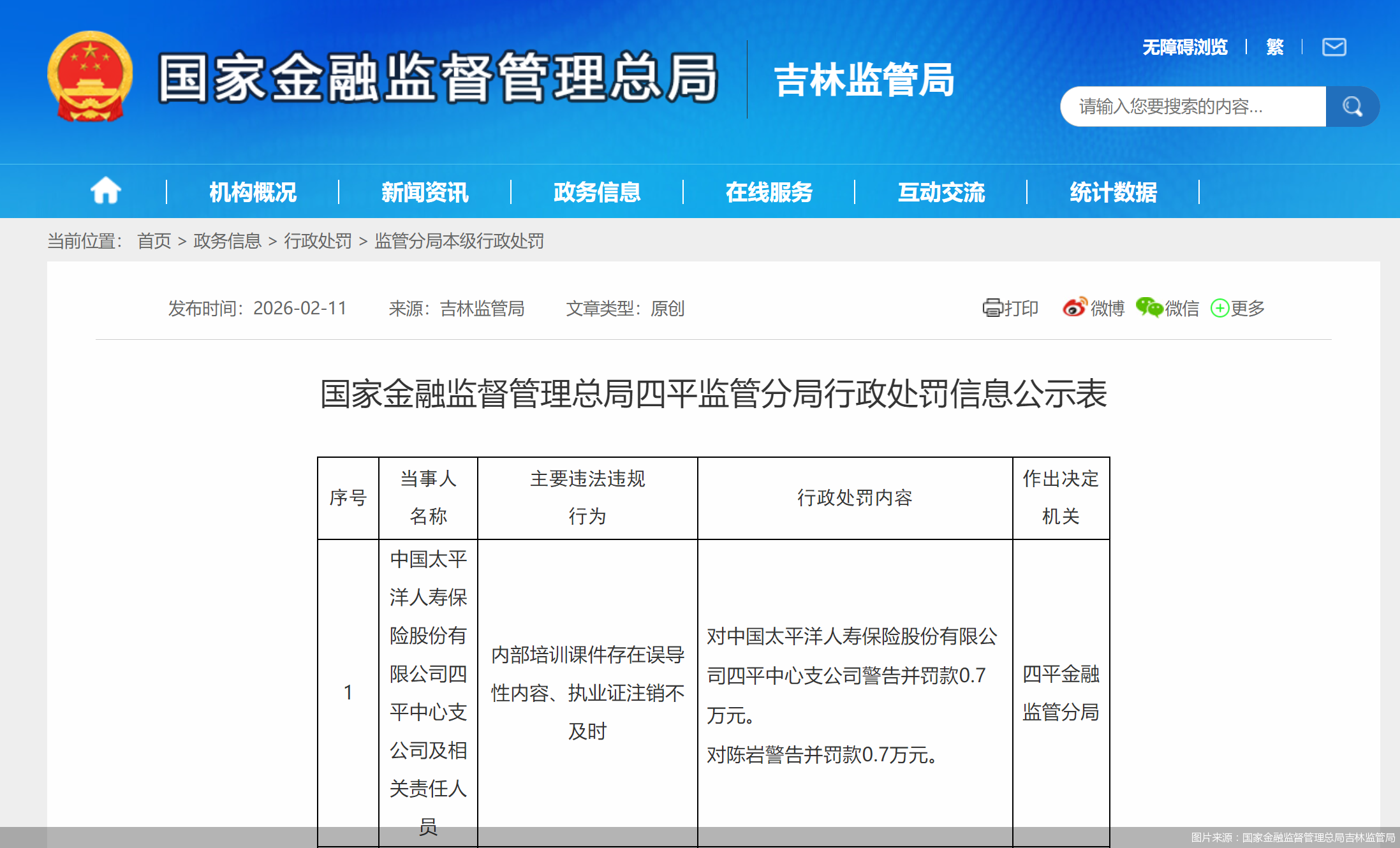
因内部培训课件存在误导性内容等,太保寿险四平中支合计被罚1.4万元
Bei Jing Shang Bao· 2026-02-11 11:20
Group 1 - The core viewpoint of the article highlights that China Pacific Life Insurance Co., Ltd. was penalized for misleading content in internal training materials and delayed cancellation of professional licenses [1] - The regulatory authority, the National Financial Supervision Administration, issued a warning and imposed a fine of 0.07 million yuan (0.7万元) on the company [1] - Individual responsibility was also addressed, with a fine of 0.07 million yuan (0.7万元) imposed on an individual named Chen Yan [1]

申万宏源:预计险企NBV增速亮眼 市场波动阶段性影响4Q25业绩表现
智通财经网· 2026-02-11 06:23
Group 1 - The core viewpoint is that the strong performance in the first three quarters lays a solid foundation for the annual results, with a high growth trend in NBV expected to continue into 2025 [1][2] - It is projected that the net profit attributable to shareholders of A-share insurance companies will increase by 22.7% year-on-year to 426.4 billion yuan in 2025, with a decrease in growth rate of 10.9 percentage points compared to the first three quarters of 2025 [1] - Specific companies are expected to show significant growth in net profit, including China Taiping (215%-225%), China Life (45.8%), and New China Life (43.0%) [1] Group 2 - The liability side of life insurance is expected to maintain a high growth trend, with projected NBV growth rates for various companies such as PICC Life (60.2%) and Sunshine Insurance (49.9%) [2] - The property insurance sector is expected to see a year-on-year premium income increase of 3.9% to 1.76 trillion yuan in 2025, with claims expenses rising by 1.6% to 1.17 trillion yuan [3] - The impact of Typhoon "Maitai" in October 2025 is expected to cause a temporary effect on the combined ratio (COR) performance, with significant economic losses reported [3] Group 3 - The strategy for insurance capital entering the market is continuously advancing, with the scale and proportion of investments in the secondary market increasing significantly [4] - By the end of September 2025, the balance of insurance funds in the secondary market reached 5.59 trillion yuan, accounting for 14.9% of total investments, an increase of 1.49 trillion yuan and 2.6 percentage points from the end of 2024 [4] - Market fluctuations are anticipated to exert pressure on investment performance in the fourth quarter of 2025, with various indices showing mixed performance [4]


聊城监管分局同意太保寿险聊城市东昌府支公司变更营业场所
Jin Tou Wang· 2026-02-11 03:49
Core Viewpoint - The National Financial Supervision Administration of Liaocheng has approved the change of business location for China Pacific Life Insurance Co., Ltd. Liaocheng Dongchangfu Branch to a new address [1] Group 1 - The new business location will be at 100 Xinhua East Road, 4th Floor, Dongchangfu District, Liaocheng City, Shandong Province [1] - The company is required to handle the change and obtain the necessary permits in accordance with relevant regulations [1]
险资购金试点一周年:配置克制 显“耐心资本”本色
Bei Jing Shang Bao· 2026-02-11 01:55
Core Insights - The insurance funds have cautiously entered the gold market, contrary to expectations of aggressive investment, reflecting a prudent approach amid market volatility [1][3][5] - The pilot program for insurance funds to invest in gold has been operational for a year, with ten insurance companies approved, but only six have completed membership with the Shanghai Gold Exchange [1][2][3] Group 1: Pilot Program Overview - The pilot program was officially launched on February 7, 2025, allowing ten insurance companies, including major players like China Life and PICC, to invest in gold [2][4] - By March 2025, several insurance companies completed their first transactions, indicating initial engagement with the gold market [2][3] Group 2: Investment Strategy and Caution - Despite the theoretical investment limit of nearly 200 billion yuan, actual investments remain low, with many companies still in a trial phase [3][5] - The cautious approach is attributed to the volatile nature of gold prices and the lack of experience among insurance companies in gold investment [5][7] Group 3: Challenges and Professional Barriers - Insurance companies face challenges due to the complex nature of gold as an asset, which requires sophisticated analysis and risk management capabilities [5][6] - Regulatory requirements mandate that insurance companies maintain strict internal controls and reporting mechanisms, adding to the operational complexity [6] Group 4: Long-term Perspectives - Long-term, gold is being recognized for its strategic value in diversifying portfolios and mitigating risks, especially in uncertain market conditions [7][8] - The shift towards gold investment is seen as a response to the limitations of traditional fixed-income assets, prompting insurance companies to explore new avenues for asset growth [7][9]
机器人“上岗”谁来兜底? 保险业加速布局机器人保障
Jin Rong Shi Bao· 2026-02-11 01:32
Core Insights - The emergence of "robot insurance" is crucial for addressing the risks associated with the deployment of intelligent robots in real-world scenarios, alleviating concerns from both suppliers and users [1][2] Group 1: Market Demand and Supply - The Chinese humanoid robot market is projected to reach 8.239 billion yuan by 2025, accounting for approximately 50% of the global market [3] - The complexity of robots leads to high repair costs, ranging from 30,000 to 300,000 yuan per incident, and introduces new risks such as network attacks and data breaches [3] - Real-world incidents have highlighted the necessity of insurance for robots, as accidents can lead to significant damages and liabilities [3][4] Group 2: Insurance Product Development - The first "lifetime liability insurance for elderly care robots" has been launched, addressing the concerns of both robot manufacturers and care institutions [2] - Insurance products are evolving to cover both self-protection and third-party liabilities, with comprehensive coverage for various risks including natural disasters and algorithm failures [4] - Innovative insurance solutions are being developed, integrating technology and capital to create a robust ecosystem for the robot industry [4] Group 3: Challenges and Solutions - The rapid technological advancements in robotics present challenges for insurance product design and pricing, as traditional data-driven models may not apply [5][6] - Collaboration among insurance companies, industry players, and academic institutions is essential for building a risk database and establishing industry standards [7] - Government policies and subsidies are being implemented to stimulate market demand and support the development of insurance products for robots [7] Group 4: Future Market Potential - The humanoid robot market is expected to grow significantly, with projections estimating a market size of 20 to 50 billion yuan by 2028 and potentially reaching 10 trillion yuan by 2045 [8] - The establishment of a comprehensive insurance system is vital for the sustainable development of the robotics industry, addressing various risk scenarios from operational errors to cybersecurity threats [8]