
CPIC(601601)

Search documents
险有所保、护有所依、养有所安——中国太保寿险发布“长护太保家园专属定制方案”
Xin Lang Cai Jing· 2026-02-07 01:11
Core Insights - The article discusses the transition of China's long-term care insurance (LTCI) from pilot exploration to comprehensive establishment in 2026, marking a significant step in addressing the urgent need for elderly care amidst an aging population [1][2] Group 1: Industry Context - China's aging population is rapidly increasing, with 1 in every 6 individuals being elderly and 1 in 6 elderly individuals being disabled or semi-disabled, resulting in a total of 45 million disabled elderly [2] - The supply of professional caregivers is severely lacking, with only 20,000 certified professionals available to meet the needs of nearly 45 million disabled elderly, highlighting a significant gap in care services [2] - The "421" family structure is becoming common, leading to nearly 100 million elderly living alone or in empty-nest situations, which weakens family care capabilities [2] Group 2: Long-Term Care Insurance Development - The LTCI pilot program has shown significant results since its initiation in 2016, expanding to 49 cities by 2020, with 12,000 designated service institutions and nearly 300 million insured individuals by 2025 [2] - The program has benefited over 3.3 million disabled individuals, reducing their financial burden by approximately 12,000 yuan annually [2] - The government has emphasized the acceleration of commercial LTCI development, aiming for a collaborative care insurance model between the government and the market [2] Group 3: Company Initiatives - China Pacific Insurance (CPIC) has actively participated in over 50% of the national LTCI pilot projects, covering 43 cities and serving nearly 80 million insured individuals, with payouts exceeding 5.3 billion yuan [3] - CPIC launched the "Long-Term Care Taibao Home Exclusive Customized Plan," integrating insurance expertise, LTCI experience, and health care resources to provide a comprehensive solution for elderly care [3][5] - The "Xin Long Care" product offers tax benefits and covers care responsibilities for specific diseases or disabilities, providing flexible financial solutions for clients [3] Group 4: Future Outlook - CPIC plans to continue enhancing its comprehensive health and care strategy, upgrading insurance solutions, and improving service levels to contribute to the high-quality development of LTCI in response to the aging population [7]



险资巨头再次举牌同行 专家分析,此举有利于提升险企长期投资收益率
Zheng Quan Ri Bao· 2026-02-06 16:42
Group 1 - China Ping An increased its stake in China Life by 10.12% after acquiring 10.895 million H-shares, triggering relevant regulations in the Hong Kong market [1] - The insurance sector is seeing a trend where insurance capital is increasingly investing in undervalued stocks with stable governance and good business models, which helps alleviate the "asset shortage" and improve long-term investment returns [1] - Since last year, China Ping An has repeatedly increased its holdings in peer companies, with its stake in China Pacific Insurance rising from 5.04% to 11.28%, also triggering multiple regulatory events [1] Group 2 - Analysts expect the insurance sector's valuation to have significant upside potential due to strong market demand and improving liability costs, with a forecasted recovery in long-term interest rates supporting investment returns [2] - The insurance industry is entering an upward cycle in terms of both volume and price, driven by factors such as strong demand for savings and pension products, as well as regulatory changes affecting product pricing [2] - Insurance companies are expected to adopt a "fixed income plus" investment strategy, increasing their equity investments while enhancing their long-term fixed income assets [3]


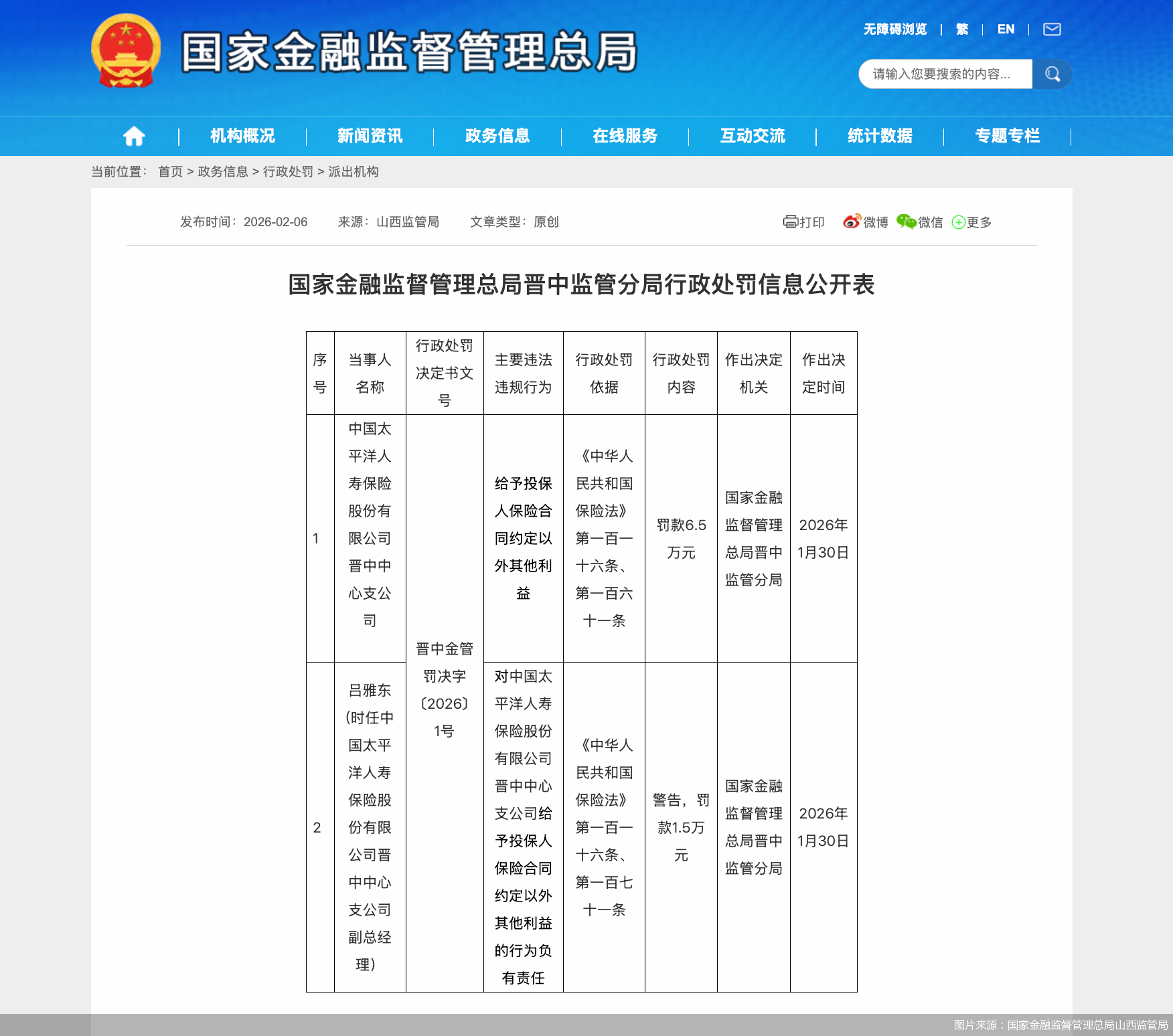
给予投保人保险合同约定以外的其他利益,太保寿险晋中中心支公司被罚8万元
Bei Jing Shang Bao· 2026-02-06 12:10
Core Viewpoint - China Pacific Life Insurance Co., Ltd. was fined for providing benefits outside of the insurance contract to policyholders, highlighting regulatory scrutiny in the insurance sector [1][3]. Group 1: Company Actions - China Pacific Life Insurance Co., Ltd. was penalized with a fine of 65,000 yuan for violating insurance regulations [1][3]. - The company's vice president, Lü Yadong, received a warning and was fined 15,000 yuan for his role in the violation [1][3]. Group 2: Regulatory Framework - The penalties were based on violations of the Insurance Law of the People's Republic of China, specifically Articles 116 and 111 [3].
加码“银发经济” 国寿、太保等头部险企竞逐“大康养”生态
2 1 Shi Ji Jing Ji Bao Dao· 2026-02-06 09:31
南方财经全媒体记者 林汉垚 国家统计局最新数据显示,2025年末,我国60岁及以上人口32338万人,占总人口的23.0%,比上年增加1307万人;65岁及以上人口22365万 人,占总人口的15.9%,比上年增加342万人。 在人口老龄化加速推进的背景下,养老产业已成为国家多层次社会保障体系建设的关键一环,亦成为拥有长期资金优势的保险机构战略转型与 生态布局的核心赛道。 "城心模式"成新选择 政策、市场驱动险企布局养老产业 养老产业兼具民生属性和市场潜力,其发展始终受到国家政策的有力牵引。 近年来,从《关于发展银发经济增进老年人福祉的意见》、《关于深化养老服务改革发展的意见》到《关于培育养老服务经营主体 促进银发 经济发展的若干措施》,一系列顶层设计密集出台,明确了鼓励社会力量参与、促进医养结合、发展银发经济的总基调。 金融方面,中央金融工作会议将"养老金融"列为五篇大文章之一。随后。国家金融监管总局发布《关于银行业保险业做好金融"五篇大文章"的 指导意见》明确,"在风险有效隔离的基础上,支持保险机构以适当方式参与养老服务体系建设,探索实现长期护理、风险保障与机构养老、 社区养老等服务有效衔接。" 与此同时 ...




机构行为更新专题:理解‘平准基金’的三个视角
Guoxin Securities· 2026-02-06 01:20
Investment Rating - The report maintains an "Outperform" rating for the non-bank financial sector [5][4]. Core Insights - The report emphasizes that the intervention of stabilization funds has become a normalized and institutionalized mechanism in capital markets, which requires institutional investors to adapt their asset allocation strategies to include policy variables for long-term considerations [2][11]. - The shift from direct intervention in individual stocks to a focus on broad-based ETFs represents a strategic evolution aimed at maintaining market stability while minimizing distortions in price signals [3][52]. - The report highlights that the actions of the "national team" in stabilizing the market have led to a gradual formation of a "slow bull" market, improving the operating environment for non-bank financial sectors and enhancing long-term valuations for brokerages and insurance companies [3][12]. Summary by Sections Overseas Perspective - Stabilization funds are viewed as essential stabilizing forces in capital markets, with examples from Japan and the U.S. demonstrating their long-term operational roles rather than short-term emergency measures [2][11]. - Japan's central bank has become a major player in market interventions, with its ETF holdings reaching approximately 37 trillion yen by the end of 2025, indicating a shift to a normalized intervention strategy [14][20]. Domestic Practice - Since 2023, the central financial institutions in China have optimized their strategies by focusing on increasing holdings in broad-based ETFs like the CSI 300 and SSE 50, which has effectively reduced irrational market volatility and guided investors towards core market assets [3][12]. - The report notes that this transition from precise stock interventions to macro-guided asset combinations has laid a solid foundation for a long-term value return in the market [3][12]. Key Company Earnings Forecasts - The report provides earnings per share (EPS) and price-to-earnings (PE) ratios for several companies, all rated as "Outperform": - China Ping An: EPS 7.87 (2025E), PE 8.56 (2025E) [4] - China Life: EPS 6.07 (2025E), PE 8.02 (2025E) [4] - China Pacific Insurance: EPS 5.40 (2025E), PE 8.28 (2025E) [4] - CITIC Securities: EPS 2.21 (2025E), PE 12.83 (2025E) [4] - Guotai Junan: EPS 1.53 (2025E), PE 13.08 (2025E) [4] - Industrial Securities: EPS 0.39 (2025E), PE 17.69 (2025E) [4] - Dongfang Securities: EPS 0.69 (2025E), PE 14.84 (2025E) [4]



寿险银保渠道保费增速榜 透视三大阵营分化
Nan Fang Du Shi Bao· 2026-02-05 23:13
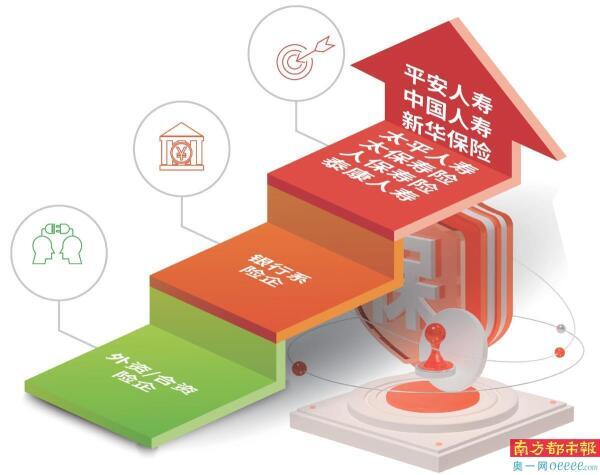
Core Insights - The article discusses the increasing trend of banks promoting insurance products, driven by the ongoing "deposit migration" and the urgent need for banks to boost their intermediary business revenue [2][6] - The insurance industry is witnessing a competitive landscape in the bancassurance channel, with significant growth in premium income, particularly among leading insurance companies [3][6] Group 1: Industry Trends - In 2025, the bancassurance channel for life insurance is expected to see an overall premium growth rate of approximately 10%, with leading insurers outperforming the industry average [3] - The "old seven" life insurance companies (including Ping An Life and China Life) achieved over 40% growth in bancassurance premiums, with Ping An Life leading at a remarkable 163% year-on-year increase [3][6] - The total premium income of the insurance industry surpassed 6 trillion yuan in 2025, marking a 7.4% year-on-year growth, with life insurance companies contributing significantly [6] Group 2: Competitive Landscape - There is a clear division among bank-affiliated insurance companies, with some experiencing significant growth while others face declines; for instance, Everbright Life Insurance saw a 111% increase, while others like China Merchants Life faced negative growth [4][5] - Foreign and joint venture insurers, although smaller in size, are achieving impressive growth rates by focusing on high-net-worth clients and long-term value services [5] Group 3: Strategic Developments - The removal of restrictions on the number of insurance companies a single bank branch can partner with has expanded product selection and improved matching with customer needs [7] - Insurers are actively enhancing their bancassurance channel strategies, with predictions indicating that new business value growth will be primarily driven by this channel in 2026 [8][11] - Major insurers are establishing extensive partnerships with banks, with China Life collaborating with over 100 banks and other companies also expanding their banking partnerships [9][11]
创新发展 | 中国太保举办首届科技创新大会,推动“人工智能+”战略落地
Sou Hu Cai Jing· 2026-02-05 13:52
Core Insights - China Pacific Insurance (CPIC) held its first Technology Innovation Conference themed "All in AI, Reshaping Insurance," marking a significant step in the implementation of its "AI+" strategy [1][3] - The company has officially launched three major strategies: "Health and Wellness," "Internationalization," and "AI+," with the "AI+" strategy being the core force to reshape the insurance value chain [3] Group 1: AI Strategy Implementation - CPIC aims to transform risk management from a "post-compensation" model to a proactive risk control approach, enhancing its role as a "stabilizer" and "shock absorber" for social development [3] - The company plans to improve service experience by ensuring technology delivers a brand promise of being "by your side" at every service moment [3] - CPIC is focusing on collaborative productivity and organizational synergy, with pilot projects for "AI-native subsidiaries" to transition from "human-driven" to "human-machine collaboration" [3] Group 2: AI Applications and Development - CPIC released the "Taibao AI Application White Paper," showcasing 23 cutting-edge cases that reveal its overall AI construction strategy [4] - The property insurance sector is targeting customer management, cost reduction, and efficiency improvement, planning over 60 business scenarios across nine areas, with a goal to create 10 benchmark AI products covering more than 100 business scenarios in the next three years [4] - The life insurance sector introduced the "Taibao Little Blue" intelligent matrix, focusing on empowering field staff, enhancing internal efficiency, and expanding internet business [4] Group 3: Future Vision - The conference signifies the full-scale implementation of CPIC's "AI+" strategy, aiming to transition from traditional compensation models to proactive risk management [4] - CPIC seeks to build an open and symbiotic insurance technology ecosystem, continuously leading the industry towards high-quality development and contributing to the construction of a strong financial nation [4]

中国太保:公司将密切关注黄金市场变化
Zheng Quan Ri Bao· 2026-02-05 12:17
Core Viewpoint - China Pacific Insurance (CPIC) emphasizes its commitment to prudent investment strategies and robust risk management in response to increased volatility in the gold market [1] Group 1: Investment Strategy - The company’s subsidiaries adhere strictly to regulatory requirements, focusing on medium to long-term asset allocation [1] - CPIC has established a clear decision-making authority and a comprehensive gold investment management system [1] Group 2: Market Conditions - Recent factors have led to significant fluctuations in gold prices, increasing uncertainty in the market [1] - The company will closely monitor changes in the gold market to enhance its risk management practices [1]
保险股跌幅居前 传大型险企将迎特别国债注资 机构称行业仍面临偿付能力
Zhi Tong Cai Jing· 2026-02-05 03:19
Core Viewpoint - The insurance stocks have experienced significant declines, with major companies like China Life, New China Life, and China Pacific Insurance seeing drops of 3.81%, 3.6%, and 3.14% respectively. The government is planning to issue approximately 200 billion yuan in special bonds to inject capital into large insurance firms, marking a potential first for such a move in China [1]. Group 1: Stock Performance - China Life (601628) shares fell by 3.81%, trading at 33.82 HKD [1] - New China Life (601336) shares decreased by 3.6%, trading at 60.2 HKD [1] - China Pacific Insurance (601601) shares dropped by 3.14%, trading at 38.24 HKD [1] Group 2: Government Action - The government plans to issue around 200 billion yuan in special bonds to provide capital to state-owned insurance companies like China Life and PICC [1] - This initiative could be announced as early as the first quarter of this year [1] - It represents a potential first for the issuance of special bonds aimed at injecting capital into insurance firms in China [1] Group 3: Industry Analysis - According to Industrial Securities, leading state-owned insurance companies require additional capital due to the lagging nature of the 750-day curve used in calculating reserves [1] - The 750-day curve is expected to continue declining, which will further pressure solvency despite interest rates remaining stable [1] - The recent increase in equity allocation by insurance companies is likely to exacerbate existing solvency pressures, indicating that the industry faces ongoing challenges [1] - From a regulatory perspective, the capital injection may aim to mitigate tail risks within the industry [1]
中国太保董事长傅帆:数智化转型是生存和发展的必答题
Zhong Zheng Wang· 2026-02-05 02:29
Core Viewpoint - China Pacific Insurance (601601) is launching a new strategic initiative focused on "AI+" to reshape the insurance value chain, emphasizing proactive risk management, enhanced service experience, and collaborative productivity [1][2] Group 1: Strategic Initiatives - The company has officially initiated three major strategies: "Health and Wellness," "Internationalization," and "AI+" [1] - The "AI+" strategy is identified as the core force for transforming the insurance value chain [1] Group 2: Key Focus Areas - The first focus area is to reshape risk management from a reactive to a proactive approach, transitioning from "post-compensation" to "pre-risk control and in-process reduction" [1] - The second focus area aims to enhance service experience by ensuring technology delivers a brand promise of being "by your side" at every service moment [1] - The third focus area involves transforming productivity and organizational collaboration through pilot "AI-native subsidiaries," moving from "human-driven" to "human-machine collaboration" [1] Group 3: Digital Transformation - The chairman emphasized that digital transformation is not optional but a necessity for survival and development [1] - The implementation of the "AI+" strategy will involve strong leadership, dynamic assessment, and a commitment to genuine digital transformation rather than superficial changes [1] Group 4: Collaborative Ecosystem - At the conference, China Pacific Insurance announced collaborations with Tencent Cloud, iFlytek (002230), Huawei, Baidu Cloud, and Alibaba Cloud to showcase advancements in various AI applications [2] - The company aims to leverage AI technology as a core engine to shift from traditional compensation models to proactive risk management, fostering a new open and symbiotic insurance technology ecosystem [2]