PSBC(601658)

Search documents
银行行业2026年1月金融数据点评:政府债发力明显,股市活跃推动存款搬家
Zhong Guo Yin He Zheng Quan· 2026-02-15 06:24
Investment Rating - The report maintains a "Recommended" rating for the banking sector, highlighting its high dividend and low valuation attributes that continue to attract long-term capital [5]. Core Insights - The banking sector is experiencing a significant contribution from government bonds to social financing growth, with a notable increase in government bond issuance in January 2026 [5]. - The report indicates that while social financing has increased year-on-year, the growth rate has decreased compared to the previous month, primarily due to weaker RMB loans and fluctuating demand from the real economy [5]. - The capital market's activity is driving a "deposit migration" process, as increased market engagement leads to higher liquidity in the banking sector [5]. Summary by Sections Banking Industry - In January 2026, new social financing reached 7.22 trillion yuan, an increase of 165.4 billion yuan year-on-year, with government bonds being the main contributor [5]. - RMB loans increased by 4.9 trillion yuan, which is a decrease of 319.4 billion yuan year-on-year, influenced by demand fluctuations and debt restructuring [5]. - The report notes that short-term loans in the real sector have increased, while medium and long-term loans remain weak, particularly in the real estate sector, which saw a 28.5% decline in sales for major developers [5]. Market Activity - The report highlights that M1 and M2 growth rates are at 4.9% and 9% respectively, indicating an increase in liquidity [5]. - Financial institutions' RMB deposits increased by 9.9% year-on-year, with a monthly increase of 8.09 trillion yuan, driven by both household and corporate deposits [5]. - The report emphasizes the role of an active capital market in attracting deposits, with a 58% increase in average daily trading volume in January [5].






银行业周报:央行关注存款搬家,2025Q4银行业净利增速回正
Zhong Guo Yin He Zheng Quan· 2026-02-15 06:24
Investment Rating - The report maintains a "Recommended" rating for the banking sector, highlighting the continued attractiveness of high dividend yields and low valuations for long-term investors [5]. Core Insights - The banking sector is expected to benefit from a stable growth in scale and a recovery in net profit growth, with a year-on-year increase of 2.33% in net profit for 2025 [9][11]. - The central bank's monetary policy will continue to be moderately accommodative, focusing on structural optimization and financial support for key areas such as domestic demand and small and medium enterprises [7][8]. - The phenomenon of "deposit migration" is impacting the liability structure of banks, but overall liquidity remains stable [8][9]. Summary by Sections Latest Research Insights - The central bank's 2025Q4 monetary policy report emphasizes maintaining ample liquidity and optimizing financial resource allocation through fiscal and monetary policy coordination [7]. - The report indicates that the average weighted interest rate for new loans in 2025 was 3.15%, a decrease of 9 basis points compared to the previous year [7]. Weekly Market Performance - The banking sector underperformed the market, with a decline of 1.31% compared to a 0.36% increase in the CSI 300 index [5]. - The current price-to-book ratio for the banking sector is 0.64, with a dividend yield of 4.64% [5]. Regulatory and Policy Updates - The banking sector's key regulatory indicators for 2025Q4 show a net profit growth recovery, with total assets increasing by 9% year-on-year [9][10]. - The non-performing loan ratio decreased to 1.5%, indicating an improvement in asset quality across various types of banks [10][11]. Investment Recommendations - The report suggests focusing on banks with low valuations and high dividend yields, recommending specific banks such as ICBC, Agricultural Bank of China, and Postal Savings Bank [5][39]. - The anticipated continuation of accommodative monetary policy and structural financial support is expected to enhance the effectiveness of policies aimed at boosting domestic demand [5][7].
自助设备“安家”银行网点,海淀区打造“不动产登记+金融”便民新样本
Bei Jing Ri Bao Ke Hu Duan· 2026-02-15 02:11
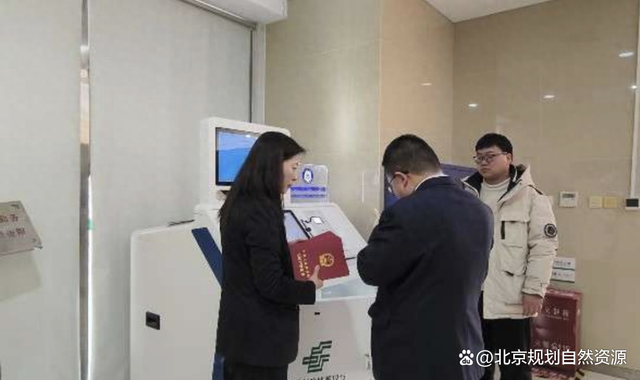
Group 1 - The core initiative involves the launch of self-service real estate registration and inquiry devices at the China Postal Savings Bank, marking a significant step in enhancing "real estate registration + finance" services in Haidian District [1] - This initiative is part of Beijing's broader strategy to extend self-service real estate services to financial institutions, aiming to create a "15-minute real estate registration service circle" for residents [1][2] - The project reflects a shift from in-person services to online self-service, with a target of over 59.13% for personal stock housing transfer registration and 75% for mortgage/de-mortgage registration to be processed online by 2025 [2] Group 2 - The self-service terminals allow residents to complete identity verification through facial recognition and access real estate registration information or print certificates directly at the bank [4] - This service is particularly beneficial for individuals involved in mortgage loans, property pledges, or second-hand housing transactions, significantly reducing the time and costs associated with obtaining necessary documents [5] - The project prioritizes information security, ensuring data encryption and controlled access, while also alleviating congestion at real estate registration offices [6] Group 3 - Following the successful implementation at the first pilot site, plans are underway to expand the deployment of self-service terminals to more eligible bank locations, enhancing the "real estate registration + finance" service model [6]

“小”压岁钱撬动“大”市场,银行发力差异化竞争新赛道
Zhong Guo Zheng Quan Bao· 2026-02-14 13:09
Core Viewpoint - The upcoming Spring Festival has prompted banks to launch special products for children's "lucky money," aiming to attract customers through higher deposit rates and additional benefits, thereby addressing their deposit acquisition pressures and enhancing brand recognition and customer loyalty [1]. Group 1: Bank Products - Beijing Bank has introduced a children's exclusive bank card called "Xiao Jing Card," offering a three-year fixed deposit rate of 1.75%, which is higher than the standard rate for the same term, with a minimum deposit of 1,000 yuan [2]. - Industrial and Commercial Bank of China (ICBC) has launched the "Baby Card" for children under 16, providing a three-year deposit rate of 1.55% for a 5,000 yuan deposit, along with waived card issuance and annual fees [3]. - Huaxia Bank's "Sunshine Growth Plan" offers a specialized savings service for minors, with a minimum deposit of only 50 yuan and an annual interest rate of 1.75% [4]. Group 2: Industry Insights - Industry experts view these children's financial products as a marketing strategy to alleviate deposit acquisition pressures and as a means to enhance customer loyalty through scenario-based finance [5]. - The competition in the banking sector is intensifying, and children's financial products are seen as a new growth point for deposits, allowing banks to bind family relationships and transition from simple savings to comprehensive services that include education and support [6]. - The strategic focus on children's financial services not only aims to secure current funds but also seeks to integrate financial literacy into family wealth management, creating a cross-generational customer value chain [6].


“扫货”港股金融圈!银、保双线出击 平安人寿再度举牌国寿H股
2 1 Shi Ji Jing Ji Bao Dao· 2026-02-14 09:01
Core Viewpoint - Ping An Life has increased its stake in China Life's H-shares, surpassing the 10% threshold, indicating a strategic move to build a substantial high-dividend financial asset pool in the Hong Kong market [1][4]. Group 1: Investment Actions - Ping An Life's investment in China Life's H-shares reached 10.12% after acquiring approximately 1,089.50 million shares at an average price of 33.2588 HKD per share [4]. - This is not the first time Ping An has increased its stake in a peer company; it previously acquired shares in China Pacific Insurance and China Life in August 2025, triggering initial stake notifications [2][3]. - The company has been actively buying shares in major banks, including Agricultural Bank of China, with its stake rising from 5% to 20.10% by the end of 2025 [5][6]. Group 2: Investment Strategy - Ping An's investment strategy focuses on asset-liability matching, ensuring that investments align effectively with its liability business [1][7]. - The company employs a "three criteria" principle for investments, assessing reliability, growth potential, and sustainable dividends [7]. - Analysts suggest that the motivations behind Ping An's stake increases can be categorized into two types: seeking stable dividend cash flows and targeting companies with strong return on equity (ROE) [7].



邮储银行:芦苇就任行长
Cai Jing Wang· 2026-02-14 07:51
Core Viewpoint - Postal Savings Bank of China has appointed Lu Wei as the new president and executive director, with his qualifications approved by the National Financial Regulatory Administration [1] Group 1: Appointment Details - The board of directors of Postal Savings Bank approved the appointment of Lu Wei as president on December 26, 2025 [1] - The first extraordinary shareholders' meeting of 2026 elected Lu Wei as an executive director on January 19, 2026 [1] - Lu Wei officially assumes the role of president and executive director starting February 13, 2026 [1] Group 2: Committee Roles - Lu Wei will also serve as the chairman and member of the bank's Board Social Responsibility and Consumer Rights Protection Committee [1] - He is appointed as a member of the Board Strategic Planning Committee [1] - Lu Wei will be a member of the Board Nomination and Remuneration Committee [1]
2026年1月金融数据点评:存款搬家加速,M1、M2增速大幅回升
GF SECURITIES· 2026-02-14 05:23
Investment Rating - The industry rating is "Buy" [6] Core Insights - The overall social financing growth slightly declined to 8.2% in January, while M1 and M2 growth rates significantly rebounded, with M1 growing by 4.9% and M2 by 9.0% [6][16] - Government net financing increased significantly by 2,831 billion yuan year-on-year, contributing to the overall social financing growth [6][17] - The report indicates a shift in deposit structure due to accelerated deposit migration, impacting M1 negatively while having limited effect on M2 [6][16] Summary by Sections Overall Situation - Social financing growth decreased slightly to 8.2%, while M1 and M2 growth rates increased significantly [15][16] - M1 and M2 growth rates rose by 1.1 percentage points and 0.5 percentage points respectively compared to the previous month [6][16] Government Sector - Fiscal strength showed a year-on-year decline, impacting overall financing dynamics [39] Household Sector - Demand remained stable year-on-year, with short-term loan demand increasing [39] Corporate Sector - Short-term loan demand increased year-on-year, while bill financing saw a significant reduction [39] Non-Bank Sector - The acceleration of deposit migration was noted, with non-bank deposits increasing by 1.45 trillion yuan year-on-year [6][39]


最新21家系统重要性银行名单公布
Jing Ji Ri Bao· 2026-02-14 04:21
Group 1 - The People's Bank of China and the National Financial Regulatory Administration have conducted an assessment for the 2025 systemically important banks, identifying 21 domestic banks as systemically important, including 6 state-owned commercial banks, 10 joint-stock commercial banks, and 5 city commercial banks [1][3] - The list aims to establish a comprehensive macro-prudential management system and strengthen the regulation of systemically important financial institutions [2] Group 2 - Systemically important banks in China are categorized into five groups based on their importance scores, with the first group consisting of 11 banks, the second group having 4 banks, the third group with 2 banks, the fourth group containing 4 banks, and no banks in the fifth group [3] - The People's Bank of China plans to enhance the combined effect of macro-prudential management and micro-prudential regulation, continuing to solidify additional supervision for systemically important banks to promote their safe and sound operation and better serve the high-quality development of the real economy [3]




国内系统重要性银行名单发布 21家银行入选
Cai Jing Wang· 2026-02-14 02:03
Core Viewpoint - The People's Bank of China has conducted an assessment of systemically important banks for 2025, identifying 21 domestic banks categorized into five groups based on their systemic importance scores [1] Group 1: Assessment Overview - The assessment is part of a broader effort to establish a comprehensive macro-prudential management system and strengthen the regulation of systemically important financial institutions [1] - The evaluation was carried out in collaboration with the National Financial Regulatory Administration [1] Group 2: Classification of Banks - A total of 21 banks were recognized as systemically important, including 6 state-owned commercial banks, 10 joint-stock commercial banks, and 5 city commercial banks [1] - The banks are divided into five groups based on their systemic importance scores: - Group 1: 11 banks including China Minsheng Bank, China Everbright Bank, Ping An Bank, Huaxia Bank, Ningbo Bank, Jiangsu Bank, Beijing Bank, Nanjing Bank, Guangfa Bank, Zheshang Bank, and Shanghai Bank [1] - Group 2: 4 banks including Industrial Bank, China CITIC Bank, Shanghai Pudong Development Bank, and China Postal Savings Bank [1] - Group 3: 2 banks including Bank of Communications and China Merchants Bank [1] - Group 4: 4 banks including Industrial and Commercial Bank of China, Bank of China, China Construction Bank, and Agricultural Bank of China [1] - Group 5: No banks were classified in this group [1]

央行重要发布!名单公布
Sou Hu Cai Jing· 2026-02-14 01:14
Core Viewpoint - The People's Bank of China and the National Financial Regulatory Administration have conducted an assessment of systemically important banks for 2025, identifying 21 domestic banks categorized into five groups based on their systemic importance scores [1]. Group 1: Assessment of Systemically Important Banks - A total of 21 banks have been recognized as systemically important, including 6 state-owned commercial banks, 10 joint-stock commercial banks, and 5 city commercial banks [1]. - The banks are divided into five groups based on their systemic importance scores, with the first group containing 11 banks, the second group 4 banks, the third group 2 banks, the fourth group 4 banks, and the fifth group having no banks [1]. Group 2: Breakdown of Banks by Group - **First Group (11 banks)**: Includes China Minsheng Bank, China Everbright Bank, Ping An Bank, Huaxia Bank, Ningbo Bank, Jiangsu Bank, Beijing Bank, Nanjing Bank, Guangfa Bank, Zheshang Bank, and Shanghai Bank [1]. - **Second Group (4 banks)**: Includes Industrial Bank, China CITIC Bank, Shanghai Pudong Development Bank, and China Postal Savings Bank [1]. - **Third Group (2 banks)**: Includes Bank of Communications and China Merchants Bank [1]. - **Fourth Group (4 banks)**: Includes Industrial and Commercial Bank of China, Bank of China, China Construction Bank, and Agricultural Bank of China [1]. - **Fifth Group**: No banks are included in this group [1]. Group 3: Future Regulatory Actions - The People's Bank of China and the National Financial Regulatory Administration will implement additional regulatory measures for systemically important banks according to the "Regulations on Additional Supervision of Systemically Important Banks (Trial)" [1]. - The aim is to enhance the synergy between macro-prudential management and micro-prudential supervision, ensuring the safe and sound operation of systemically important banks and better supporting the high-quality development of the real economy [1].