
Datang Power(601991)

Search documents
“黑天鹅”,突袭!
券商中国· 2025-12-29 13:08
Core Viewpoint - The power sector experienced significant declines, particularly in thermal power stocks, due to downward pressure on long-term electricity prices for 2026, which fell short of market expectations [2][5]. Group 1: Stock Performance - Major thermal power stocks saw substantial declines, with Guodian Power down 7.96%, Anhui Energy down 6.46%, and Huaneng International down 5.07% [2][3]. - Other notable declines included Shanghai Electric and Inner Mongolia Huadian, both dropping over 5% [2]. Group 2: Electricity Price Trends - The long-term electricity price for Guangdong in 2026 was set at 372.14 cents/kWh, a decrease of 19.72 cents/kWh from the previous year, nearing the lower limit of the benchmark price [5]. - In Jiangsu, the average price for January 2026 was 324.71 yuan/MWh, down 19.9% year-on-year, reflecting significant downward pressure on electricity prices in economically developed regions [5]. Group 3: Market Analysis - Analysts suggest that the ongoing market reforms may lead to a gradual increase in electricity prices, with the introduction of capacity pricing mechanisms reinforcing the foundational role of coal power [4]. - Despite the current downward trend, some institutions believe that the electricity market may not be overly pessimistic for 2026, as the government is beginning to focus on stabilizing electricity prices [7]. Group 4: Competitive Landscape - The retail electricity market has seen irrational competition, with companies engaging in aggressive pricing strategies to capture market share, leading to a temporary failure in price discovery [6]. - The introduction of new policies may help mitigate the excessive price competition among retail electricity companies, potentially restoring order to the market [7]. Group 5: Future Outlook - The construction of a new power system under the "dual carbon" goals is expected to rely on enhanced system regulation and support from the government, which may improve the performance of power operators in the future [8].








——申万公用环保周报(25/12/22~25/12/26):二三产拉动11月用电全球气价小幅震荡-20251229
Shenwan Hongyuan Securities· 2025-12-29 10:36
Investment Rating - The report provides a positive investment outlook for various sectors within the energy industry, particularly recommending companies involved in coal power, hydropower, nuclear power, green energy, and gas [1]. Core Insights - The report highlights that in November 2025, the total electricity consumption reached 835.6 billion kWh, marking a year-on-year increase of 6.2%. The growth contributions from the primary, secondary, and tertiary industries, as well as residential consumption, were 2%, 49%, 29%, and 19% respectively [4][6]. - The secondary industry remains the largest contributor to electricity consumption, accounting for over 60% of the total, with significant growth in high-tech and equipment manufacturing sectors [5][6]. - Natural gas prices have shown fluctuations, with the U.S. Henry Hub spot price at $3.31/mmBtu, reflecting a weekly decline of 7.30%. The report notes that the domestic LNG ex-factory price is 3915 yuan/ton, down 2.85% week-on-week [1][16]. Summary by Sections Electricity Sector - In November 2025, the electricity consumption by the first, second, and third industries grew by 7.9%, 4.4%, and 10.3% respectively, while residential consumption increased by 9.8% [4][6]. - The high-tech and equipment manufacturing sectors saw a 6.7% increase in electricity consumption, with automotive manufacturing leading at a 10% growth rate [5][6]. Natural Gas Sector - The report indicates that global gas prices are experiencing slight fluctuations, with the U.S. market showing a significant drop in spot prices. The report anticipates that the demand for natural gas will increase as winter approaches, potentially stabilizing prices [1][16]. - Recommendations include focusing on integrated gas companies and those benefiting from cost reductions and improved profitability due to lower oil prices [39][40]. Investment Recommendations - For coal power, companies like Guodian Power and Inner Mongolia Huadian are recommended due to their diversified revenue sources [1]. - Hydropower companies such as Yangtze Power and State Power Investment Corporation are favored due to expected improvements in profit margins from reduced capital expenditures [1]. - Nuclear power firms like China National Nuclear Power and China General Nuclear Power are highlighted for their stable cost structures and growth potential [1]. - In the green energy sector, companies like Xintian Green Energy and Longyuan Power are recommended for their stable returns and increasing operational value [1]. - The report also suggests investment in gas companies like Shenzhen Energy and Kunlun Energy, which are expected to benefit from cost reductions and improved market conditions [1][39].



电力板块12月29日跌1.61%,恒盛能源领跌,主力资金净流出20.16亿元
Zheng Xing Xing Ye Ri Bao· 2025-12-29 09:06
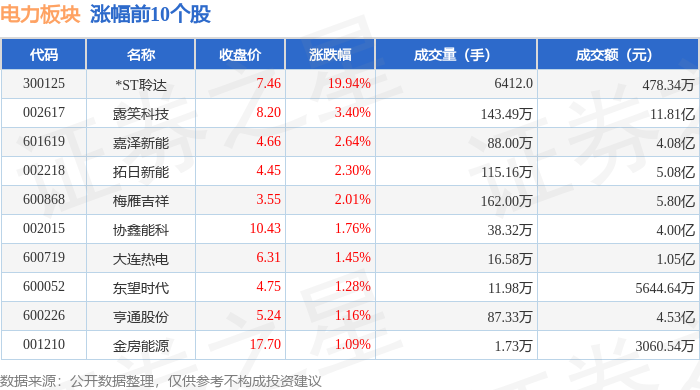
Market Overview - The electricity sector experienced a decline of 1.61% on the previous trading day, with Hengsheng Energy leading the drop [1] - The Shanghai Composite Index closed at 3965.28, up 0.04%, while the Shenzhen Component Index closed at 13537.1, down 0.49% [1] Stock Performance - Notable gainers in the electricity sector included: - *ST Lingda (300125): Closed at 7.46, up 19.94% with a trading volume of 6412 lots [1] - Luxiao Technology (002617): Closed at 8.20, up 3.40% with a trading volume of 143.49 million [1] - Jiaze New Energy (619109): Closed at 4.66, up 2.64% with a trading volume of 88.00 million [1] - Major decliners included: - Hengsheng Energy (605580): Closed at 23.31, down 10.00% with a trading volume of 231,400 lots [2] - Guodian Power (600795): Closed at 5.32, down 7.96% with a trading volume of 3.1875 million [2] - Waneng Power (000543): Closed at 8.25, down 6.46% with a trading volume of 869,300 [2] Capital Flow - The electricity sector saw a net outflow of 2.016 billion yuan from main funds, while retail funds experienced a net inflow of 809 million yuan [2] - Key stocks with significant capital flow included: - Meiyuan Jixiang (600868): Main funds net inflow of 87.96 million yuan, retail net outflow of 86.09 million yuan [3] - Luxiao Technology (002617): Main funds net inflow of 82.38 million yuan, retail net outflow of 81.53 million yuan [3] - Xiexin Energy (002015): Main funds net inflow of 62.51 million yuan, retail net outflow of 47.88 million yuan [3]

2026电力行业年度策略:火绿重构,水核筑基,燃气优化
GOLDEN SUN SECURITIES· 2025-12-29 08:38
Group 1: Industry Overview - The public utility sector experienced a modest increase of 0.92% from January to September 2025, underperforming the CSI 300 index by 17.02 percentage points, with total revenue reaching 1.381783 trillion yuan, a slight year-on-year growth of 0.02% [1][13] - The overall profitability of the power sector remained stable, with a net profit attributable to shareholders of 172.32 billion yuan, reflecting an 8.43% increase year-on-year [1][13] - The electricity consumption growth rate for the first three quarters of 2025 was 4.6%, with a notable decline in the elasticity coefficient to 0.88, indicating a shift towards balanced supply and demand in the electricity market [2] Group 2: Thermal Power - The thermal power sector reported a net profit of 71.12 billion yuan for the first three quarters of 2025, marking a 15.83% increase year-on-year, supported by low coal prices [1][20] - The overall revenue for the thermal power sector was 905.78 billion yuan, a decrease of 3.08% year-on-year, while operating costs fell by 6.15% to 745.64 billion yuan [20] - The sector is expected to see a restructuring of its profit model, with a focus on high-dividend thermal power leaders and companies in regions with stable electricity prices [3] Group 3: Renewable Energy - The wind power sector achieved a net profit of 22.03 billion yuan, a year-on-year increase of 31.67%, with revenue rising by 29.98% to 108.09 billion yuan [1][28] - The solar power sector, however, faced challenges with a revenue decline of 18.63% to 26.10 billion yuan, despite a significant profit increase of 67.57% to 2.90 billion yuan [1][28] - The introduction of market-oriented policies and the acceleration of green energy subsidies are expected to improve cash flow for renewable energy companies [3] Group 4: Nuclear Power - The nuclear power sector is projected to see significant growth, with an expected operational capacity of 110 million kilowatts by 2030, driven by the increasing importance of nuclear energy in the context of AI competition [4] - The marketization of nuclear power pricing is gradually increasing, with expectations for price rebounds in Guangdong province due to policy changes [4] - Investment opportunities are recommended in nuclear power operators and companies involved in nuclear fusion and uranium mining [4] Group 5: Hydropower - The hydropower sector reported a revenue of 148.76 billion yuan, with a year-on-year growth of 1.56%, and a net profit of 51.32 billion yuan, reflecting a 3.30% increase [1][37] - The sector's stability and high dividend yield make it an attractive investment, especially in a fluctuating market environment [3][37] - Companies in the hydropower sector are encouraged to maintain strong dividend policies to attract investors [3] Group 6: Natural Gas - The natural gas sector is expected to recover profitability as global LNG production ramps up, with a projected oversupply of 65 billion cubic meters by 2030 [3] - The implementation of pricing reforms in various cities is alleviating margin pressures for city gas companies, leading to increased sales volumes [3] - Investment focus is recommended on high-quality city gas leaders with stable dividend policies [3]
9家A股ESG强信披银行碳排同比上升
2 1 Shi Ji Jing Ji Bao Dao· 2025-12-29 08:20
Group 1: Climate Disclosure Standards - The Ministry of Finance, along with nine other departments, issued the "Corporate Sustainable Disclosure Standard No. 1 - Climate (Trial)" on December 25, marking a significant step towards a unified sustainable disclosure standard system in China [1] - The "Climate Standard" is currently positioned as a trial document, with voluntary implementation by companies until specific requirements are established [1] - The Ministry of Finance plans to adopt a gradual approach to implementation, expanding from listed companies to non-listed companies, and from large enterprises to small and medium-sized enterprises [1] Group 2: ESG Disclosure in A-Share Banks - The A-share ESG strong disclosure list has expanded to 27 banks, including 6 state-owned banks, 9 joint-stock banks, 10 city commercial banks, and 2 rural commercial banks [2] - Among the 27 banks, 16 reported a year-on-year decrease in carbon emissions, while 9 banks, including 1 state-owned bank and 6 city commercial banks, reported an increase in carbon emissions [2] - The top five banks with the highest year-on-year increase in carbon emissions are Beijing Bank (13.88%), Nanjing Bank (13.23%), Qingdao Bank (11.92%), Chongqing Bank (10.96%), and Hangzhou Bank (10.02%) [3] Group 3: Regulatory Actions and Penalties - First Capital's subsidiary was fined 12.7358 million yuan for failing to diligently supervise a convertible bond project [4] - Jinghua Pharmaceutical's subsidiary was fined 500,000 yuan for environmental pollution, which is not expected to significantly impact the company's net profit for 2025 [5] - Tianyi Medical is facing a potential fine of 8.7852 million yuan for not producing medical devices according to registered technical requirements [6][7] Group 4: Energy Sector ESG Developments - The "National Energy Sustainable Development Index" was officially launched, achieving a cumulative return rate of 40% [8] - Five thermal power companies have been included in the ESG strong disclosure category, which will require them to improve ESG governance and reporting by 2026 [9] - A report evaluated the low-carbon transition performance of 33 thermal power companies, indicating significant disparities in transition progress and a slower development of non-fossil energy compared to national averages [9]



申万公用环保周报:二三产拉动11月用电,全球气价小幅震荡-20251229
Shenwan Hongyuan Securities· 2025-12-29 07:16
Investment Rating - The report maintains a "Positive" outlook on the utility and environmental sectors, indicating potential investment opportunities in these areas [2]. Core Insights - The report highlights that in November, the total electricity consumption in China reached 835.6 billion kWh, representing a year-on-year growth of 6.2%. The contributions from various sectors were: primary industry (7.9%), secondary industry (4.4%), tertiary industry (10.3%), and urban and rural residents (9.8%) [3][8]. - The growth in electricity consumption is primarily driven by the tertiary industry, particularly in sectors related to big data analysis and artificial intelligence services, which saw significant increases in electricity usage [9]. - The report notes that the natural gas market is experiencing slight fluctuations, with LNG prices continuing to decline. As of December 26, the national LNG ex-factory price was 3915 RMB/ton, down 2.85% week-on-week [3][40]. Summary by Sections Electricity Sector - In November, the total electricity consumption was 8356 billion kWh, with a year-on-year increase of 6.2%. The secondary industry contributed 49% to the growth, while the tertiary industry followed with a 29% contribution [10][11]. - The high-tech and equipment manufacturing sectors showed a notable increase in electricity consumption, with a year-on-year growth of 6.7%, surpassing the average growth rate of the manufacturing sector by 2.5 percentage points [9][10]. Natural Gas Sector - The report indicates that global gas prices are experiencing minor fluctuations, with the Henry Hub spot price at $3.31/mmBtu, reflecting a weekly decrease of 7.30%. The TTF spot price in the Netherlands was €27.70/MWh, down 1.42% week-on-week [3][19]. - The report suggests that the LNG ex-factory price in China is under pressure due to high inventory levels and low-cost sea gas resources, leading to a continued downward trend [40][41]. Investment Recommendations - The report recommends several companies based on their performance and market positioning: - For thermal power, companies like Guodian Power, Inner Mongolia Huadian, and Datang Power are highlighted for their integrated coal and power operations [3][17]. - In the hydropower sector, companies such as Yangtze Power and Guotou Power are recommended due to their stable financial performance and reduced capital expenditures [3][17]. - For nuclear power, China National Nuclear Power and China General Nuclear Power are suggested due to their stable cost structures and growth potential [3][17]. - In the green energy sector, companies like Xintian Green Energy and Longyuan Power are noted for their improved returns from stable project yields [3][17].
【干货】2025年煤矿机械产业链全景梳理及区域热力地图
Qian Zhan Wang· 2025-12-29 06:09
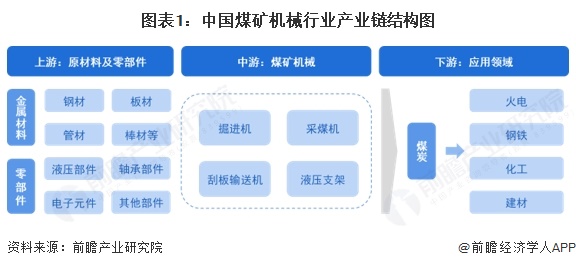
Core Insights - The coal mining machinery industry is experiencing a shift towards intelligent, green, and globalized operations, with major investments from leading companies and energy groups focusing on high-end equipment projects and technological collaborations [11]. Industry Overview - The coal mining machinery industry consists of three main segments: upstream (raw materials and components), midstream (manufacturing of coal mining equipment), and downstream (coal industry applications) [2][4]. - Upstream suppliers include companies like Benxi Steel and Hengli Hydraulic, while midstream manufacturers include Zhengzhou Coal Mining Machinery and SANY Heavy Industry [4][5]. - The downstream sector primarily consists of coal enterprises such as China Coal Energy and Datang Power [4][5]. Regional Distribution - Jiangsu Province is identified as the primary hub for coal mining machinery companies, with significant activity also in Shandong, Shaanxi, and Shanxi provinces [6]. - The coal mining machinery industry is well-established in Liaoning, Shanxi, and Beijing, covering all segments of the supply chain [9]. Investment Trends - Recent investments in the coal mining machinery sector focus on smart technology, green initiatives, and international expansion [11]. - Notable investments include: - In 2023, Shanxi Coal Machinery invested 2.1 billion yuan in a smart high-end coal machinery project, expected to generate an annual output value of 3 billion yuan [13]. - In 2023, Shaanxi Coal Group acquired Xuzhou Coal Mining Machinery for 1.8 billion yuan, increasing its market share in intelligent conveyor systems from 16% to 27% [13]. - In 2025, XCMG launched the world's first unmanned electric mining truck, aiming for zero-carbon operations [13].


A股电力股集体下跌,国电电力、皖能电力跌超6%
Ge Long Hui A P P· 2025-12-29 05:13
格隆汇12月29日|A股市场电力股集体下跌,其中,国电电力、皖能电力跌超6%,上海电力、华能国 际跌超5%,圣元环保、内蒙华电跌超4%,兆新股份、大唐发电、京能电力、华电国际跌超3%。消息面 上,广东等地2026年长协电价陆续出炉。广东2026年度交易均价372.14厘/千瓦时,同比下降19.72厘/千 瓦时,接近基准价下浮下限;江苏2026年1月集中竞价均价324.71元/兆瓦时,较基准价下浮17%。 MACD金叉信号形成,这些股涨势不错! | 代码 | 名称 | | 涨幅%↑ | 总市值 | 年初至今涨幅% | | --- | --- | --- | --- | --- | --- | | 600795 | 国电电力 | | -6.92 | 960亿 | 22.46 | | 000543 | 皖−九 | | -6.92 | 186亿 | 8.52 | | 600021 | 上海电力 | 1 | -5.26 | 584亿 | 133.00 | | 600011 | 华能国际 | | -5.07 | 1206亿 | 17.71 | | 300867 | 圣元环保 | 1 | -4.82 | 50.92亿 | ...

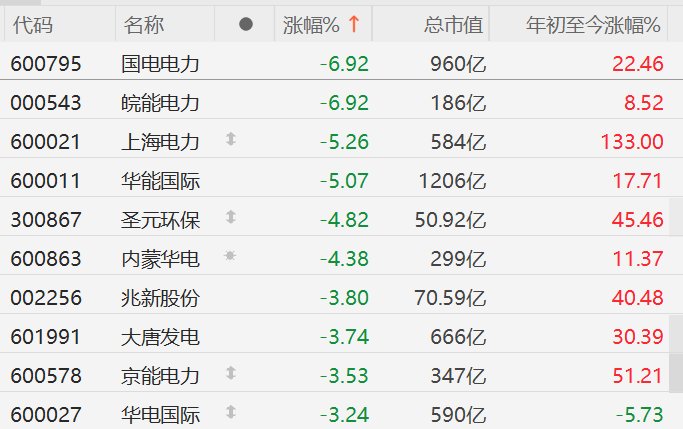
电力股集体走低 广东等地长协电价陆续出炉 机构称沿海省份电价预期或均有松动
Zhi Tong Cai Jing· 2025-12-29 03:17
Group 1 - Power stocks collectively declined, with Huaneng International down 7.13% at HKD 5.73, Datang Power down 4.27% at HKD 2.24, Huadian International down 2.88% at HKD 4.05, and China Resources Power down 2.19% at HKD 17.39 [1] - The announcement of long-term electricity prices for 2026 in Guangdong and other regions indicates a significant drop, with Guangdong's average trading price at 372.14 cents/kWh, a decrease of 19.72 cents/kWh year-on-year, approaching the lower limit of the benchmark price [1] - Jiangsu's average centralized bidding price for January 2026 is 324.71 yuan/MWh, reflecting a 17% decrease from the benchmark price, suggesting a potential easing of electricity price expectations in coastal provinces [1] Group 2 - The National Energy Administration reported that the total electricity consumption in November 2025 reached 835.6 billion kWh, a year-on-year increase of 6.2% [2] - The power generation in November 2025 was 779.2 billion kWh, with a year-on-year growth of 2.7%, averaging 25.97 billion kWh per day [2] - Breakdown of power generation shows thermal power at 496.95 billion kWh (down 4.20%), hydropower at 96.68 billion kWh (up 17.10%), wind power at 104.55 billion kWh (up 22.00%), and nuclear power at 39.81 billion kWh (up 4.70%) [2]

电价预期逐步明朗,如何看待火电行情表现?
Changjiang Securities· 2025-12-28 15:40
Investment Rating - The investment rating for the industry is "Positive" and maintained [7] Core Insights - The annual electricity price expectations are gradually becoming clearer, with multiple factors constraining electricity price levels. The average transaction price for Guangdong's annual electricity trading in 2026 has reached the lower limit of the medium to long-term trading price, indicating a downward price expectation [2][6] - Despite the clear downward expectation for electricity prices, the thermal power sector has shown relative stability, outperforming the hydroelectric sector, which is less impacted by price fluctuations [2][6] - The recent decline in coal prices and the expected increase in capacity prices for 2026 are expected to provide a buffer against the downward trend in long-term contract prices, supporting market expectations for thermal power company profitability [2][6] Summary by Sections Electricity Price Expectations - The electricity supply and demand situation is at risk of deterioration, and there are non-seasonal risks associated with coal prices. The market's expectation for the 2026 annual electricity price has been negatively impacted by weak monthly and spot electricity prices in some provinces [2][7] - The average monthly prices for Guangdong and Jiangsu this year were 373 and 377 cents/kWh, respectively, down by 47 and 52 cents/kWh year-on-year. The announcement of the annual trading results has confirmed the market's previous pessimistic expectations [2][6] Thermal Power Sector Performance - The thermal power sector has shown resilience despite the downward price expectations, driven by two main factors: a significant "inverted V" trend in coal prices since October and the expected stepwise increase in capacity prices for 2026 [2][6] - The price of Qinhuangdao Q5500 thermal coal peaked at 834 yuan/ton in late November but has since dropped to 672 yuan/ton by December 26, a decrease of 162 yuan/ton [2][6] - The expected increase in capacity prices by approximately 65 yuan/year·kW across provinces is anticipated to enhance the profitability stability of thermal power companies [2][6] Investment Recommendations - Recommended companies include Huaneng International, Datang Power, Guodian Power, Huadian International, China Power, China Resources Power, and Funiu Co., as well as Inner Mongolia Huadian, which represents "coal-electricity integration" thermal power [2][12][13] - For the hydroelectric sector, recommended companies include Yangtze Power, Guotou Power, Chuan Investment Energy, and Huaneng Hydropower [2][12][14] - In the renewable energy sector, companies such as Longyuan Power H, Xintian Green Energy H, China Nuclear Power, and Zhongmin Energy are recommended due to their potential for growth [2][12][15]