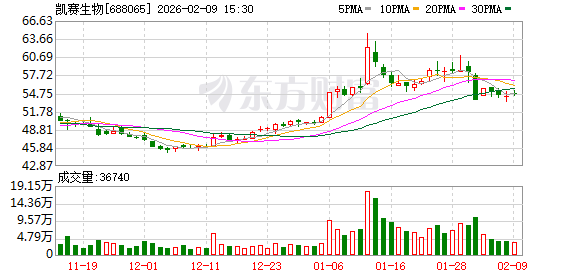
Cathay Biotech (688065)

Search documents
上海凯赛生物技术股份有限公司 2025年度业绩快报公告
Zhong Guo Zheng Quan Bao - Zhong Zheng Wang· 2026-02-28 01:24
本公司董事会及全体董事保证本公告内容不存在任何虚假记载、误导性陈述或者重大遗漏,并对其内容 的真实性、准确性和完整性依法承担法律责任。 本公告所载2025年度主要财务数据为初步核算数据,未经会计师事务所审计,具体数据以上海凯赛生物 技术股份有限公司(以下简称"公司")2025年年度报告为准,提请投资者注意投资风险。 一、2025年度主要财务数据和指标 单位:万元 ■ 注:1.以上财务数据及指标以未审计的合并报表数据填列; 2.以上表格中数据尾差为数据四舍五入所致。 二、经营业绩和财务状况情况说明 (一)报告期的经营情况、财务状况及影响经营业绩的主要因素 1、2025年度公司实现营业收入329,544.89万元,同比上升11.41%;实现利润总额63,150.35万元,同比 上升15.23%;实现归属于上市公司股东的净利润56,572.04万元,同比上升15.70%,归属于上市公司股东 的扣除非经常性损益的净利润52,592.04万元,同比上升13.17%,基本每股收益0.83元/股,同比下降 1.19%,加权平均净资产收益率3.52%,同比减少0.79个百分点。 2、2025年末公司总资产2,389,970. ...

凯赛生物:2025年净利润同比上升15.70%
Zheng Quan Ri Bao Zhi Sheng· 2026-02-27 12:38
证券日报网讯 2月27日,凯赛生物发布2025年度业绩快报公告称,公司2025年度实现营业收入329544.89 万元,同比上升11.41%;实现归属于上市公司股东的净利润56572.04万元,同比上升15.70%。 (编辑 王雪儿) ...
凯赛生物(688065) - 2025 Q4 - 年度业绩
2026-02-27 09:10
本公司董事会及全体董事保证本公告内容不存在任何虚假记载、误导性陈述 或者重大遗漏,并对其内容的真实性、准确性和完整性依法承担法律责任。 证券代码:688065 证券简称:凯赛生物 公告编号:2026-001 上海凯赛生物技术股份有限公司 2025 年度业绩快报公告 本公告所载2025年度主要财务数据为初步核算数据,未经会计师事务所审 计,具体数据以上海凯赛生物技术股份有限公司(以下简称"公司")2025年年 度报告为准,提请投资者注意投资风险。 一、2025 年度主要财务数据和指标 单位:万元 | 科目 | 本期数 | 上年同期 | 增减变动幅度(%) | | --- | --- | --- | --- | | 营业收入 | 329,544.89 | 295,791.16 | 11.41 | | 营业利润 | 63,509.18 | 55,156.12 | 15.14 | | 利润总额 | 63,150.35 | 54,801.52 | 15.23 | | 归属于上市公司股东的净利润 | 56,572.04 | 48,896.19 | 15.70 | | 归属于上市公司股东的扣除非 经常性损益的净利润 | 5 ...
凯赛生物:2025年净利润5.66亿元,同比增长15.70%
Di Yi Cai Jing· 2026-02-27 08:57
凯赛生物晚间公告,2025年度公司实现营业收入32.95亿元,同比上升11.41%;实现利润总额6.32亿 元,同比上升15.23%;实现归属于上市公司股东的净利润5.66亿元,同比上升15.70%;归属于上市公司 股东的扣除非经常性损益的净利润5.26亿元,同比上升13.17%。 ...
蓝星收购埃肯有机硅资产,我国首个生物燃油混兑政策落地
Huaan Securities· 2026-02-26 05:47
Investment Rating - The industry investment rating is upgraded to "Overweight" [3] Core Insights - The chemical industry is expected to experience a recovery driven by both cyclical and growth factors, with a focus on organic silicon, PTA, polyester filament, caprolactam, spandex, vitamins, sweeteners, refrigerants, and phosphorus chemicals [7] - The organic silicon industry is entering a recovery phase, with new applications becoming the core growth driver. From 2019 to 2024, domestic DMC capacity expanded rapidly, leading to temporary oversupply and declining prices. However, with no new capacity expected in 2025 and increasing demand from sectors like new energy vehicles and photovoltaics, the supply-demand balance is improving [7] - The PTA and polyester filament industries are approaching a turning point, with the expansion cycle nearing its end. The demand side is expected to continue growing, supported by easing trade tensions and improved external demand [7] - The introduction of quota policies is expected to lead refrigerants into a high prosperity cycle, with supply constraints and stable demand growth from markets like heat pumps and cold chain logistics [9] - The synthetic biology sector is poised for explosive growth, driven by the transition to low-energy products and breakthroughs in non-grain bio-based materials [9] - OLED technology is accelerating its penetration into various display sizes, supported by policy measures aimed at fostering the new display industry [10] - The demand for high-frequency and low-loss electronic resins is increasing due to the rise of AI infrastructure, with AI server shipments expected to grow significantly [11] - The electronic chemicals sector is benefiting from the expansion of wafer production capacity, with increasing demand for key materials like photoresists and packaging materials [12] Summary by Sections Industry Performance - The chemical sector's overall performance ranked 14th with a weekly change of 0.78%, outperforming the Shanghai Composite Index by 0.38 percentage points [6][21] - Key stocks such as Honghe Technology and Zhongcai Technology saw significant price increases due to rising demand in AI servers and high-speed network equipment [6] Supply-Side Tracking - A total of 155 companies in the chemical industry had their production capacities affected, with 4 new repairs and 7 restarts reported [14] Key Industry Dynamics - BlueStar announced the acquisition of Elkem's core organic silicon assets, marking a strategic move to enhance its position in the global organic silicon industry [34] - The first biofuel blending policy in China was approved, allowing for local blending and reducing reliance on imports [34]


化工周报:春晚机器人大放异彩,美国关税下调利好出口链,化工春旺行情将至-20260224
Shenwan Hongyuan Securities· 2026-02-24 02:49
Investment Rating - The report maintains a "Positive" rating for the chemical industry [4][3]. Core Insights - The macroeconomic outlook for the chemical industry indicates a stable increase in oil demand due to global economic recovery and tariff adjustments, with Brent crude oil expected to remain in the range of $60-75 per barrel [4][5]. - The report highlights a potential spring boom in the chemical sector, driven by the success of domestic robotics showcased during the Spring Festival and favorable export conditions following tariff reductions [4][3]. - Investment opportunities are identified in various chains, including textiles, agricultural chemicals, and overseas real estate, with specific companies recommended for investment [4][3]. Industry Dynamics - Oil supply is tightening due to OPEC+ production delays and peak shale oil output, while demand is stabilizing with improved global economic conditions [5]. - The chemical industry is at a cyclical turning point, with downstream operations gradually resuming post-holiday, indicating a positive demand outlook for the year [4][3]. - The report notes that the Producer Price Index (PPI) for industrial products decreased by 1.4% year-on-year in January, while the manufacturing PMI recorded 49.3, indicating some volatility in manufacturing activity [7][4]. Investment Analysis - The report suggests a diversified investment strategy focusing on four key areas: textiles, agricultural chemicals, export chains, and beneficiaries of "anti-involution" policies [4][3]. - Specific companies to watch include those in the textile chain like Lu Xi Chemical and Tongkun Co., and in the agricultural chain like Hualu Hengsheng and Baofeng Energy [4][3]. - The report emphasizes the importance of self-sufficiency in key materials, particularly in semiconductor and panel materials, recommending companies such as Yake Technology and Ruilian New Materials [4][3].


免费领取!《2025中国合成生物制造产业发展白皮书》
synbio新材料· 2026-02-13 23:01
Core Viewpoint - The article emphasizes the rising importance of biomanufacturing as a strategic and innovative field that disrupts traditional production methods, presenting it as a new growth point for optimizing industrial structure and transforming economic models [1]. Group 1: Current Status and Trends - The "2025 China Synthetic Biomanufacturing Industry Development White Paper" was officially released on August 1, highlighting the current state and trends of biomanufacturing [1]. - The report analyzes the global biomanufacturing industry, including key platform facilities and a comparative study of the US and China in this sector [7]. Group 2: Policy Landscape - The white paper outlines major domestic and international policies affecting biomanufacturing from 2024 to 2025, providing insights into regulatory frameworks [7]. Group 3: Industry Map and Applications - It presents a comprehensive map of the Chinese biomanufacturing industry and identifies key application areas, including pharmaceuticals, food, personal care, agriculture, chemicals, materials, and energy [7]. Group 4: Key Enterprises - The report selects ten leading enterprises in the Chinese biomanufacturing sector and details the strategic directions of 15 listed companies in synthetic biology [7][8]. Group 5: Investment and Challenges - The document discusses the investment landscape in synthetic biology from 2024 to mid-2025 and addresses the challenges faced by the biomanufacturing industry in China, along with proposed countermeasures [7].





凯赛生物与招商局深化合作 生物基新材料商业化加速
Jing Ji Guan Cha Wang· 2026-02-12 02:35
Group 1 - The core viewpoint of the articles highlights the collaboration between the company and China Merchants Group to advance the commercialization of bio-based new materials in various sectors such as highways, bridges, construction, containers, and ships [1] - The company is accelerating the testing and product validation work, aiming to expand commercialization channels through demonstration projects [1] - The company's core development directions for the next 3-5 years include the research and development of high-value utilization technology for biomass waste, the expansion of bio-based polyamide and its composite materials, and the construction of an industrial ecosystem [1] Group 2 - The company has adjusted the expected operational status date for its "annual production of 500,000 tons of bio-based hexamethylenediamine and 900,000 tons of bio-based polyamide project" from December 31, 2025, to December 31, 2027, while the project construction content remains unchanged [2]
合成生物学周报:工信部公布35例非粮生物基材料,阿洛酮糖应用有望迎来爆发
Huaan Securities· 2026-02-10 13:30
Investment Rating - The industry rating is "Overweight" [3] Core Insights - The report highlights the ongoing active research in life sciences and the rapid integration of biotechnology into economic and social development, providing innovative solutions to major challenges such as health, climate change, resource security, and food security. The National Development and Reform Commission has issued the "14th Five-Year Plan for the Development of the Bioeconomy," indicating a trillion-yuan market potential in the bioeconomy sector [3][4]. Industry Performance - The Huazhong Synthetic Biology Index increased by 0.11% to 1278.44 during the week of February 2-6, 2026, outperforming the Shanghai Composite Index by 1.39 percentage points and the ChiNext Index by 3.40 percentage points [4]. - The report notes that the synthetic biology sector is experiencing a policy dividend, with Shenzhen proposing up to 100 million yuan in support for R&D efforts in the field [8]. Company Developments - Beijing Huaguan Bio completed a multi-hundred million yuan C-round financing to enhance its R&D and production capabilities in the pharmaceutical and health sectors [32]. - Dejin Bio secured several million yuan in A-round financing to advance its recombinant botulinum toxin clinical research and international expansion [33]. - The report mentions that Impossible Foods is leveraging technology to reshape the plant protein market [11]. Market Dynamics - The report indicates that the synthetic biology sector is witnessing a surge in financing, with nearly a hundred companies completing new funding rounds since 2025 [31]. - The top five companies in the synthetic biology sector by stock performance during the week were Pingtan Development (+12%), Jinbo Bio (+12%), Huaxi Bio (+12%), Shandong Heda (+10%), and Yaxiang Co. (+10%) [17]. Policy and Regulatory Developments - The Ministry of Industry and Information Technology announced 35 examples of non-grain bio-based materials, marking a significant step towards establishing a new green development framework [7]. - The National Health Commission approved 22 new food items, including a significant breakthrough in domestic human milk oligosaccharides (HMOs) production [7]. Research and Innovation - Tsinghua University has initiated a national key R&D project focused on the intelligent design principles of efficient microbial chassis cells, aiming for breakthroughs in both fundamental theory and application demonstration [9]. - The report highlights the strategic cooperation between Tianjin University and China National Petroleum Corporation to expand efforts in synthetic biology and related fields [9].


凯赛生物总裁杨晨:以生物智造筑牢双碳基石 打造产业协同生态
Zhong Guo Zheng Quan Bao· 2026-02-09 23:17
Core Viewpoint - Biomanufacturing is a crucial component of national strategic technological strength and a key engine for promoting green and low-carbon industrial transformation. The company, Kasei Biotech, has been deeply engaged in this field for over 20 years, leveraging core technologies and products to build competitive advantages [2] Group 1: Green Transformation in Downstream Industries - Kasei Biotech focuses on developing chemicals through biotechnological processes, aiming to create low-cost alternatives to traditional petrochemical products. The biomanufacturing process is characterized by mild reaction conditions and the use of renewable plant materials or biomass waste, significantly reducing reliance on non-renewable fossil resources [3] - The company has developed a series of biobased long-chain dicarboxylic acids and biobased hexamethylenediamine, which are typical products in the biomanufacturing industry. These products meet high-performance requirements while being cost-effective and environmentally friendly, thus supporting downstream industries in overcoming carbon barriers and enhancing market competitiveness [3] Group 2: Application and Production Capacity - Kasei Biotech's biobased composite materials have been successfully applied in various sectors, including new energy, transportation logistics, pipelines, and construction. For instance, biobased polyamide composite materials for battery shells reduce weight and costs while meeting fire resistance and protection needs [4] - The company has established a production capacity of 40,000 tons of biobased dodecanedioic acid and a 5,000-ton production line for biobased high-temperature polyamide. The company is also building a complete industrial chain in its Hefei biobased materials base [4] Group 3: Future Development and Innovation - Kasei Biotech plans to expand the application scenarios of biobased polyamides and composite materials, focusing on sectors such as automotive, energy storage, and robotics through joint ventures with industry leaders [5] - The company emphasizes the importance of technological innovation and supply chain security, continuously increasing R&D investment to support the development and commercialization of biobased products [6] - Future plans include enhancing the efficiency of core products, advancing research on new biobased materials, and developing high-value utilization technologies for biomass waste [7] Group 4: Collaborative Ecosystem - Kasei Biotech believes that the commercialization of new materials requires collaboration among various stakeholders, including capital, technology, industry, and government. The company has engaged in partnerships with state-owned enterprises and local governments to establish its first biomanufacturing materials industrial base [8] - The collaboration model of "central enterprises + local governments + industry leaders" is seen as an effective way to integrate resources and drive innovation in biobased materials [8] - The company aims to break the inertia of traditional petrochemical materials in downstream industries through application demonstration projects, thereby enhancing industry awareness and expanding commercialization pathways [9]