
Baimtec Material (688563)

Search documents
商业航天:箭体不锈钢+发动机高温合金正成为火箭新材料体系(附报告)
材料汇· 2026-01-22 15:32
Core Viewpoint - The article emphasizes that "rocket body stainless steel + engine high-temperature alloy" is evolving into a new generation of rocket material systems, driven by the commercialization and reusability of space launches [1][7]. Group 1: Investment Opportunities in New Materials - The rapid development of commercial space is driving the demand for aerospace stainless steel and high-temperature alloy materials [2]. - Stainless steel is becoming the primary choice for rocket bodies in reusable rockets due to its low cost, high-temperature resistance, and ease of processing [4][12]. - High-temperature alloys are essential for the hot-end components of liquid rocket engines, with an average usage of 28% in liquid rocket engines [5][19]. Group 2: Historical Context and Current Trends - Historically, aluminum alloys dominated rocket materials, with limited applications for stainless steel and high-temperature alloys [3]. - Currently, the rocket material system is transitioning from aluminum-dominated to a combination of stainless steel and high-temperature alloys, particularly in reusable rocket designs [4][11]. Group 3: Future Outlook - In the future, aerospace stainless steel and high-temperature alloys are expected to be key materials for rocket technology evolution, providing advantages in extreme temperature environments and manufacturing speed [6][8]. - The demand for large low-orbit satellite constellations is anticipated to drive the scale of rocket launches, enhancing the growth prospects for stainless steel and high-temperature alloys [47]. Group 4: Supply Chain and Market Dynamics - The supply of aerospace stainless steel is highly segmented and customized, with early movers and validated companies likely to experience structural growth opportunities [8]. - High-temperature alloy suppliers face high barriers to entry, resulting in a favorable competitive landscape [8][21].






商业航天拉动不锈钢及高温合金需求
HTSC· 2026-01-22 13:20
Investment Rating - The report maintains an "Overweight" rating for the aerospace and military industry, as well as for the steel sector [5]. Core Insights - The rapid development of commercial aerospace is driving demand for aerospace stainless steel and high-temperature alloys, which are becoming the new material system for rockets [1][4]. - Stainless steel is increasingly being adopted for rocket structures due to its cost-effectiveness, high-temperature resistance, and ease of processing, while high-temperature alloys are essential for engine components [1][3][4]. - The transition from aluminum alloys to a combination of stainless steel and high-temperature alloys is a significant trend in rocket material evolution, driven by the need for cost reduction and performance enhancement [9][10]. Summary by Sections Historical Context - Historically, aluminum alloys dominated rocket materials, with limited use of stainless steel and high-temperature alloys [1][2]. Current Status - The current rocket material landscape is transitioning from aluminum dominance to the integration of stainless steel and high-temperature alloys, particularly in reusable rocket designs [2][3]. Future Outlook - The future of rocket technology is expected to favor stainless steel and high-temperature alloys due to their superior properties, which are essential for the evolving demands of rocket design and operation [3][4]. Investment Conclusion - The report suggests focusing on companies involved in the supply of stainless steel for rocket tanks and components, as well as leading enterprises in high-temperature alloy production [4][19]. - Key companies identified include Fushun Special Steel, Aerospace Materials, and others that have established a strong foothold in the aerospace materials supply chain [4][19]. Demand Analysis - The demand for rockets is anticipated to surge due to the rapid growth of low Earth orbit satellite constellations, which will drive the need for increased launch frequency and scale [4][45]. Supply Analysis - The supply side of aerospace stainless steel is characterized by high customization and segmentation, with early movers likely to benefit from structural growth opportunities [4][19]. - High-temperature alloy suppliers face significant barriers to entry, indicating a favorable competitive landscape for established players [4][19].
航空装备板块1月21日涨0.46%,华秦科技领涨,主力资金净流出3.68亿元
Zheng Xing Xing Ye Ri Bao· 2026-01-21 09:08
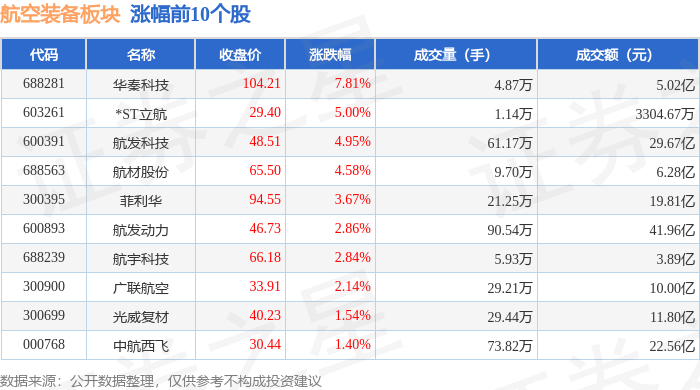
Group 1 - The aviation equipment sector saw a rise of 0.46% on January 21, with Huayin Technology leading the gains [1] - The Shanghai Composite Index closed at 4116.94, up 0.08%, while the Shenzhen Component Index closed at 14255.12, up 0.7% [1] - Key stocks in the aviation equipment sector included Huayin Technology, which rose by 7.81% to a closing price of 104.21, with a trading volume of 48,700 lots and a transaction value of 502 million [1] Group 2 - The aviation equipment sector experienced a net outflow of 368 million in main funds, while retail investors saw a net inflow of 309 million [2] - The stock with the highest net inflow from main funds was AVIC Power, with 263 million, while Guangwei Composite had a net inflow of 94.37 million [3] - The overall trend showed that retail investors were more active, contributing to a net inflow despite the main funds' outflow [2][3]


看好国产大飞机及军贸主线
2026-01-20 03:54
Summary of the Conference Call Industry Overview - The focus is on the military industry, particularly in the context of China's military modernization and export potential, with two key areas of interest: domestic large aircraft and high-end military trade [2][3][4] Key Points and Arguments Domestic Large Aircraft - The domestic large aircraft, specifically the C919, is highlighted as a significant player in the market, aiming to compete with Airbus and Boeing [5][6] - The C919 has completed the third phase of certification for the European market, with expectations to finalize all certifications by mid-2027 [6][7] - The aircraft has already achieved over 4 million safe flights domestically, indicating operational success [7][8] - Future production targets for the C919 are projected to reach 200 to 400 units by 2030 to 2035, supported by a robust supply chain [8][9] - The development of derivative models, such as high-altitude and extended-range versions, is underway to meet diverse customer needs [9][10] Military Trade - The export of advanced military aircraft, such as the FC-1 (also known as the JF-17 or Thunder), is seen as a catalyst for expanding China's military trade [13][19] - The demand for the FC-1 from countries like Pakistan is expected to enhance China's military supply chain and promote further exports of advanced military equipment [13][19] - Upcoming defense exhibitions in Saudi Arabia and Singapore are anticipated to serve as platforms for showcasing China's military capabilities and fostering international military trade relationships [20][21] Investment Strategy - The investment strategy emphasizes a focus on companies that can create long-term value, particularly those involved in the second growth curve, which includes new business areas like commercial aerospace and military exports [4][5] - The military industry is characterized by a shift towards bottom-up stock selection, with a focus on individual companies that demonstrate potential for growth and profitability [4][5] Additional Important Content - The military industry is experiencing structural changes, with three main segments identified: military trade, military-to-civilian transitions, and domestic military equipment construction [3][4] - The military trade sector is expected to benefit from increased global military spending, particularly as geopolitical tensions rise [16][17] - The U.S. defense budget is projected to increase significantly, which may further stimulate global military trade dynamics [16][17] - The conference also discussed the importance of technological advancements in military equipment and the need for a comprehensive military industrial base to support these developments [17][18] Company-Specific Insights - Torch Electronics is highlighted for its growth potential in specialized electronic components and new materials, with a focus on military applications [23][24] - The company is recognized as a leading supplier of multilayer ceramic capacitors (MLCC) in the military sector, with plans for expansion into new materials for aerospace and missile applications [25][26] - Torch Electronics has implemented multiple employee stock incentive plans to align the interests of management and employees, which is expected to support long-term growth [26][27] This summary encapsulates the key insights from the conference call, focusing on the military industry, investment strategies, and specific company developments.



商业航天王者归来?中航机载、航发动力等三股涨停封板,通用航空ETF(159231)劲涨2.2%强势收复10日均线
Xin Lang Cai Jing· 2026-01-19 14:31
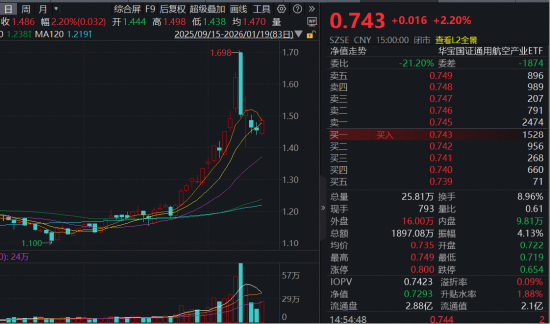
Core Viewpoint - The commercial aerospace sector has rebounded strongly after recent volatility, with the Huabao General Aviation ETF (159231) showing significant gains and increased trading volume, indicating positive market sentiment [1][4]. Group 1: Market Performance - The Huabao General Aviation ETF opened strong, rising over 3% at one point and closing up 2.20%, recovering above the 10-day moving average and touching the 5-day moving average, with a trading volume of 18.97 million yuan, a noticeable increase from the previous trading day [1][4]. - Among the 50 constituent stocks, 30 saw gains, with notable performers including China Aviation Industry Corporation (10.02% increase), Aero Engine Corporation of China (10.01% increase), and others exceeding 8% gains [4][11]. Group 2: Industry Trends - The commercial aerospace sector is supported by strong government policies and an upward trend in the industry. The National Venture Capital Guidance Fund is set to launch by the end of 2025, with investments in various sectors including aerospace [3][10]. - The International Telecommunication Union (ITU) has reported that China submitted an application for frequency and orbital resources for 203,000 new satellites, marking the largest international frequency application in the country's history, which is expected to drive further industry orders [3][10]. Group 3: Profitability Outlook - The profitability growth rate of the top 10 stocks in the commercial aerospace index improved from -14.5% in Q2 2025 to 1.5% in Q3 2025, with projections indicating a 37.5% year-on-year growth in 2026 [3][10]. - The commercial aerospace sector's performance is expected to continue improving, similar to the trends seen in the renewable energy sector, influenced by valuation sentiment, policies, and sector rotation [3][10].


商用大飞机及航空发动机行业深度:大国之翼,逐梦启航
Changjiang Securities· 2026-01-19 00:56
Investment Rating - The report maintains a "Positive" investment rating for the aerospace and defense sector [9]. Core Insights - The report indicates that during the 14th Five-Year Plan period, the production pace of domestic commercial aircraft and the self-sufficiency of commercial aviation engines are expected to accelerate, becoming significant growth drivers for the military aviation sector. This is anticipated to lead to a revaluation of related stocks in the aviation sector [3]. - Over the next 20 years, the global commercial aviation market is projected to reach approximately 48.5 trillion yuan, averaging about 2.4 trillion yuan annually. The Chinese market is expected to accumulate around 10 trillion yuan, averaging over 500 billion yuan per year [6]. - By 2029, China's civil aviation fleet is expected to require more than 400 new commercial aircraft annually, with a cumulative need for nearly 2,000 aircraft during the 14th Five-Year Plan period [6][18]. Summary by Sections Domestic Commercial Aircraft - The domestic commercial aircraft market is expected to break the oligopoly of Airbus and Boeing, which currently hold over 90% of the global market share. The C919 aircraft has various models, including the basic, extended, and plateau versions, with plans for an extended version to enhance market coverage [6][25][33]. - The structure of the C919 aircraft is primarily produced by domestic manufacturers, achieving basic localization. The body structure accounts for approximately 30%-35% of the total value, while the engine and onboard systems account for 20%-25% and 25%-30%, respectively [38][39]. Domestic Commercial Aviation Engines - The domestic commercial aviation engine market is projected to exceed 2.9 trillion yuan over the next 20 years, with an expected demand for over 900 engines annually by 2029. Currently, the market is dominated by foreign manufacturers, with no domestic engines in operation as of 2024 [7][46][49]. - The report highlights that the domestic engine manufacturer, AVIC Engine, is making strides towards self-sufficiency, with products like the CJ1000 and CJ2000 engines showing technological maturity [7][46]. Commercial Aviation Industry Chain - The commercial aviation industry chain consists of three main segments: aircraft body, onboard systems, and engines. Key players include AVIC Xi'an Aircraft Industry Group, AVIC Heavy Machinery, and others, which are positioned to benefit from the growth of the domestic aircraft market [8][9]. - The report emphasizes the importance of achieving self-sufficiency in the aviation engine sector, as it is currently a critical bottleneck for domestic aircraft production [7][46].


航材股份:公司目前生产经营情况一切正常
Zheng Quan Ri Bao Wang· 2026-01-13 14:16
Core Viewpoint - The company,航材股份, has confirmed that its production and operational status is normal and there are no undisclosed significant matters [1] Group 1 - The company is actively engaging with investors through an interactive platform [1] - The company emphasizes the importance of investors being aware of secondary market trading risks [1] - The company encourages rational decision-making and prudent investment among investors [1]
航空装备板块1月12日涨4.11%,江航装备领涨,主力资金净流出13.13亿元
Zheng Xing Xing Ye Ri Bao· 2026-01-12 09:10
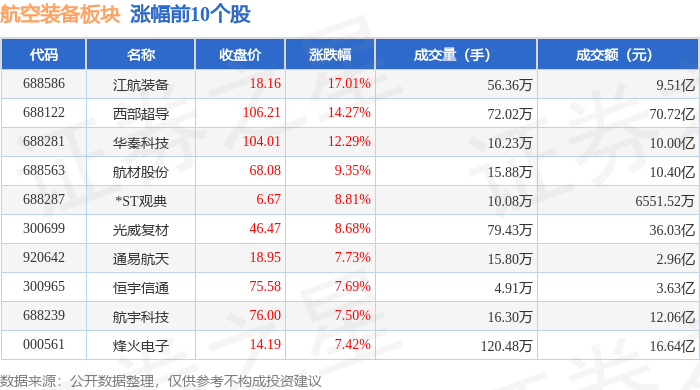
Core Viewpoint - The aviation equipment sector experienced a significant increase of 4.11% on January 12, with Jianghang Equipment leading the gains, reflecting positive market sentiment in this industry [1]. Group 1: Market Performance - The Shanghai Composite Index closed at 4165.29, up by 1.09%, while the Shenzhen Component Index closed at 14366.91, up by 1.75% [1]. - Jianghang Equipment (688586) saw a closing price of 18.16, with a remarkable increase of 17.01% and a trading volume of 563,600 shares, amounting to a transaction value of 9.51 billion [1]. - Other notable performers included Xibu Superconductor (688122) with a closing price of 106.21, up by 14.27%, and Huamai Technology (688281) at 104.01, up by 12.29% [1]. Group 2: Fund Flow Analysis - The aviation equipment sector experienced a net outflow of 1.313 billion from institutional investors, while retail investors saw a net inflow of 852 million [2]. - The individual stock fund flow indicated that Guangwei Composite (300699) had a net inflow of 2.39 million from institutional investors, while it faced a net outflow of 28.2 million from retail investors [3]. - Zhongjian Technology (300777) reported a net inflow of 102 million from institutional investors, contrasting with a net outflow of 36.97 million from retail investors [3].


航材股份股价涨5.01%,华夏基金旗下1只基金位居十大流通股东,持有475.58万股浮盈赚取1483.81万元
Xin Lang Cai Jing· 2026-01-12 05:29
Group 1 - The core viewpoint of the news is that Hangcai Co., Ltd. experienced a stock price increase of 5.01%, reaching 65.38 yuan per share, with a trading volume of 538 million yuan and a turnover rate of 7.21%, resulting in a total market capitalization of 29.421 billion yuan [1] - Hangcai Co., Ltd. is primarily engaged in the research, production, and sales of components and materials for aviation and aerospace, with its main business revenue composition being: aviation finished products 46.54%, basic materials 44.60%, non-aviation finished products 4.18%, processing services 3.96%, and others 0.72% [1] Group 2 - Among the top ten circulating shareholders of Hangcai Co., Ltd., a fund under Huaxia Fund holds a significant position. The Huaxia SSE STAR 50 ETF (588000) reduced its holdings by 2.6701 million shares in the third quarter, now holding 4.7558 million shares, which accounts for 4.07% of the circulating shares [2] - The Huaxia SSE STAR 50 ETF (588000) has a current scale of 75.62 billion yuan, with a year-to-date return of 9.8%, ranking 518 out of 5580 in its category, and a one-year return of 53.19%, ranking 1120 out of 4203 [2]
航材股份(688563) - 关于以集中竞价交易方式回购公司股份的进展公告
2026-01-06 08:31
证券代码:688563 证券简称:航材股份 公告编号:2026-001 根据《上市公司股份回购规则》《上海证券交易所上市公司自律监管指引第 7 号——回购股份》等相关规定,公司应当在每个月的前 3 个交易日内公告截至上 月末的回购进展情况,现将公司回购股份进展的具体情况公告如下: 截至 2025 年 12 月 31 日,公司通过集中竞价交易方式回购公司股份 1,000 股, 已回购股份占公司总股本的比例为 0.0002%,回购成交最低价格为 57.50 元/股,成 交最高价格为 57.50 元/股,成交总金额为人民币 5.75 万元(不含交易佣金等交易 费用)。 北京航空材料研究院股份有限公司 关于以集中竞价交易方式回购公司股份的进展公告 本公司董事会及全体董事保证本公告内容不存在任何虚假记载、误导性陈述 或者重大遗漏,并对其内容的真实性、准确性和完整性承担法律责任。 重要内容提示: | 回购方案首次披露日 | 2025/11/21 | | | | | | | | | | --- | --- | --- | --- | --- | --- | --- | --- | --- | --- | | 回购方案实施期 ...